
CVSP 203 Final, Fall 2002
American University of Beirut · Modern and Contemporary Culture · 2 pages
More CVSP 203 files
Show the text of this final exam
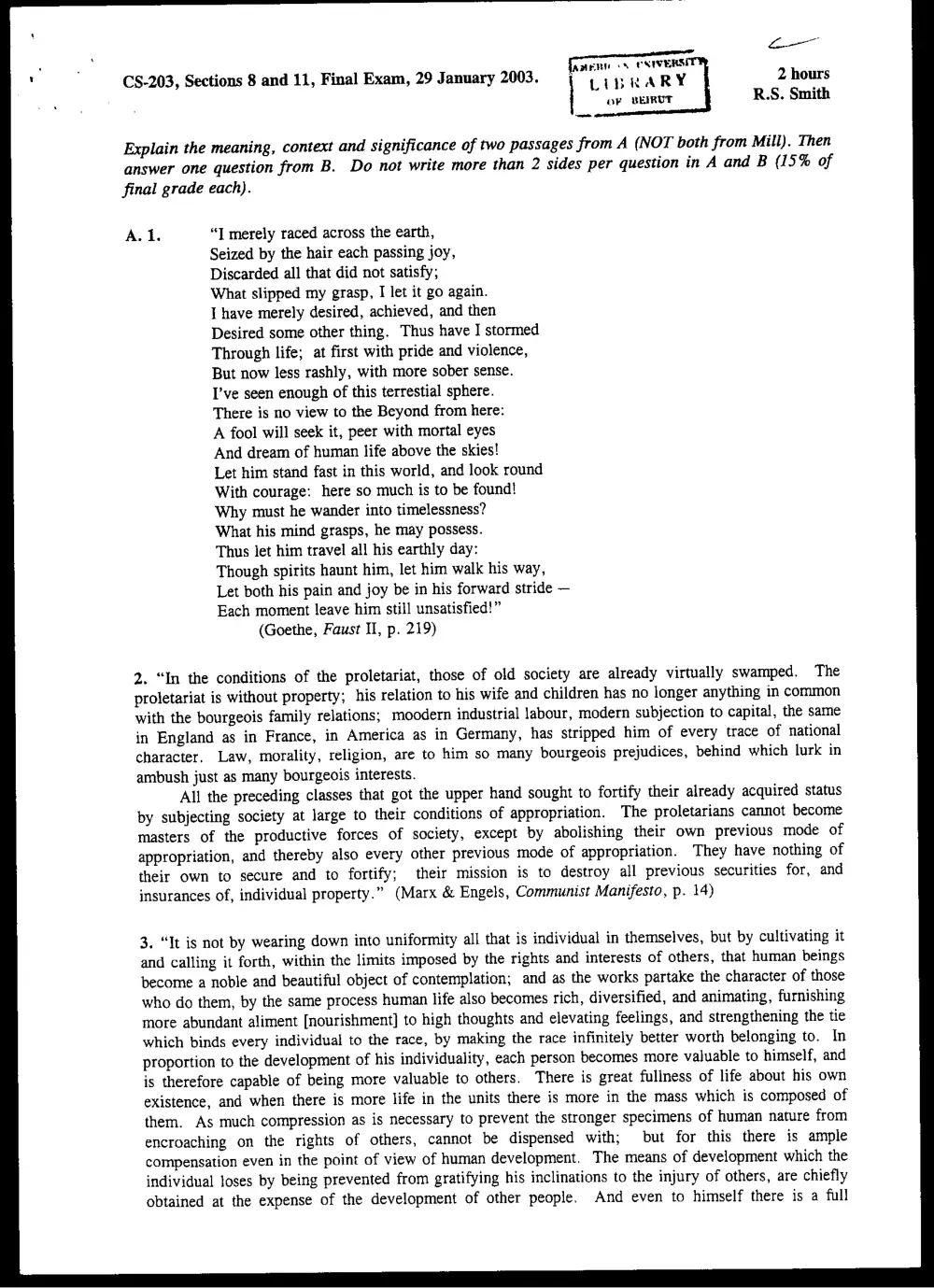
Explain the meaning, context and significance of two passages from A (NOT both from Mill). Then
answer one question from B. Do not write more than 2 sides per question in A and B (15% of
final grade each).
ALL. “J merely raced across the earth,
Seized by the hair each passing joy,
Discarded all that did not satisfy;
What slipped my grasp, I let it go again.
I have merely desired, achieved, and then
Desired some other thing. Thus have I stormed
Through life; at first with pride and violence,
But now less rashly, with more sober sense.
I’ve seen enough of this terrestial sphere.
There is no view to the Beyond from here:
A fool will seek it, peer with mortal eyes
And dream of human life above the skies!
Let him stand fast in this world, and look round
With courage: here so much is to be found!
Why must he wander into timelessness?
What his mind grasps, he may possess.
Thus let him travel all his earthly day:
Though spirits haunt him, let him walk his way,
Let both his pain and joy be in his forward stride —
Each moment leave him still unsatisfied!”
(Goethe, Faust II, p. 219)
2. “In the conditions of the proletariat, those of old society are already virtually swamped. The
proletariat is without property; his relation to his wife and children has no longer anything in common
with the bourgeois family relations; moodern industrial labour, modern subjection to capital, the same
in England as in France, in America as in Germany, has stripped him of every trace of national
character. Law, morality, religion, are to him so many bourgeois prejudices, behind which lurk in
ambush just as many bourgeois interests.
All the preceding classes that got the upper hand sought to fortify their already acquired status
by subjecting society at large to their conditions of appropriation. The proletarians cannot become
masters of the productive forces of society, except by abolishing their own previous mode of
appropriation, and thereby also every other previous mode of appropriation. They have nothing of
their own to secure and to fortify; their mission is to destroy all previous securities for, and
insurances of, individual property.” (Marx & Engels, Communist Manifesto, p. 14)
3. “It is not by wearing down into uniformity all that is individual in themselves, but by cultivating it
and calling it forth, within the limits imposed by the rights and interests of others, that human beings
become a noble and beautiful object of contemplation; and as the works partake the character of those
who do them, by the same process human life also becomes rich, diversified, and animating, furnishing
more abundant aliment [nourishment] to high thoughts and elevating feelings, and strengthening the tie
which binds every individual to the race, by making the race infinitely better worth belonging to. In
proportion to the development of his individuality, each person becomes more valuable to himself, and
is therefore capable of being more valuable to others. There is great fullness of life about his own
existence, and when there is more life in the units there is more in the mass which is composed of
them. As much compression as is necessary to prevent the stronger specimens of human nature from
encroaching on the rights of others, cannot be dispensed with, but for this there is ample
compensation even in the point of view of human development. The means of development which the
individual loses by being prevented from gratifying his inclinations to the injury of others, are chiefly
obtained at the expense of the development of other people. And even to himself there is a full
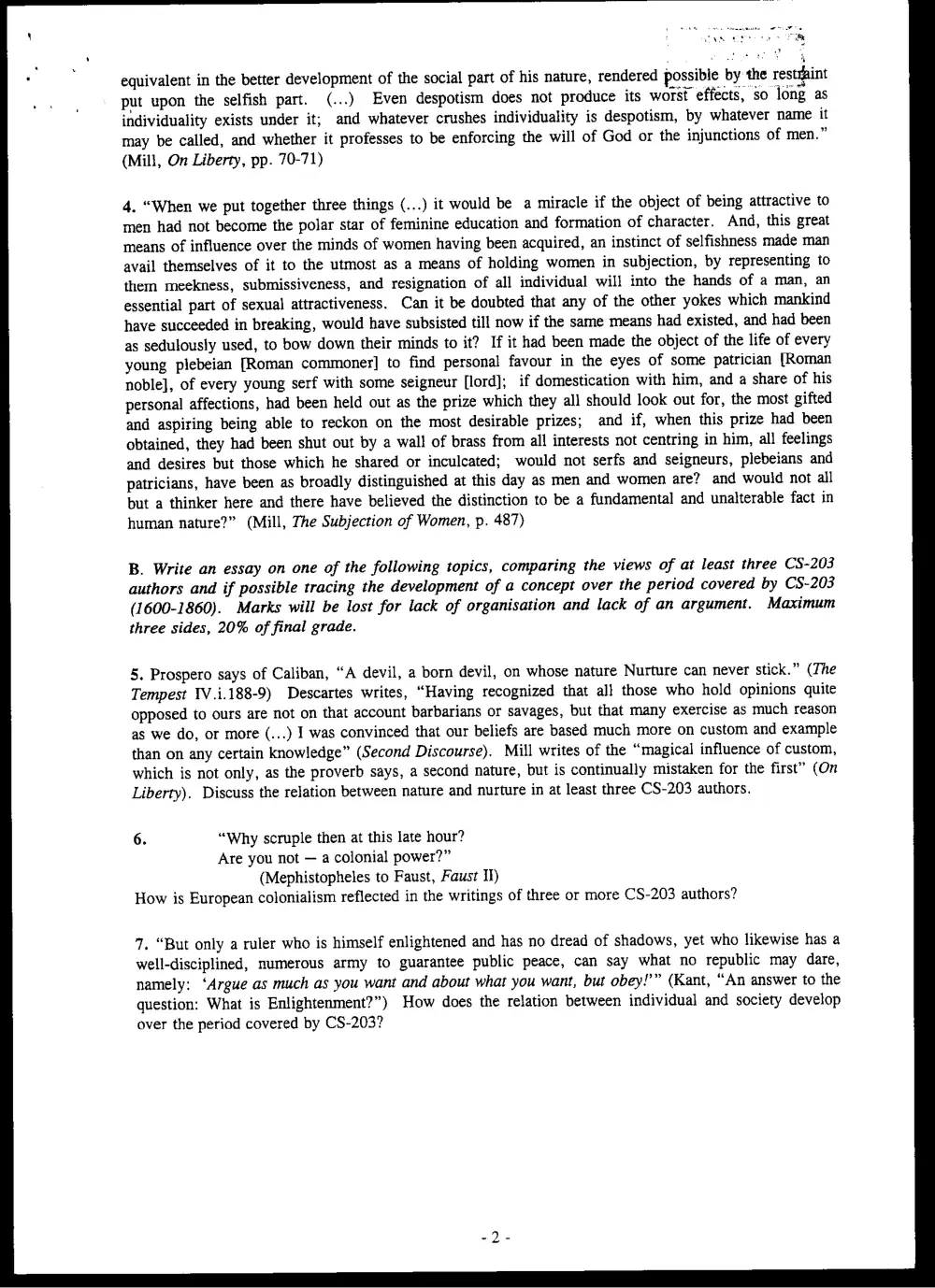
equivalent in the better development of the social part of his nature, rendered possible by the restyaint
put upon the selfish part. (...) Even despotism does not produce its worst effects, so long as
individuality exists under it, and whatever crushes individuality is despotism, by whatever name it
may be called, and whether it professes to be enforcing the will of God or the injunctions of men.”
(Mill, On Liberty, pp. 70-71)
4. “When we put together three things (...) it would be a miracle if the object of being attractive to
men had not become the polar star of feminine education and formation of character. And, this great
means of influence over the minds of women having been acquired, an instinct of selfishness made man
avail themselves of it to the utmost as a means of holding women in subjection, by representing to
them meekness, submissiveness, and resignation of all individual will into the hands of a man, an
essential part of sexual attractiveness. Can it be doubted that any of the other yokes which mankind
have succeeded in breaking, would have subsisted till now if the same means had existed, and had been
as sedulously used, to bow down their minds to it? If it had been made the object of the life of every
young plebeian [Roman commoner] to find personal favour in the eyes of some patrician [Roman
noble], of every young serf with some seigneur [lord]; if domestication with him, and a share of his
personal affections, had been held out as the prize which they all should look out for, the most gifted
and aspiring being able to reckon on the most desirable prizes; and if, when this prize had been
obtained, they had been shut out by a wall of brass from all interests not centring in him, all feelings
and desires but those which he shared or inculcated; would not serfs and seigneurs, plebeians and
patricians, have been as broadly distinguished at this day as men and women are? and would not all
but a thinker here and there have believed the distinction to be a fundamental and unalterable fact in
human nature?” (Mill, The Subjection of Women, p. 487)
B. Write an essay on one of the following topics, comparing the views of at least three CS-203
authors and if possible tracing the development of a concept over the period covered by CS-203
(1600-1860). Marks will be lost for lack of organisation and lack of an argument. Maximum
three sides, 20% of final grade.
5. Prospero says of Caliban, “A devil, a born devil, on whose nature Nurture can never stick.” (The
Tempest IV.i.188-9) Descartes writes, “Having recognized that all those who hold opinions quite
opposed to ours are not on that account barbarians or savages, but that many exercise as much reason
as we do, or more (...) I was convinced that our beliefs are based much more on custom and example
than on any certain knowledge” (Second Discourse). Mill writes of the “magical influence of custom,
which is not only, as the proverb says, a second nature, but is continually mistaken for the first” (On
Liberty). Discuss the relation between nature and nurture in at least three CS-203 authors.
“Why scruple then at this late hour?
Are you not — a colonial power?”
(Mephistopheles to Faust, Faust Il)
How is European colonialism reflected in the writings of three or more CS-203 authors?
7, “But only a ruler who is himself enlightened and has no dread of shadows, yet who likewise has a
well-disciplined, numerous army to guarantee public peace, can say what no republic may dare,
namely: ‘Argue as much as you want and about what you want, but obey!” (Kant, “An answer to the
question: What is Enlightenment?”) How does the relation between individual and society develop
over the period covered by CS-203?