
CVSP 203 Final, Fall 2004
American University of Beirut · Modern and Contemporary Culture · 2 pages
More CVSP 203 files
Show the text of this final exam
OF BEIRUT
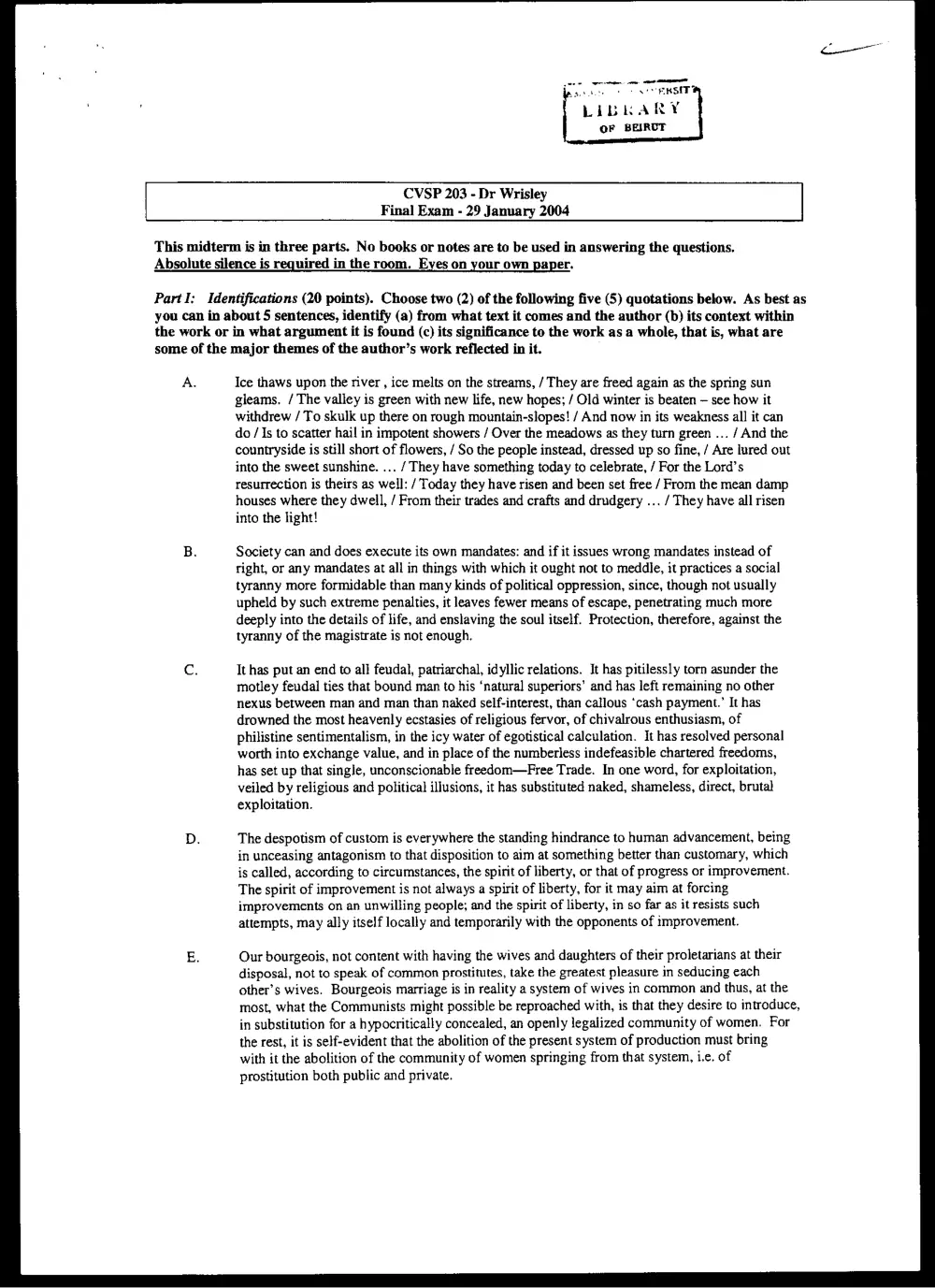
CVSP 203 - Dr Wrisley
Final Exam - 29 January 2004
This midterm is in three parts. No books or notes are to be used in answering the questions.
Absolute silence is required in the room. Eyes on your own paper.
PartI:; Identifications (20 points). Choose two (2) of the following five (5) quotations below. As best as
you can in about 5 sentences, identify (a) from what text it comes and the author (b) its context within
the work or in what argument it is found (c) its significance to the work as a whole, that is, what are
some of the major themes of the author’s work reflected in it.
A. Ice thaws upon the river , ice melts on the streams, / They are freed again as the spring sun
gleams. / The valley is green with new life, new hopes; / Old winter is beaten — see how it
withdrew / To skulk up there on rough mountain-slopes! / And now in its weakness all it can
do / Is to scatter hail in impotent showers / Over the meadows as they turn green ... / And the
countryside is still short of flowers, / So the people instead, dressed up so fine, / Are lured out
into the sweet sunshine. ... / They have something today to celebrate, / For the Lord’s
resurrection is theirs as well: / Today they have risen and been set free / From the mean damp
houses where they dwell, / From their trades and crafts and drudgery ... / They have all risen
into the light!
Society can and does execute its own mandates: and if it issues wrong mandates instead of
right, or any mandates at all in things with which it ought not to meddle, it practices a social
tyranny more formidable than many kinds of political oppression, since, though not usually
upheld by such extreme penalties, it leaves fewer means of escape, penetrating much more
deeply into the details of life, and enslaving the soul itself. Protection, therefore, against the
tyranny of the magistrate is not enough.
It has put an end to all feudal, patriarchal, idyllic relations. It has pitilessly torn asunder the
motley feudal ties that bound man to his ‘natural superiors’ and has left remaining no other
nexus between man and man than naked self-interest, than callous ‘cash payment.’ It has
drowned the most heavenly ecstasies of religious fervor, of chivalrous enthusiasm, of
philistine sentimentalism, in the icy water of egotistical calculation. It has resolved personal
worth into exchange value, and in place of the numberless indefeasible chartered freedoms,
has set up that single, unconscionable freedom—Free Trade. In one word, for exploitation,
veiled by religious and political illusions, it has substituted naked, shameless, direct, brutal
exploitation.
The despotism of custom is everywhere the standing hindrance to human advancement, being
in unceasing antagonism to that disposition to aim at something better than customary, which
is called, according to circumstances, the spirit of liberty, or that of progress or improvement.
The spirit of improvement is not always a spirit of liberty, for it may aim at forcing
improvements on an unwilling people; and the spirit of liberty, in so far as it resists such
attempts, may ally itself locally and temporarily with the opponents of improvement.
Our bourgeois, not content with having the wives and daughters of their proletarians at their
disposal, not to speak of common prostitutes, take the greatest pleasure in seducing each
other’s wives. Bourgeois marriage is in reality a system of wives in common and thus, at the
most, what the Communists might possible be reproached with, is that they desire to introduce,
in substitution for a hypocritically concealed, an openly legalized community of women. For
the rest, it is self-evident that the abolition of the present system of production must bring
with it the abolition of the community of women springing from that system, i.e. of
prostitution both public and private.
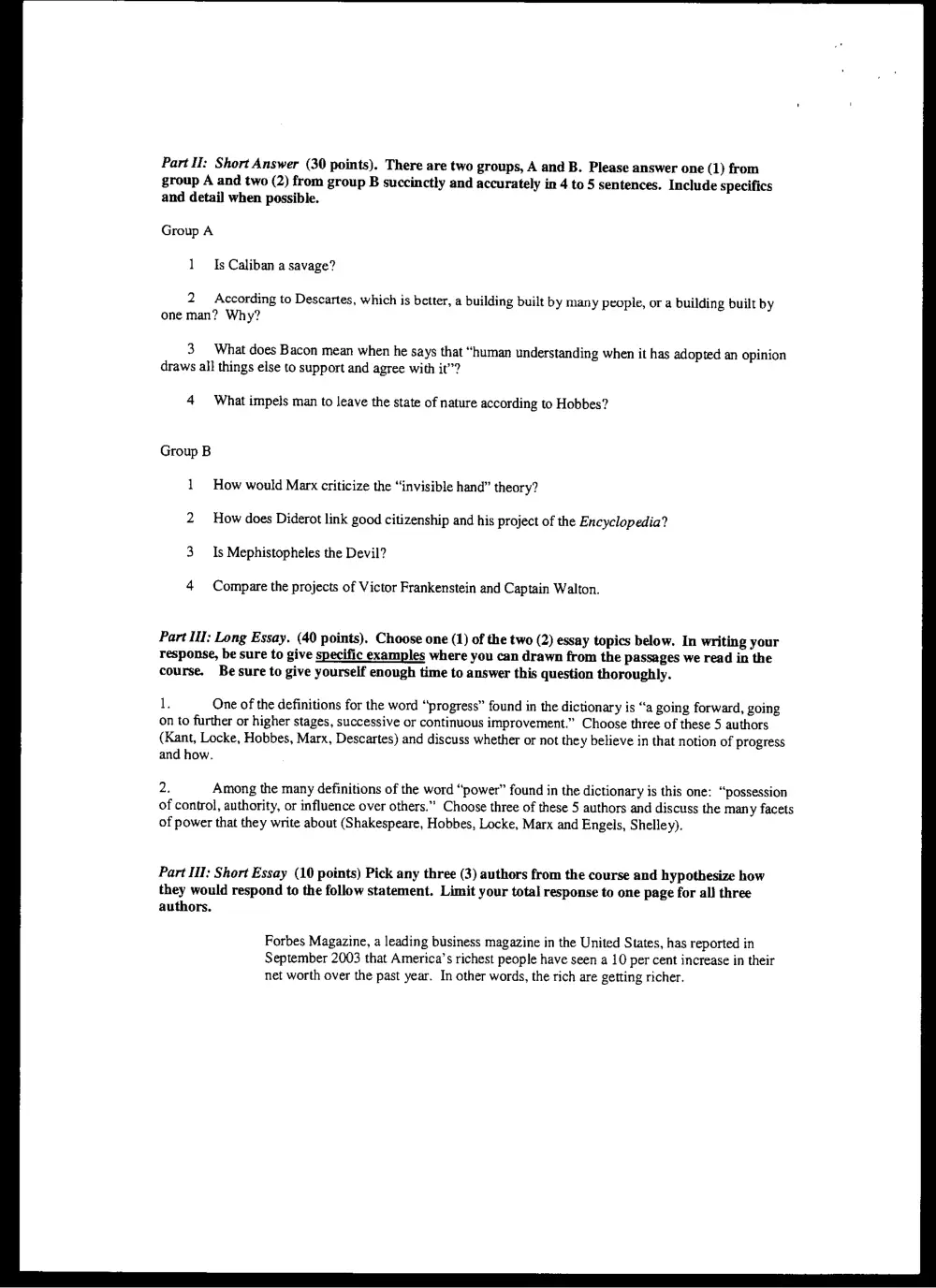
Part I: Short Answer (30 points). There are two groups, A and B. Please answer one (1) from
group A and two (2) from group B succinctly and accurately in 4 to 5 sentences. Include specifics
and detail when possible.
Group A
1 Is Caliban a savage?
2 According to Descartes, which is better, a building built by many people, or a building built by
one man? Why?
3 What does Bacon mean when he says that “human understanding when it has adopted an opinion
draws all things else to support and agree with it”?
4 What impels man to leave the state of nature according to Hobbes?
Group B
1 How would Marx criticize the “invisible hand” theory?
2 How does Diderot link good citizenship and his project of the Encyclopedia?
3 Is Mephistopheles the Devil?
4 Compare the projects of Victor Frankenstein and Captain Walton.
Part III: Long Essay. (40 points). Choose one (1) of the two (2) essay topics below. In writing your
response, be sure to give specific examples where you can drawn from the passages we read in the
course. Be sure to give yourself enough time to answer this question thoroughly.
1. One of the definitions for the word “progress” found in the dictionary is “‘a going forward, going
on to further or higher stages, successive or continuous improvement.” Choose three of these 5 authors
(Kant, Locke, Hobbes, Marx, Descartes) and discuss whether or not they believe in that notion of progress
and how.
2. Among the many definitions of the word “power” found in the dictionary is this one: “possession
of control, authority, or influence over others.” Choose three of these 5 authors and discuss the many facets
of power that they write about (Shakespeare, Hobbes, Locke, Marx and Engels, Shelley).
Part III: Short Essay (10 points) Pick any three (3) authors from the course and hypothesize how
they would respond to the follow statement. Limit your total response to one page for all three
authors.
Forbes Magazine, a leading business magazine in the United States, has reported in
September 2003 that America’s richest people have seen a 10 per cent increase in their
net worth over the past year. In other words, the rich are getting richer.