
CVSP 203 Final, Fall 2004
American University of Beirut · Modern and Contemporary Culture · 2 pages

More CVSP 203 files
Show the text of this final exam
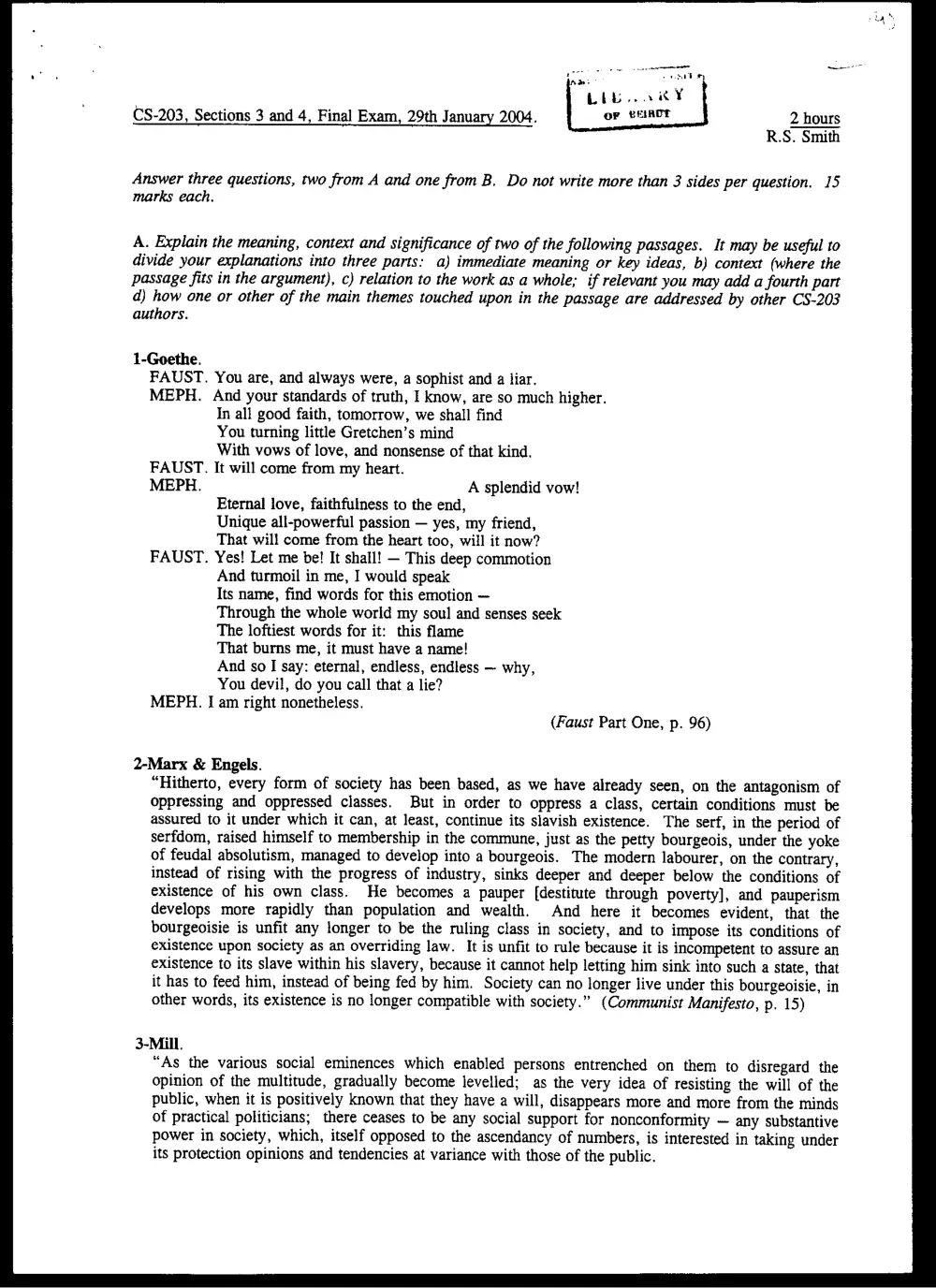
CS-203, Sections 3 and 4, Final Exam, 29th January 2004. 2 hours
R.S. Smith
Answer three questions, two from A and one from B. Do not write more than 3 sides per question. 15
marks each.
A. Explain the meaning, context and significance of two of the following passages. It may be useful to
divide your explanations into three parts: a) immediate meaning or key ideas, b) context (where the
passage fits in the argument), c) relation to the work as a whole; if relevant you may add a fourth part
d) how one or other of the main themes touched upon in the passage are addressed by other CS-203
authors.
1-Goethe.
FAUST. You are, and always were, a sophist and a liar.
MEPH. And your standards of truth, I know, are so much higher.
In all good faith, tomorrow, we shall find
You turning little Gretchen’s mind
With vows of love, and nonsense of that kind.
FAUST. It will come from my heart.
MEPH. A splendid vow!
Eternal love, faithfulness to the end,
Unique all-powerful passion — yes, my friend,
That will come from the heart too, will it now?
FAUST. Yes! Let me be! It shall! — This deep commotion
And turmoil in me, I would speak
Its name, find words for this emotion —
Through the whole world my soul and senses seek
The loftiest words for it: this flame
That burns me, it must have a name!
And so I say: eternal, endless, endless ~ why,
You devil, do you call that a lie?
MEPH. I am right nonetheless.
(Faust Part One, p. 96)
2-Marx & Engels.
“Hitherto, every form of society has been based, as we have already seen, on the antagonism of
Oppressing and oppressed classes. But in order to oppress a class, certain conditions must be
assured to it under which it can, at least, continue its slavish existence. The serf, in the period of
serfdom, raised himself to membership in the commune, just as the petty bourgeois, under the yoke
of feudal absolutism, managed to develop into a bourgeois. The modern labourer, on the contrary,
instead of rising with the progress of industry, sinks deeper and deeper below the conditions of
existence of his own class. He becomes a pauper [destitute through poverty], and pauperism
develops more rapidly than population and wealth. And here it becomes evident, that the
bourgeoisie is unfit any longer to be the ruling class in society, and to impose its conditions of
existence upon society as an overriding law. It is unfit to rule because it is incompetent to assure an
existence to its slave within his slavery, because it cannot help letting him sink into such a state, that
it has to feed him, instead of being fed by him. Society can no longer live under this bourgeoisie, in
other words, its existence is no longer compatible with society.” (Communist Manifesto, p. 15)
3-Mill.
“As the various social eminences which enabled persons entrenched on them to disregard the
opinion of the multitude, gradually become levelled; as the very idea of resisting the will of the
public, when it is positively known that they have a will, disappears more and more from the minds
of practical politicians; there ceases to be any social support for nonconformity — any substantive
power in society, which, itself opposed to the ascendancy of numbers, is interested in taking under
its protection opinions and tendencies at variance with those of the public.
of BETKOT
' The combination of all these causes forms so great a mass of influences hostile to Individuality, that
it is not easy to see how it can stand its ground. It will do so with increasing difficulty, unless the
intelligent part of the public can be made to feel its value — to see that it is good there should be
differences, even though not for the better, even though, as it may appear to them, some should be
for the worse. If the claims of Individuality are ever to be asserted, the time is now, while much is
still wanting to complete the enforced assimilation. It is only in the earlier stages that any stand can
be successfully made against the encroachment. The demand that all other people shall resemble
ourselves, grows by what it feeds on. If resistance waits till life is reduced nearly to one uniform
type, all deviations from that type will come to be considered impious, immoral, even monstrous
and contrary to nature. Mankind speedily become unable to conceive diversity, when they have
been for some time unaccustomed to see it.” (On Liberty, p. 82)
4. “Unable to endure the aspect of the being I had created, I rushed out of the room and continued a
long time traversing my bedchamber, unable to compose my mind to sleep. At length lassitude
succeeded to the tumult I had before endured, and I threw myself on the bed in my clothes,
endeavouring to seek a few moments of forgetfulness. But it was in vain; I slept, indeed, but I was
disturbed by the wildest dreams. I thought I saw Elizabeth, in the bloom of health, walking in the
streets of Ingoistadt. Delighted and surprised, I embraced her, but as I imprinted the first kiss on
her lips, they became livid with the hue of death; her features appeared to change, and I thought
that I held the corpse of my dead mother in my arms; a shroud enveloped her form, and I saw the
grave-worms crawling in the folds of the flannel [cloth]. I started from my sleep with horror; a
cold dew covered my forehead, my teeth chattered, and every limb became convulsed; when, by the
dim and yellow light of the moon, as it forced its way through the window shutters, I beheld the
wretch — the miserable monster whom I had created. He held up the curtain of the bed; and his
eyes, if eyes they may be called, were fixed on me. His jaws opened, and he muttered some
inarticulate sounds, while a grin wrinkled his cheeks. He might have spoken, but I did not hear;
one hand was stretched out, seemingly to detain me, but I escaped and rushed downstairs.”
(Frankenstein, pp. 42-43)
C. Write an essay on one of the following topics. Essays lacking organization or argument will lose
marks.
5. When considering present forms of colonialism or imperialism (political, economic or intellectual),
how relevant do you find the work of CS-203 authors (choose three)?
6. Is reason the slave of passion? How do CS-203 authors handle this theme (choose three)?
7.“If the matter be truly considered, natural philosophy [i.e. science] is ... at once the surest medicine
against superstition and the most approved nourishment for faith” (Bacon, The New Organum,
Aphorism-89)
Discuss the role of religious faith implicit or explicit in the work of any three CS-203 authors.
8. In what ways is the depiction of a non-human monster by Shakespeare and Mary Shelley comparable
to the depiction of humans who are in some sense incompletely developed or who have lost a part of
their humanity (Locke’s slaves, Kant’s South Sea Islanders, Mill’s barbarians)?