
CVSP 203 Final, Spring 2000
American University of Beirut · Modern and Contemporary Culture · 2 pages
More CVSP 203 files
Show the text of this final exam
AMEAMIEAN CNTY TEESE o
Li BRARY
or HEINE H
—_——_——
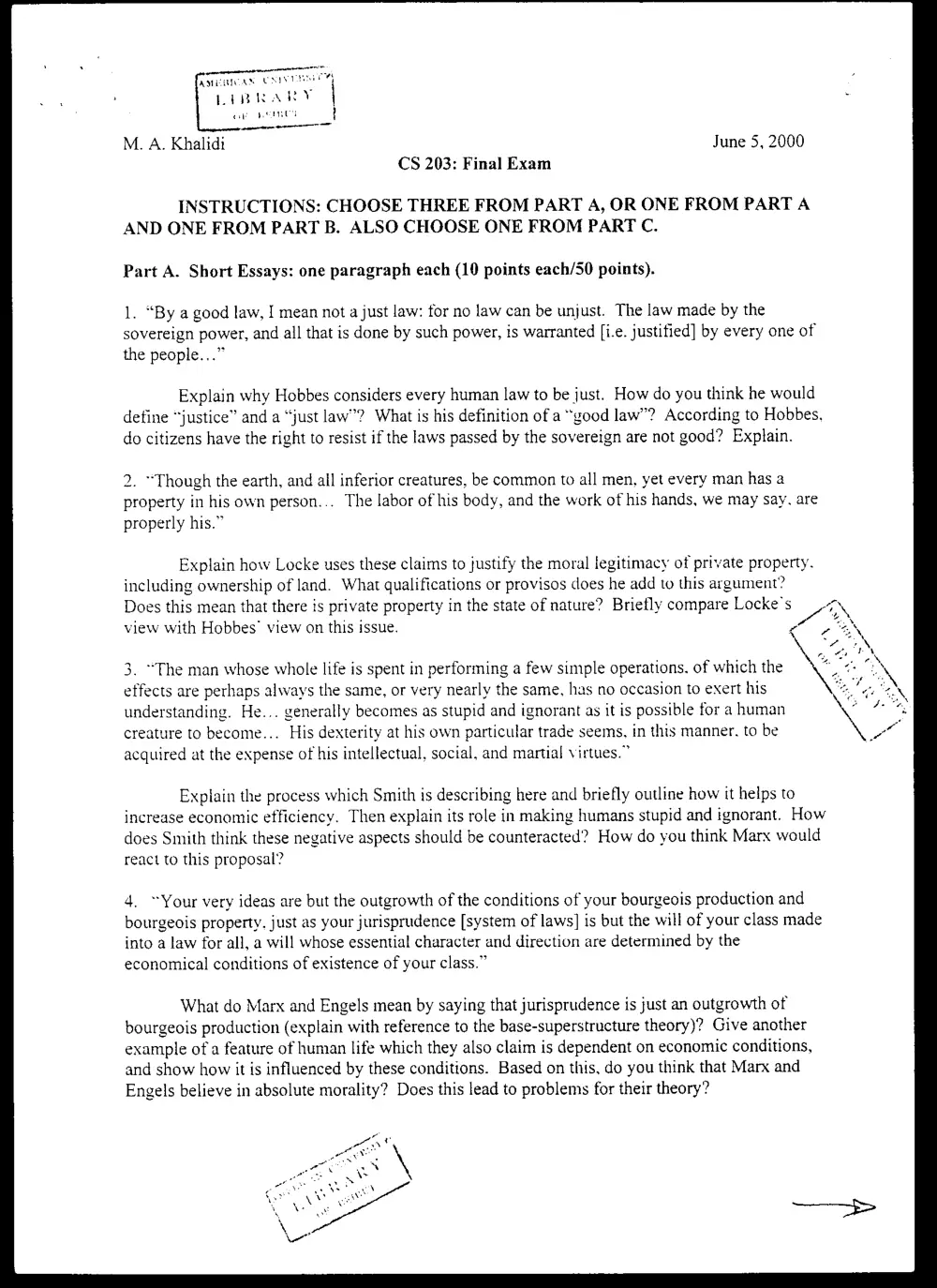
M. A. Khalidi June 5, 2000
CS 203: Final Exam
INSTRUCTIONS: CHOOSE THREE FROM PART A, OR ONE FROM PART A
AND ONE FROM PART B. ALSO CHOOSE ONE FROM PART C.
Part A. Short Essays: one paragraph each (10 points each/50 points).
1. “By a good law, I mean not a just law: for no law can be unjust. The law made by the
sovereign power, and all that is done by such power, is warranted [i.e. justified] by every one of
the people...”
Explain why Hobbes considers every human law to be just. How do you think he would
detine “justice” and a “just law’? What is his definition of a “good law”? According to Hobbes,
do citizens have the right to resist if the laws passed by the sovereign are not good? Explain.
2. “Though the earth, and all inferior creatures, be common to all men, yet every man has a
property in his own person... The labor of his body, and the work of his hands, we may say. are
properly his.”
Explain how Locke uses these claims to justify the moral legitimacy of private property.
including ownership of land. What qualifications or provisos does he add to this argument?
Does this mean that there is private property in the state of nature? Briefly compare Locke's ON
view with Hobbes’ view on this issue. “oy
3. “The man whose whole life is spent in performing a few simple operations. of which the
effects are perhaps always the same, or very nearly the same, has no occasion to exert his
understanding. He... generally becomes as stupid and ignorant as it is possible for a human
creature to become... His dexterity at his own particular trade seems, in this manner. to be
acquired at the expense of his intellectual, social, and martial virtues.”
Explain the process which Smith is describing here and briefly outline how it helps to
increase economic efficiency. Then explain its role in making humans stupid and ignorant. How
does Smith think these negative aspects should be counteracted? How do you think Marx would
react to this proposal?
4. “Your very ideas are but the outgrowth of the conditions of your bourgeois production and
bourgeois property. just as your jurisprudence [system of laws] is but the will of your class made
into a law for all, a will whose essential character and direction are determined by the
economical conditions of existence of your class.”
What do Marx and Engels mean by saying that jurisprudence is just an outgrowth of
bourgeois production (explain with reference to the base-superstructure theory)? Give another
example of a feature of human life which they also claim is dependent on economic conditions,
and show how it is influenced by these conditions. Based on this, do you think that Marx and
Engels believe in absolute morality? Does this lead to problems for their theory?
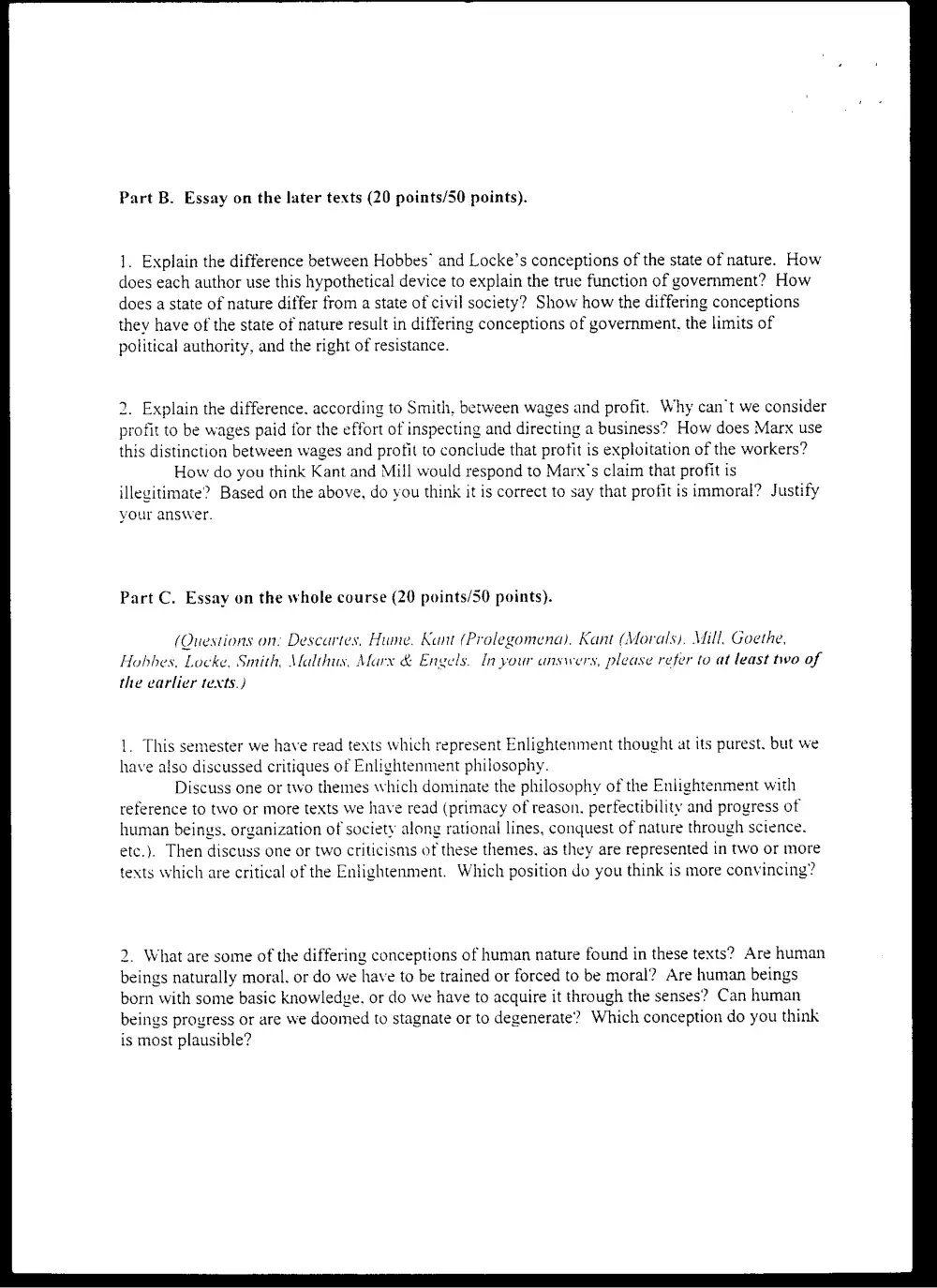
Part B. Essay on the later texts (20 points/30 points).
1. Explain the difference between Hobbes’ and Locke’s conceptions of the state of nature. How
does each author use this hypothetical device to explain the true function of government? How
does a state of nature differ from a state of civil society? Show how the differing conceptions
they have of the state of nature result in differing conceptions of government, the limits of
political authority, and the right of resistance.
2. Explain the difference. according to Smith, between wages and profit. Why can’t we consider
profit to be wages paid for the effort of inspecting and directing a business? How does Marx use
this distinction between wages and profit to conclude that protit is exploitation of the workers?
How do you think Kant and Mill would respond to Marx’s claim that profit is
illegitimate? Based on the above, do you think it is correct to say that profit is immoral? Justify
your answer.
Part C. Essay on the whole course (20 points/30 points).
(Questions on: Descartes, Hume. Kant (Prolegomena). Kant (Morals). Mill. Goethe,
Hobhes, Locke, Smith, Malthus, Marx & Engels. In your answers, please refer to at least two of
the earlier texts.)
1. This semester we have read texts which represent Enlightenment thought at its purest. but we
have also discussed critiques of Enlightenment philosophy.
Discuss one or two themes which dominate the philosophy of the Enlightenment with
reference to two or more texts we have read (primacy of reason. perfectibility and progress of
human beings. organization of society along rational lines, conquest of nature through science.
etc.). Then discuss one or two criticisms of these themes, as they are represented in two or more
texts which are critical of the Enlightenment. Which position do you think is more convincing?
2. What are some of the differing conceptions of human nature found in these texts? Are human
beings naturally moral. or do we have to be trained or forced to be moral? Are human beings
born with some basic knowledge. or do we have to acquire it through the senses? Can human
beings progress or are we doomed to stagnate or to degenerate? Which conception do you think
is most plausible?