
CVSP 203 Final, Spring 2000
American University of Beirut · Modern and Contemporary Culture · 2 pages

More CVSP 203 files
Show the text of this final exam
CIVILIZATION SEQUENCE 203
FINAL EXAMINATION
TIME: Two Hours June 5, 2000
Ms. R. Fakhry
Short-answer Questions
Comment briefly on three of the following quotations, in light of
your readings in this course:
1.
“But though this be a state of liberty, yet it is not a state of
licence... The state of nature has a law to govern it, which
obliges every one: and reason, which is that law, teaches all
mankind, who will but consult it, that being all equal and
independent, no one ought to harm another in his life,
health, liberty, or possessions...”
“By pursuing his own interest he frequently promotes that of
the society more effectually than when he really intends to
promote it.”
“...Thus I have stormed through life; at first with pride and
violence, But now less rashly, with more sober sense. I’ve
seen enough of this terrestrial sphere. There is no view to
the Beyond from here: A fool will seek it, peer with mortal
eyes And dream of human life above the skies! Let him
stand fast in this world, and look round with courage: here
so much is to be found!... Let both his pain and joy be in his
forward stride Each moment leave him still unsatisfied!”
“\fE]ven though there might never yet have been a sincere
friend, still pure sincerity in friendship is nonetheless
required of every man, because this duty, prior to all
experience, is contained in general in the idea of a reason
that determines the will by means of apriori grounds...
Moreover, worse service cannot be rendered morality than
that an attempt be made to derive it from examples.”
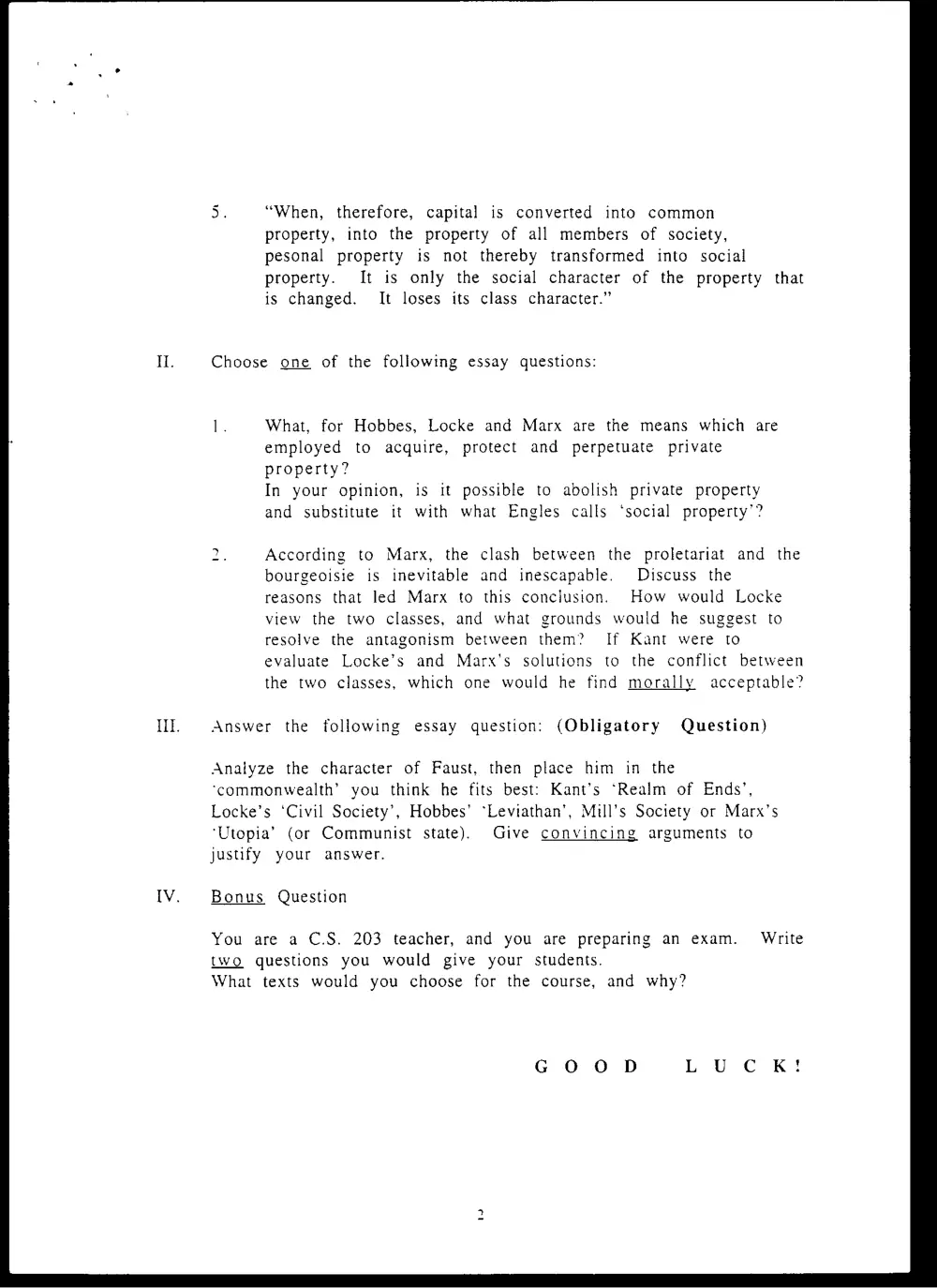
“When, therefore, capital is converted into common
property, into the property of all members of society,
pesonal property is not thereby transformed into social
property. It is only the social character of the property that
is changed. It loses its class character.”
II. Choose one of the following essay questions:
What, for Hobbes, Locke and Marx are the means which are
employed to acquire, protect and perpetuate private
property?
In your opinion, is it possible to abolish private property
and substitute it with what Engles calls ‘social property’?
According to Marx, the clash between the proletariat and the
bourgeoisie is inevitable and inescapable. Discuss the
reasons that led Marx to this conclusion. How would Locke
view the two classes, and what grounds would he suggest to
resolve the antagonism between them? If Kant were to
evaluate Locke’s and Marx’s solutions to the conflict between
the two classes, which one would he find morally acceptable?
UI. Answer the following essay question: (Obligatory Question)
Analyze the character of Faust, then place him in the
‘commonwealth’ you think he fits best: Kant’s “Realm of Ends’,
Locke’s ‘Civil Society’, Hobbes’ ‘Leviathan’, Mill’s Society or Marx’s
‘Utopia’ (or Communist state). Give convincing arguments to
justify your answer.
Bonus Question
You are a C.S. 203 teacher, and you are preparing an exam. Write
two questions you would give your students.
What texts would you choose for the course, and why?