
CVSP 203 Final, Spring 2001
American University of Beirut · Modern and Contemporary Culture · 2 pages
More CVSP 203 files
Show the text of this final exam
AB,
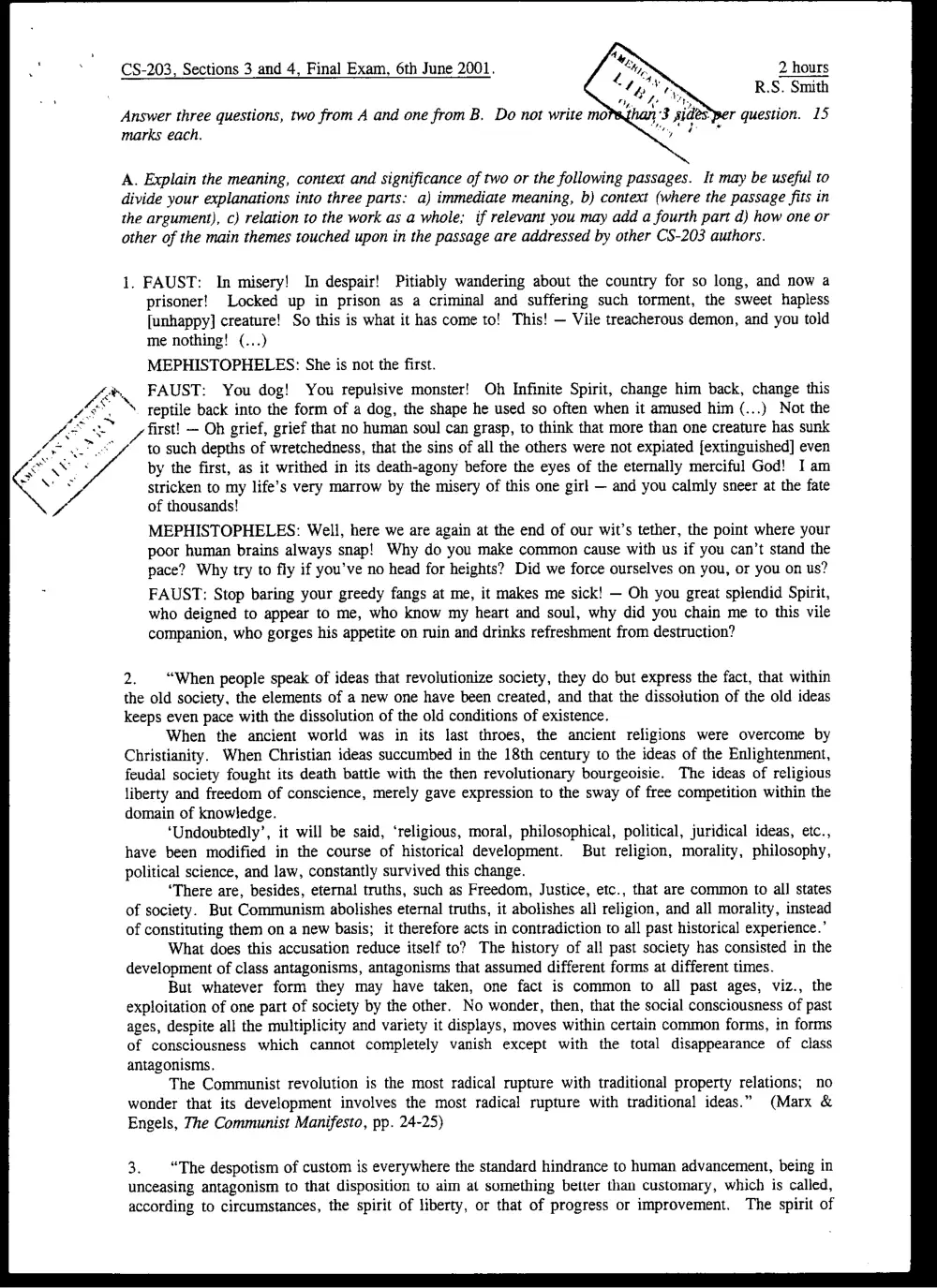
CS-203, Sections 3 and 4, Final Exam, 6th June 2001. “hip 2 hours
. " R.S. Smith
Answer three questions, two from A and one from B. Do not write mo
marks each.
A. Explain the meaning, context and significance of two or the following passages. It may be useful to
divide your explanations into three parts: a) immediate meaning, b) context (where the passage fits in
the argument), c) relation to the work as a whole; if relevant you may add a fourth part d) how one or
other of the main themes touched upon in the passage are addressed by other CS-203 authors.
1. FAUST: In misery! In despair! Pitiably wandering about the country for so long, and now a
prisoner! Locked up in prison as a criminal and suffering such torment, the sweet hapless
[unhappy] creature! So this is what it has come to! This! — Vile treacherous demon, and you told
me nothing! (...)
MEPHISTOPHELES: She is not the first.
.. FAUST: You dog! You repulsive monster! Oh Infinite Spirit, change him back, change this
‘. reptile back into the form of a dog, the shape he used so often when it amused him (...) Not the
first! — Oh grief, grief that no human soul can grasp, to think that more than one creature has sunk
to such depths of wretchedness, that the sins of all the others were not expiated [extinguished] even
by the first, as it writhed in its death-agony before the eyes of the eternally merciful God! I am
stricken to my life’s very marrow by the misery of this one girl — and you calmly sneer at the fate
of thousands!
MEPHISTOPHELES: Well, here we are again at the end of our wit’s tether, the point where your
poor human brains always snap! Why do you make common cause with us if you can’t stand the
pace? Why try to fly if you’ve no head for heights? Did we force ourselves on you, or you on us?
FAUST: Stop baring your greedy fangs at me, it makes me sick! — Oh you great splendid Spirit,
who deigned to appear to me, who know my heart and soul, why did you chain me to this vile
companion, who gorges his appetite on ruin and drinks refreshment from destruction?
2. “When people speak of ideas that revolutionize society, they do but express the fact, that within
the old society, the elements of a new one have been created, and that the dissolution of the old ideas
keeps even pace with the dissolution of the old conditions of existence.
When the ancient world was in its last throes, the ancient religions were overcome by
Christianity. When Christian ideas succumbed in the 18th century to the ideas of the Enlightenment,
feudal society fought its death battle with the then revolutionary bourgeoisie. The ideas of religious
liberty and freedom of conscience, merely gave expression to the sway of free competition within the
domain of knowledge.
‘Undoubtedly’, it will be said, ‘religious, moral, philosophical, political, juridical ideas, etc.,
have been modified in the course of historical development. But religion, morality, philosophy,
political science, and law, constantly survived this change.
‘There are, besides, eternal truths, such as Freedom, Justice, etc., that are common to all states
of society. But Communism abolishes eternal truths, it abolishes all religion, and all morality, instead
of constituting them on a new basis; it therefore acts in contradiction to all past historical experience.’
What does this accusation reduce itself to? The history of all past society has consisted in the
development of class antagonisms, antagonisms that assumed different forms at different times.
But whatever form they may have taken, one fact is common to all past ages, viz., the
exploitation of one part of society by the other. No wonder, then, that the social consciousness of past
ages, despite all the multiplicity and variety it displays, moves within certain common forms, in forms
of consciousness which cannot completely vanish except with the total disappearance of class
antagonisms.
The Communist revolution is the most radical rupture with traditional property relations; no
wonder that its development involves the most radical rupture with traditional ideas.” (Marx &
Engels, The Communist Manifesto, pp. 24-25)
3. “The despotism of custom is everywhere the standard hindrance to human advancement, being in
unceasing antagonism to that disposition to aim at something better than customary, which is called,
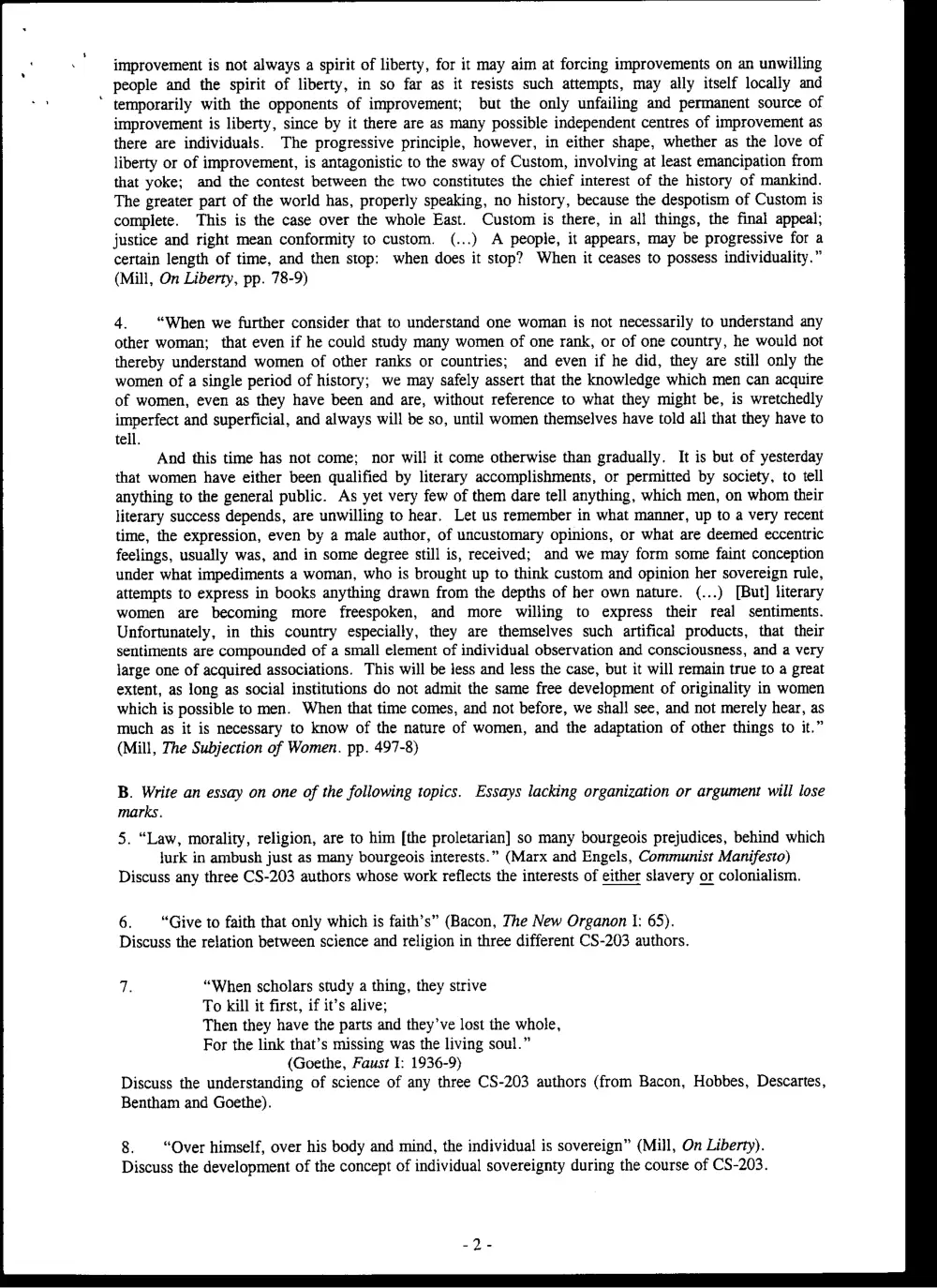
according to circumstances, the spirit of liberty, or that of progress or improvement. The spirit of
improvement is not always a spirit of liberty, for it may aim at forcing improvements on an unwilling
people and the spirit of liberty, in so far as it resists such attempts, may ally itself locally and
‘ temporarily with the opponents of improvement; but the only unfailing and permanent source of
improvement is liberty, since by it there are as many possible independent centres of improvement as
there are individuals. The progressive principle, however, in either shape, whether as the love of
liberty or of improvement, is antagonistic to the sway of Custom, involving at least emancipation from
that yoke; and the contest between the two constitutes the chief interest of the history of mankind.
The greater part of the world has, properly speaking, no history, because the despotism of Custom is
complete. This is the case over the whole East. Custom is there, in all things, the final appeal;
justice and right mean conformity to custom. (...) A people, it appears, may be progressive for a
certain length of time, and then stop: when does it stop? When it ceases to possess individuality.”
(Mill, On Liberty, pp. 78-9)
4. | “When we further consider that to understand one woman is not necessarily to understand any
other woman; that even if he could study many women of one rank, or of one country, he would not
thereby understand women of other ranks or countries; and even if he did, they are still only the
women of a single period of history; we may safely assert that the knowledge which men can acquire
of women, even as they have been and are, without reference to what they might be, is wretchedly
imperfect and superficial, and always will be so, until women themselves have told all that they have to
tell.
And this time has not come; nor will it come otherwise than gradually. It is but of yesterday
that women have either been qualified by literary accomplishments, or permitted by society, to tell
anything to the general public. As yet very few of them dare tell anything, which men, on whom their
literary success depends, are unwilling to hear. Let us remember in what manner, up to a very recent
time, the expression, even by a male author, of uncustomary opinions, or what are deemed eccentric
feelings, usually was, and in some degree still is, received; and we may form some faint conception
under what impediments a woman, who is brought up to think custom and opinion her sovereign rule,
attempts to express in books anything drawn from the depths of her own nature. (...) [But] literary
women are becoming more freespoken, and more willing to express their real sentiments.
Unfortunately, in this country especially, they are themselves such artifical products, that their
sentiments are compounded of a small element of individual observation and consciousness, and a very
large one of acquired associations. This will be less and less the case, but it will remain true to a great
extent, as long as social institutions do not admit the same free development of originality in women
which is possible to men. When that time comes, and not before, we shall see, and not merely hear, as
much as it is necessary to know of the nature of women, and the adaptation of other things to it.”
(Mill, The Subjection of Women. pp. 497-8)
B. Write an essay on one of the following topics. Essays lacking organization or argument will lose
marks.
5. “Law, morality, religion, are to him [the proletarian] so many bourgeois prejudices, behind which
turk in ambush just as many bourgeois interests.” (Marx and Engels, Communist Manifesto)
Discuss any three CS-203 authors whose work reflects the interests of either slavery or colonialism.
6. “Give to faith that only which is faith’s” (Bacon, The New Organon I: 65).
Discuss the relation between science and religion in three different CS-203 authors.
“When scholars study a thing, they strive
To kill it first, if it’s alive;
Then they have the parts and they’ve lost the whole,
For the link that’s missing was the living soul.”
(Goethe, Faust I: 1936-9)
Discuss the understanding of science of any three CS-203 authors (from Bacon, Hobbes, Descartes,
Bentham and Goethe).
8. “Over himself, over his body and mind, the individual is sovereign” (Mill, On Liberty).
Discuss the development of the concept of individual sovereignty during the course of CS-203.