
CVSP 203 Final, Spring 2003
American University of Beirut · Modern and Contemporary Culture · 1 page
Stuck on a question? A tutor can walk you through it.
More CVSP 203 files
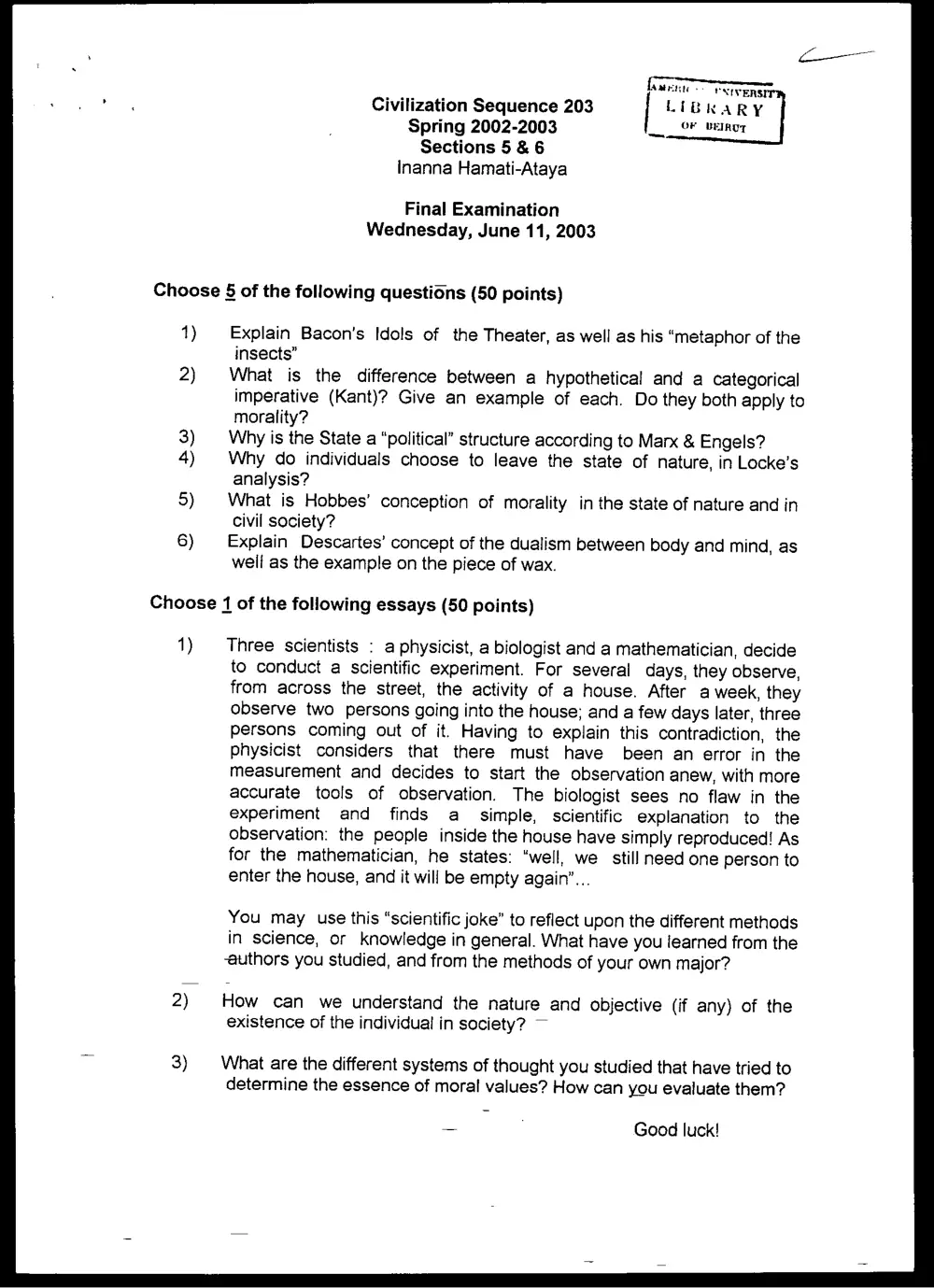
Show the text of this final exam
oe
nao
MEK TNIVERS!
Civilization Sequence 203 | LIBRARY
Spring 2002-2003 OF BEIRUT
Sections 5&6
Inanna Hamati-Ataya
Final Examination
Wednesday, June 11, 2003
Choose § of the following questions (50 points)
1) Explain Bacon's Idols of the Theater, as well as his “metaphor of the
insects”
2) What is the difference between a hypothetical and a categorical
imperative (Kant)? Give an example of each. Do they both apply to
morality?
3) Why is the State a “political” structure according to Marx & Engels?
4) | Why do individuals choose to leave the state of nature, in Locke’s
analysis?
5) | What is Hobbes’ conception of morality in the state of nature and in
civil society?
6) Explain Descartes’ concept of the dualism between body and mind, as
well as the example on the piece of wax.
Choose 1 of the following essays (50 points)
1) Three scientists : a physicist, a biologist and a mathematician, decide
to conduct a scientific experiment. For several days, they observe,
from across the street, the activity of a house. After a week, they
observe two persons going into the house; and a few days later, three
persons coming out of it. Having to explain this contradiction, the
physicist considers that there must have been an error in the
measurement and decides to start the observation anew, with more
accurate tools of observation. The biologist sees no flaw in the
experiment and finds a simple, scientific explanation to the
observation: the people inside the house have simply reproduced! As
for the mathematician, he states: “well, we still need one person to
enter the house, and it will be empty again’...
You may use this “scientific joke” to reflect upon the different methods
in science, or knowledge in general. What have you learned from the
authors you studied, and from the methods of your own major?
2) How can we understand the nature and objective (if any) of the
existence of the individual in society? —
3) What are the different systems of thought you studied that have tried to
determine the essence of moral values? How can you evaluate them?
= ; Good luck!