
CVSP 203 Final, Spring 2003
American University of Beirut · Modern and Contemporary Culture · 1 page
Stuck on a question? A tutor can walk you through it.
More CVSP 203 files
Show the text of this final exam
a cenacel
EMICAN CNIVERSIT
f" IBKLARY
OF BEIRUT
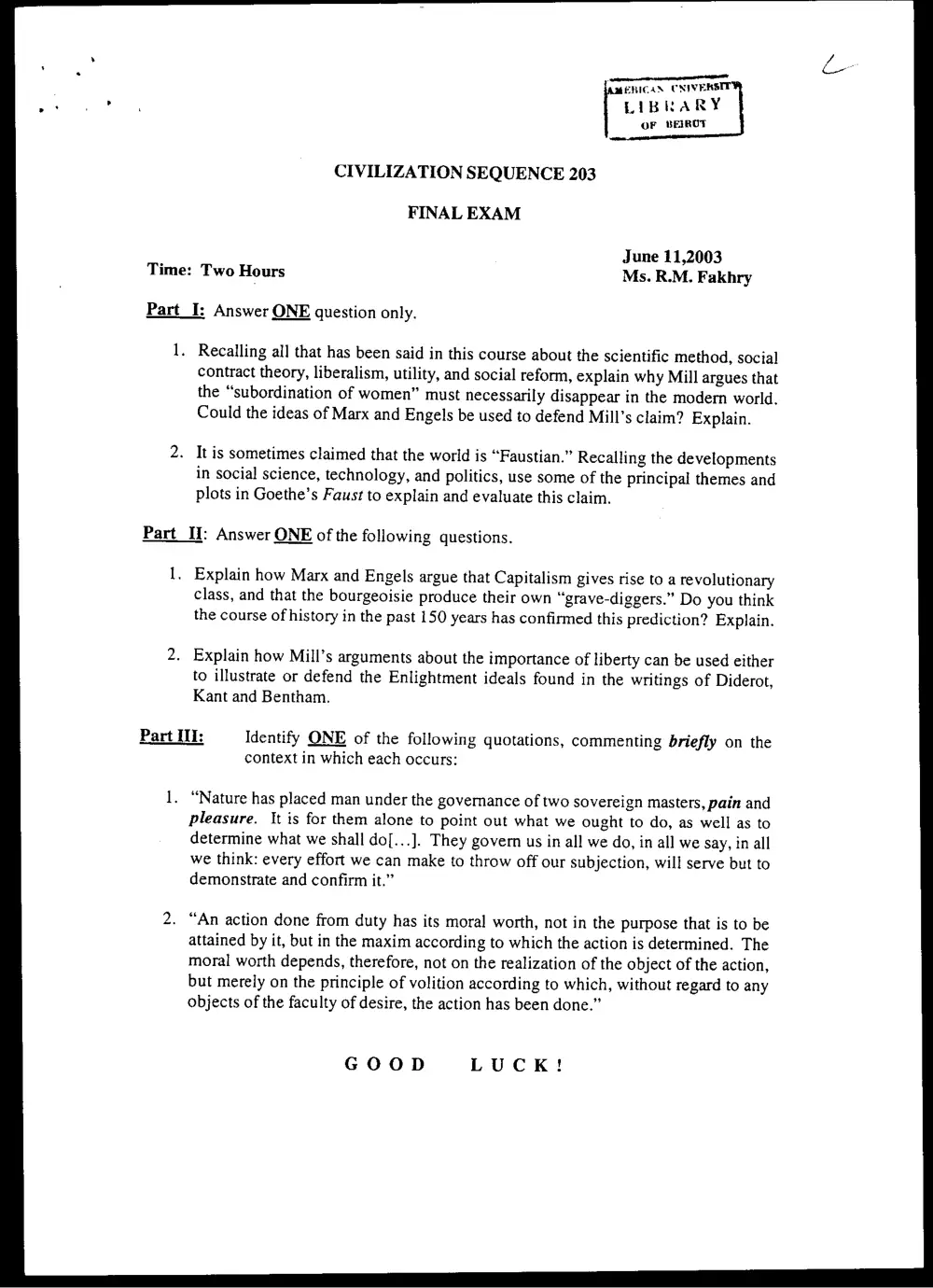
CIVILIZATION SEQUENCE 203
FINAL EXAM
June 11,2003
Time: Two Hours Ms. R.M. Fakhry
Part_I: Answer ONE question only.
1. Recalling all that has been said in this course about the scientific method, social
contract theory, liberalism, utility, and social reform, explain why Mill argues that
the “subordination of women” must necessarily disappear in the modern world.
Could the ideas of Marx and Engels be used to defend Mill’s claim? Explain.
. It is sometimes claimed that the world is “Faustian.” Recalling the developments
in social science, technology, and politics, use some of the principal themes and
plots in Goethe’s Faust to explain and evaluate this claim.
Part II: Answer ONE of the following questions.
1. Explain how Marx and Engels argue that Capitalism gives rise to a revolutionary
class, and that the bourgeoisie produce their own “grave-diggers.” Do you think
the course of history in the past 150 years has confirmed this prediction? Explain.
. Explain how Mill’s arguments about the importance of liberty can be used either
to illustrate or defend the Enlightment ideals found in the writings of Diderot,
Kant and Bentham.
Part III: Identify ONE of the following quotations, commenting briefly on the
context in which each occurs:
1. “Nature has placed man under the governance of two sovereign masters, pain and
pleasure. It is for them alone to point out what we ought to do, as well as to
determine what we shall do[...]. They govern us in all we do, in all we say, in all
we think: every effort we can make to throw off our subjection, will serve but to
demonstrate and confirm it.”
. “An action done from duty has its moral worth, not in the purpose that is to be
attained by it, but in the maxim according to which the action is determined. The
moral worth depends, therefore, not on the realization of the object of the action,
but merely on the principle of volition according to which, without regard to any
objects of the faculty of desire, the action has been done.”
GOoD LUCK!