
CVSP 203 Final, Spring 2004
American University of Beirut · Modern and Contemporary Culture · 2 pages
More CVSP 203 files
Show the text of this final exam
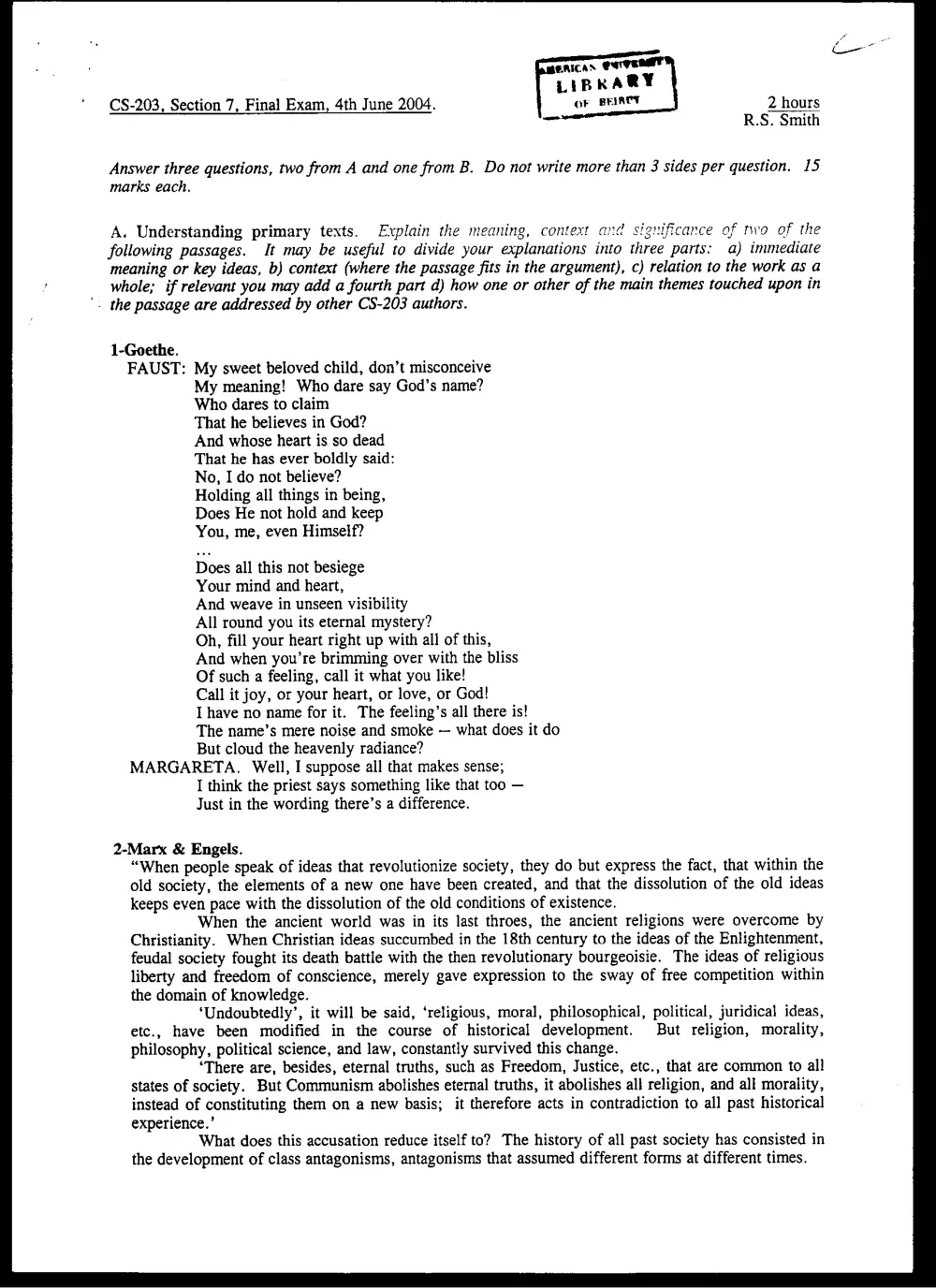
RICAN CUTTS!
LIBRARY
CS-203, Section 7, Final Exam, 4th June 2004. OF BRIATT 2 hours
R.S. Smith
Answer three questions, two from A and one from B. Do not write more than 3 sides per question. 15
marks each.
A. Understanding primary texts. Explain the meaning, context and significance of two of the
following passages. It may be useful to divide your explanations into three parts: a) immediate
meaning or key ideas, b) context (where the passage fits in the argument), c) relation to the work as a
whole; if relevant you may add a fourth part d) how one or other of the main themes touched upon in
*. the passage are addressed by other CS-203 authors.
1-Goethe.
FAUST: My sweet beloved child, don’t misconceive
My meaning! Who dare say God’s name?
Who dares to claim
That he believes in God?
And whose heart is so dead
That he has ever boldly said:
No, I do not believe?
Holding all things in being,
Does He not hold and keep
You, me, even Himself?
Does all this not besiege
Your mind and heart,
And weave in unseen visibility
All round you its eternal mystery?
Oh, fill your heart right up with all of this,
And when you’re brimming over with the bliss
Of such a feeling, call it what you like!
Call it joy, or your heart, or love, or God!
I have no name for it. The feeling’s all there is!
The name’s mere noise and smoke — what does it do
But cloud the heavenly radiance?
MARGARETA. Well, I suppose all that makes sense;
I think the priest says something like that too —
Just in the wording there’s a difference.
2-Marx & Engels.
“When people speak of ideas that revolutionize society, they do but express the fact, that within the
old society, the elements of a new one have been created, and that the dissolution of the old ideas
keeps even pace with the dissolution of the old conditions of existence.
When the ancient world was in its last throes, the ancient religions were overcome by
Christianity. When Christian ideas succumbed in the 18th century to the ideas of the Enlightenment,
feudal society fought its death battle with the then revolutionary bourgeoisie. The ideas of religious
liberty and freedom of conscience, merely gave expression to the sway of free competition within
the domain of knowledge.
‘Undoubtedly’, it will be said, ‘religious, moral, philosophical, political, juridical ideas,
etc., have been modified in the course of historical development. But religion, morality,
philosophy, political science, and law, constantly survived this change.
‘There are, besides, eternal truths, such as Freedom, Justice, etc., that are common to all
states of society. But Communism abolishes eternal truths, it abolishes all religion, and all morality,
instead of constituting them on a new basis; it therefore acts in contradiction to all past historical
experience.’
What does this accusation reduce itself to? The history of all past society has consisted in
the development of class antagonisms, antagonisms that assumed different forms at different times.
kee pe
te. :
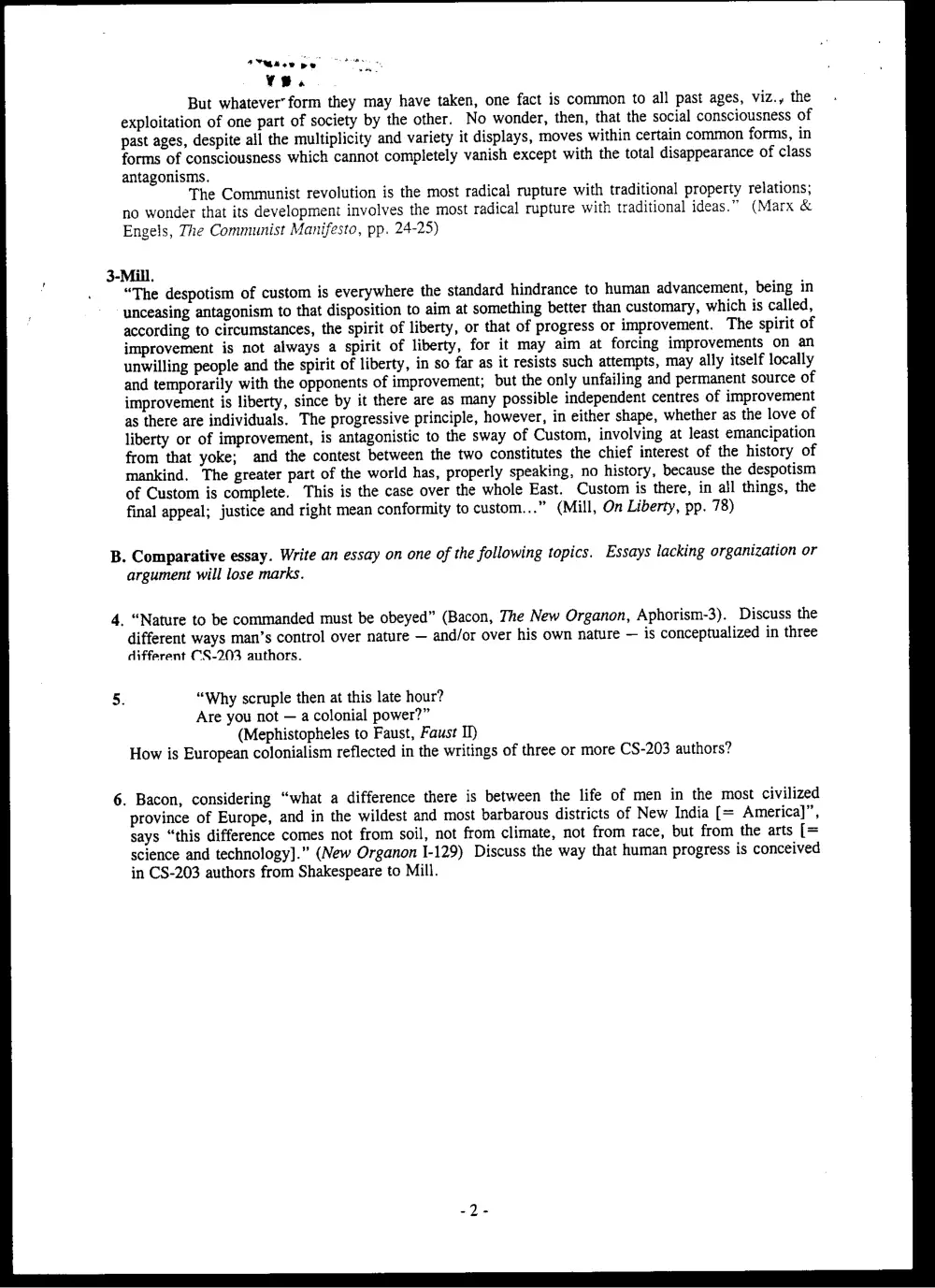
But whatever’form they may have taken, one fact is common to all past ages, viz., the
exploitation of one part of society by the other. No wonder, then, that the social consciousness of
past ages, despite all the multiplicity and variety it displays, moves within certain common forms, in
forms of consciousness which cannot completely vanish except with the total disappearance of class
antagonisms.
The Communist revolution is the most radical rupture with traditional property relations;
no wonder that its development involves the most radical rupture with traditional ideas.” (Marx &
Engels, The Communist Manifesto, pp. 24-25)
3-Mill.
“The despotism of custom is everywhere the standard hindrance to human advancement, being in
unceasing antagonism to that disposition to aim at something better than customary, which is called,
according to circumstances, the spirit of liberty, or that of progress or improvement. The spirit of
improvement is not always a spirit of liberty, for it may aim at forcing improvements on an
unwilling people and the spirit of liberty, in so far as it resists such attempts, may ally itself locally
and temporarily with the opponents of improvement; but the only unfailing and permanent source of
improvement is liberty, since by it there are as many possible independent centres of improvement
as there are individuals. The progressive principle, however, in either shape, whether as the love of
liberty or of improvement, is antagonistic to the sway of Custom, involving at least emancipation
from that yoke; and the contest between the two constitutes the chief interest of the history of
mankind. The greater part of the world has, properly speaking, no history, because the despotism
of Custom is complete. This is the case over the whole East. Custom is there, in all things, the
final appeal; justice and right mean conformity to custom...” (Mill, On Liberty, pp. 78)
B. Comparative essay. Write an essay on one of the following topics. Essays lacking organization or
argument will lose marks.
4. “Nature to be commanded must be obeyed” (Bacon, The New Organon, Aphorism-3). Discuss the
different ways man’s control over nature — and/or over his own nature — is conceptualized in three
different CS-203 authors.
“Why scruple then at this late hour?
Are you not — a colonial power?”
(Mephistopheles to Faust, Faust Il)
How is European colonialism reflected in the writings of three or more CS-203 authors?
6. Bacon, considering “what a difference there is between the life of men in the most civilized
province of Europe, and in the wildest and most barbarous districts of New India [= America]”,
says “this difference comes not from soil, not from climate, not from race, but from the arts [=
science and technology].” (New Organon I-129) Discuss the way that human progress is conceived
in CS-203 authors from Shakespeare to Mill.