
CVSP 203 Final, Spring 2005
American University of Beirut · Modern and Contemporary Culture · 6 pages
More CVSP 203 files
Show the text of this final exam
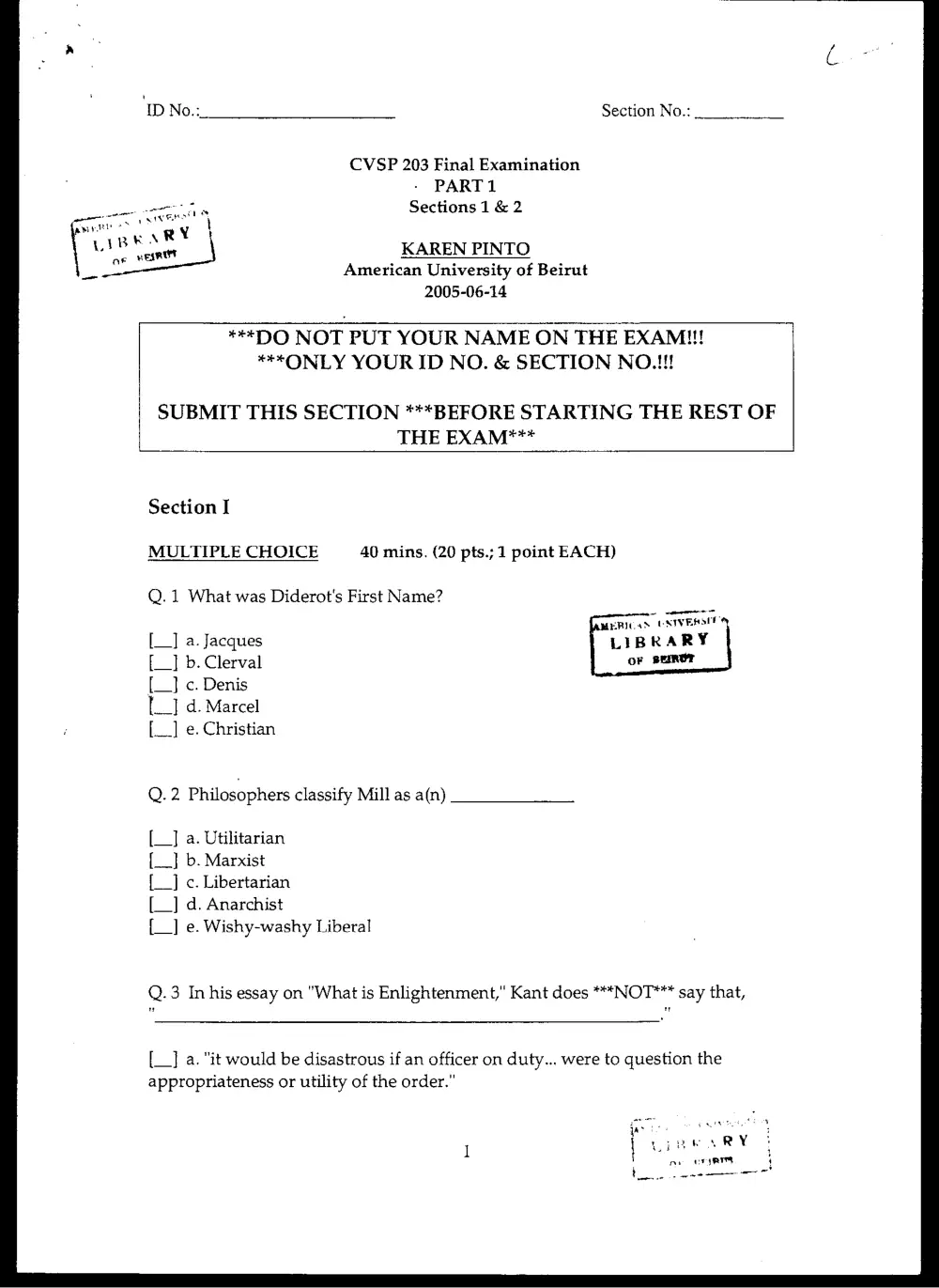
'D No.: Section No.:
CVSP 203 Final Examination
PART 1
aon et Sections 1 & 2
peri es TNE
wr . R Y
Forse | KAREN PINTO
_- American University of Beirut
2005-06-14
***DO NOT PUT YOUR NAME ON THE EXAM!!!
*** ONLY YOUR ID NO. & SECTION NO!!!
SUBMIT THIS SECTION ***BEFORE STARTING THE REST OF
THE EXAM***
Section I
MULTIPLE CHOICE 40 mins. (20 pts.; 1 point EACH)
Q. 1 What was Diderot's First Name?
ERICA UNTVER OTE
[__] a. Jacques LIBRARY
[__] b. Clerval OF SEIROT
{_]} c. Denis
[_] d. Marcel
[__] e. Christian
Q.2 Philosophers classify Mill as a(n)
[__] a. Utilitarian
[__] b. Marxist
{__] c. Libertarian
[__] d. Anarchist
{__] e. Wishy-washy Liberal
Q.3 In his essay on "What is Enlightenment," Kant does ***NOT* say that,
"
{__] a. "it would be disastrous if an officer on duty... were to question the
appropriateness or utility of the order."
ID No.: Section No.:
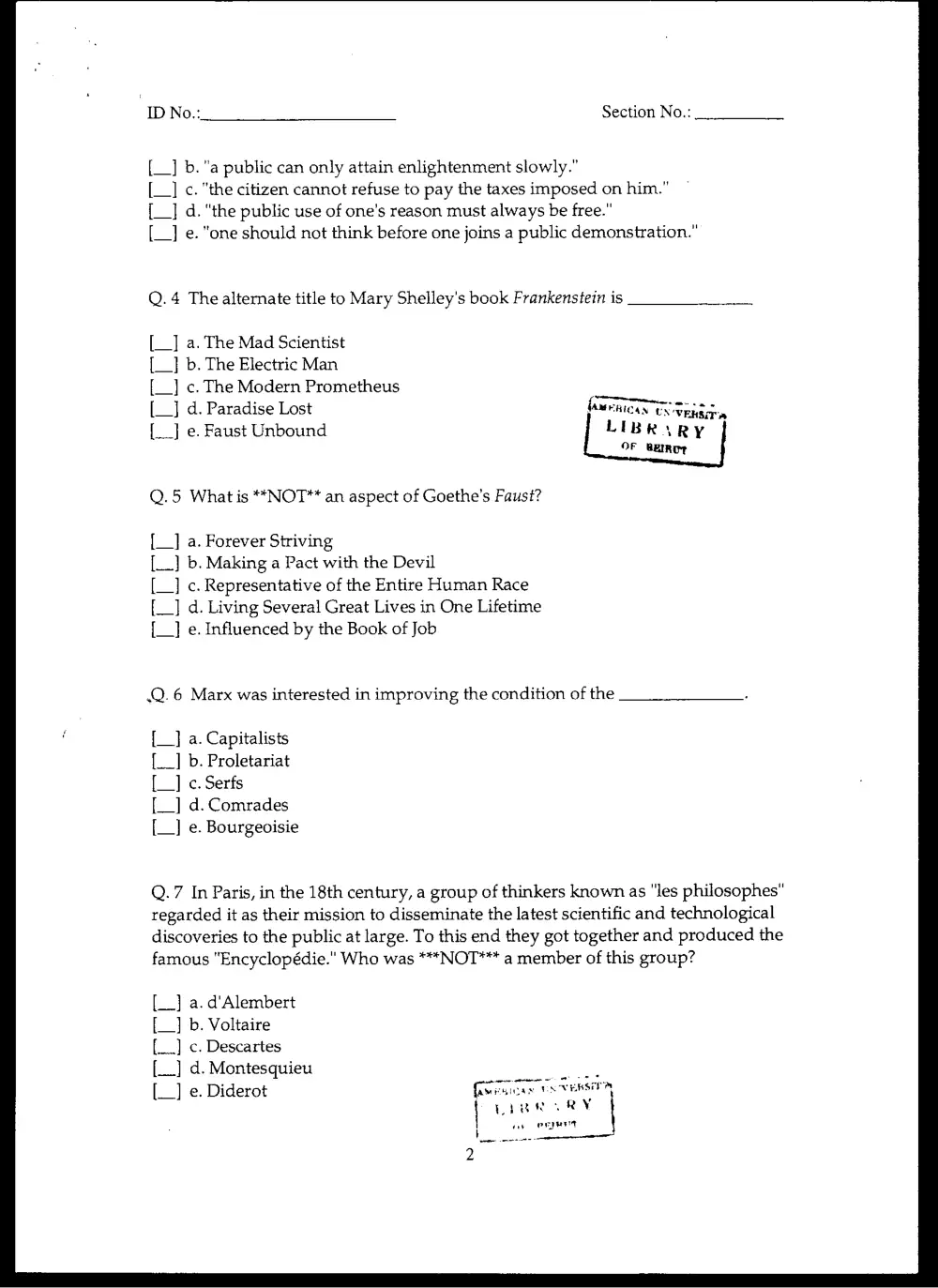
b. "a public can only attain enlightenment slowly.”
c. "the citizen cannot refuse to pay the taxes imposed on him.”
d. "the public use of one’s reason must always be free."
e. "one should not think before one joins a public demonstration."
[_]
[_]
L_]
[_]
Q. 4 The alternate title to Mary Shelley's book Frankenstein is
[_] a. The Mad Scientist
[__] b. The Electric Man
[__] c. The Modern Prometheus
[__] d. Paradise Lost (aurnican Ox Say
{__]
ST
e. Faust Unbound LIBR \RY
OF BEIRUT
Q.5 What is **NOT** an aspect of Goethe's Faust?
{__] a. Forever Striving
[__] b. Making a Pact with the Devil
{__] c. Representative of the Entire Human Race
[__] d. Living Several Great Lives in One Lifetime
{__] e. Influenced by the Book of Job
Q.6 Marx was interested in improving the condition of the
{__] a. Capitalists
{__] b. Proletariat
[__] c. Serfs
[_] d. Comrades
{__] e. Bourgeoisie
Q.7 In Paris, in the 18th century, a group of thinkers known as "les philosophes"
regarded it as their mission to disseminate the latest scientific and technological
discoveries to the public at large. To this end they got together and produced the
famous "Encyclopédie." Who was ***NOT*** a member of this group?
[__} a. d'Alembert
[__] b. Voltaire
{__.] c. Descartes
{__] d. Montesquieu .
[_] Paiaas
e. Diderot Re ngicay UN VERSIE A
Li BR LR Vv
fy omer
t
2
ID No.: Section No.:
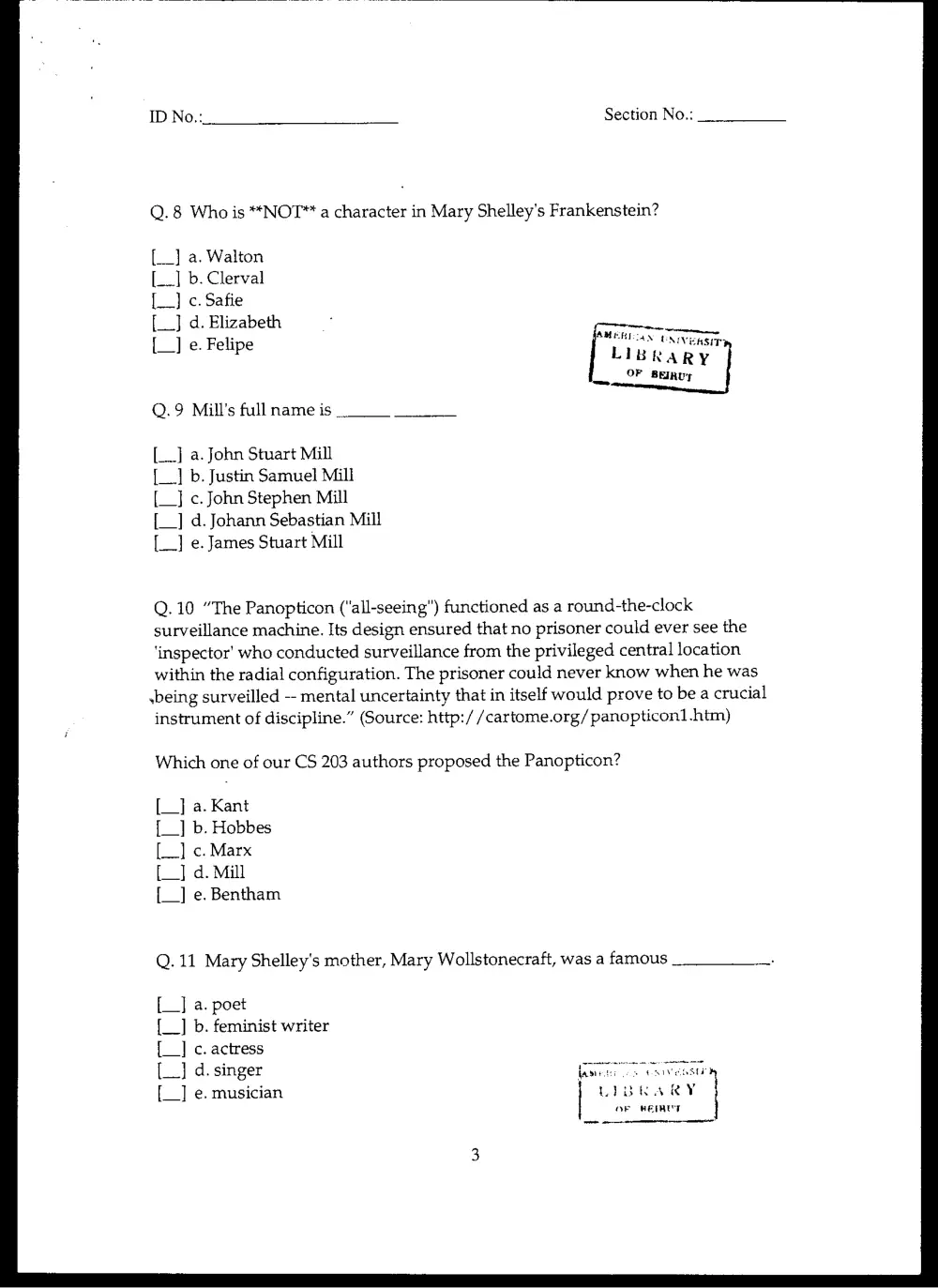
Q. 8 Who is **NOT* a character in Mary Shelley's Frankenstein?
{__] a. Walton
[__] b. Clerval
[_] c. Safie
[__J d. Elizabeth
{_]
e. Felipe MARIAN UN WeRSiP
LIBRARY
OF BEIRUT
Q.9 Mill's full name is
[__] a. John Stuart Mill
[__] b. Justin Samuel Mill
[__] ¢. John Stephen Mill
[__] d. Johann Sebastian Mill
[__] e. James Stuart Mill
Q.10 “The Panopticon ("all-seeing") functioned as a round-the-clock
surveillance machine. Its design ensured that no prisoner could ever see the
‘inspector’ who conducted surveillance from the privileged central location
within the radial configuration. The prisoner could never know when he was
.being surveilled -- mental uncertainty that in itself would prove to be a crucial
instrument of discipline.” (Source: http:/ /cartome.org/panopticon! htm)
Which one of our CS 203 authors proposed the Panopticon?
[__] a. Kant
[__] b. Hobbes
[__] ¢. Marx
[_] d. Mill
[_] e. Bentham
Q.11 Mary Shelley's mother, Mary Wollstonecraft, was a famous
[_] a. poet
{__] b. feminist writer
[__] c. actress
[__] d. singer Gnciy oy enivensth
—! &, musician LIBKAR
{_] ici RY
OF HELAUT
ID No.: Section No.:
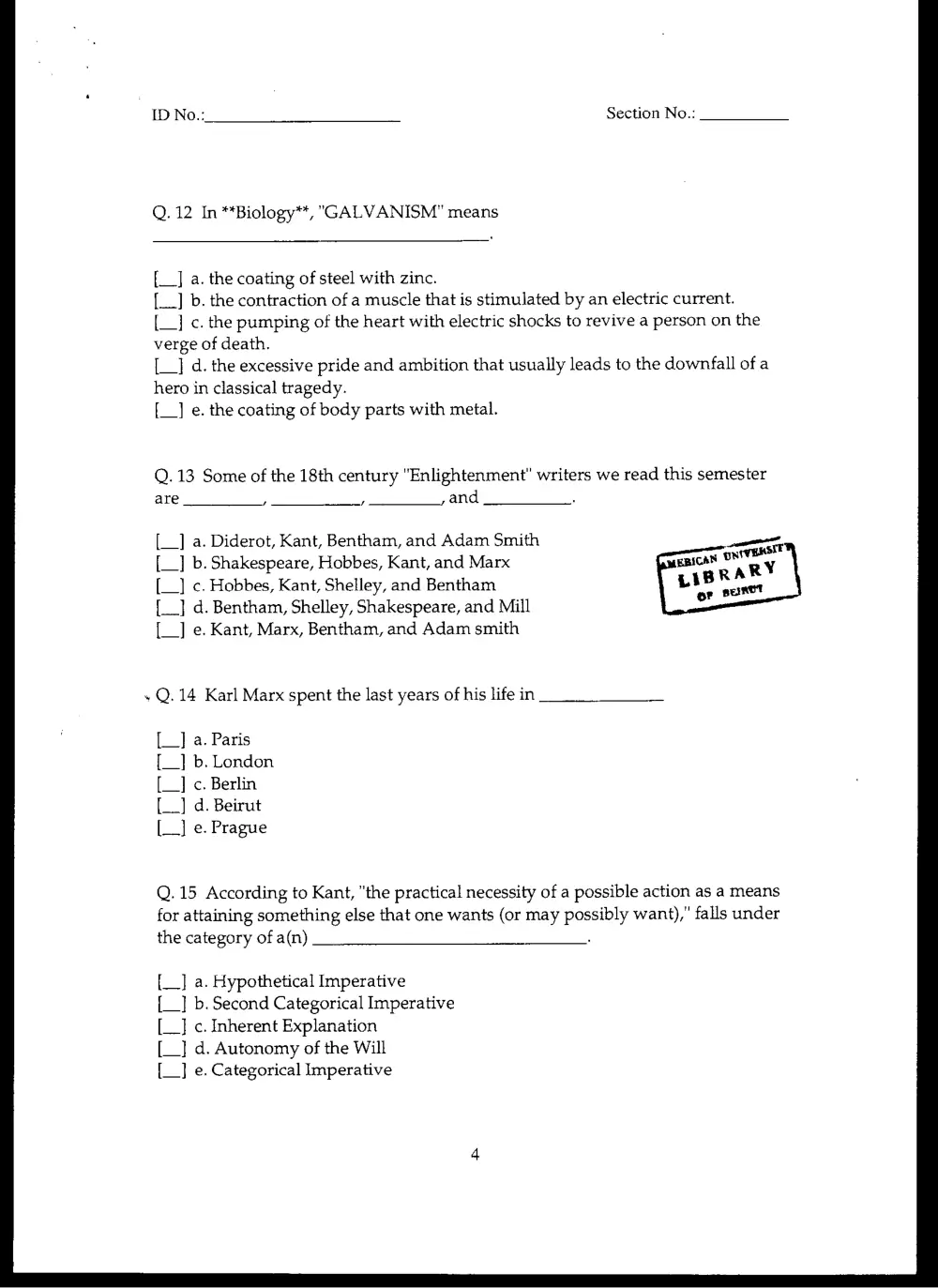
Q.12 In *Biology**, "GALVANISM" means
{__] a. the coating of steel with zinc.
ia b. the contraction of a muscle that is stimulated by an electric current.
[__] c. the pumping of the heart with electric shocks to revive a person on the
verge of death.
[__] d. the excessive pride and ambition that usually leads to the downfall of a
hero in classical tragedy.
[__] e. the coating of body parts with metal.
Q.13 Some of the 18th century “Enlightenment” writers we read this semester
are , , and
[__] a. Diderot, Kant, Bentham, and Adam Smith
{__] b. Shakespeare, Hobbes, Kant, and Marx
[__] c. Hobbes, Kant, Shelley, and Bentham
{_]
[_]
__] d. Bentham, Shelley, Shakespeare, and Mill
__J e. Kant, Marx, Bentham, and Adam smith
+ Q. 14 Karl Marx spent the last years of his life in
Q.15 According to Kant, "the practical necessity of a possible action as a means
for attaining something else that one wants (or may possibly want),” falls under
the category of a(n)
a. Hypothetical Imperative
b. Second Categorical Imperative
d. Autonomy of the Will
{_]
L_]
[__] c. Inherent Explanation
[_]
[__] e. Categorical Imperative
Section No.:
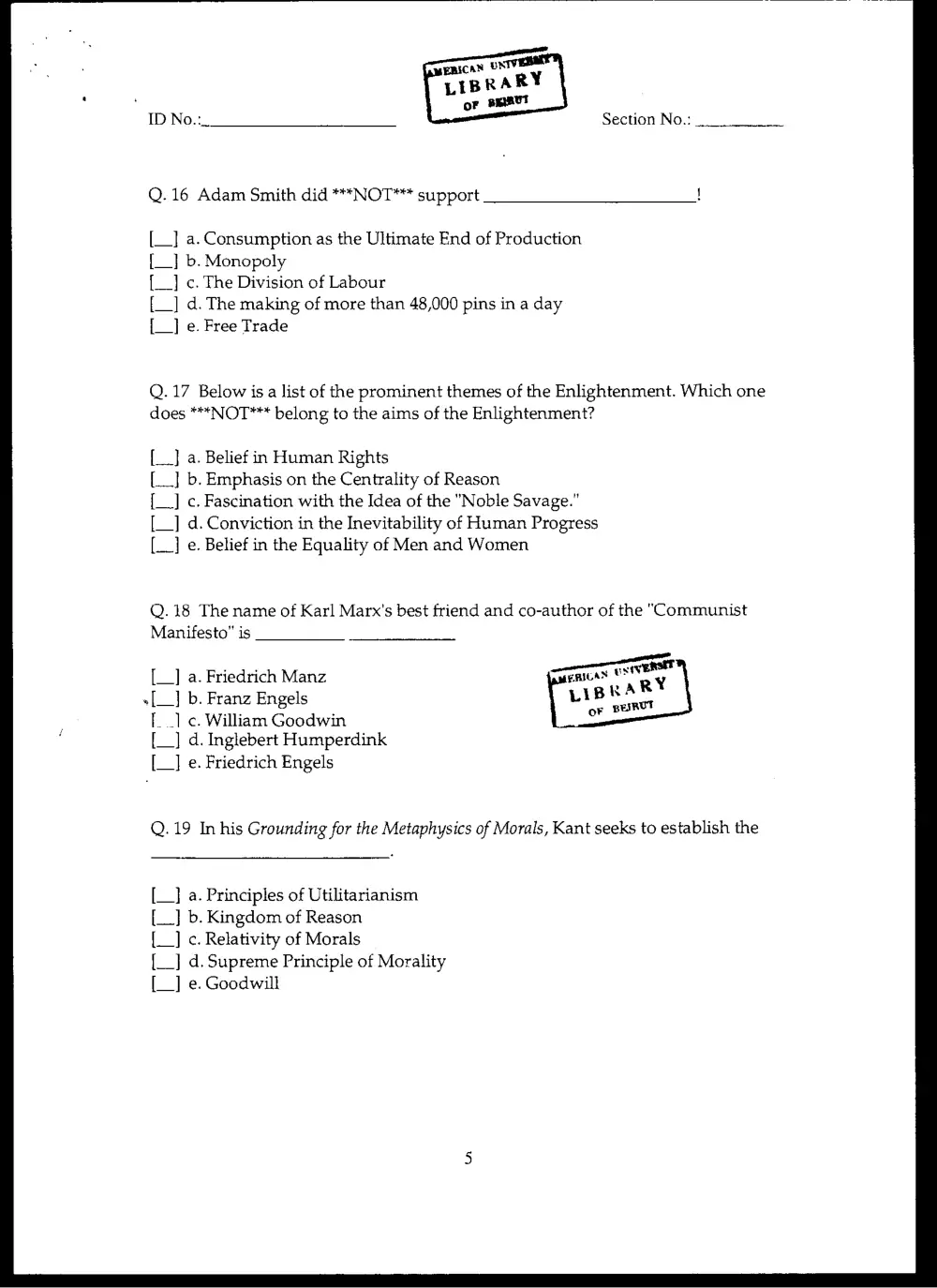
Q. 16 Adam Smith did **NOT*™ support
[__] a. Consumption as the Ultimate End of Production
[__] b. Monopoly
[__] c. The Division of Labour
{__] d. The making of more than 48,000 pins in a day
[__] e. Free Trade
Q. 17 Below is a list of the prominent themes of the Enlightenment. Which one
does ***NOT*** belong to the aims of the Enlightenment?
{__] a. Belief in Human Rights
{__.] b. Emphasis on the Centrality of Reason
{__] c. Fascination with the Idea of the "Noble Savage.”
[__] d. Conviction in the Inevitability of Human Progress
{__] e. Belief in the Equality of Men and Women
Q. 18 The name of Karl Marx's best friend and co-author of the "Communist
Manifesto” is
a. Friedrich Manz
b. Franz Engels
*
d. Inglebert Humperdink
=
=
[_
[__] e. Friedrich Engels
]
]
| c. William Goodwin
]
]
Q. 19 In his Grounding for the Metaphysics of Morals, Kant seeks to establish the
{__] a. Principles of Utilitarianism
[__] b. Kingdom of Reason
{__] c. Relativity of Morals
{__] d. Supreme Principle of Morality
[__] e. Goodwill
ID No.: Section No.:
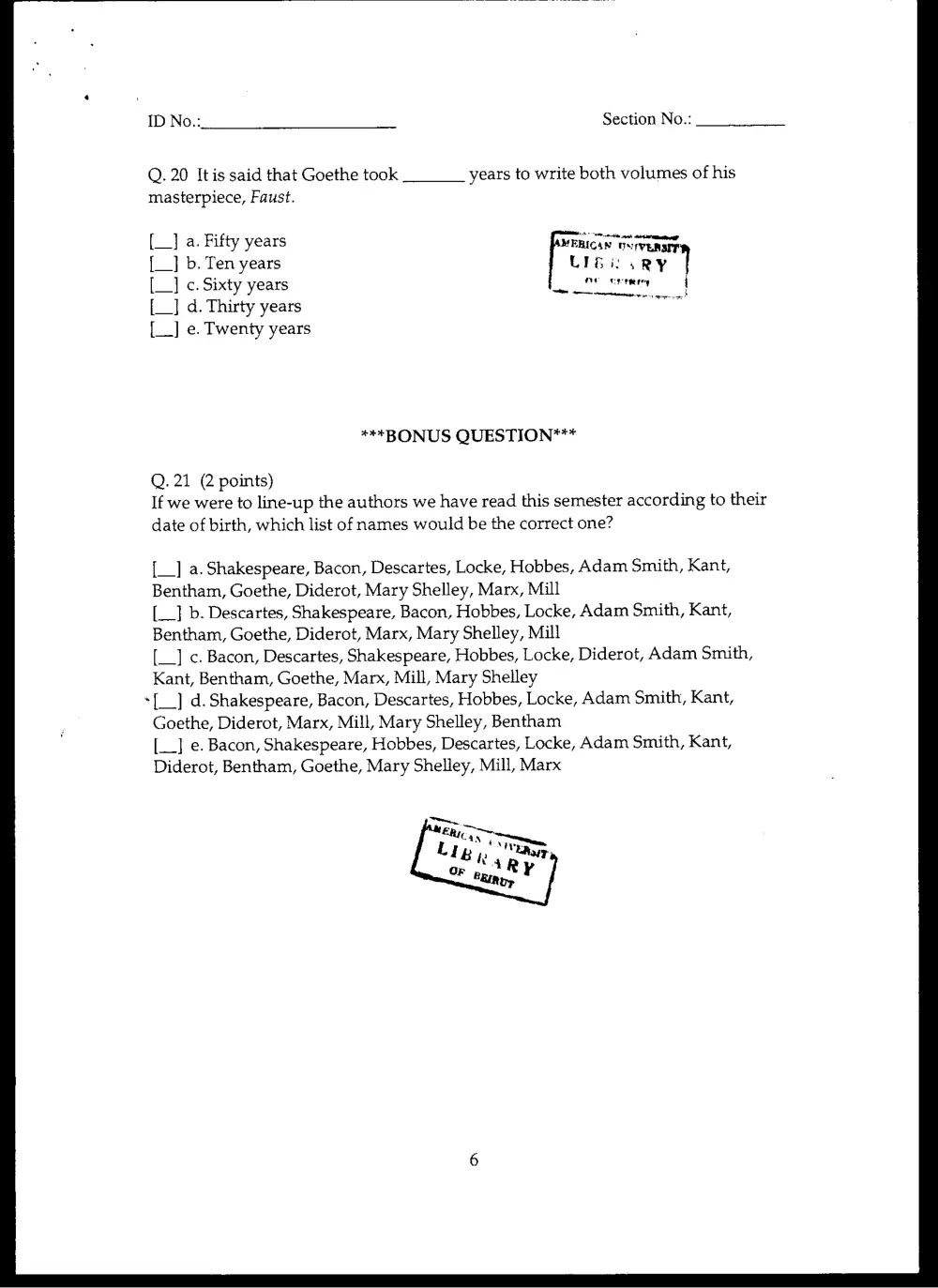
Q. 20 Itis said that Goethe took years to write both volumes of his
masterpiece, Faust.
[__] a. Fifty years ino
[__] b. Ten years LIB SRY 1
[__] c. Sixty years te erterr {
[__] d. Thirty years erent
[__] e. Twenty years
***BONUS QUESTION***
Q. 21 (2 points)
If we were to line-up the authors we have read this semester according to their
date of birth, which list of names would be the correct one?
a. Shakespeare, Bacon, Descartes, Locke, Hobbes, Adam Smith, Kant,
Bentham, Goethe, Diderot, Mary Shelley, Marx, Mill
b. Descartes, Shakespeare, Bacon, Hobbes, Locke, Adam Smith, Kant,
Bentham, Goethe, Diderot, Marx, Mary Shelley, Mill
c. Bacon, Descartes, Shakespeare, Hobbes, Locke, Diderot, Adam Smith,
Kant, Bentham, Goethe, Marx, Mill, Mary Shelley
d. Shakespeare, Bacon, Descartes, Hobbes, Locke, Adam Smith, Kant,
Goethe, Diderot, Marx, Mill, Mary Shelley, Bentham
e. Bacon, Shakespeare, Hobbes, Descartes, Locke, Adam Smith, Kant,
Diderot, Bentham, Goethe, Mary Shelley, Mill, Marx