
CVSP 203 Final, Spring 2005
American University of Beirut · Modern and Contemporary Culture · 3 pages

More CVSP 203 files
Show the text of this final exam
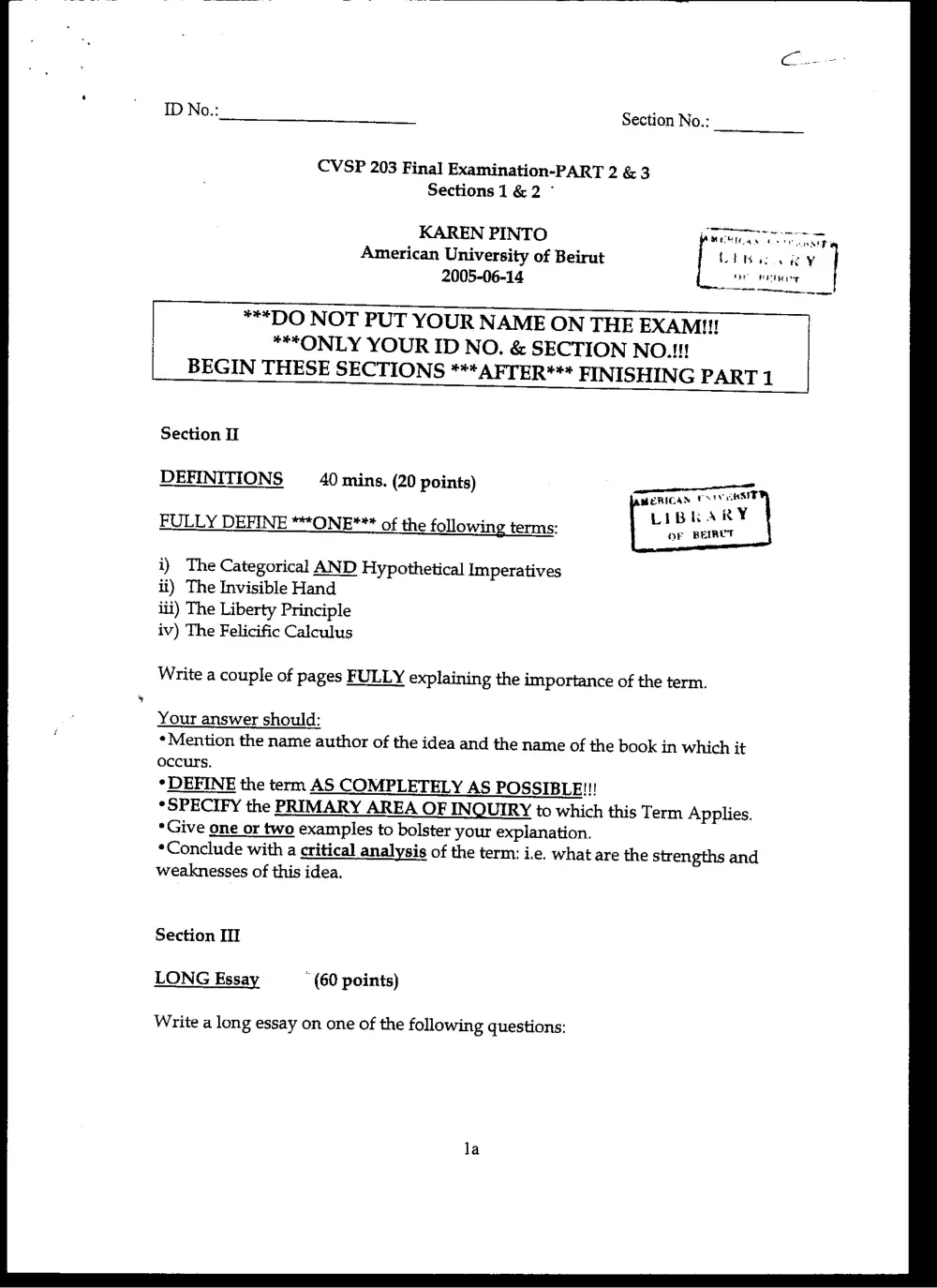
ID No.: Section No.:
CVSP 203 Final Examination-PART 2 & 3
Sections 1 & 2 °
KAREN PINTO rarer ranters
American University of Beirut Libawky
2005-06-14 een
***DO NOT PUT YOUR NAME ON THE EXAMI!
***ONLY YOUR ID NO. & SECTION NO.!!!
BEGIN THESE SECTIONS ***AFTER*** FINISHING PART1
Section
DEFINITIONS 40 mins. (20 points)
FULLY DEFINE **ONE*** of the following terms: OF permet
i) The Categorical AND Hypothetical Imperatives
ii) The Invisible Hand
ili) The Liberty Principle
iv) The Felicific Calculus
Write a couple of pages FULLY explaining the importance of the term.
Your answer should:
* Mention the name author of the idea and the name of the book in which it
occurs.
* DEFINE the term AS COMPLETELY AS POSSIBLE!!!
° SPECIFY the PRIMARY AREA OF INQUIRY to which this Term Applies.
*Give one or two examples to bolster your explanation.
“Conclude with a critical analysis of the term: i.e. what are the strengths and
weaknesses of this idea.
Section III
LONG Essay “(60 points)
Write a long essay on one of the following questions:
la
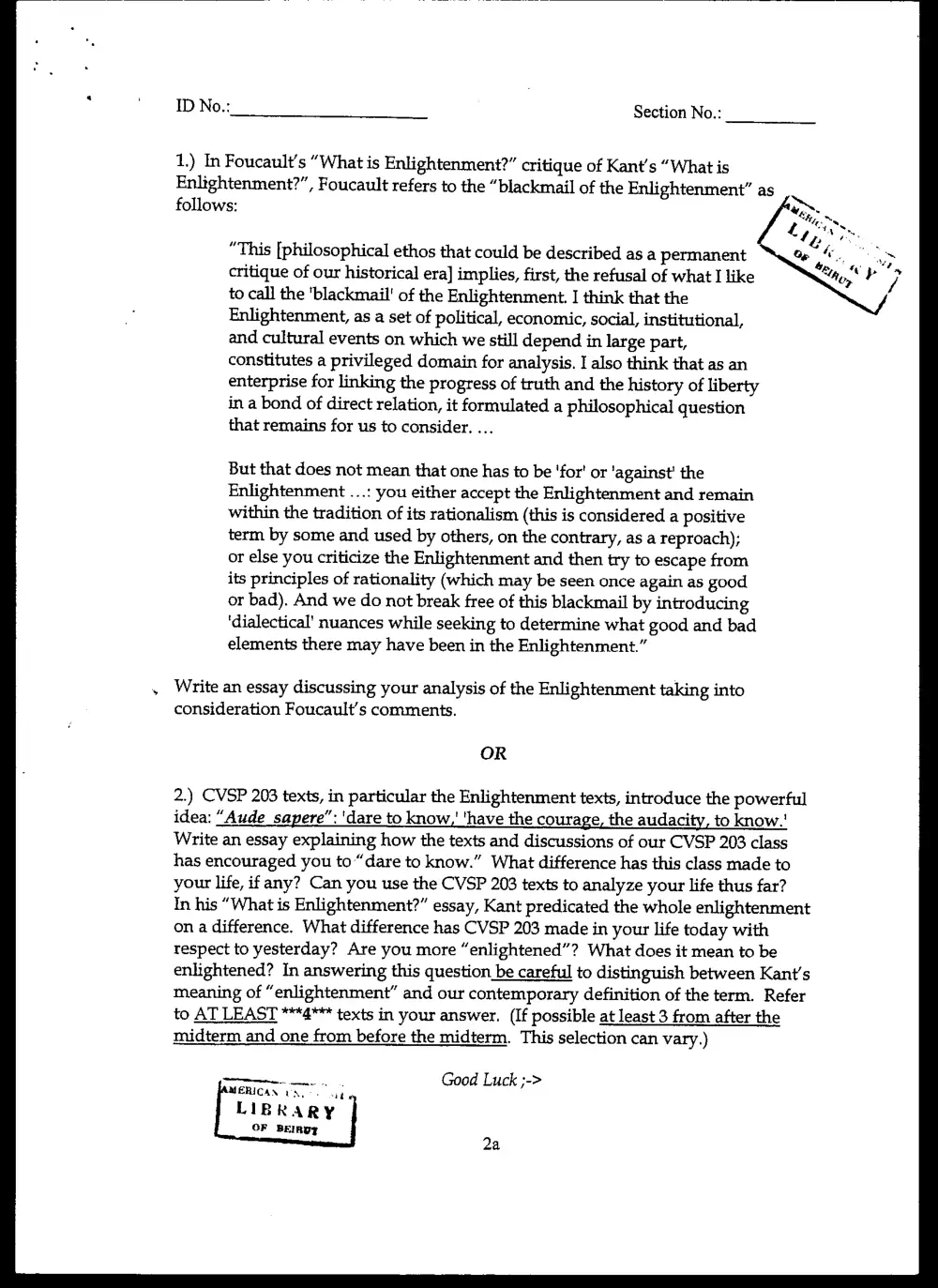
IDNo.: Section No.:
1) In Foucault's “What is Enlightenment?” critique of Kant’s “What is
Enlightenment?”, Foucault refers to the “blackmail of the Enlightenment” as
follows:
“This [philosophical ethos that could be described asa permanent
critique of our historical era] implies, first, the refusal of what I like
to call the 'blackmail' of the Enlightenment. I think that the
Enlightenment, as a set of political, economic, social, institutional,
and cultural events on which we still depend in large part,
constitutes a privileged domain for analysis. I also think that as an
enterprise for linking the progress of truth and the history of liberty
in a bond of direct relation, it formulated a philosophical question
that remains for us to consider. ...
But that does not mean that one has to be ‘for' or ‘against’ the
Enlightenment ...: you either accept the Enlightenment and remain
within the tradition of its rationalism (this is considered a positive
term by some and used by others, on the contrary, as a reproach);
or else you criticize the Enlightenment and then try to escape from
its principles of rationality (which may be seen once again as good
or bad). And we do not break free of this blackmail by introducing
‘dialectical’ nuances while seeking to determine what good and bad
elements there may have been in the Enlightenment.”
, Write an essay discussing your analysis of the Enlightenment taking into
consideration Foucault’s comments.
OR
2.) CVSP 203 texts, in particular the Enlightenment texts, introduce the powerful
idea: “Aude _ sapere”: ‘dare to know,' ‘have the courage, the audacity, to know.’
Write an essay explaining how the texts and discussions of our CVSP 203 class
has encouraged you to “dare to know.” What difference has this class made to
your life, if any? Can you use the CVSP 203 texts to analyze your life thus far?
In his “What is Enlightenment?” essay, Kant predicated the whole enlightenment
on a difference. What difference has CVSP 203 made in your life today with
respect to yesterday? Are you more “enlightened”? What does it mean to be
enlightened? In answering this question be careful to distinguish between Kant’s
meaning of “enlightenment” and our contemporary definition of the term. Refer
to AT LEAST ***4*** texts in your answer. (If possible at least 3 from after the
midterm and one from before the midterm. This selection can vary.)
ae Good Luck ;->
OF BEIRUT
2a
ID No.: Section No.:
***NOTE THAT YOU HAVE UNTIL MIDNIGHT TONIGHT June 14th, 2005
TO COMPLETE YOUR WEB-CT POSTINGS!!!
ee |, cet
bau KICON @ SEFRASIT »
LIBRARY
OF Sree
3a