
DCSN 200 Midterm, Fall 2004
American University of Beirut · Managerial Decision Making · 4 pages
More DCSN 200 files
Show the text of this exam
-: Fo) WY AMERICAN UNIVERSITY OF BEIRUT
'
Suliman S. Olayan School of Business ae |
aah
——- [. OF BEIRUT |
fawenic bat Triste
| LIBRARY
OF PTIKET | DCSN 200: Managerial Decision Making
Fall 2004-2005 Mid-term Exam
Date: November 12", 2004; Time: 5:30 pm-7:00 pm.
Version B
This exam is administered in full observance of the Olayan School of Business Honor Code and the
penalties it sets for violations of the standard of academic conduct. You are required to fully understand
the code and to strongly adhere to it. In particular, cellular telephones, programmable calculators and
computers of any shape or size are not allowed. No questions, no comments, no borrowing and no
disturbance of the peace of any kind will be permitted or tolerated. You are required to stop working on
the exam and hand it immediately when a proctor instructs you to do so. Any cheating or attempted
cheating will subject the offender to a zero on the exam and a referral to the Student Affairs Committee
for further penalties. Please, sign the following pledge and return these question sheets inside your
answers’ booklet.
“I fully understand and strongly adhere to the School of Business Honor Code.”
qiore?
Signature
Name GeRome Cossob dan3oi2Bi+
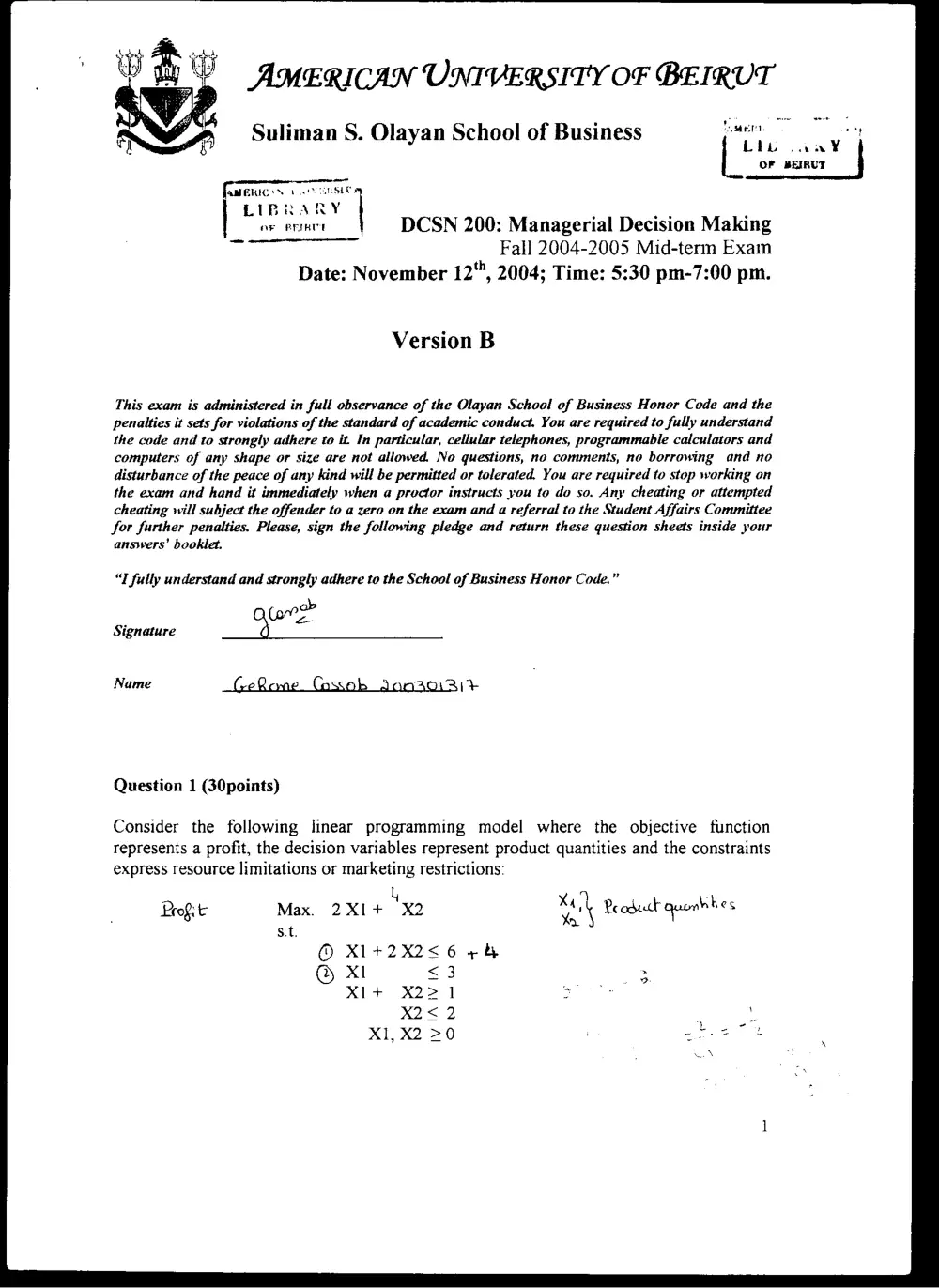
Question 1 (30points)
Consider the following linear programming model where the objective function
represents a profit, the decision variables represent product quantities and the constraints
express resource limitations or marketing restrictions:
Profit Max. 2 XI1+ iy mh Product quonbhes
s.t.
@ X1+2X2<6 +4
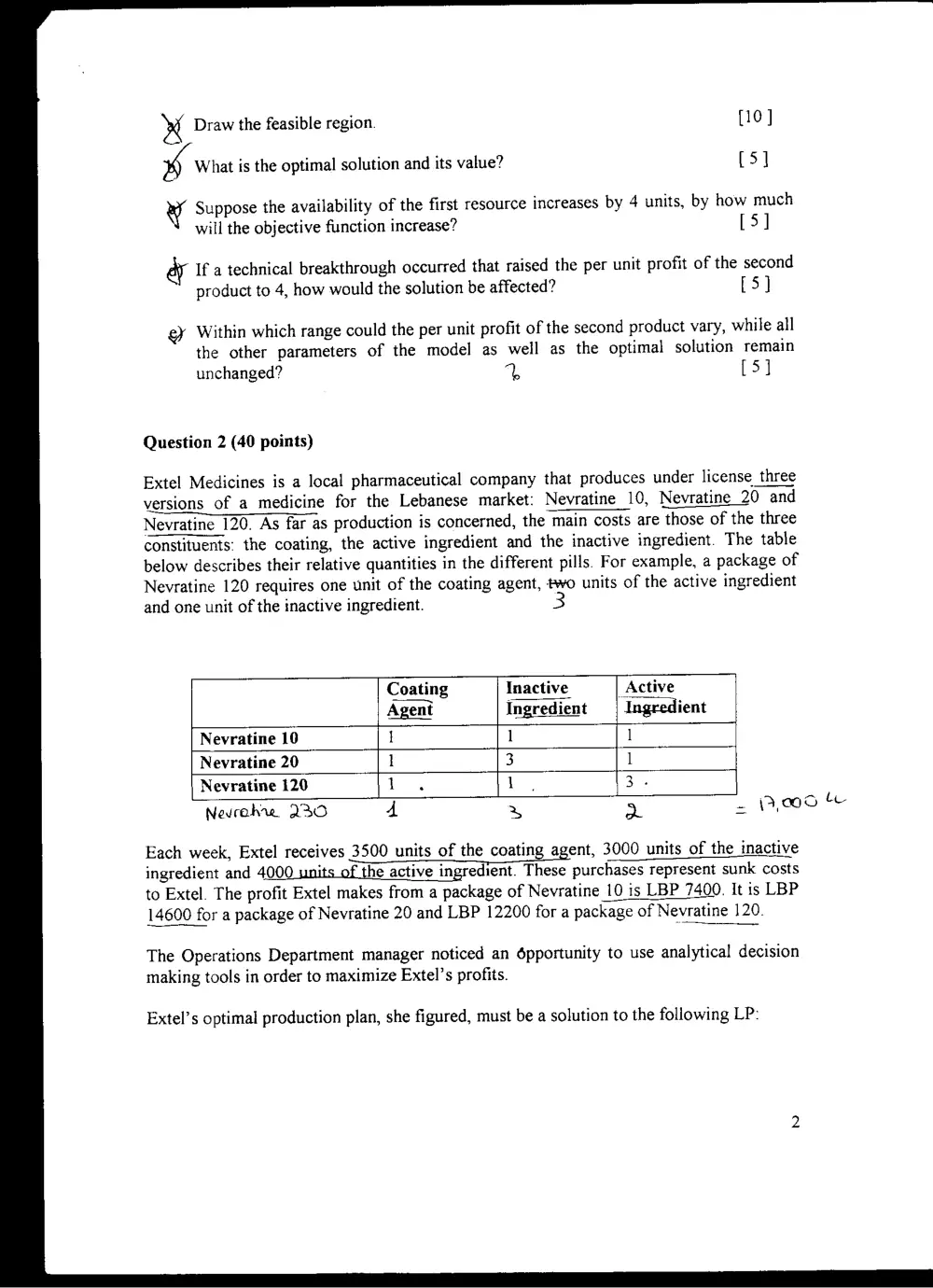
x Draw the feasible region.
# What is the optimal solution and its value? 5]
yw Suppose the availability of the first resource increases by 4 units, by how much
will the objective function increase? 5]
If a technical breakthrough occurred that raised the per unit profit of the second
product to 4, how would the solution be affected? 5]
ey Within which range could the per unit profit of the second product vary, while all
the other parameters of the model as well as the optimal solution remain
unchanged? % 5]
Question 2 (40 points)
Extel Medicines is a local pharmaceutical company that produces under license three
versions of a medicine for the Lebanese market: Nevratine 10, Nevratine 20 and
Nevratine 120. As far as production is concerned, the main costs are those of the three
constituents: the coating, the active ingredient and the inactive ingredient. The table
below describes their relative quantities in the different pills. For example, a package of
Nevratine 120 requires one unit of the coating agent, two units of the active ingredient
and one unit of the inactive ingredient. 3
Coating Inactive Active
Agent Ingredient | Ingredient
Nevratine 10 1 1 1
Nevratine 20 1 3 1
Nevratine 120 1. 1. 3.
Nevraha 230 4 x Q 9,000 &
Each week, Extel receives 3500 units of the coating agent, 3000 units of the inactive
ingredient and 4000 units of the active ingredient. These purchases represent sunk costs
to Extel. The profit Extel makes from a package of Nevratine 10 is LBP 7400. It is LBP
14600 for a package of Nevratine 20 and LBP 12200 for a package of Nevratine 120.
The Operations Department manager noticed an é6pportunity to use analytical decision
making tools in order to maximize Extel’s profits.
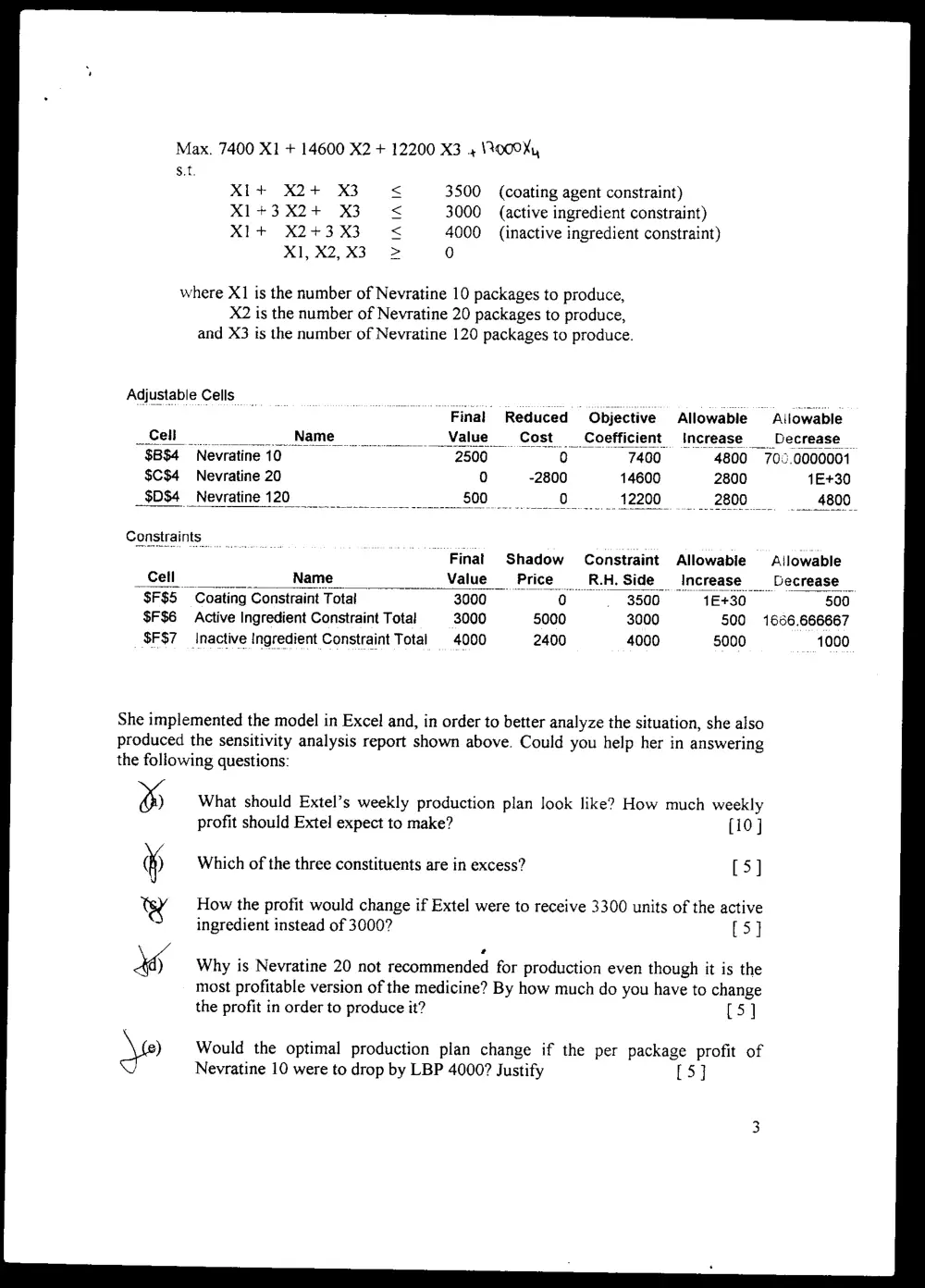
Extel’s optimal production plan, she figured, must be a solution to the following LP:
Max. 7400 X1 + 14600 X2 + 12200 X3 4 ook,
$.t.
XI+ X2+ X3
X1+3X2+ x3
XI+ X2+3X3
X1, X2, X3
3500 (coating agent constraint)
3000 (active ingredient constraint)
4000 (inactive ingredient constraint)
0
IVIAIAIA
where X1 is the number of Nevratine 10 packages to produce,
X2 is the number of Nevratine 20 packages to produce,
and X3 is the number of Nevratine 120 packages to produce.
Adjustable Cells a a
Allowable Atilowable
Increase __ Decrease _
4800 70%.0000001
2800 1E+30
2800 4800
Final Reduced Objective
Name Value Cost___ Coefficient
$B$4 Nevratine 10 2500 0
$C$4_Nevratine 20 0 -2800
$D$4__Nevratine 120 500 _ 0)
Cell
Name ficient
7460
14600
0 12200
Constraints a _
Finat Shadow Constraint Allowabie Ailowable
Value Price -R.H. Side Increase.
3000 0 3500
3000 5000 3000
4000 2400 4000
Cel Name _
$F$5 Coating Constraint Total
$F$6 Active Ingredient Constraint Total
$F$7 Inactive Ingredient Constraint Total
1E+30
500 1686.666667
5000 1000
She implemented the model in Excel and, in order to better analyze the situation, she also
produced the sensitivity analysis report shown above. Could you help her in answering
the following questions:
What should Extel’s weekly production plan look like? How much weekly
profit should Extel expect to make?
Which of the three constituents are in excess?
[10 ]
[5]
How the profit would change if Extel were to receive 3300 units of the active
ingredient instead of 3000? [5]
Why is Nevratine 20 not recommended for production even though it is the
most profitable version of the medicine? By how much do you have to change
the profit in order to produce it?
[5]
Would the optimal production plan change if the per package profit of
Nevratine 10 were to drop by LBP 4000? Justify [5]
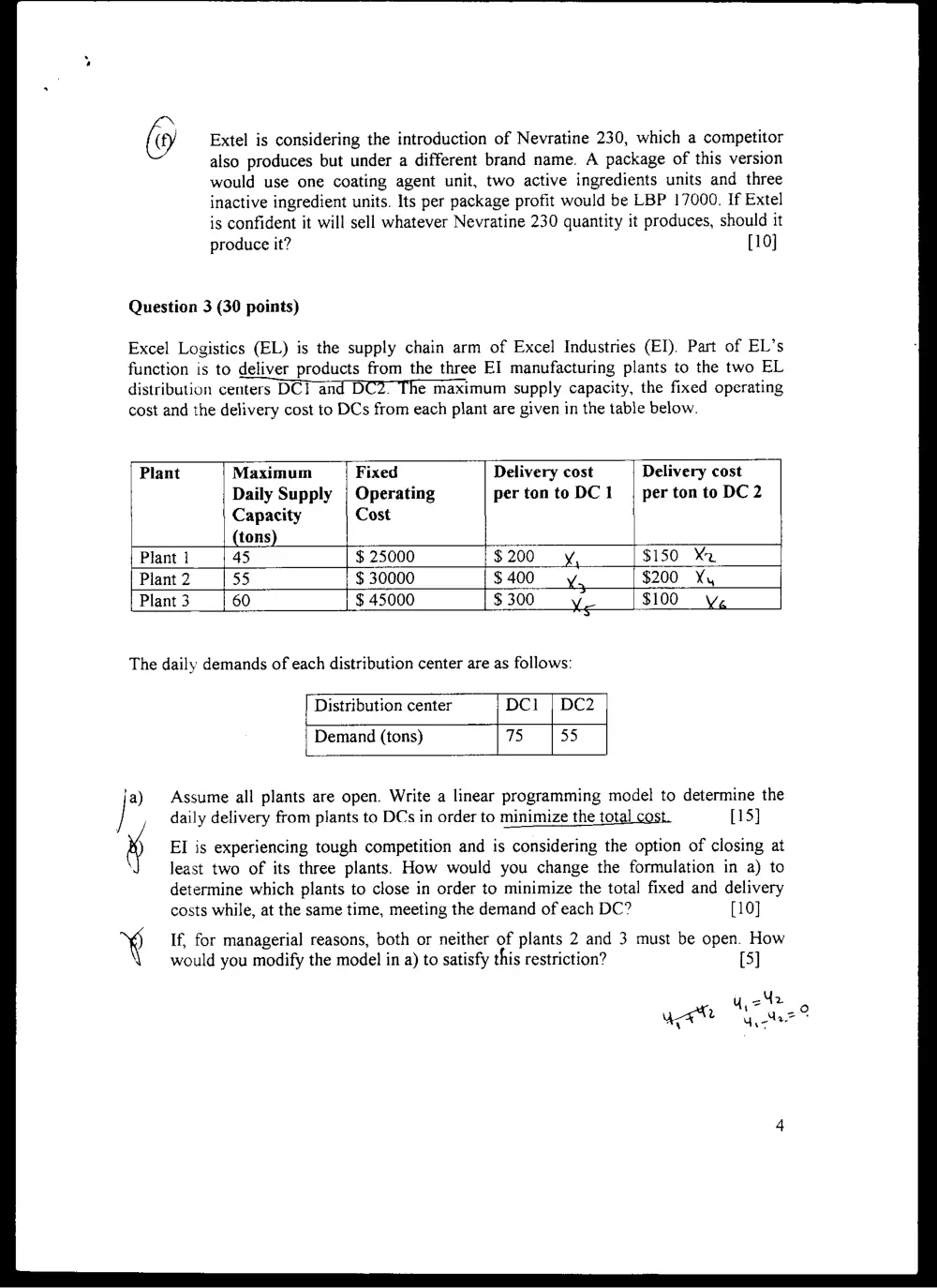
Extel is considering the introduction of Nevratine 230, which a competitor
also produces but under a different brand name. A package of this version
would use one coating agent unit, two active ingredients units and three
inactive ingredient units. Its per package profit would be LBP 17000. If Extel
is confident it will sell whatever Nevratine 230 quantity it produces, should it
produce it? [10]
Question 3 (30 points)
Excel Logistics (EL) is the supply chain arm of Excel Industries (EI). Part of EL’s
function is to deliver products from the three EI manufacturing plants to the two EL
distribution centers DCT and DC2. The maximum supply capacity, the fixed operating
cost and the delivery cost to DCs from each plant are given in the table below.
Maximum Fixed Delivery cost Delivery cost
Daily Supply | Operating pertontoDC1! | per ton to DC 2
Capacity Cost
(tons)
Plant 1 45 $ 25000 $200 y, $150 Xe
Plant 2 55 $ 30000 $400 4 $200 Xy
Plant 3 60 $ 45000 $ 300 Ye $100 va
The daily demands of each distribution center are as follows:
Distribution center DC! | DC2
Demand (tons) 75 55
Assume all plants are open. Write a linear programming model to determine the
daily delivery from plants to DCs in order to minimize the total cost. [15]
EI is experiencing tough competition and is considering the option of closing at
least two of its three plants. How would you change the formulation in a) to
determine which plants to close in order to minimize the total fixed and delivery
costs while, at the same time, meeting the demand of each DC? [10]
If, for managerial reasons, both or neither of plants 2 and 3 must be open. How
would you modify the model in a) to satisfy this restriction? [5]
u, oz
cat 4 ane e