
DCSN 200 Midterm, Fall 2009
American University of Beirut · Managerial Decision Making · 11 pages


Showing the first 10 of 11 pages. Download the PDF to see all of it.
More DCSN 200 files
Show the text of this exam
Page 1 of 11
AMERICAN UNIVERSITY OF BEIRUT
SULIMAN OLAYAN SCHOOL OF BUSINESS
DCSN 200: OPERATIONS MANAGEMENT
MIDTERM EXAM
November 30, 2009
7:00 PM – 9:00 PM
NAME
_______________________________________________
STUDENT ID _______________________________________________
SECTION _______________________________________________
INSTRUCTOR _______________________________________________
This exam is administered in full observance of the Olayan School of Business Honor Code and
the penalties it sets for violations of the standard of academic conduct. You are required to fully
understand the code and to strongly adhere to it. In particular, cellular telephones, and
computers of any shape or size are not allowed. No questions, no comments, no borrowing and
no disturbance of the peace of any kind will be permitted or tolerated. You are required to stop
working on the exam and hand it immediately when a proctor instructs you to do so. Any
cheating or attempted cheating will subject the offender to a zero on the exam and a referral to
the Student Affairs Committee for further penalties.
You have 2 hours to complete the exam. You can answer questions in any order.
Your understanding of the questions is part of the exam. No questions will be answered
by instructors. If in doubt, write your assumptions and continue solving.
Do not start the exam (do not turn to the next page) until instructed to do so.
When you start the exam, make sure that your exam paper has 11 pages.
o “I vow to complete the exam on my own without giving or receiving help from anyone
and to adhere to the academic integrity standards reflected in the AUB student code of
conduct”
SIGNATURE _______________________________________________
Page 2 of 11
PART I. MULTIPLE CHOICE QUESTIONS (15 points)
CIRCLE THE MOST APPROPRIATE ANSWER
1.
Circle the correct statement:
a. You expect a continuous process to have a low utilization because volume is large
b. A continuous process can afford to have a high utilization because variety is low
c. You expect a process focus to have a moderate utilization because volume is low
d. A steel production facility is an example of a repetitive process
2.
Mass Customization:
a. Are Facilities designed to mass produce: Example: car manufacturing
b. Is Another name for process focused: Example Major retail stores such as
Walmart
c. Are Facilities designed to assemble large volume with high variety: Computer
manufacturer such as Dell
d. Are facilities that make-to-order
3.
Hospitals are:
a. Professional services
b. Mass services
c. Service shops
d. Service factories
4.
We expect a product in its early growth period to be produced using
a. Mass customization
b. Repetitive focused facilities
c. Process focused facilities
d. Product focused facilities
5.
A company is planning to start producing a new product. The product will have a price
of $20 per unit. Machine A has fixed cost of $2,000 and variable cost of $5. Machine
B has fixed cost of $3,000 and variable cost of $10
a. Machine A should be chosen for volumes less than or equal to 200 and machine B
should be chosen for higher volumes.
b. Machine B is better for all possible volumes.
c. Machine B should never be chosen.
d. The two machines cannot be compared based on the available data.
e. Neither of the two machines should be chosen. They are both too expensive for
the production to break-even.
Page 3 of 11
6.
Which of the following process analysis techniques divides activities into operations,
transportations, inspections, delays, and storage?
a. Flow diagram
b. Time-function mapping
c. Value-stream mapping
d. Process chart
e. Service blueprinting
7.
“Sensors are used to measure temperature, pressure, and volume of liquids in several
tanks in a chemical processing facility. The measurements are displayed on a computer
screen.” This describes a(n)
a. Automatic identification system
b. Flexible manufacturing system
c. Computer-integrated manufacturing system
d. Process control system
e. Virtual reality system
8.
Which of the following transformations generally has the highest equipment
utilization?
a. process-focused process
b. repetitive process
c. product-focused process
d. specialized process
e. modular process
9.
Job A requires 5 days of work and is due in 4 days, job B requires 4 days of work and
is due in 3 days, and job C requires 3 days of work and is due on 2 days. If the critical
ratio rule is used, which job should be scheduled first
a. Job A
b. Job B
c. Job C
d. None of the jobs, because they are all late.
e. Any of the jobs, because they are all late.
10.
Productivity can be improved by
a.
increasing inputs while holding outputs steady
b.
decreasing outputs while holding inputs steady
c.
increasing inputs and outputs in the same proportion
d.
decreasing inputs while holding outputs steady
e.
none of the above
11. Gibson Valves produces cast bronze valves on an assembly line, currently producing
1600 valves per shift. If the production is increased to 2000 valves per shift, labor
productivity will increase by:
a. 10%
b. 20%
c. 25%
d. 40%
e. 50%
Page 4 of 11
12.
If demand exceeds capacity at a new facility, an organization can use which of the
following to move demand to an existing facility
a. aggressive marketing
b. lower prices at all facilities
c. build a facility of the correct size
d. add a complementary product
e. reduce lead times
13. Process A has fixed costs of $1000 and variable costs of $5 per unit. Process B has fixed
costs of $500 and variable costs of $15 per unit. The crossover point between process
A and process B is
a. 50 units
b. 200 units
c. $2,500
d. $5,000
e. $9,500
14. Among the ethical and social challenges facing operations managers
a. honoring community commitments
b. maintaining a clean environment
c. efficiently developing and producing safe quality products
d. providing a safe workplace
e. all of the above
15. The use of information technology to monitor and control a physical process is known as
a.
process control
b.
computer-aided design
c.
information numeric control
d.
numeric control
e.
none of the above
Page 5 of 11
PART II
Write your answers in the spaces provided. Be concise and follow the instructions closely. If
you run out of space, continue on the back of the previous page, but indicate this fact clearly.
Question 1 (7 points)
Michael’s Engineering, Inc. manufactures components for the ever-changing notebook
computer business. He is considering moving from a small custom design facility to an
operation capable of much more rapid design of components. This means that Michael must
consider upgrading his CAD equipment. Option 1 is to purchase two new desktop CAD
systems at $100,000 each. Option 2 is to purchase an integrated system and the related server at
$500,000. Michael’s sales manager has estimated that if the market for notebook computers
continues to expand, sales over the life of either system will be $1,000,000. He places the odds
of this happening at 40%. He thinks the likelihood of the market having already peaked to be
60% and future sales in this case to be only $700,000. What do you suggest Michael do and
what is the EMV of this decision?
Page 6 of 11
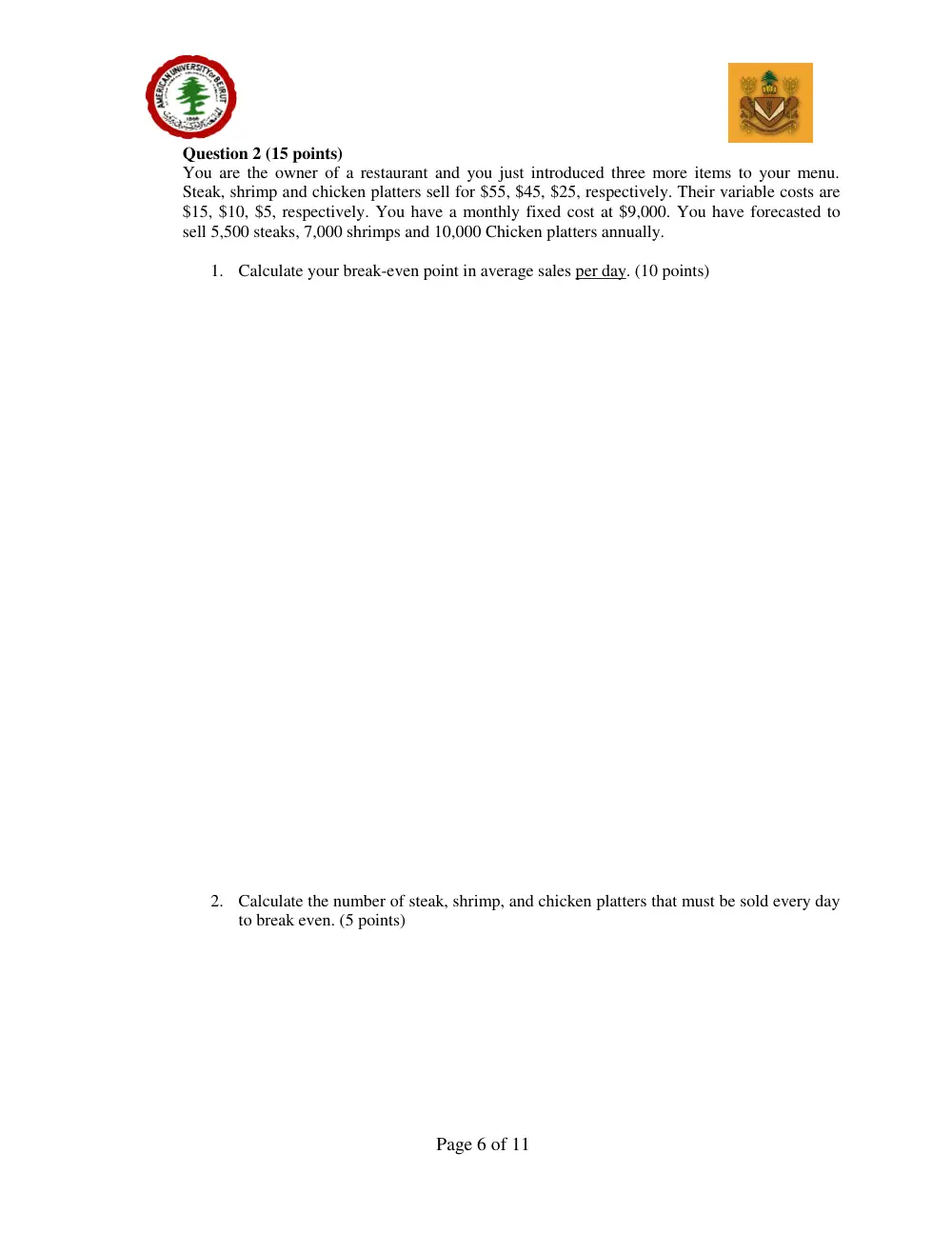
Question 2 (15 points)
You are the owner of a restaurant and you just introduced three more items to your menu.
Steak, shrimp and chicken platters sell for $55, $45, $25, respectively. Their variable costs are
$15, $10, $5, respectively. You have a monthly fixed cost at $9,000. You have forecasted to
sell 5,500 steaks, 7,000 shrimps and 10,000 Chicken platters annually.
1. Calculate your break-even point in average sales per day. (10 points)
2. Calculate the number of steak, shrimp, and chicken platters that must be sold every day
to break even. (5 points)
Page 7 of 11
Question 3 (20points)
Bob Dresser operates a major appliance warranty service center. His operation has two
inspection stations that are required at the end of every repair task performed by his appliance
repair staff. These are the Functionality Review (FR) and the Overall Scan (OS). The FR must
be performed successfully before the OS is begun.
It is now Friday, 3pm, and five repair jobs, listed in the table, are awaiting inspections.
Processing times are given in minutes. Bob would like to perform the inspections as quickly as
possible and go home.
1. In what sequence should the jobs be processed? (4 Points)
2. At what time will Bob be able to go home? (4 Points)
3. How much idle time will there be on the FR station and how much on the OS station?(4
Points)
4. Which jobs will be inspected at 3:45pm? (3 Points)
5. Assume that the OS inspection of job E takes 5 minutes longer. Would that change the
sequence of processing jobs? How much longer will Bob have to stay at work? Justify
your answer. (5 Points)
Job FR OS
A
20
5
B
8
12
C
3
6
D
14
16
E
10
6
Page 8 of 11
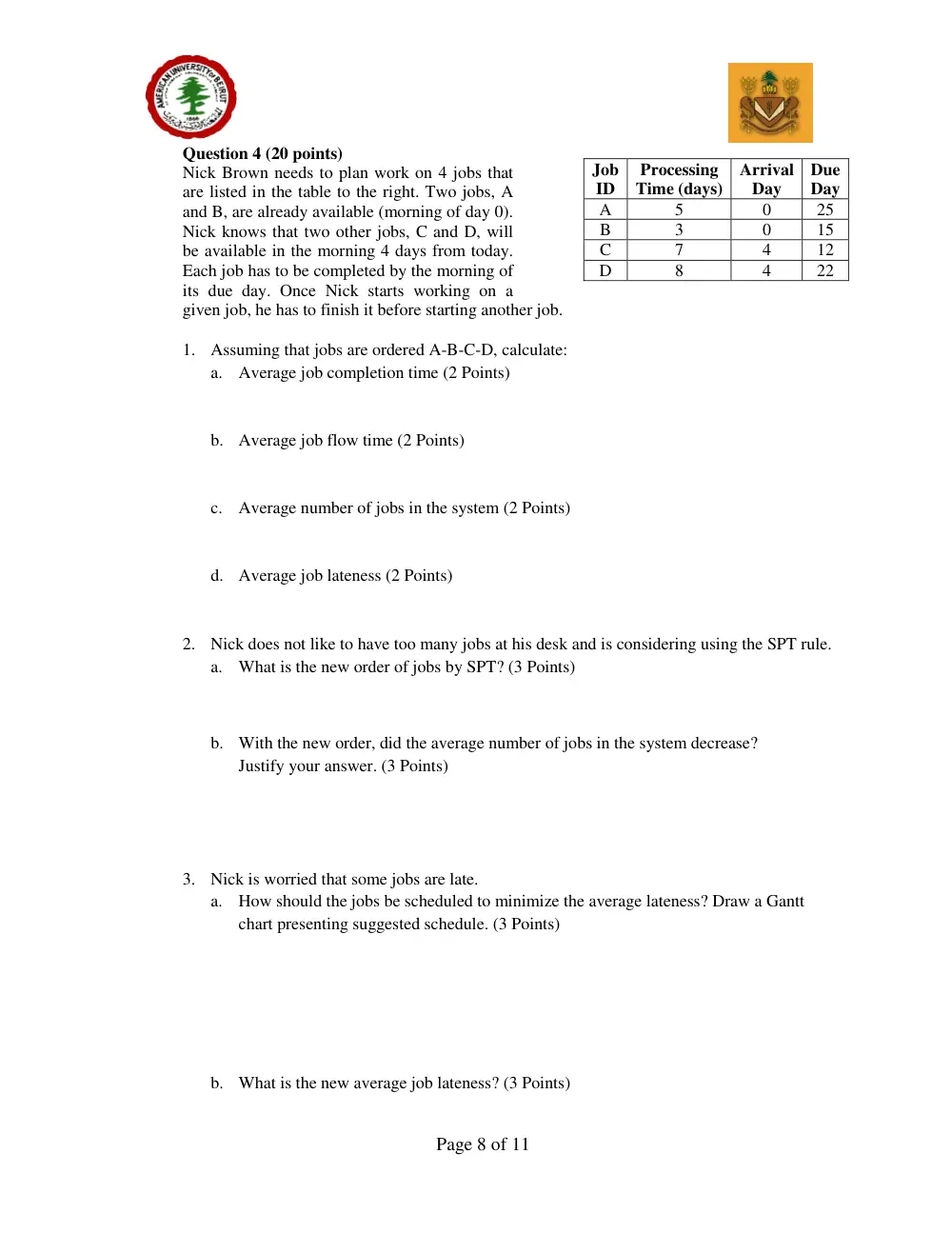
Question 4 (20 points)
Nick Brown needs to plan work on 4 jobs that
are listed in the table to the right. Two jobs, A
and B, are already available (morning of day 0).
Nick knows that two other jobs, C and D, will
be available in the morning 4 days from today.
Each job has to be completed by the morning of
its due day. Once Nick starts working on a
given job, he has to finish it before starting another job.
1. Assuming that jobs are ordered A-B-C-D, calculate:
a. Average job completion time (2 Points)
b. Average job flow time (2 Points)
c. Average number of jobs in the system (2 Points)
d. Average job lateness (2 Points)
2. Nick does not like to have too many jobs at his desk and is considering using the SPT rule.
a. What is the new order of jobs by SPT? (3 Points)
b. With the new order, did the average number of jobs in the system decrease?
Justify your answer. (3 Points)
3. Nick is worried that some jobs are late.
a. How should the jobs be scheduled to minimize the average lateness? Draw a Gantt
chart presenting suggested schedule. (3 Points)
b. What is the new average job lateness? (3 Points)
Job
ID
Processing
Time (days)
Arrival
Day
Due
Day
A
5
0
25
B
3
0
15
C
7
4
12
D
8
4
22
Page 9 of 11
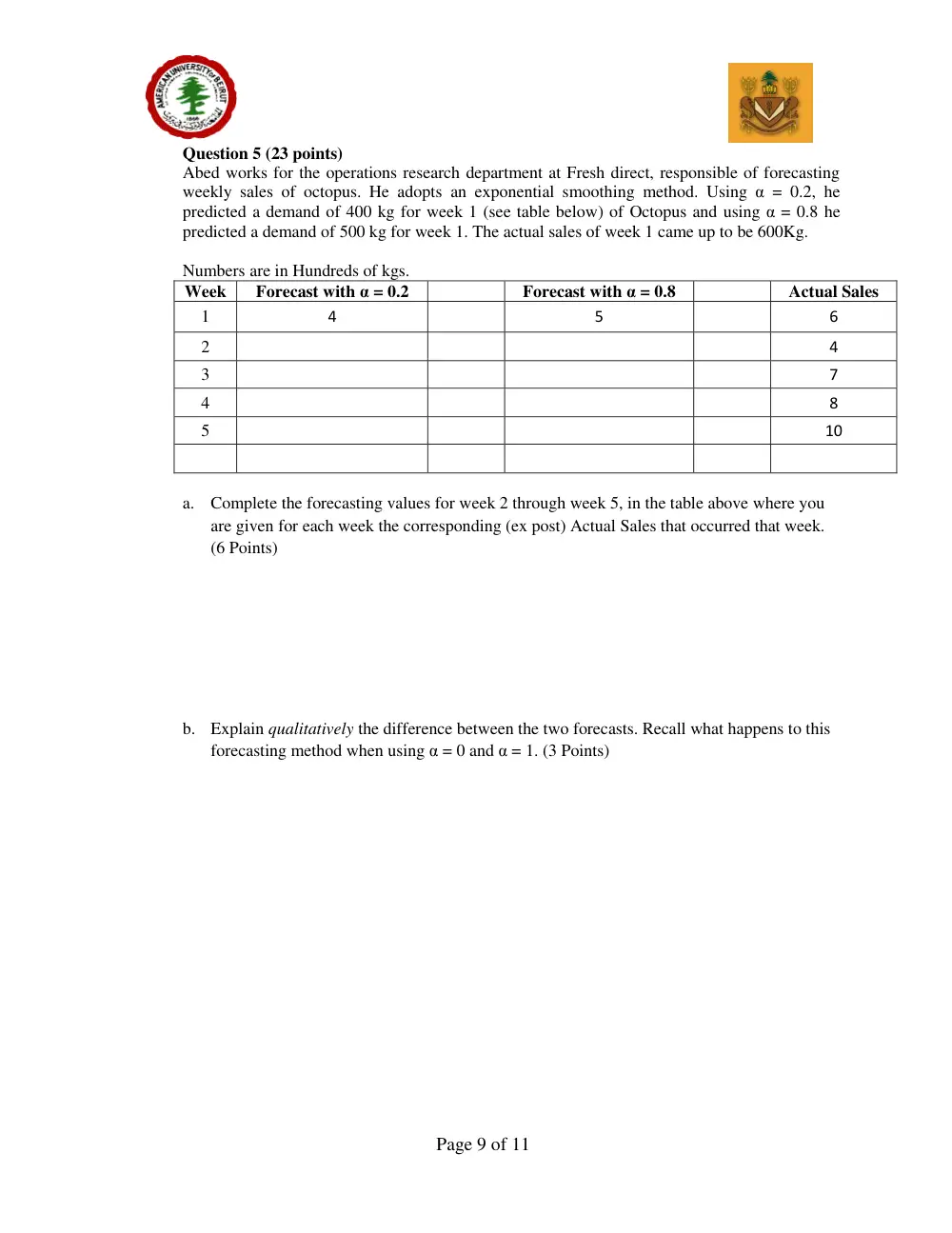
Question 5 (23 points)
Abed works for the operations research department at Fresh direct, responsible of forecasting
weekly sales of octopus. He adopts an exponential smoothing method. Using α = 0.2, he
predicted a demand of 400 kg for week 1 (see table below) of Octopus and using α = 0.8 he
predicted a demand of 500 kg for week 1. The actual sales of week 1 came up to be 600Kg.
Numbers are in Hundreds of kgs.
Week
Forecast with α = 0.2
Forecast with α = 0.8
Actual Sales
1
4
5
6
2
4
3
7
4
8
5
10
a. Complete the forecasting values for week 2 through week 5, in the table above where you
are given for each week the corresponding (ex post) Actual Sales that occurred that week.
(6 Points)
b. Explain qualitatively the difference between the two forecasts. Recall what happens to this
forecasting method when using α = 0 and α = 1. (3 Points)
Page 10 of 11
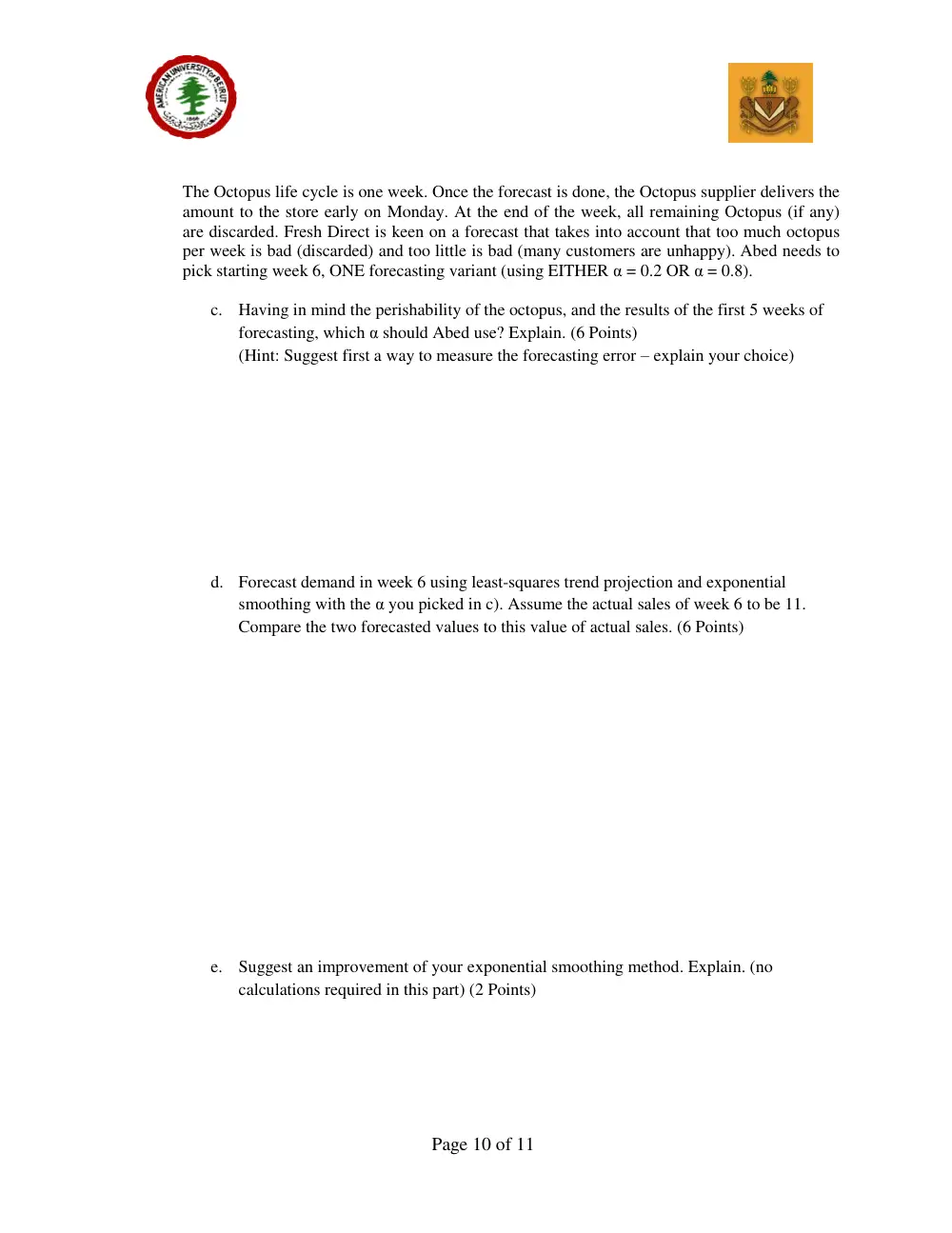
The Octopus life cycle is one week. Once the forecast is done, the Octopus supplier delivers the
amount to the store early on Monday. At the end of the week, all remaining Octopus (if any)
are discarded. Fresh Direct is keen on a forecast that takes into account that too much octopus
per week is bad (discarded) and too little is bad (many customers are unhappy). Abed needs to
pick starting week 6, ONE forecasting variant (using EITHER α = 0.2 OR α = 0.8).
c. Having in mind the perishability of the octopus, and the results of the first 5 weeks of
forecasting, which α should Abed use? Explain. (6 Points)
(Hint: Suggest first a way to measure the forecasting error – explain your choice)
d. Forecast demand in week 6 using least-squares trend projection and exponential
smoothing with the α you picked in c). Assume the actual sales of week 6 to be 11.
Compare the two forecasted values to this value of actual sales. (6 Points)
e. Suggest an improvement of your exponential smoothing method. Explain. (no
calculations required in this part) (2 Points)
Page 11 of 11
Formula Sheet: