
ECON 211 Final Sample, Summer 2011
American University of Beirut · Elementary Microeconomics Theory · 31 pages
Showing the first 10 of 31 pages. Download the PDF to see all of it.
More ECON 211 files
- Notes COURSE SUMMARY ECON 211 FOR FINAL · Fall 2017Final examView
- Final Moodle Exam · Summer 2008Final examView
- Final · Spring 2003Final examView
- Midterm · Spring 2019ExamView
- Useful File Previouses · Fall 2018FileView
- Useful File Test Banks Version 1 · Spring 2016FileView
- Useful File Test Banks Version 2 · Spring 2016FileView
- Lecture Chapter Five · Spring 2015LabView
Show the text of this final exam
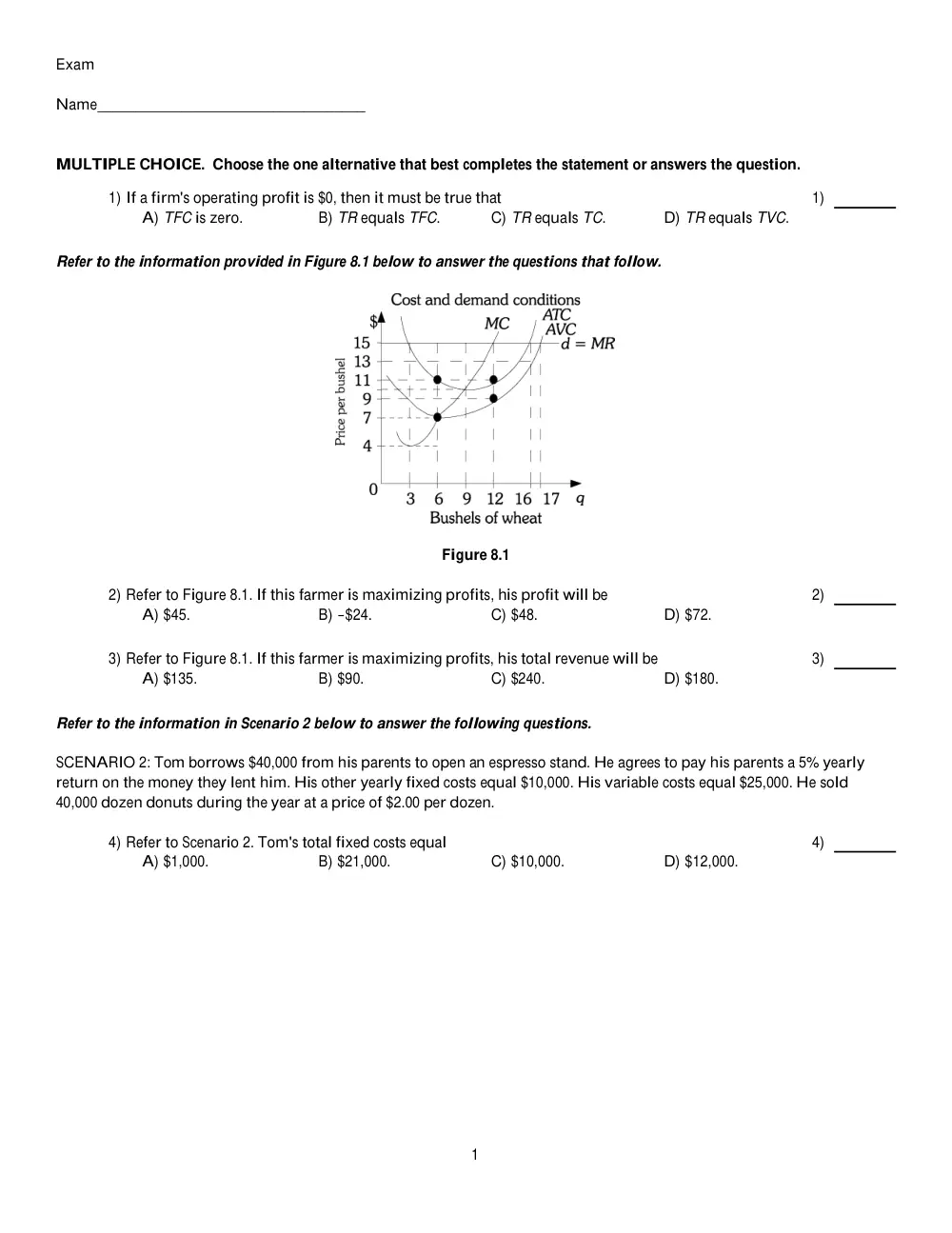
Exam
Name___________________________________
MULTIPLE CHOICE. Choose the one alternative that best completes the statement or answers the question.
1) If a firm's operating profit is $0, then it must be true that
1)
A) TFC is zero.
B) TR equals TFC.
C) TR equals TC.
D) TR equals TVC.
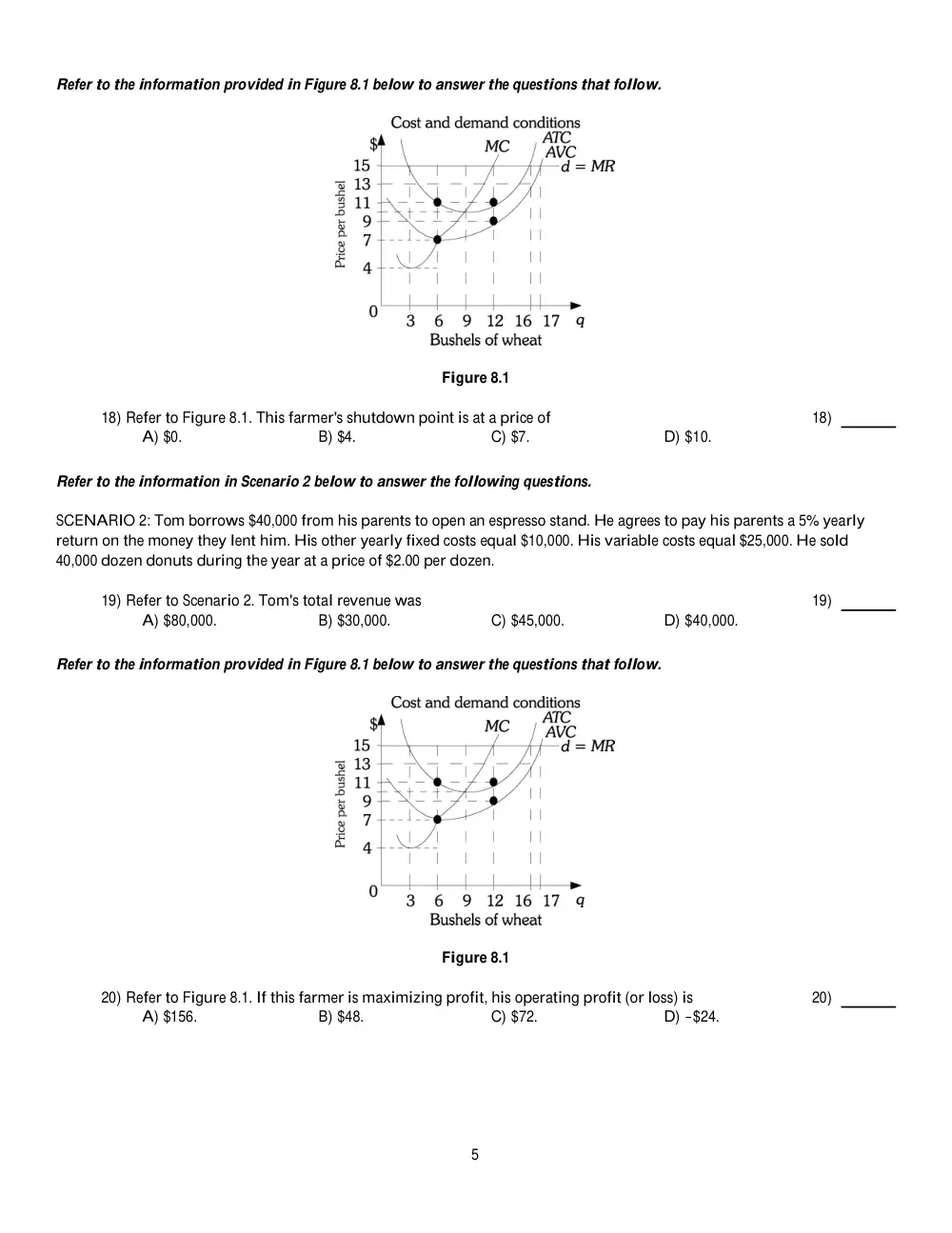
Refer to the information provided in Figure 8.1 below to answer the questions that follow.
Figure 8.1
2) Refer to Figure 8.1. If this farmer is maximizing profits, his profit will be
2)
A) $45.
B) -$24.
C) $48.
D) $72.
3) Refer to Figure 8.1. If this farmer is maximizing profits, his total revenue will be
3)
A) $135.
B) $90.
C) $240.
D) $180.
Refer to the information in Scenario 2 below to answer the following questions.
SCENARIO 2: Tom borrows $40,000 from his parents to open an espresso stand. He agrees to pay his parents a 5% yearly
return on the money they lent him. His other yearly fixed costs equal $10,000. His variable costs equal $25,000. He sold
40,000 dozen donuts during the year at a price of $2.00 per dozen.
4) Refer to Scenario 2. Tom's total fixed costs equal
4)
A) $1,000.
B) $21,000.
C) $10,000.
D) $12,000.
1
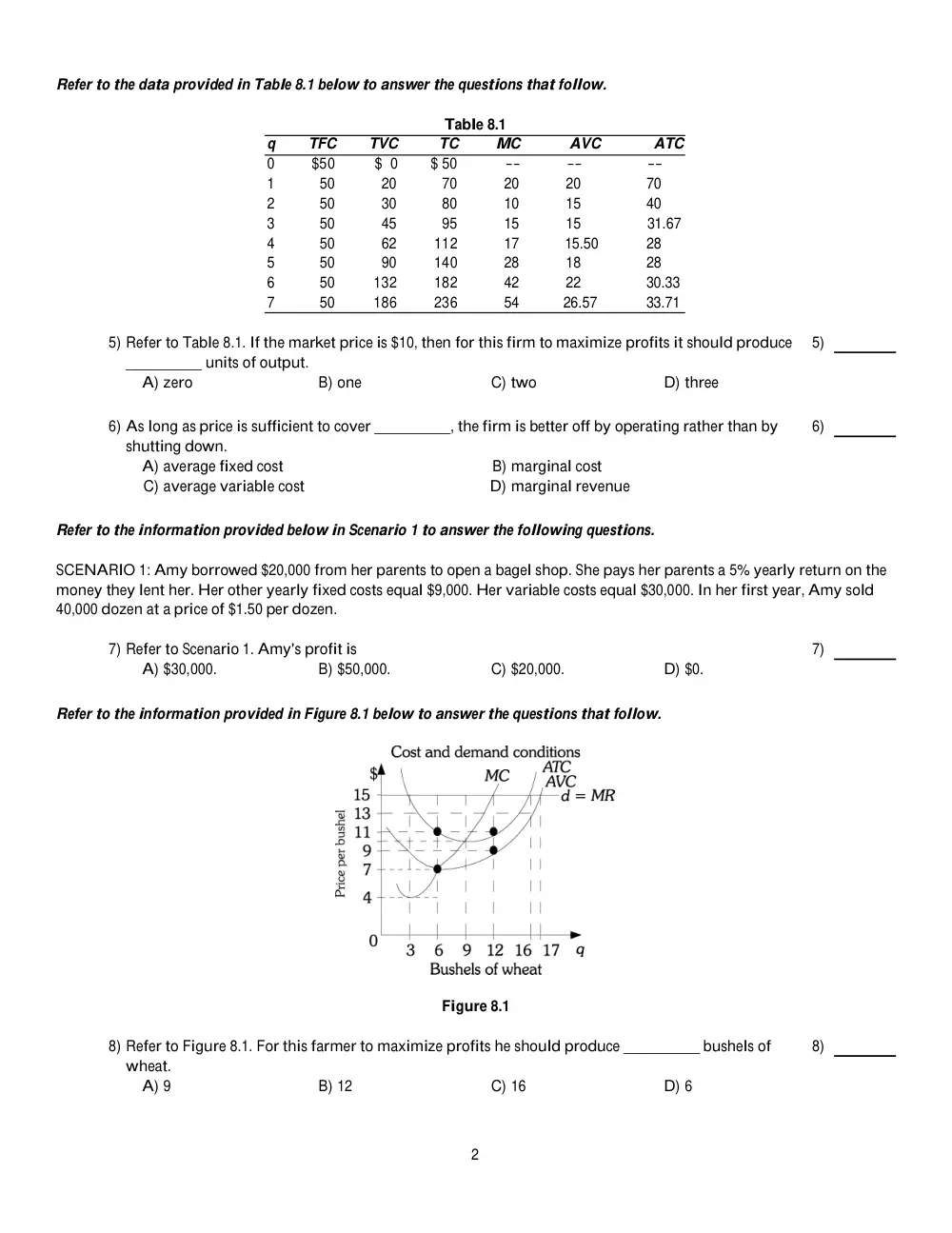
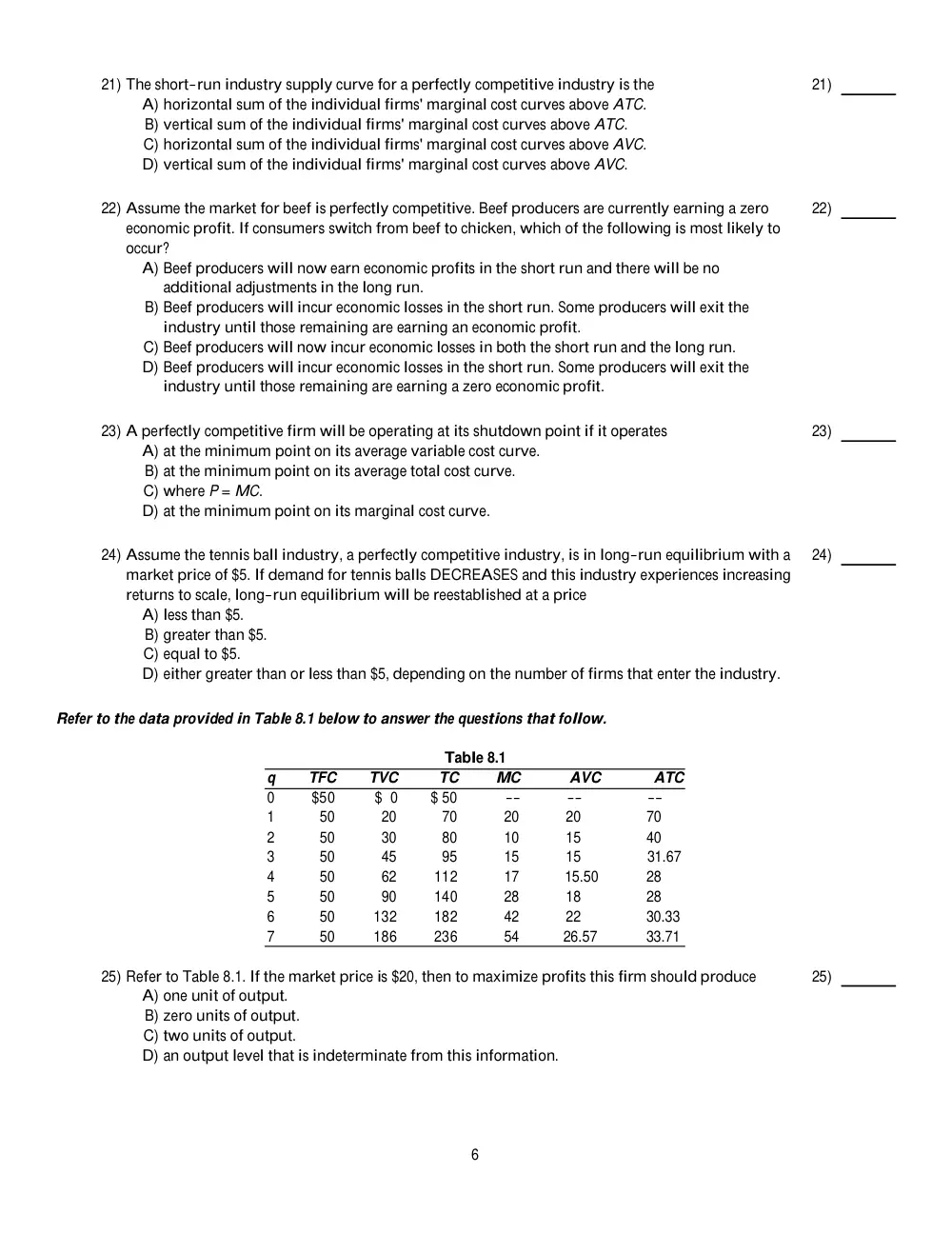
Refer to the data provided in Table 8.1 below to answer the questions that follow.
Table 8.1
q
TFC
TVC
TC
MC
AVC
ATC
0
1
2
3
4
5
6
7
$50
50
50
50
50
50
50
50
$ 0
20
30
45
62
90
132
186
$ 50
70
80
95
112
140
182
236
--
20
10
15
17
28
42
54
--
20
15
15
15.50
18
22
26.57
--
70
40
31.67
28
28
30.33
33.71
5) Refer to Table 8.1. If the market price is $10, then for this firm to maximize profits it should produce
__________ units of output.
5)
A) zero
B) one
C) two
D) three
6) As long as price is sufficient to cover __________, the firm is better off by operating rather than by
shutting down.
6)
A) average fixed cost
B) marginal cost
C) average variable cost
D) marginal revenue
Refer to the information provided below in Scenario 1 to answer the following questions.
SCENARIO 1: Amy borrowed $20,000 from her parents to open a bagel shop. She pays her parents a 5% yearly return on the
money they lent her. Her other yearly fixed costs equal $9,000. Her variable costs equal $30,000. In her first year, Amy sold
40,000 dozen at a price of $1.50 per dozen.
7) Refer to Scenario 1. Amy's profit is
7)
A) $30,000.
B) $50,000.
C) $20,000.
D) $0.
Refer to the information provided in Figure 8.1 below to answer the questions that follow.
Figure 8.1
8) Refer to Figure 8.1. For this farmer to maximize profits he should produce __________ bushels of
wheat.
8)
A) 9
B) 12
C) 16
D) 6
2
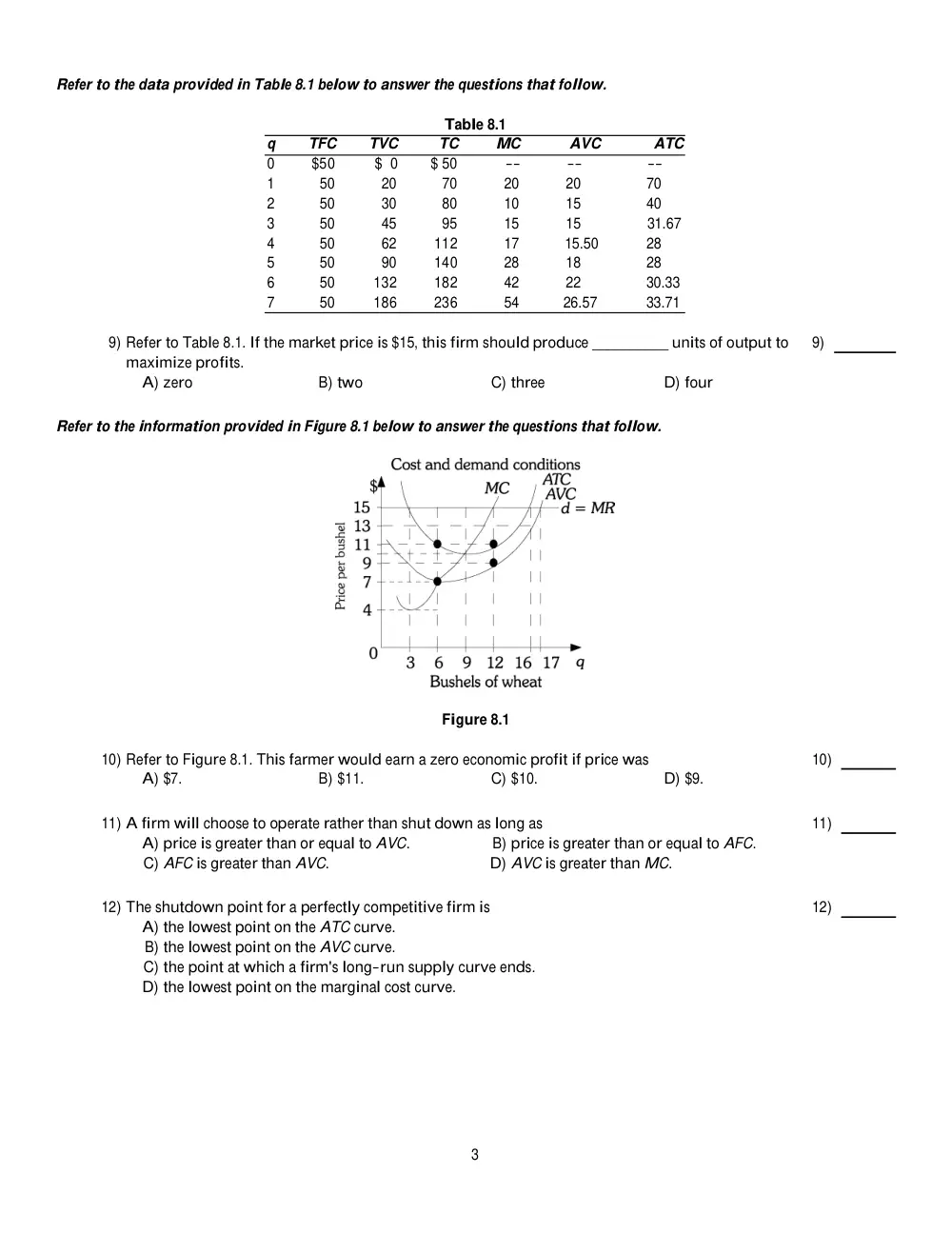
Refer to the data provided in Table 8.1 below to answer the questions that follow.
Table 8.1
q
TFC
TVC
TC
MC
AVC
ATC
0
1
2
3
4
5
6
7
$50
50
50
50
50
50
50
50
$ 0
20
30
45
62
90
132
186
$ 50
70
80
95
112
140
182
236
--
20
10
15
17
28
42
54
--
20
15
15
15.50
18
22
26.57
--
70
40
31.67
28
28
30.33
33.71
9) Refer to Table 8.1. If the market price is $15, this firm should produce __________ units of output to
maximize profits.
9)
A) zero
B) two
C) three
D) four
Refer to the information provided in Figure 8.1 below to answer the questions that follow.
Figure 8.1
10) Refer to Figure 8.1. This farmer would earn a zero economic profit if price was
10)
A) $7.
B) $11.
C) $10.
D) $9.
11) A firm will choose to operate rather than shut down as long as
11)
A) price is greater than or equal to AVC.
B) price is greater than or equal to AFC.
C) AFC is greater than AVC.
D) AVC is greater than MC.
12) The shutdown point for a perfectly competitive firm is
12)
A) the lowest point on the ATC curve.
B) the lowest point on the AVC curve.
C) the point at which a firm's long-run supply curve ends.
D) the lowest point on the marginal cost curve.
3
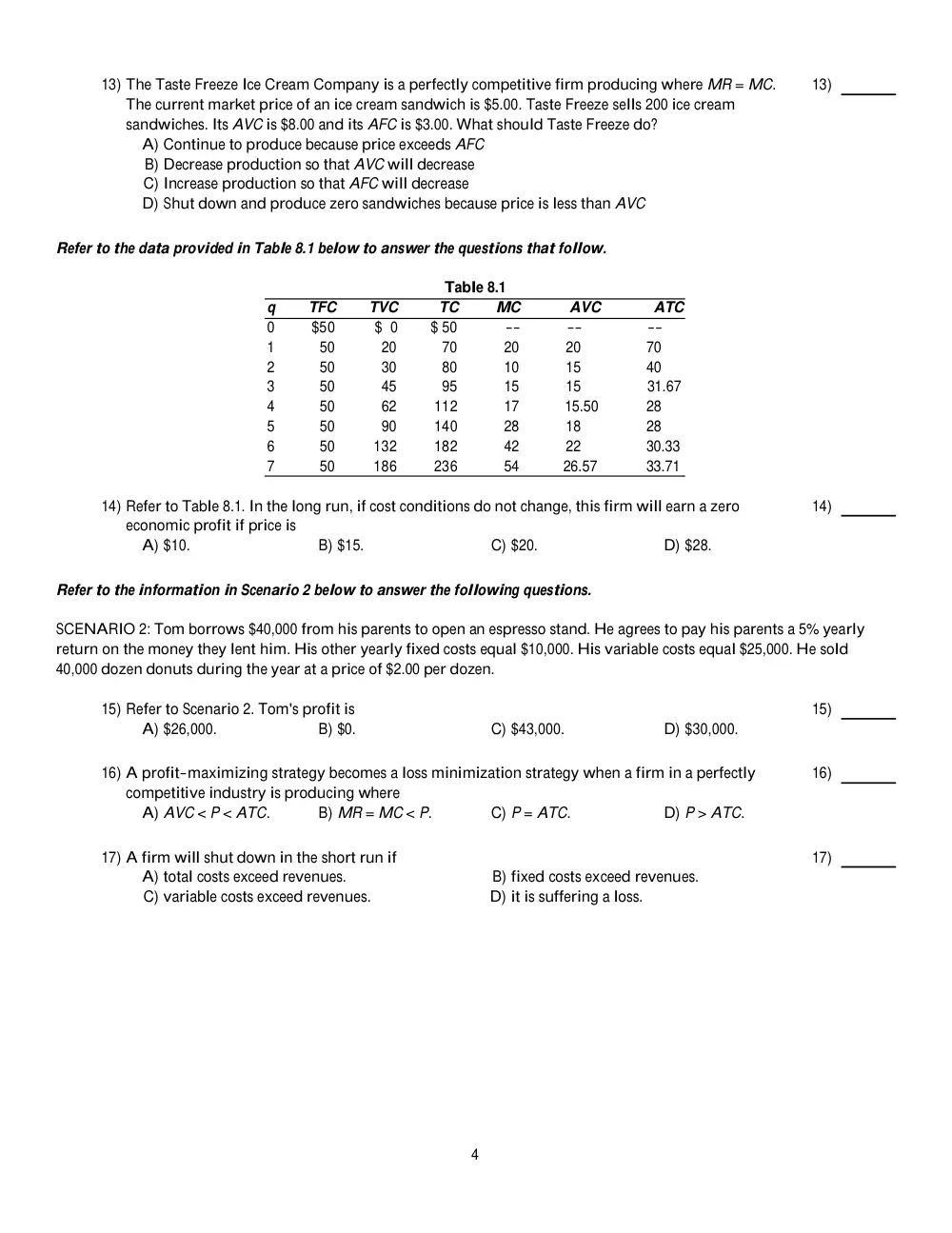
13) The Taste Freeze Ice Cream Company is a perfectly competitive firm producing where MR = MC.
The current market price of an ice cream sandwich is $5.00. Taste Freeze sells 200 ice cream
sandwiches. Its AVC is $8.00 and its AFC is $3.00. What should Taste Freeze do?
13)
A) Continue to produce because price exceeds AFC
B) Decrease production so that AVC will decrease
C) Increase production so that AFC will decrease
D) Shut down and produce zero sandwiches because price is less than AVC
Refer to the data provided in Table 8.1 below to answer the questions that follow.
Table 8.1
q
TFC
TVC
TC
MC
AVC
ATC
0
1
2
3
4
5
6
7
$50
50
50
50
50
50
50
50
$ 0
20
30
45
62
90
132
186
$ 50
70
80
95
112
140
182
236
--
20
10
15
17
28
42
54
--
20
15
15
15.50
18
22
26.57
--
70
40
31.67
28
28
30.33
33.71
14) Refer to Table 8.1. In the long run, if cost conditions do not change, this firm will earn a zero
economic profit if price is
14)
A) $10.
B) $15.
C) $20.
D) $28.
Refer to the information in Scenario 2 below to answer the following questions.
SCENARIO 2: Tom borrows $40,000 from his parents to open an espresso stand. He agrees to pay his parents a 5% yearly
return on the money they lent him. His other yearly fixed costs equal $10,000. His variable costs equal $25,000. He sold
40,000 dozen donuts during the year at a price of $2.00 per dozen.
15) Refer to Scenario 2. Tom's profit is
15)
A) $26,000.
B) $0.
C) $43,000.
D) $30,000.
16) A profit-maximizing strategy becomes a loss minimization strategy when a firm in a perfectly
competitive industry is producing where
16)
A) AVC < P < ATC.
B) MR = MC < P.
C) P = ATC.
D) P > ATC.
17) A firm will shut down in the short run if
17)
A) total costs exceed revenues.
B) fixed costs exceed revenues.
C) variable costs exceed revenues.
D) it is suffering a loss.
4
Refer to the information provided in Figure 8.1 below to answer the questions that follow.
Figure 8.1
18) Refer to Figure 8.1. This farmer's shutdown point is at a price of
18)
A) $0.
B) $4.
C) $7.
D) $10.
Refer to the information in Scenario 2 below to answer the following questions.
SCENARIO 2: Tom borrows $40,000 from his parents to open an espresso stand. He agrees to pay his parents a 5% yearly
return on the money they lent him. His other yearly fixed costs equal $10,000. His variable costs equal $25,000. He sold
40,000 dozen donuts during the year at a price of $2.00 per dozen.
19) Refer to Scenario 2. Tom's total revenue was
19)
A) $80,000.
B) $30,000.
C) $45,000.
D) $40,000.
Refer to the information provided in Figure 8.1 below to answer the questions that follow.
Figure 8.1
20) Refer to Figure 8.1. If this farmer is maximizing profit, his operating profit (or loss) is
20)
A) $156.
B) $48.
C) $72.
D) -$24.
5
21) The short-run industry supply curve for a perfectly competitive industry is the
21)
A) horizontal sum of the individual firms' marginal cost curves above ATC.
B) vertical sum of the individual firms' marginal cost curves above ATC.
C) horizontal sum of the individual firms' marginal cost curves above AVC.
D) vertical sum of the individual firms' marginal cost curves above AVC.
22) Assume the market for beef is perfectly competitive. Beef producers are currently earning a zero
economic profit. If consumers switch from beef to chicken, which of the following is most likely to
occur?
22)
A) Beef producers will now earn economic profits in the short run and there will be no
additional adjustments in the long run.
B) Beef producers will incur economic losses in the short run. Some producers will exit the
industry until those remaining are earning an economic profit.
C) Beef producers will now incur economic losses in both the short run and the long run.
D) Beef producers will incur economic losses in the short run. Some producers will exit the
industry until those remaining are earning a zero economic profit.
23) A perfectly competitive firm will be operating at its shutdown point if it operates
23)
A) at the minimum point on its average variable cost curve.
B) at the minimum point on its average total cost curve.
C) where P = MC.
D) at the minimum point on its marginal cost curve.
24) Assume the tennis ball industry, a perfectly competitive industry, is in long-run equilibrium with a
market price of $5. If demand for tennis balls DECREASES and this industry experiences increasing
returns to scale, long-run equilibrium will be reestablished at a price
24)
A) less than $5.
B) greater than $5.
C) equal to $5.
D) either greater than or less than $5, depending on the number of firms that enter the industry.
Refer to the data provided in Table 8.1 below to answer the questions that follow.
Table 8.1
q
TFC
TVC
TC
MC
AVC
ATC
0
1
2
3
4
5
6
7
$50
50
50
50
50
50
50
50
$ 0
20
30
45
62
90
132
186
$ 50
70
80
95
112
140
182
236
--
20
10
15
17
28
42
54
--
20
15
15
15.50
18
22
26.57
--
70
40
31.67
28
28
30.33
33.71
25) Refer to Table 8.1. If the market price is $20, then to maximize profits this firm should produce
25)
A) one unit of output.
B) zero units of output.
C) two units of output.
D) an output level that is indeterminate from this information.
6
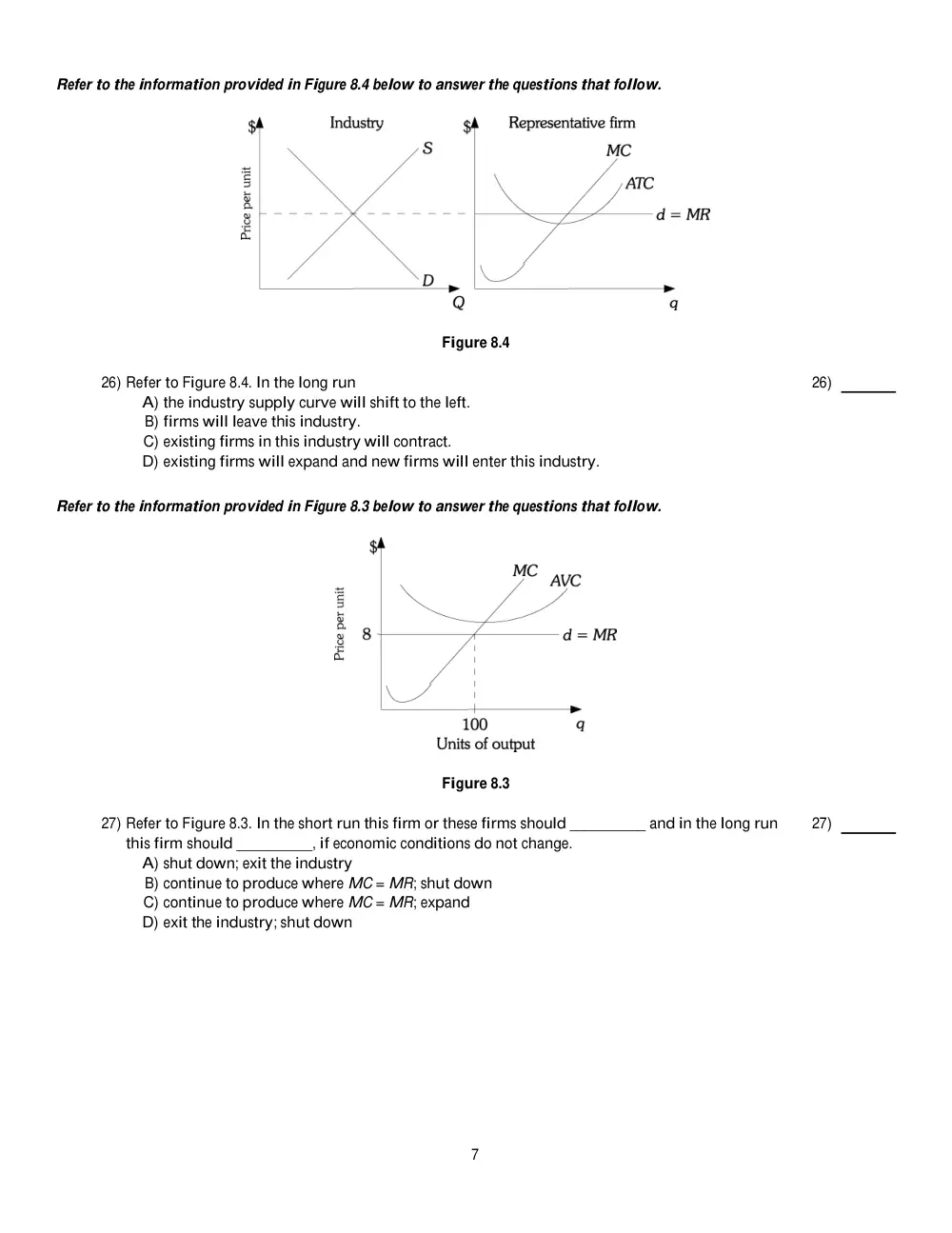
Refer to the information provided in Figure 8.4 below to answer the questions that follow.
Figure 8.4
26) Refer to Figure 8.4. In the long run
26)
A) the industry supply curve will shift to the left.
B) firms will leave this industry.
C) existing firms in this industry will contract.
D) existing firms will expand and new firms will enter this industry.
Refer to the information provided in Figure 8.3 below to answer the questions that follow.
Figure 8.3
27) Refer to Figure 8.3. In the short run this firm or these firms should __________ and in the long run
this firm should __________, if economic conditions do not change.
27)
A) shut down; exit the industry
B) continue to produce where MC = MR; shut down
C) continue to produce where MC = MR; expand
D) exit the industry; shut down
7
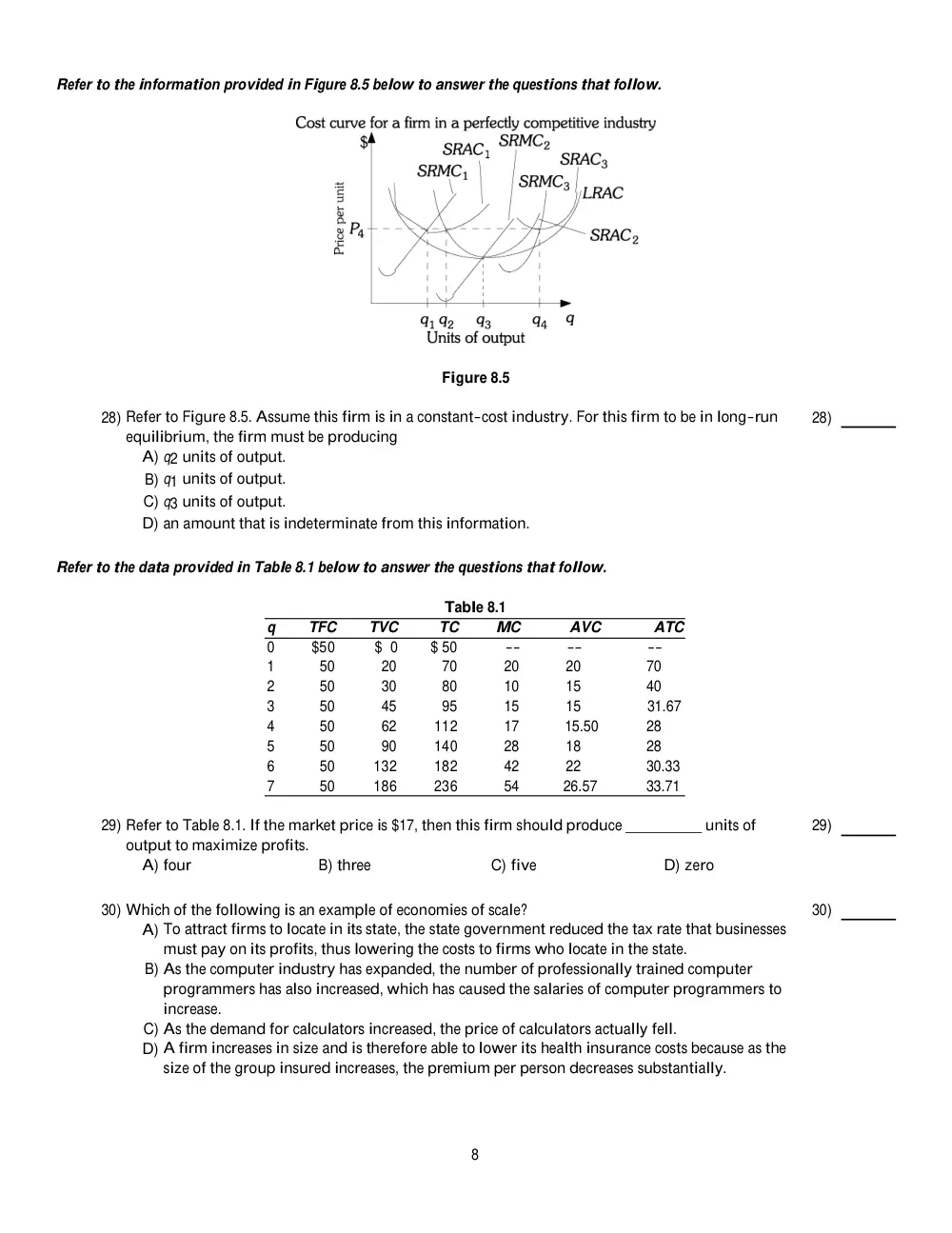
Refer to the information provided in Figure 8.5 below to answer the questions that follow.
Figure 8.5
28) Refer to Figure 8.5. Assume this firm is in a constant-cost industry. For this firm to be in long-run
equilibrium, the firm must be producing
28)
A) q2 units of output.
B) q1 units of output.
C) q3 units of output.
D) an amount that is indeterminate from this information.
Refer to the data provided in Table 8.1 below to answer the questions that follow.
Table 8.1
q
TFC
TVC
TC
MC
AVC
ATC
0
1
2
3
4
5
6
7
$50
50
50
50
50
50
50
50
$ 0
20
30
45
62
90
132
186
$ 50
70
80
95
112
140
182
236
--
20
10
15
17
28
42
54
--
20
15
15
15.50
18
22
26.57
--
70
40
31.67
28
28
30.33
33.71
29) Refer to Table 8.1. If the market price is $17, then this firm should produce __________ units of
output to maximize profits.
29)
A) four
B) three
C) five
D) zero
30) Which of the following is an example of economies of scale?
30)
A) To attract firms to locate in its state, the state government reduced the tax rate that businesses
must pay on its profits, thus lowering the costs to firms who locate in the state.
B) As the computer industry has expanded, the number of professionally trained computer
programmers has also increased, which has caused the salaries of computer programmers to
increase.
C) As the demand for calculators increased, the price of calculators actually fell.
D) A firm increases in size and is therefore able to lower its health insurance costs because as the
size of the group insured increases, the premium per person decreases substantially.
8
31) Firms are making profits in an increasing-cost industry. Which of the following statements
describes what will happen in the long run?
31)
A) Firms will exit this industry, causing the industry supply schedule to shift to the right and the
LRAC curve to shift down.
B) More firms will enter this industry, causing the industry supply schedule to shift to the right
and the LRAC curve facing firms to shift down.
C) More firms will enter this industry, causing the industry supply schedule to shift to the right
and the LRAC curve facing firms to shift up.
D) Firms will exit this industry, causing the industry supply schedule to shift to the left and the
LRAC curve to shift down.
32) If a firm's long-run average cost curve declines as output increases, then
32)
A) there should be only one firm in the industry.
B) small firms would have lower average costs of production than large firms.
C) there should be a large number of firms in the industry.
D) small firms and large firms will have identical average costs.
Refer to the data provided in Table 8.1 below to answer the questions that follow.
Table 8.1
q
TFC
TVC
TC
MC
AVC
ATC
0
1
2
3
4
5
6
7
$50
50
50
50
50
50
50
50
$ 0
20
30
45
62
90
132
186
$ 50
70
80
95
112
140
182
236
--
20
10
15
17
28
42
54
--
20
15
15
15.50
18
22
26.57
--
70
40
31.67
28
28
30.33
33.71
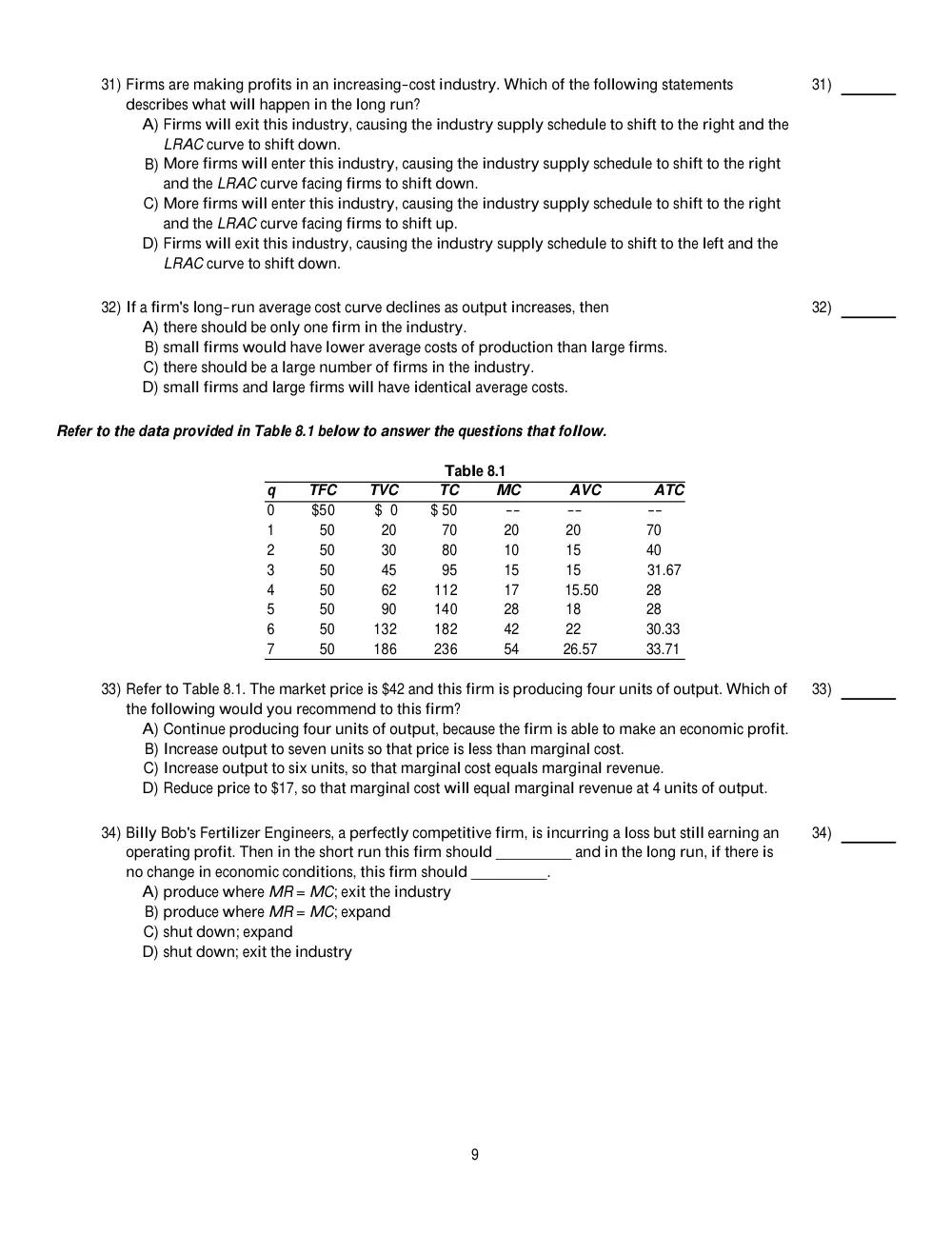
33) Refer to Table 8.1. The market price is $42 and this firm is producing four units of output. Which of
the following would you recommend to this firm?
33)
A) Continue producing four units of output, because the firm is able to make an economic profit.
B) Increase output to seven units so that price is less than marginal cost.
C) Increase output to six units, so that marginal cost equals marginal revenue.
D) Reduce price to $17, so that marginal cost will equal marginal revenue at 4 units of output.
34) Billy Bob's Fertilizer Engineers, a perfectly competitive firm, is incurring a loss but still earning an
operating profit. Then in the short run this firm should __________ and in the long run, if there is
no change in economic conditions, this firm should __________.
34)
A) produce where MR = MC; exit the industry
B) produce where MR = MC; expand
C) shut down; expand
D) shut down; exit the industry
9
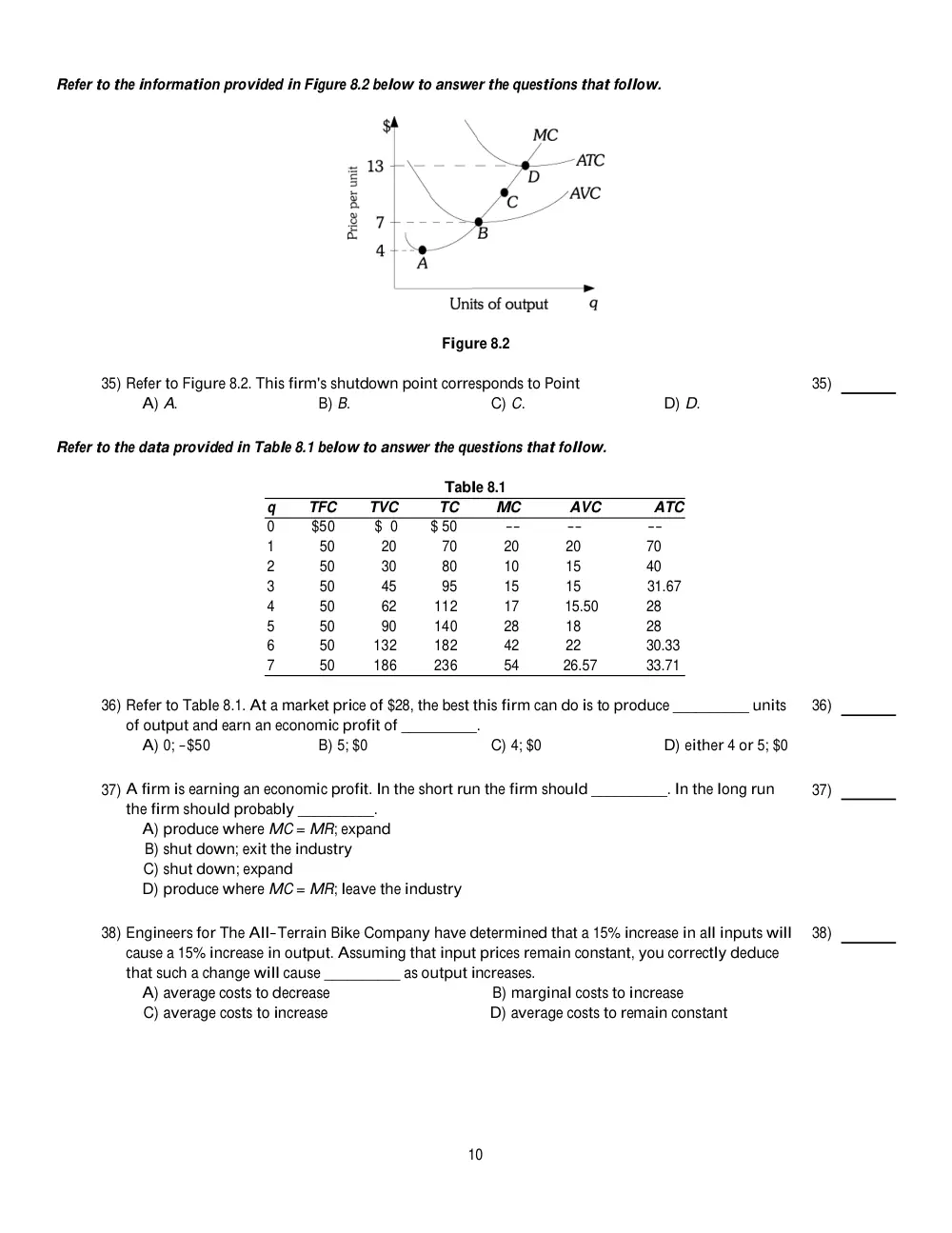
Refer to the information provided in Figure 8.2 below to answer the questions that follow.
Figure 8.2
35) Refer to Figure 8.2. This firm's shutdown point corresponds to Point
35)
A) A.
B) B.
C) C.
D) D.
Refer to the data provided in Table 8.1 below to answer the questions that follow.
Table 8.1
q
TFC
TVC
TC
MC
AVC
ATC
0
1
2
3
4
5
6
7
$50
50
50
50
50
50
50
50
$ 0
20
30
45
62
90
132
186
$ 50
70
80
95
112
140
182
236
--
20
10
15
17
28
42
54
--
20
15
15
15.50
18
22
26.57
--
70
40
31.67
28
28
30.33
33.71
36) Refer to Table 8.1. At a market price of $28, the best this firm can do is to produce __________ units
of output and earn an economic profit of __________.
36)
A) 0; -$50
B) 5; $0
C) 4; $0
D) either 4 or 5; $0
37) A firm is earning an economic profit. In the short run the firm should __________. In the long run
the firm should probably __________.
37)
A) produce where MC = MR; expand
B) shut down; exit the industry
C) shut down; expand
D) produce where MC = MR; leave the industry
38) Engineers for The All-Terrain Bike Company have determined that a 15% increase in all inputs will
cause a 15% increase in output. Assuming that input prices remain constant, you correctly deduce
that such a change will cause __________ as output increases.
38)
A) average costs to decrease
B) marginal costs to increase
C) average costs to increase
D) average costs to remain constant
10
39) If a firm is incurring an operating loss, in the short run the firm should __________ and in the long
run the firm should __________.
39)
A) produce where MC = MR; expand
B) produce where MC = MR; exit the industry
C) shut down; expand
D) shut down; exit the industry
Refer to the data provided in Table 8.1 below to answer the questions that follow.
Table 8.1
q
TFC
TVC
TC
MC
AVC
ATC
0
1
2
3
4
5
6
7
$50
50
50
50
50
50
50
50
$ 0
20
30
45
62
90
132
186
$ 50
70
80
95
112
140
182
236
--
20
10
15
17
28
42
54
--
20
15
15
15.50
18
22
26.57
--
70
40
31.67
28
28
30.33
33.71
40) Refer to Table 8.1. If the market price was $17, then this firm's profit would be
40)
A) -$50.
B) -$44.
C) $68.
D) $6.
41) Assume the peanut industry, a perfectly competitive industry, is in long-run equilibrium with a
market price of $5. If demand for peanuts increases and this industry is a decreasing-cost industry,
long-run equilibrium will be reestablished at a price
41)
A) less than $5.
B) equal to $5.
C) greater than $5.
D) either greater than or less than $5, depending on the number of firms that enter the industry.
42) Assume a perfectly competitive industry is in long-run equilibrium at a price of $20. If this
industry is a constant-cost industry and the demand for the product decreases, long-run
equilibrium will be reestablished at a price
42)
A) less than $20.
B) of $20.
C) greater than $20.
D) either greater than or less than $20 depending on the magnitude of the decrease in demand.
11
Refer to the information provided in Figure 8.6 below to answer the questions that follow.
Figure 8.6
43) Refer to Figure 8.6. The type of industry depicted in this situation is
43)
A) a constant-cost industry.
B) an increasing-cost industry.
C) a decreasing-cost industry.
D) impossible to determine from this information.
44) Which of the following is the set of conditions necessary for long-run equilibrium for a perfectly
competitive firm?
44)
A) P > SRMC = SRAC = LRAC
B) P = SRMC = SRAC = LRAC
C) P = SRMC = SRAC > LRAC
D) P = SRMC < SRAC = LRAC
Refer to the information provided in Figure 8.6 below to answer the questions that follow.
Figure 8.6
45) Refer to Figure 8.6. This increasing cost industry's long-run supply curve would be found by
drawing a line from
45)
A) Points A to E.
B) Points B to E.
C) Points B to F.
D) Points B to C.
46) Ameritech® has a monopoly over local telephone service. If Ameritech® is producing where
marginal revenue is less than marginal cost, the firm
46)
A) is maximizing profits.
B) must be earning a zero profit.
C) could increase profits by increasing output.
D) could increase profits by reducing output.
12
Refer to the information provided in Figure 12.4 below to answer the questions that follow.
Figure 12.4
47) Refer to Figure 12.4. This firm's marginal revenue will be negative at
47)
A) prices above $12.
B) all prices.
C) prices between $4 and $18
D) prices below $10.
48) For a monopolist, price
48)
A) is less than marginal revenue.
B) equals marginal revenue.
C) is greater than marginal revenue.
D) can be greater than or less than marginal revenue.
Refer to the information provided in Figure 12.3 below to answer the questions that follow.
Figure 12.3
49) Refer to Figure 12.3. This firm's marginal revenue will be negative at
49)
A) prices below $5.
B) all prices.
C) prices above $5.
D) prices between $4 and $8.
13
50) The XYZ Computer Company has a monopoly over the production of a specialized color printer.
The XYZ Computer Company will find it profitable to increase the production of specialized color
printers as long as marginal cost
50)
A) is positive.
B) is less than marginal revenue.
C) is greater than marginal revenue.
D) equals marginal revenue.
Refer to the information provided in Figure 12.7 below to answer the question that follows.
Figure 12.7
51) Refer to Figure 12.7. The Memory Company's operating profit is
51)
A) $800.
B) -$1,000.
C) -$800.
D) $1,000.
52) Relative to a competitively organized industry, a monopoly produces
52)
A) more output, charges higher prices and, earns economic profits.
B) less output, charges lower prices and, earns only a normal profit.
C) less output, charges higher prices and, earns economic profit.
D) less output, charges lower prices and, earns economic profits.
14
Refer to the information provided in Figure 12.3 below to answer the questions that follow.
Figure 12.3
53) Refer to Figure 12.3. The marginal revenue of the sixth pound of cheese is
53)
A) -$1.
B) $4.
C) -$4.
D) $1.
54) Refer to Figure 12.3. This firm's marginal revenue will be positive at
54)
A) prices above $5.
B) all prices.
C) prices between $4 and $8.
D) prices below $5.
55) The XYZ Computer Company has a monopoly over the production of a specialized color printer.
The XYZ Computer Company will find it profitable to reduce output as long as marginal revenue
55)
A) is greater than marginal cost.
B) is less than marginal cost.
C) equals marginal cost.
D) is positive.
Refer to the information provided in Figure 12.7 below to answer the question that follows.
Figure 12.7
56) Refer to Figure 12.7. The profit-maximizing level of profit for the Memory Company is
56)
A) -$1,800.
B) -$800.
C) -$1,200.
D) $0.
15
Refer to the information provided in Figure 12.5 below to answer the questions that follow.
Figure 12.5
57) Refer to Figure 12.5. If this firm is producing the profit-maximizing quantity and selling it at the
profit-maximizing price, the firm's profit will be
57)
A) $80.
B) $84.
C) $132.
D) $88.
58) Stereo Sound Unlimited has a monopoly over the installation of quadraphonic sound systems. If
Stereo Sound Unlimited's total revenue from installing 10 sound systems is $20,000 and its total
revenue from installing 11 sound systems is $18,000, what is the marginal revenue of the eleventh
sound system?
58)
A) $3,800
B) $2,000
C) -$1,000
D) -$2,000
Refer to the information provided in Figure 12.5 below to answer the questions that follow.
Figure 12.5
59) Refer to Figure 12.5. The profit-maximizing level of output for this monopolist is __________ units
of output.
59)
A) 20
B) 22
C) 26
D) 24
16
Refer to the information provided in Figure 12.4 below to answer the questions that follow.
Figure 12.4
60) Refer to Figure 12.4. The marginal revenue of the eighth pound of burritos is
60)
A) $1.
B) $6.
C) $3.
D) $24.
61) Refer to Figure 12.4. This firm's marginal revenue will be positive at
61)
A) prices between $4 and $8.
B) prices above $20.
C) prices above $10.
D) all prices.
62) The administrators of the only two hospitals in a city agree that their hospitals will provide
different surgical specialties. This is an example of
62)
A) collusion.
B) rent-seeking behavior.
C) market power.
D) regulatory control.
63) When the demand curve is a downward sloping straight line, the slope of the marginal revenue
curve is
63)
A) half as steep as the demand curve.
B) the same as the slope of the demand curve.
C) twice as steep as the demand curve.
D) always equal to one.
64) Because of a patent, Alcoa is the only manufacturer of soda cans with a stay-put tab. Alcoa can
earn a profit on the sale of soda cans with stay-put tabs
64)
A) in the long run but not the short run because the monopolist will face competition in the short
run.
B) in the long run because entry into the industry by new firms is blocked until the patent
expires.
C) only in the long run because government regulations prevent monopolists from earning
profits in the short run.
D) in the short run but not in the long run because new firms will enter the industry in the long
run.
65) A profit-maximizing monopolist will produce output where
65)
A) marginal revenue is zero.
B) marginal revenue equals marginal cost.
C) price equals marginal cost.
D) marginal cost is minimized.
17
66) Which of the following made tying contracts illegal and banned price discrimination?
66)
A) the Sherman Act
B) the Clayton Act
C) the Federal Trade Commission Act
D) the Cellar-Kefauver Act
Refer to the information provided in Figure 12.9 below to answer the questions that follow.
Figure 12.9
67) Refer to Figure 12.9. From society's point of view the efficient level of electricity production are
__________ megawatts.
67)
A) 600
B) 800
C) 500
D) 1200
68) The notion that the government becomes the tool of the rent seeker and makes the allocation of
resources even less efficient than before is known as
68)
A) public choice theory.
B) conspiracy theory.
C) collusion.
D) government failure.
Refer to the information provided in Figure 12.8 below to answer the questions that follow.
Figure 12.8
69) Refer to Figure 12.8. For Armstrong Cable the profit-maximizing number of subscribers is
69)
A) 2,500.
B) 2,200.
C) 800.
D) 1,000.
18
Refer to the information provided in Figure 12.9 below to answer the questions that follow.
Figure 12.9
70) Refer to Figure 12.9. If Ohio Edison is regulated to act as a perfectly competitive firm
70)
A) output would increase from 500 to 600 units.
B) the net social gain to society equals ACF.
C) consumer surplus would increase by the area FGBC.
D) the firm will earn profits of BEC.
Refer to the information provided in Figure 12.8 below to answer the questions that follow.
Figure 12.8
71) Refer to Figure 12.8. If Armstrong Cable is forced to sell the efficient level output it will
71)
A) earn a profit of $4,000.
B) incur a loss of $1,250.
C) earn a zero profit.
D) incur a loss of $7,250.
19
Refer to the information provided in Figure 12.9 below to answer the questions that follow.
Figure 12.9
72) Refer to Figure 12.9. If this industry was originally perfectly competitive and becomes
monopolized, the amount of consumer surplus transferred to Ohio Edison in the form of profits is
72)
A) BEC.
B) FABE.
C) FGBC.
D) FGBE.
73) Which of the following declared monopoly and trade restraints illegal?
73)
A) the Clayton Act
B) the Sherman Act
C) the Cellar-Kefauver Act
D) the Federal Trade Commission Act
Refer to the information provided in Figure 12.9 below to answer the questions that follow.
Figure 12.9
74) Refer to Figure 12.9. The amount of consumer surplus under monopoly is equal to area
74)
A) AFC.
B) GAB.
C) BEC.
D) AFE.
75) Refer to Figure 12.9. If Ohio Edison engages in rent-seeking behavior to maintain their monopoly,
the true net social cost of monopoly is
75)
A) AGB and the portion of area FGBE that pays for the rent-seeking behavior.
B) FAC.
C) FGBC.
D) BEC and the portion of area FGBE that pays for the rent-seeking behavior.
20
76) Perfect price discrimination
76)
A) is an attempt by monopolists to capture consumer surplus as profit.
B) is charging different prices to different buyers.
C) can eliminate the deadweight loss to society of a monopoly.
D) do all of the above.
77) Which of the following is NOT an example of price discrimination?
77)
A) Airlines charging lower prices to travelers who stay over a Saturday night
B) Student discounts at movie theaters
C) Discounted coffee for senior citizens at restaurants
D) back-to-school sales
78) For a monopoly to be a natural monopoly,
78)
A) economies of scale must be realized at a scale that is close to total demand in the market.
B) economies of scale must be realized at a scale that is small relative to the market.
C) the long-run average cost curve must continue to increase until it hits the market demand
curve.
D) there must be constant returns to scale.
Refer to the information provided in Figure 12.8 below to answer the questions that follow.
Figure 12.8
79) Refer to Figure 12.8. The type of industry pictured is a
79)
A) patent monopoly.
B) strategic resource monopoly.
C) profit maximizing monopoly.
D) natural monopoly.
80) An industry that realizes such large economies of scale in producing its product that single-firm
production of that good or service is most efficient is called a(n)
80)
A) patent monopoly.
B) fixed cost monopoly.
C) natural monopoly.
D) economies of scale monopoly.
81) It would be inefficient to break up a
81)
A) patent monopoly.
B) natural monopoly.
C) profit-maximizing monopoly.
D) strategic resource monopoly.
21
82) The Do It Yourself Hardware Store is a monopolistically competitive firm. Its marginal revenue
curve
82)
A) is identical to its demand curve.
B) lies below its demand curve intersecting the quantity axis midway between the origin and the
point at which the demand curve intersects it.
C) lies below its demand curve intersecting the quantity axis at the same point at which the
demand curve intersects it.
D) is below its demand curve if demand is elastic and above the demand curve if demand is
inelastic.
83) Mama Lena's, a frozen food producer, is a monopolistically competitive firm. Mama Lena's is
currently selling frozen lasagna at a price of $10. Mama Lena's marginal cost is $5 and marginal
revenue is $5. This firm should __________ to maximize profits.
83)
A) continue to produce the same output level
B) decrease output to where price just equals marginal cost
C) increase output to where price just equals marginal cost
D) decrease output so that marginal revenue exceeds marginal cost
84) For monopolistically competitive firms in long-run equilibrium,
84)
A) at the profit-maximizing quantity, the demand curve must be tangent to the average total cost
curve.
B) the demand curve must be tangent to the average total cost curve at its minimum.
C) the demand curve must intersect average total cost at its minimum.
D) at the profit-maximizing quantity, the demand curve must intersect the average total cost
curve quantity.
Refer to the information provided in Figure 13.4 below to answer the questions that follow.
Figure 13.4
85) Refer to Figure 13.4. Assume The Custom Shirt Shop has fixed costs of $150 and is a
monopolistically competitive firm. If this firm is producing the profit-maximizing level of output
and selling it at the profit-maximizing price, the firm's profit is
85)
A) -$100.
B) -$250.
C) -$50.
D) -$150.
22
Refer to the information provided in Figure 13.5 below to answer the questions that follow.
Figure 13.5
86) Refer to Figure 13.5. Assume The Custom Sweater Shop has fixed costs of $500 and is a
monopolistically competitive firm. To maximize profits in the short run, this firm should set a price
of
86)
A) $36.
B) $46.
C) $50.
D) $44.
87) Refer to Figure 13.5. Assume The Custom Sweater Shop has fixed costs of $500 and is a
monopolistically competitive firm. If this firm is producing the profit-maximizing level of output
and selling it at the profit-maximizing price, the firm's profit is
87)
A) -$400.
B) -$200.
C) -$350.
D) -$50.
88) As new firms enter a monopolistically competitive industry, the demand
88)
A) and marginal revenue curves facing each firm begin to shift to the right.
B) curve facing each firm shifts to the left, but the marginal revenue curve remains constant.
C) and marginal revenue curves facing each firm begin to shift to the left.
D) curve facing each firm begins to shift to the right but the marginal revenue curve remains
constant.
89) The Specialty Cake Store, a monopolistically competitive firm, is producing 200 decorated cakes
per day and selling each cake for $12. At that production level ATC is $20, AVC is $15, AFC is $10,
and both MR and MC are $8. This firm should
89)
A) produce zero cak