
ECON 211 Lecture, Spring 2008
American University of Beirut · Elementary Microeconomics Theory · 6 pages


More ECON 211 files
- Lecture Chapter Six · Spring 2015LabView
- Lecture Chapter Two · Spring 2015LabView
- Lecture Chapter Seven · Spring 2015LabView
- Lecture Chapter One · Spring 2015LabView
- Lecture Chapter Three · Spring 2015LabView
- Lecture Chapter Five · Spring 2015LabView
- Lecture Chapter Four · Spring 2015LabView
- Syllabus · Spring 2012LabView
Show the text of this lab
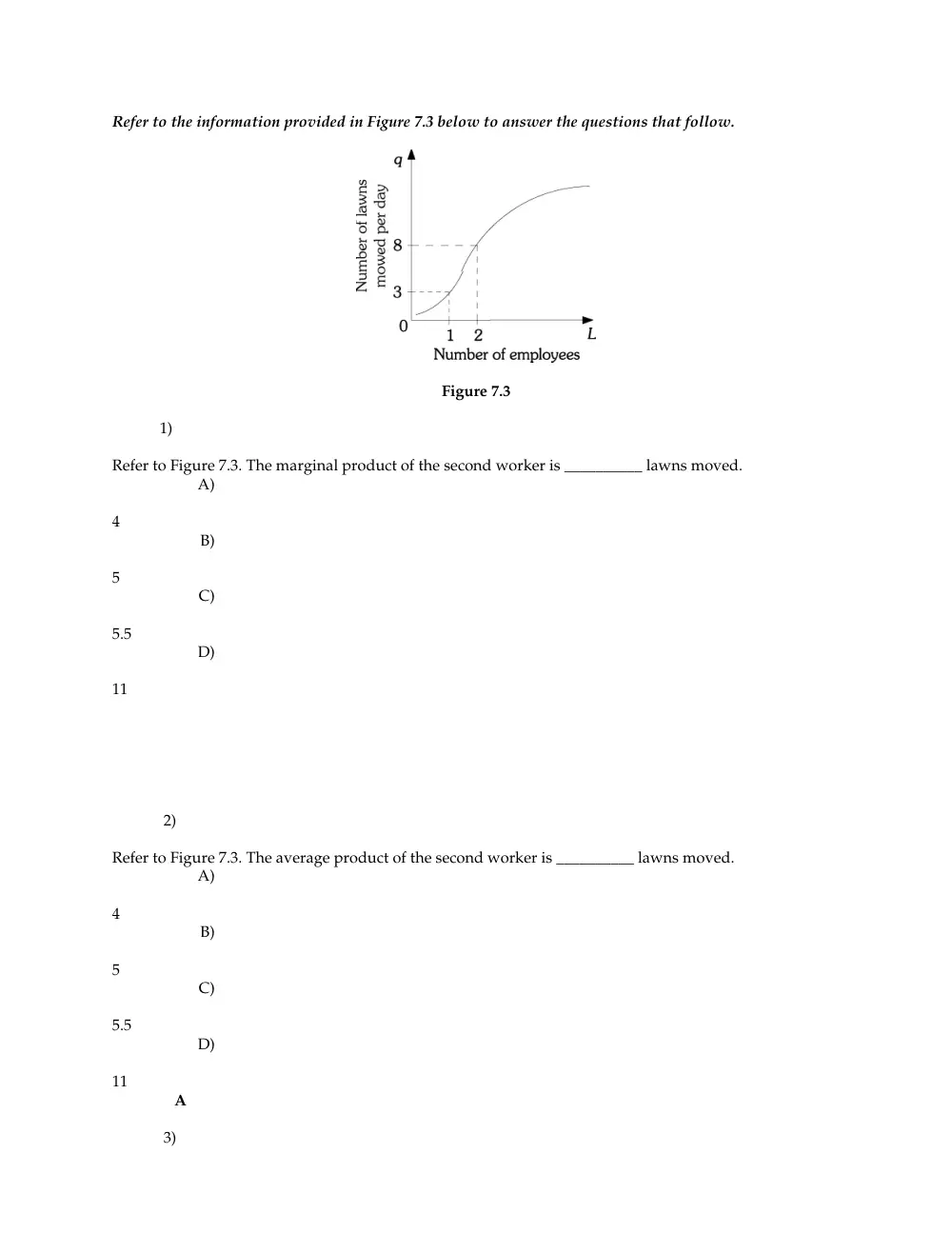
Refer to the information provided in Figure 7.3 below to answer the questions that follow.
Figure 7.3
1)
Refer to Figure 7.3. The marginal product of the second worker is __________ lawns moved.
A)
4
B)
5
C)
5.5
D)
11
2)
Refer to Figure 7.3. The average product of the second worker is __________ lawns moved.
A)
4
B)
5
C)
5.5
D)
11
A
3)
Suppose output varies, ceteris paribus, with labor input in the following manner:
After how many units of labor do diminishing returns set in?
A)
3
B)
4
C)
5
D)
They do not set in
4)
When total product is maximized, marginal product
A)
and average product are zero.
B)
is positive but average product is zero.
C)
is zero but average product is positive.
D)
and average product are positive.
5)
At the point where total product is maximized, marginal product
A)
is zero, but average product is still positive.
B)
and average product are negative.
C)
is positive, but average product is negative.
D)
and average product are positive.
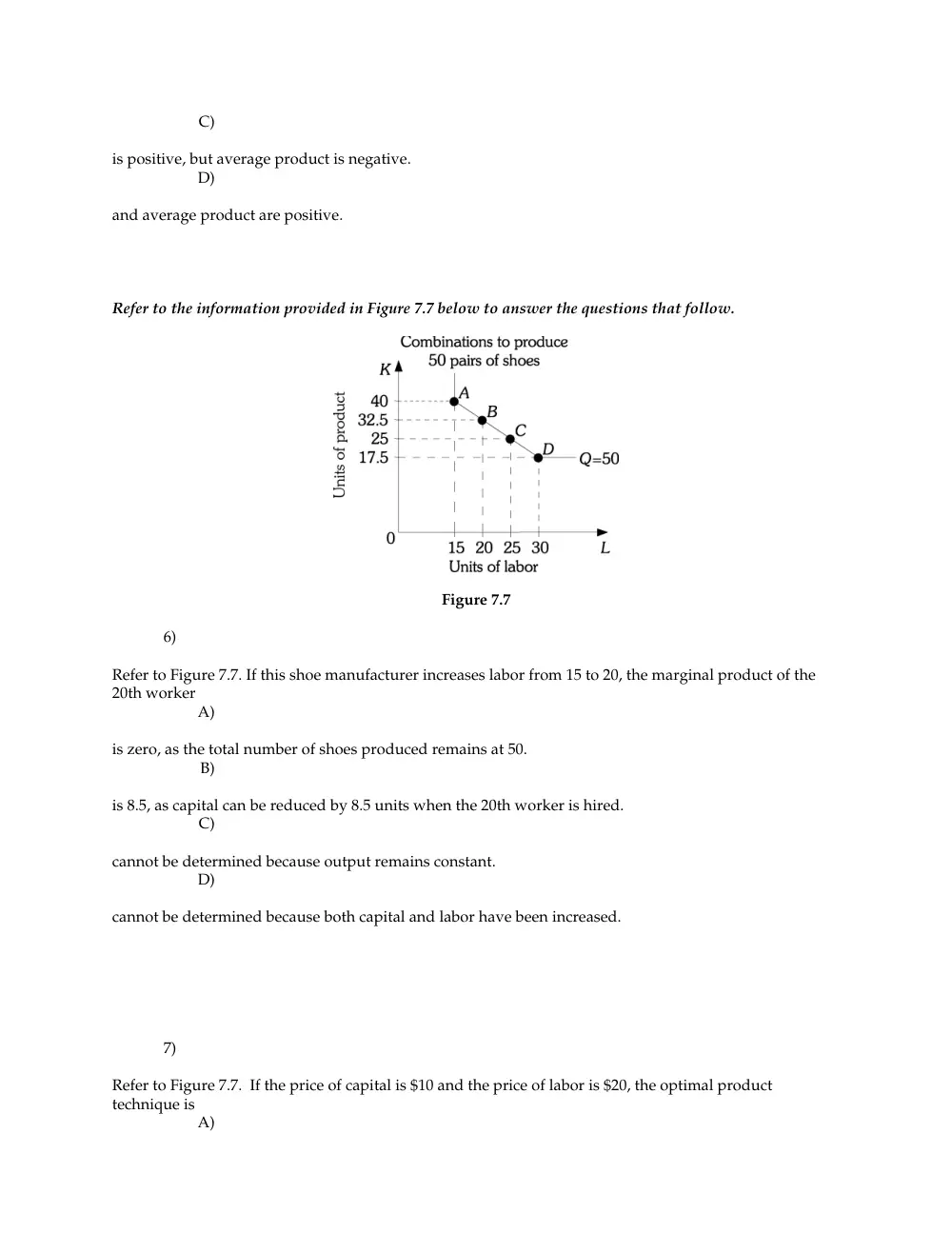
Refer to the information provided in Figure 7.7 below to answer the questions that follow.
Figure 7.7
6)
Refer to Figure 7.7. If this shoe manufacturer increases labor from 15 to 20, the marginal product of the
20th worker
A)
is zero, as the total number of shoes produced remains at 50.
B)
is 8.5, as capital can be reduced by 8.5 units when the 20th worker is hired.
C)
cannot be determined because output remains constant.
D)
cannot be determined because both capital and labor have been increased.
7)
Refer to Figure 7.7. If the price of capital is $10 and the price of labor is $20, the optimal product
technique is
A)
A.
B)
B.
C)
C.
D)
D.
8)
Assume that the price of labor and capital have remained the same, but that the average educational level
of workers has increased and therefore the productivity of labor has increased. This would lead a firm to
A)
use a more capital-intensive production technology.
B)
use a more labor-intensive technology.
C)
not change its production technology, but to produce fewer units of output.
D)
use only labor to produce the product.
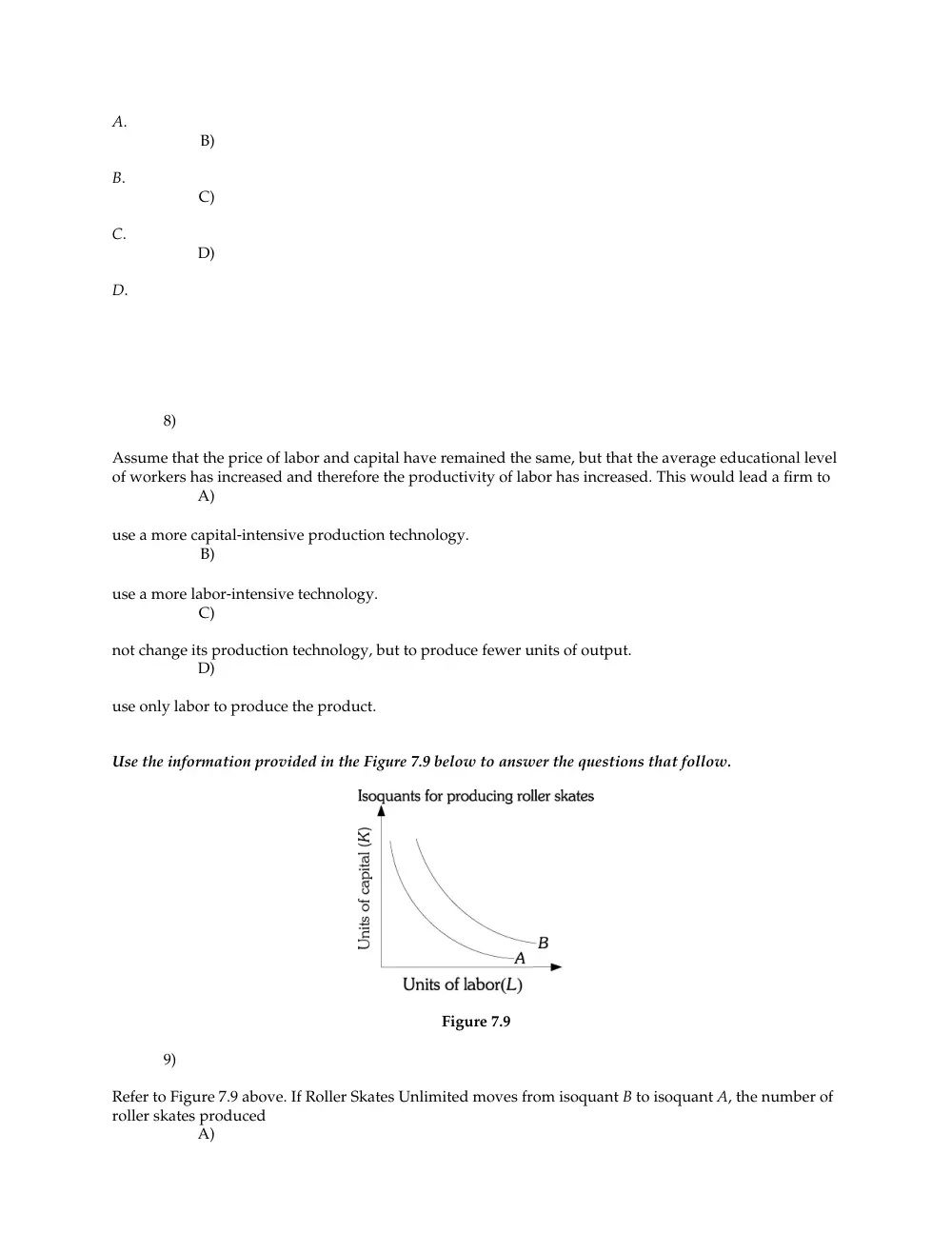
Use the information provided in the Figure 7.9 below to answer the questions that follow.
Figure 7.9
9)
Refer to Figure 7.9 above. If Roller Skates Unlimited moves from isoquant B to isoquant A, the number of
roller skates produced
A)
decreases.
B)
increases.
C)
remains constant, but Roller Skates Unlimited uses more capital and more labor.
D)
remains constant, but input prices have risen.
10)
Isoquants are downward sloping because
A)
as more units of an input are used to produce a product, total cost increases.
B)
as more units of an input are used to produce a product, the firm's marginal productivity increases.
C)
if more of one input is used, then less of the other input must be used to keep output constant.
D)
Both B and C