
ECON 211 Problems, Spring 2008
American University of Beirut · Elementary Microeconomics Theory · 30 pages




Showing the first 10 of 30 pages. Download the PDF to see all of it.
More ECON 211 files
- Problems Solutions of Book · Spring 2008Problems · with solutionView
- Problems · Spring 2008ProblemsView
- Problems with Answers · Spring 2008Problems · with solutionView
- Problems Set · Fall 2006ProblemsView
- Midterm · Spring 2019ExamView
- Useful File Previouses · Fall 2018FileView
- Notes COURSE SUMMARY ECON 211 FOR FINAL · Fall 2017Final examView
- Useful File Test Banks Version 1 · Spring 2016FileView
Show the text of this problems
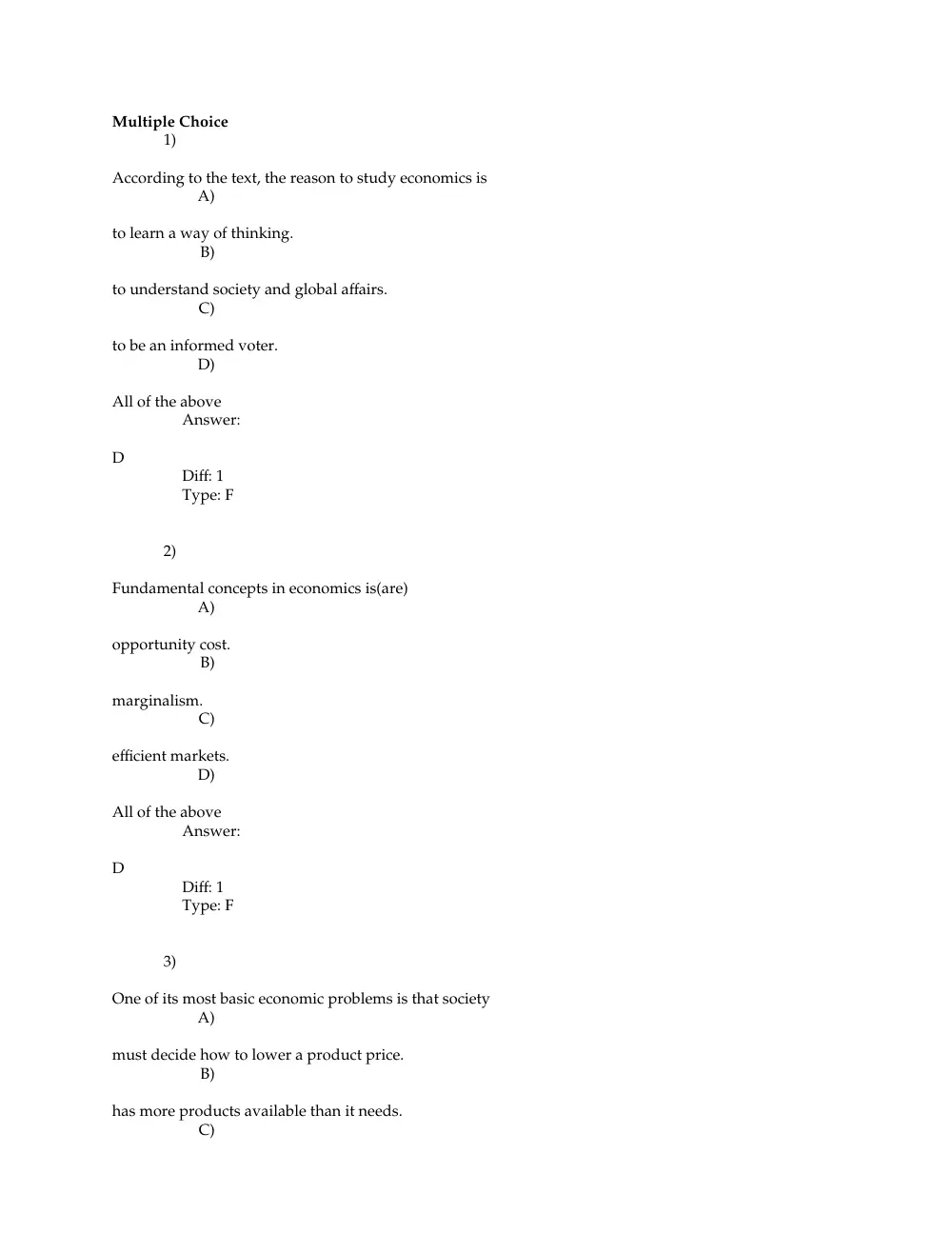
Multiple Choice
1)
According to the text, the reason to study economics is
A)
to learn a way of thinking.
B)
to understand society and global affairs.
C)
to be an informed voter.
D)
All of the above
Answer:
D
Diff: 1
Type: F
2)
Fundamental concepts in economics is(are)
A)
opportunity cost.
B)
marginalism.
C)
efficient markets.
D)
All of the above
Answer:
D
Diff: 1
Type: F
3)
One of its most basic economic problems is that society
A)
must decide how to lower a product price.
B)
has more products available than it needs.
C)
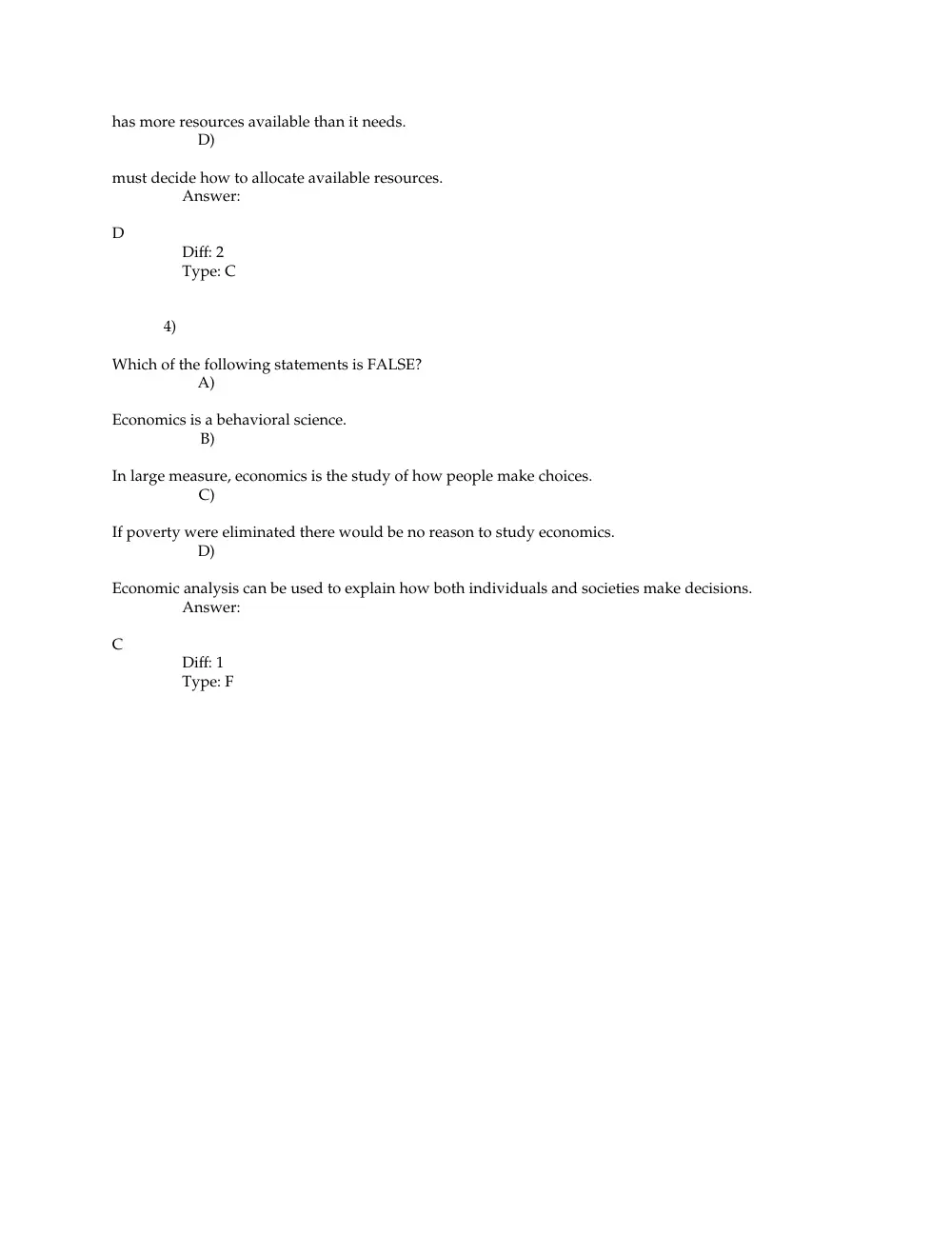
has more resources available than it needs.
D)
must decide how to allocate available resources.
Answer:
D
Diff: 2
Type: C
4)
Which of the following statements is FALSE?
A)
Economics is a behavioral science.
B)
In large measure, economics is the study of how people make choices.
C)
If poverty were eliminated there would be no reason to study economics.
D)
Economic analysis can be used to explain how both individuals and societies make decisions.
Answer:
C
Diff: 1
Type: F
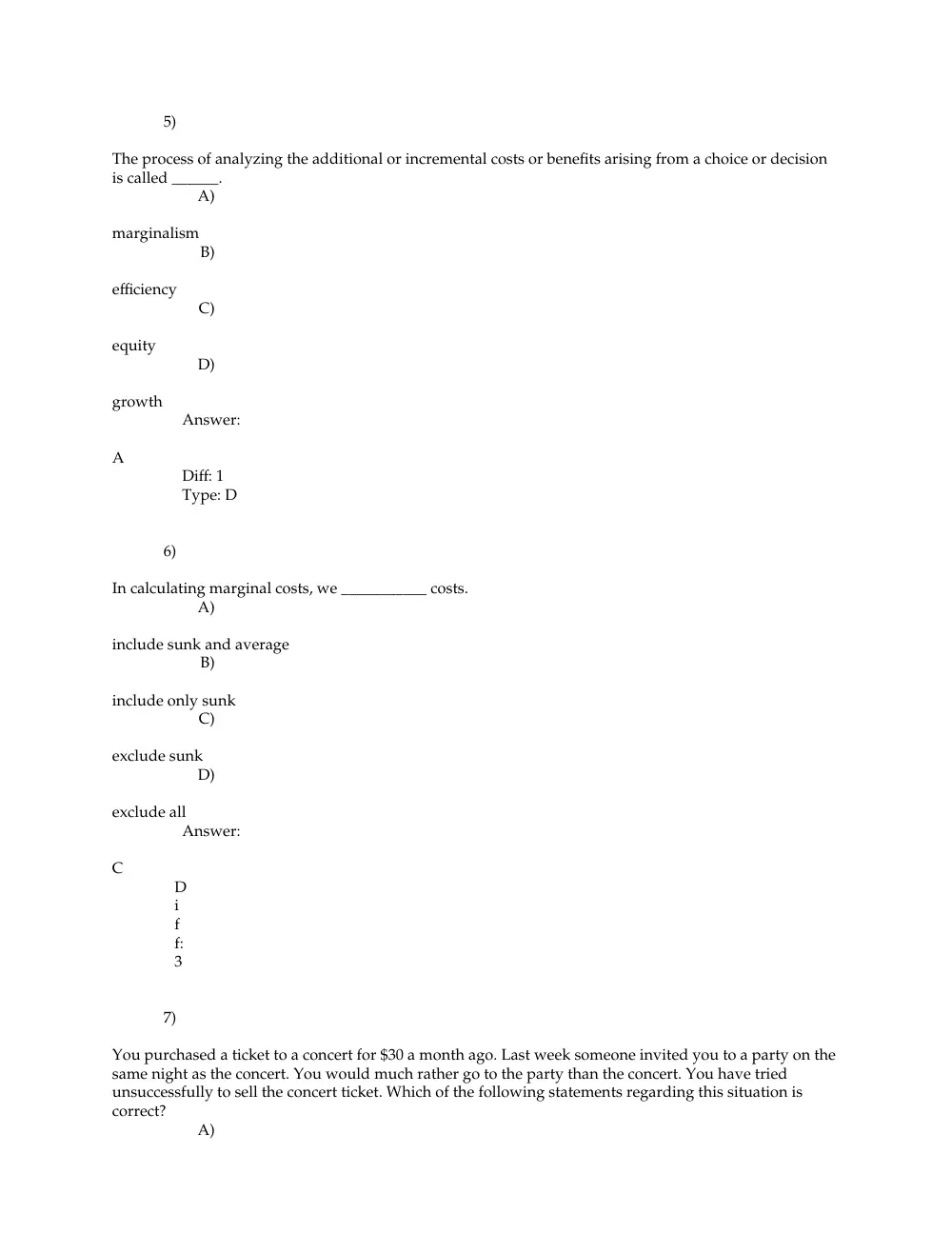
5)
The process of analyzing the additional or incremental costs or benefits arising from a choice or decision
is called ______.
A)
marginalism
B)
efficiency
C)
equity
D)
growth
Answer:
A
Diff: 1
Type: D
6)
In calculating marginal costs, we ___________ costs.
A)
include sunk and average
B)
include only sunk
C)
exclude sunk
D)
exclude all
Answer:
C
D
i
f
f:
3
7)
You purchased a ticket to a concert for $30 a month ago. Last week someone invited you to a party on the
same night as the concert. You would much rather go to the party than the concert. You have tried
unsuccessfully to sell the concert ticket. Which of the following statements regarding this situation is
correct?
A)
The $30 you paid for the concert ticket is relevant to the decision, as this represents the opportunity cost
of attending the party.
B)
You should base your decision on whether or not the party will provide you with more than $30 in
satisfaction.
C)
The $30 you paid for the concert ticket should be irrelevant in your decision making, because it is a sunk
cost.
D)
The $30 concert ticket should be irrelevant in your decision making, because it represents the marginal
cost of attending the party.
Answer:
C
Diff: 2
Type: C
8)
You spent a total of $5 buying songs for your MP3 player. After you buy one more song, your total cost
rises to $6. The marginal cost of the last song that you bought is _____.
A)
$0.50
B)
$1.00
C)
$5.00
D)
$6.00
Answer:
B
Diff: 2
Type: A
9)
The concept of opportunity cost
A)
is relevant only to economics.
B)
can be applied to the analysis of any decision-making process.
C)
applies to consumers but not to firms.
D)
refers only to actual payments and incomes.
Answer:
B
Diff: 3
Type: C
10)
Opportunity cost is
A)
that which we forgo, or give up, when we make a choice or a decision.
B)
a cost that cannot be avoided, regardless of what is done in the future.
C)
the additional cost of producing an additional unit of output.
D)
the additional cost of buying an additional unit of a product.
Answer:
A
Diff: 2
Type: D
11)
You have $100 in savings. You could earn four percent interest if you put the $100 in a bank savings
account for a year. What is your opportunity cost if you put the $100 under the pillow of your bed
instead?
A)
$0.00.
B)
$4.00.
C)
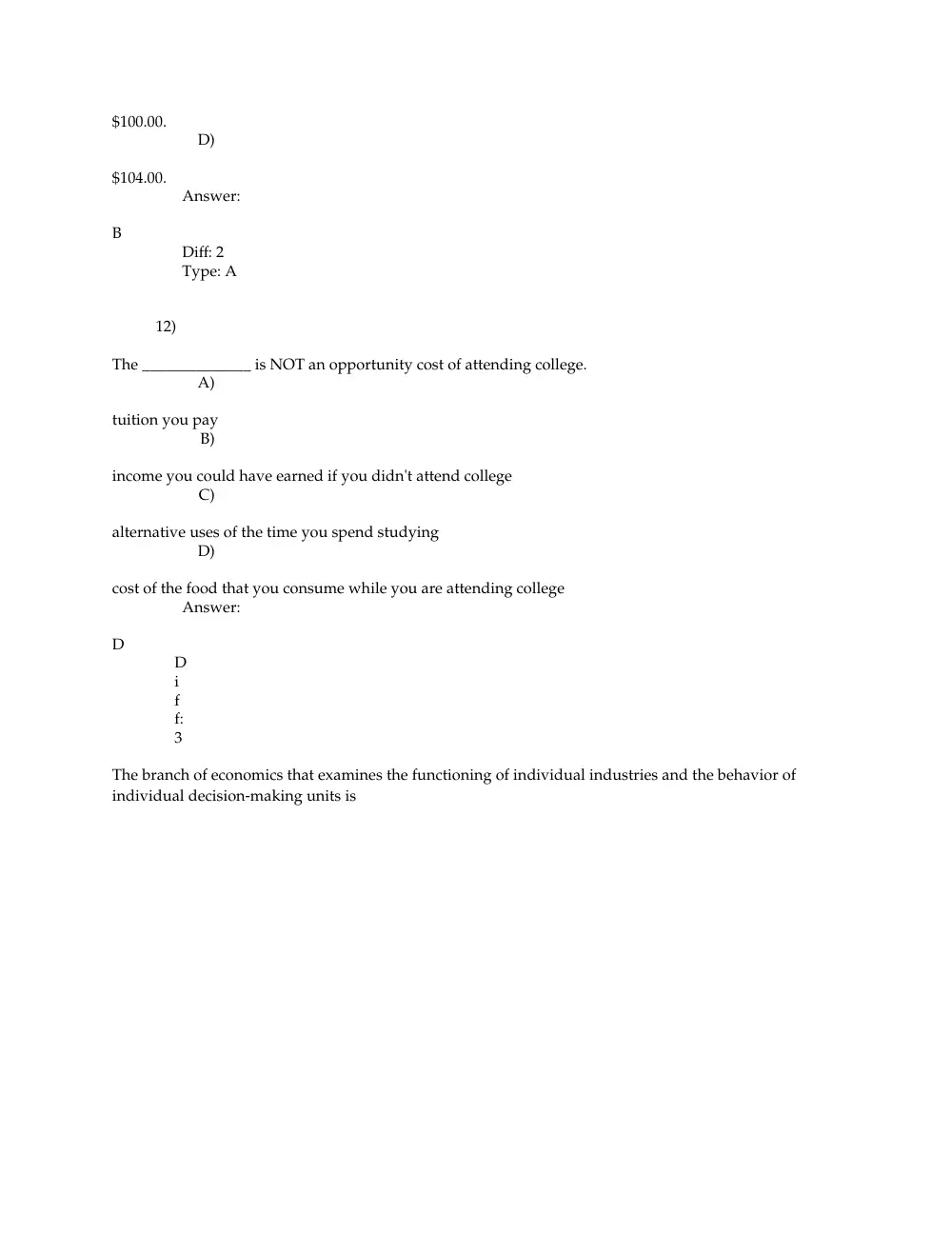
$100.00.
D)
$104.00.
Answer:
B
Diff: 2
Type: A
12)
The ______________ is NOT an opportunity cost of attending college.
A)
tuition you pay
B)
income you could have earned if you didn't attend college
C)
alternative uses of the time you spend studying
D)
cost of the food that you consume while you are attending college
Answer:
D
D
i
f
f:
3
The branch of economics that examines the functioning of individual industries and the behavior of
individual decision-making units is
Multiple Choice
1)
Positive economics is an approach to economics that
A)
seeks to understand behavior and the operation of systems while making judgments about their
usefulness to society.
B)
analyzes outcomes of economic behavior, evaluates them as good or bad, and may prescribe preferred
courses of action.
C)
describes the economy and how it works.
D)
prescribes roles for government in an economy.
Answer:
C
Diff: 1
Type: F
2)
Normative economics is an approach to economics that
A)
seeks to understand behavior and the operation of systems without making judgments.
B)
analyzes outcomes of economic behavior, evaluates them as good or bad, and may prescribe preferred
courses of action.
C)
describes the economy and how it works.
D)
would never prescribe a role for government in the economy.
Answer:
B
Diff: 1
Type: F
3)
“High taxes reduce the incentive of workers to work” is best described as a _________ statement.
A)
positive
B)
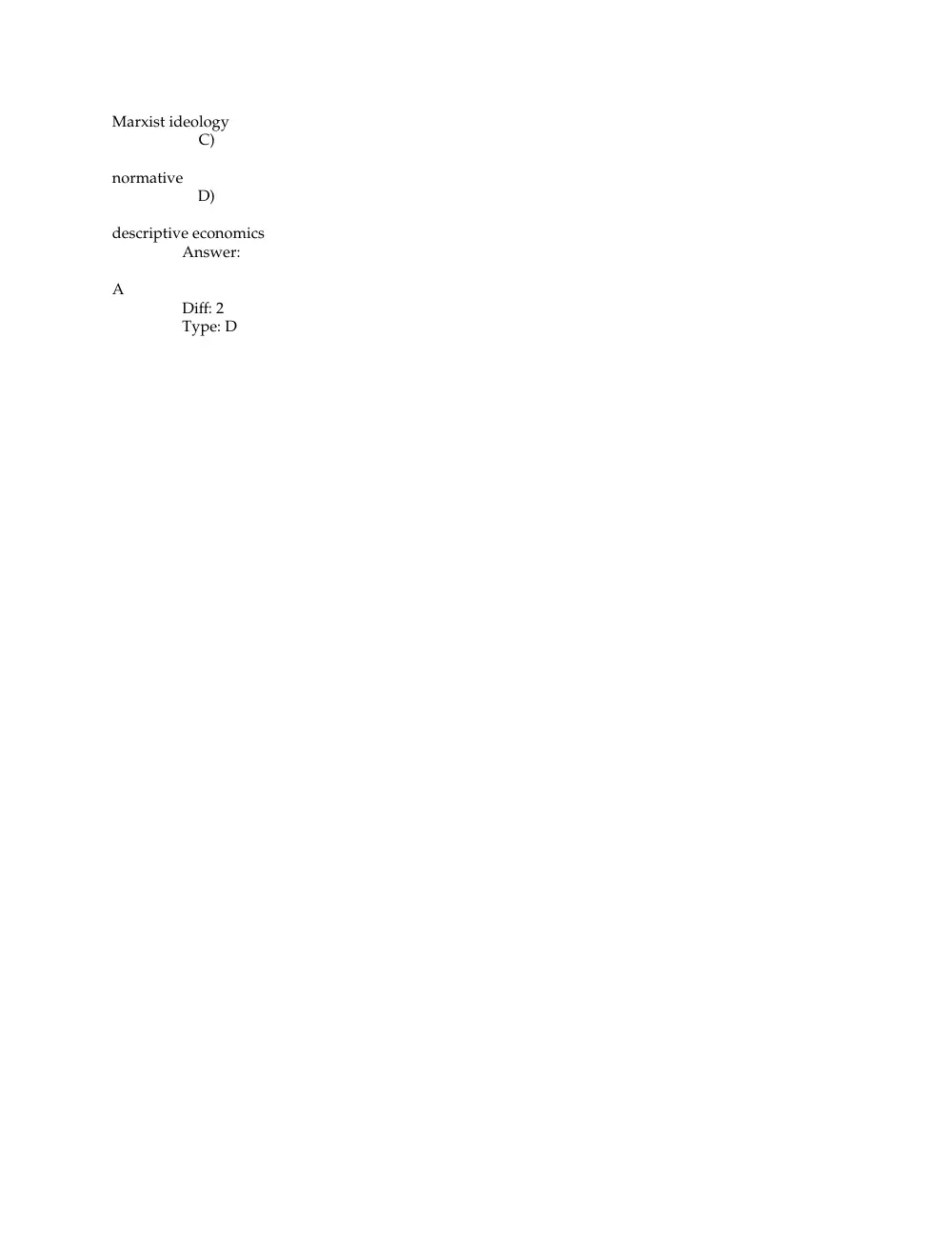
Marxist ideology
C)
normative
D)
descriptive economics
Answer:
A
Diff: 2
Type: D
4)
If the price of a product falls, then the quantity demanded of that product will rise. This is best described
as a ________ statement.
A)
positive
B)
Marxist ideology
C)
normative
D)
descriptive economics
Answer:
A
Diff: 2
Type: D
5)
Scientists should not create life in a laboratory is an example of a _________ statement.
A)
positive.
B)
Marxist ideology
C)
normative
D)
descriptive
Answer:
C
Diff: 2
Type: D
6)
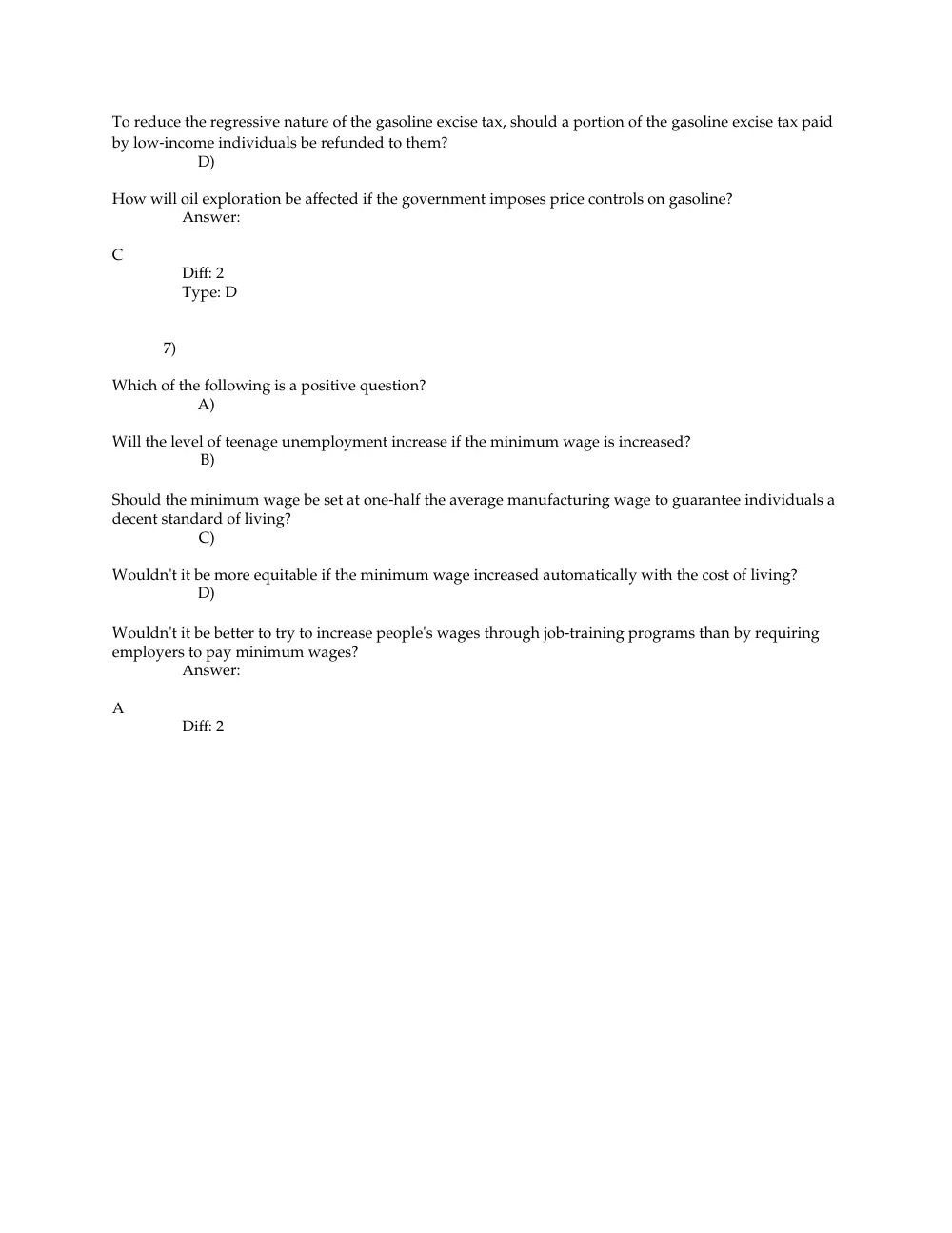
Which of the following is a normative question?
A)
Why do gasoline prices increase before holiday weekends?
B)
What will happen to gasoline consumption if excise taxes on gasoline are increased?
C)
To reduce the regressive nature of the gasoline excise tax, should a portion of the gasoline excise tax paid
by low-income individuals be refunded to them?
D)
How will oil exploration be affected if the government imposes price controls on gasoline?
Answer:
C
Diff: 2
Type: D
7)
Which of the following is a positive question?
A)
Will the level of teenage unemployment increase if the minimum wage is increased?
B)
Should the minimum wage be set at one-half the average manufacturing wage to guarantee individuals a
decent standard of living?
C)
Wouldn't it be more equitable if the minimum wage increased automatically with the cost of living?
D)
Wouldn't it be better to try to increase people's wages through job-training programs than by requiring
employers to pay minimum wages?
Answer:
A
Diff: 2
Refer to Scenario 1 below to answer the questions that follow.
SCENARIO 1: An economist wants to understand the relationship between minimum wages and the
level of teenage unemployment. The economist collects data on the values of the minimum wage and the
levels of teenage unemployment over time. The economist concludes that a 1% increase in the minimum
wage causes a 0.2% increase in teenage unemployment. From this information he concludes that the
minimum wage is harmful to teenagers and should be reduced or eliminated to increase employment
among teenagers.
13)
Refer to Scenario 1. The statement that a 1% increase in the minimum wage causes a 0.2% increase in
teenage unemployment is an example of ___________ economics.
A)
policy
B)
normative
C)
positive
D)
non-empirical
Answer:
C
Diff: 2
Type: D
14)
Refer to Scenario 1. The statement, "the minimum wage is harmful to teenagers and should be reduced or
eliminated to increase employment among teenagers," is most likely an example of _________ economics.
A)
descriptive
B)
normative
C)
positive
D)
microeconomic
Answer:
B
Diff: 2
Type: D
15)
Refer to Scenario 1. The process of collecting data on minimum wage and teenage unemployment levels
is an example of
A)
law and economics.
B)
economic history.
C)
econometrics.
D)
descriptive economics.
Answer:
D
Diff: 2
Type: D
16)
Refer to Scenario 1. The statement that an increase in the minimum wage causes an increase in teenage
unemployment is an example of
A)
descriptive reasoning.
B)
economic theory.
C)
normative economics.
D)
deductive reasoning.
Answer:
B
Diff: 3
Type: D
17)
Refer to Scenario 1. A graph of the value of the minimum wage on one axis and the level of teenage
unemployment on the other axis is an example of
A)
an economic theory.
B)
an economic model.
C)
inductive reasoning.
D)
a variable theory.
Answer:
B
Diff: 2
Refer to the information provided in Figure 1.1 below to answer the questions that follow.
Figure 1.1
1)
Refer to Figure 1.1. There is __________ relationship between the daily temperature and the number of
gallons of ice cream purchased.
A)
a negative
B)
a positive
C)
either a negative or a positive
D)
an inverse
Answer:
B
Diff: 2
Type: A
Refer to the information provided in Figure 1.2 below to answer the questions that follow.
Figure 1.2
2)
Refer to Figure 1.2. The slope of the line between Points A and B is
A)
.3.
B)
2.3.
C)
3.3.
D)
indeterminate from this information.
Answer:
A
Diff: 2
Type: A
3)
If a straight line has negative slope, a(n) ________ in X _______ Y.
A)
increase; increases
B)
decrease; lowers
C)
increase; lowers
D)
decrease; doesn’t change
Answer:
C
Diff: 2
Type: A
Refer to the information provided in Figure 1.3 below to answer the questions that follow.
Figure 1.3
4)
Refer to Figure 1.3. The slope of the line is
A)
positive.
B)
negative.
C)
increasing at an increasing rate.
D)
decreasing at an increasing rate.
Answer:
A
Diff: 2
Type: A
5)
Refer to Figure 1.3. The slope of the line between the origin and Point B is
A)
5.
B)
-2.
C)
0.5.
D)
2.
Answer:
D
Diff: 2
Type: A
6)
Refer to Figure 1.3. If a 45 degree line were also graphed, the line shown would __________ it.
A)
lie above
B)
lie below
C)
cross
D)
indeterminant from this information
Answer:
A
Diff: 3
Type: C
7)
Refer to Figure 1.3. At Point A, what is the value of Y?
A)
7.
B)
8.
C)
12.
D)
Indeterminate from this information
Answer:
B
Diff: 2
Type: A
8)
Refer to Figure 1.3. At Point A the slope of the line is 2, so at Point D the slope would be
A)
greater than 2.
B)
less than 2.
C)
equal to 2.
D)
indeterminate from this information.
Answer:
C
Diff: 2
Type: A
Situation #1 Assume that you have hired three executives to run your company each with
a different job. All are equally productive and each can do the other person’s job if
necessary. Assume that the first executive’s contribution to the company is worth
$1,000,000; the second one is worth $800,000 and the third one is worth $500,000.
1.
Referring to Situation #1 suppose that for the time being you can only afford to
hire the first executive. What is the opportunity cost of the first executive’s work
from the viewpoint of the company? Explain.
The opportunity cost of the first executive is $800,000. That is the value of the
next best available alternative which is currently forgone.
Difficulty: E
Type: C
2.
Referring to Situation #1 suppose that you can now hire two workers. What is the
opportunity cost of the second executive’s work from the viewpoint of the
company? Explain.
The second executive’s work is simply the value of the next best opportunity
which is the work that could have been done by the third executive which is
$500,000
Difficulty: E
Type: C
3.
Referring to Situation #1 suppose that you decide that you have to fire the first and
the third executive without hiring any replacements. What would be the
opportunity cost of the second executive’s work? Explain why your answer is not
the same as in the question above.
The opportunity cost of second executive’s work is $800,000. The reason is that
since each executive can perform any work that they other can then it makes
sense to change the second executive’s job so that he is now doing the most
highly valued work – that with the $1,000,000 value. That leaves the $800,000
job undone which means that becomes the opportunity cost of the second
executive’s work.
Difficulty: D
Type: C
4.
Explain why it is more likely that the opportunity cost of attending a 7:00 a.m. class
is forgone sleep but that this is not reasonably likely to be the case for a class that
meets at 12:00 noon.
At 7:00 a.m. there might not be too many other opportunity costs for your
time. Forgone sleep might reasonably be an opportunity cost of your time.
However, at 12:00 noon while it is possible that forgone sleep is your
opportunity cost it is not likely since there are probably other things of higher
value that you have given up by then unless you are a very later sleeper.
5.
What are sunk costs?
Sunk costs are costs that cannot be avoided, regardless of what is done in the
future, because they have already been incurred and cannot be refunded.
Difficulty: E
Type: D
6.
Suppose that you have purchased a round-trip ticket to the Bahamas for spring
break. The ticket is non-refundable and cannot be changed. Your best friend tells
you that she is getting married during the same week in Chicago (where you live)
and has asked you to be in the wedding party. Does the price you paid for your
Bahamas trip matter in your decision of whether to go to the Bahamas or Chicago?
Why or why not?
It should not matter because the plane fare is a sunk cost. No matter what
decision you make, you will have to pay for the ticket to the Bahamas.
7.
Explain the difference between positive economics and normative economics.
Positive economics seeks to understand behavior and the operation of
systems without making judgments. It describes what exists and how it
works. Normative economics analyzes outcomes of economic behavior,
evaluates them as good or bad, and may prescribe courses of action.
Difficulty: E
Type: D
8.
Give an example of a positive economic statement and a normative economic
statement.
Student responses will vary. What is important is that the positive statement
is objective and attempts to explain "what is". The normative statement
should include some value judgment or "what should be".
Difficulty: E
Type: D
9.
For each of the following, note whether the statement is an example of positive
economic analysis or an example of normative economic analysis:
(a.)
An increase in the minimum wage will lead to a higher rate of teenage
unemployment.
(b.)
If the government reduces the tax on tobacco, more individuals will start
smoking.
(c.)
The government should lower taxes because tax rates are too high for the
average U.S. family.
(d.)
Wealthy senior citizens can afford to buy their own health insurance and
therefore should not be given Medicare coverage.
(e.)
If the price of apples increases, people will buy more bananas.
(a.)
Positive.
(b.)
Positive.
(c.)
Normative.
(d.)
Normative.
(e.)
Positive.
Difficulty: E
Type: D
10. List and describe the two areas of positive economics.
Descriptive economics involves the compilation of data that describe
economic phenomena and facts. Economic theory involves a statement or a
set of related statements about cause and effect (action and reaction).
11. Explain what post hoc fallacy means and give an example.
Post hoc fallacy is a common error in thinking about causation. An example
would be "if Event A happens before Event B, Event A must have caused Event
B to occur".
Difficulty: E
Type: D
12. Suppose an economics forecaster discovers that on days when the sunspot count is
high stock market on the following day is bullish, that is stock market prices edge
upwards. In addition, he also observes that on days with a low sunspot count the
following day the stock market tends to be bearish, that is stock market prices tend
to fall. The forecaster then concludes that there is a positive relationship between
the sunspot count and stock market prices and proceeds to base his investment
decisions on this premise. What kind of an error has this forecaster made?
The forecaster has fallen into the post hoc fallacy. Simply because one set of
events precedes another is not enough to say that one is the cause of the
other.
Difficulty: E
Type: D
13. If crime rates in the United States fall, can incumbent lawmakers rightfully claim
credit? Why or why not?
Probably not. Lower crime rates can occur for many reasons including a
change in the age distribution of the population and lower unemployment
rates. One cannot simply conclude that the lawmakers in office were responsible for
the lower crime rates, until other plausible reasons have been ruled out.
Difficulty: E
Type: C
14. Explain what the fallacy of composition is and give an example.
The fallacy of composition is the incorrect belief that what is true for a part is
necessarily true for the whole. For example, intensive fishing in an area by a
boat may increase profits earned by the boat owner. However, if many boats
excessively fish in the same area, the stock of fish will become depleted and
all will be worse off.
Difficulty: M
Type: D
1.
Michael Jordan has more athletic ability than most individuals. Thus, he is more
productive at most tasks involving physical skill. Explain why then, it is more
efficient for Michael Jordan to pay someone else to mow his lawn.
While Michael Jordan probably has an absolute advantage in mowing his lawn,
the opportunity cost of his time is very high. He could spend the time it takes
to mow his lawn in a variety of ways including earning a large amount of
money making a commercial endorsement. Thus, it is likely that he does not
have a comparative advantage in mowing his lawn.
Difficulty: E
Type: C
2.
Because of the quantity and quality of its resources, the U.S. has an absolute
advantage in the production of many goods and services. Does this imply that the
U.S. cannot benefit from trading with a developing country that has less productive
ability? Why or why not?
The U.S. can benefit from trading with less productive countries as long as it
produces the goods for which it has a comparative advantage and trades to
receive the goods for which it does not.
Difficulty: M
Type: C
3.
Explain Ricardo's theory of comparative advantage.
Specialization and free trade will benefit all trading partners, including those
that may be absolutely more efficient producers.
Difficulty: E
Type: D
4.
The following table shows output per hour for Martha and Stewart who make gift
baskets
and potholders:
Output per Hour
Martha
Stewart
Gift Baskets
10
8
Potholders
20
12
What is the opportunity cost of a gift basket for Martha? What is the opportunity
cost of a gift basket for Stewart? Who has a comparative advantage in producing
gift baskets? How can you tell?
The opportunity cost of a gift basket for Martha is 2 potholders. The
opportunity cost of a gift basket for Stewart is 1.5 potholders. Stewart has a
comparative advantage in the production of gift baskets. His opportunity cost
of producing a gift basket is lower.
Difficulty: E
Type: A
5.
Explain the difference between absolute advantage and comparative advantage.
A person has an absolute advantage in the production of a good if he or she is
more productive at producing the good. A person has a comparative
advantage in the production of a good if he or she can produce it at the lowest
opportunity cost.
Difficulty: E
Type: D
6.
The following table shows output per hour for Martha and Stewart who make gift
baskets and potholders:
Output per Hour
Martha
Stewart
Gift Baskets
10
8
Potholders
20
12
What is the opportunity cost of a potholder for Martha? What is the opportunity
cost of a potholder for Stewart? Who has an absolute advantage in producing
potholders? Who has a comparative advantage in producing potholders?
The opportunity cost of a potholder for Martha is 1/2 of a gift basket. The
opportunity cost of a potholder for Stewart is 2/3 of a gift basket. Martha has
an absolute advantage and a comparative advantage in the production of
potholders.
7.
The following table shows output per hour for Mexico and Canada, two countries
that produce beer and T-shirts:
Output per Hour
Mexico
Canada
Beer (thousands of
bottles)
5
10
T-shirts (thousands)
10
12
What is the opportunity cost of a bottle of beer for Mexico? What is the opportunity
cost of a T-shirt for Mexico? Who has a comparative advantage in producing beer?
How can you tell?
The opportunity cost of a bottle of beer for Mexico is 2 T-shirts. The
opportunity cost of a T-shirt for Mexico is 1/2 bottle of beer. Canada has a
comparative advantage in the production of beer. Canada's opportunity cost
of producing a bottle of beer is 1.2 T-shirts and Mexico's opportunity cost of
producing a bottle of beer is 2 T-shirts.
Difficulty: M
Type: A
8.
Suppose that Rosie and Betty spend their free time making cakes and cookies. Is it
possible for Betty to have an absolute advantage in the production of both cakes
and cookies? Is it possible for Betty to have a comparative advantage in the
production of both cakes and cookies? Explain.
Yes, it is possible for Betty to have an absolute advantage in the production of
cakes and cookies. This simply means that she is able to produce more per
hour. However, Betty cannot have a comparative advantage in producing
both cakes and cookies. Because the opportunity cost of producing a cookie is
the reciprocal of the opportunity cost of making a cake, it is impossible to
have the lower opportunity cost of each.
Difficulty: E
Type: C
SCENARIO 1: Consider the following data for the harvest of crabs versus the harvest of fish
off the coast of Virginia in answering the following questions.
9.
Refer to Scenario 1. Graph the production possibilities frontier and calculate the
average opportunity cost of any of the first fifteen crabs produced.
The opportunity cost of the first fifteen crabs is of course the 10 fish given up (15C = 10F). Therefore,
the opportunity cost of any one crab is 10/15 F or 2/3 of a fish.
10. Refer to Scenario 1. What is the economic significance of 25 fish captured and 25
crabs captured?
The economic significance of capturing 25 fish and 50 crabs is that the harvest
would be inside the production possibilities frontier, which suggests some
resource unemployment. That resource unemployment could be land, labor or
capital.
Difficulty: M
Type: C
11. Refer to Scenario 1. Explain how this economy might be able to produce 45 fish and
45 crabs?
The economy could do this with the benefits of an increase in resources or a
technological advance in fishing.
Difficulty: M
Type: C
Refer to the information provided in Scenario 2 below to answer the questions that follow.
SCENARIO 2: Assume that two countries are the same in every way except that one
allocated more of its resources to the production of capital goods as opposed to
consumer
goods.
12. Refer to Scenario 2. Graphically illustrate the production choices on a production
possibilities frontier. Which country’s PPF will likely move out farther in the future
and why?
The country with the capital intensive allocation will have its PPF move
out farther since the economy will have greater productive capacity.
Difficulty: E
Type: C
13. Refer to Scenario 2. Now assume that the countries are not alike, but that one is
wealthier than the other in that it has more resources. Graphically illustrate this
scenario using the production possibilities frontiers.
Difficulty: M
Type: C
14. Refer to Scenario 2. What would be the impact of improvements in technology
assuming that each country spends one-half of its resources on capital goods?
There should be a greater improvement in wealth for the wealthier country if
each country continues to spend the same percentages.
Difficulty: E
Type: C
15. Refer to Scenario 2. What happens to the relative income distribution between the
two countries under the conditions in the previous question? Explain.
The relative income distributions, with income of the capital-good intensive
country greater than the consumer-good intensive country, would be
expected to widen as the growth is greater in the capital-good intensive
country.
Difficulty: D
Type: C