
ECON 211 Syllabus, Spring 2011
American University of Beirut · Elementary Microeconomics Theory · 3 pages · Dr. Sandra El-Saghir Sinno
More ECON 211 files
- Lecture Chapter Six · Spring 2015LabView
- Lecture Chapter Two · Spring 2015LabView
- Lecture Chapter Seven · Spring 2015LabView
- Lecture Chapter One · Spring 2015LabView
- Lecture Chapter Three · Spring 2015LabView
- Lecture Chapter Five · Spring 2015LabView
- Lecture Chapter Four · Spring 2015LabView
- Syllabus · Spring 2012LabView
Show the text of this lab
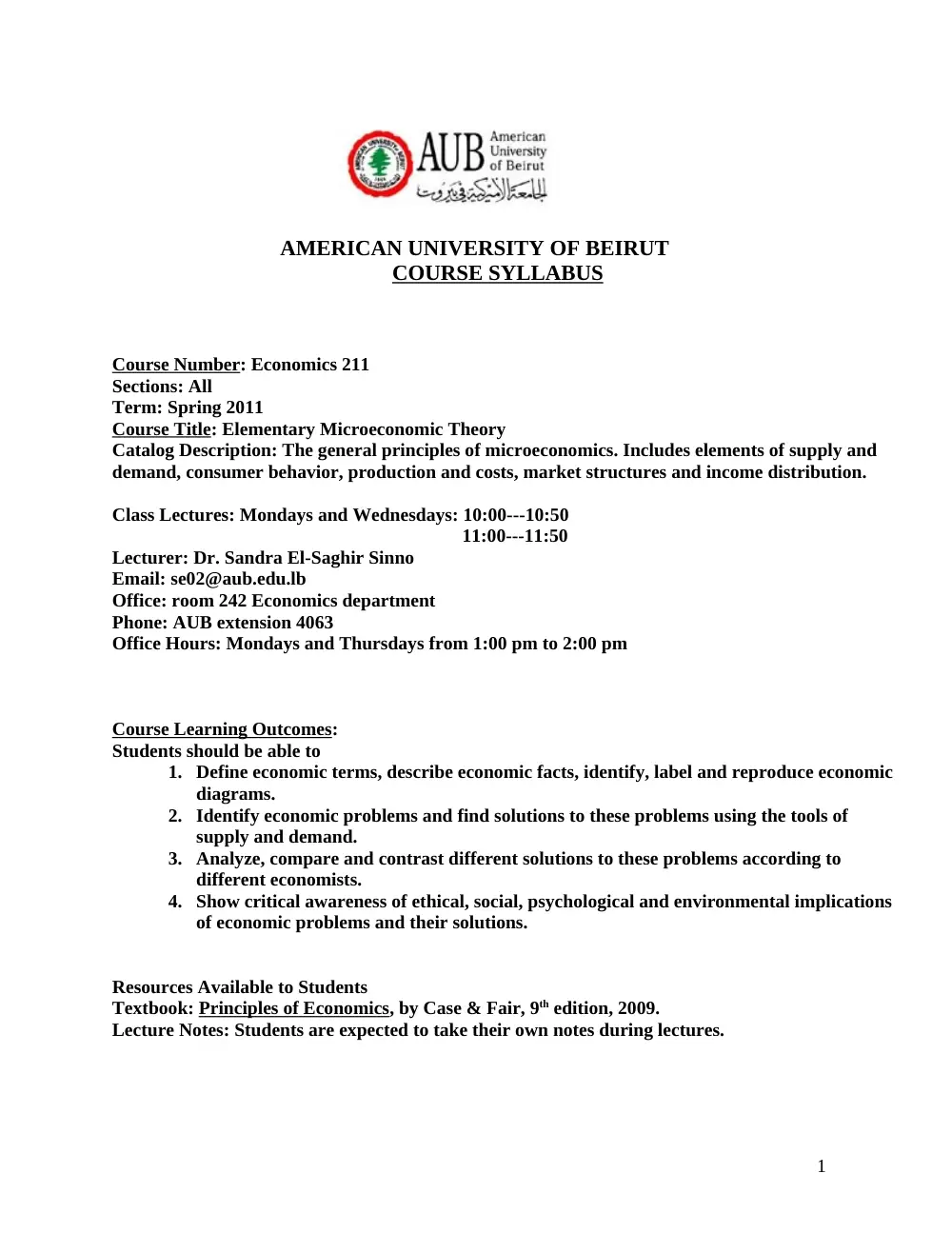
AMERICAN UNIVERSITY OF BEIRUT
COURSE SYLLABUS
Course Number: Economics 211
Sections: All
Term: Spring 2011
Course Title: Elementary Microeconomic Theory
Catalog Description: The general principles of microeconomics. Includes elements of supply and
demand, consumer behavior, production and costs, market structures and income distribution.
Class Lectures: Mondays and Wednesdays: 10:00---10:50
11:00---11:50
Lecturer: Dr. Sandra El-Saghir Sinno
Email: se02@aub.edu.lb
Office: room 242 Economics department
Phone: AUB extension 4063
Office Hours: Mondays and Thursdays from 1:00 pm to 2:00 pm
Course Learning Outcomes:
Students should be able to
1. Define economic terms, describe economic facts, identify, label and reproduce economic
diagrams.
2. Identify economic problems and find solutions to these problems using the tools of
supply and demand.
3. Analyze, compare and contrast different solutions to these problems according to
different economists.
4. Show critical awareness of ethical, social, psychological and environmental implications
of economic problems and their solutions.
Resources Available to Students
Textbook: Principles of Economics, by Case & Fair, 9th edition, 2009.
Lecture Notes: Students are expected to take their own notes during lectures.
1
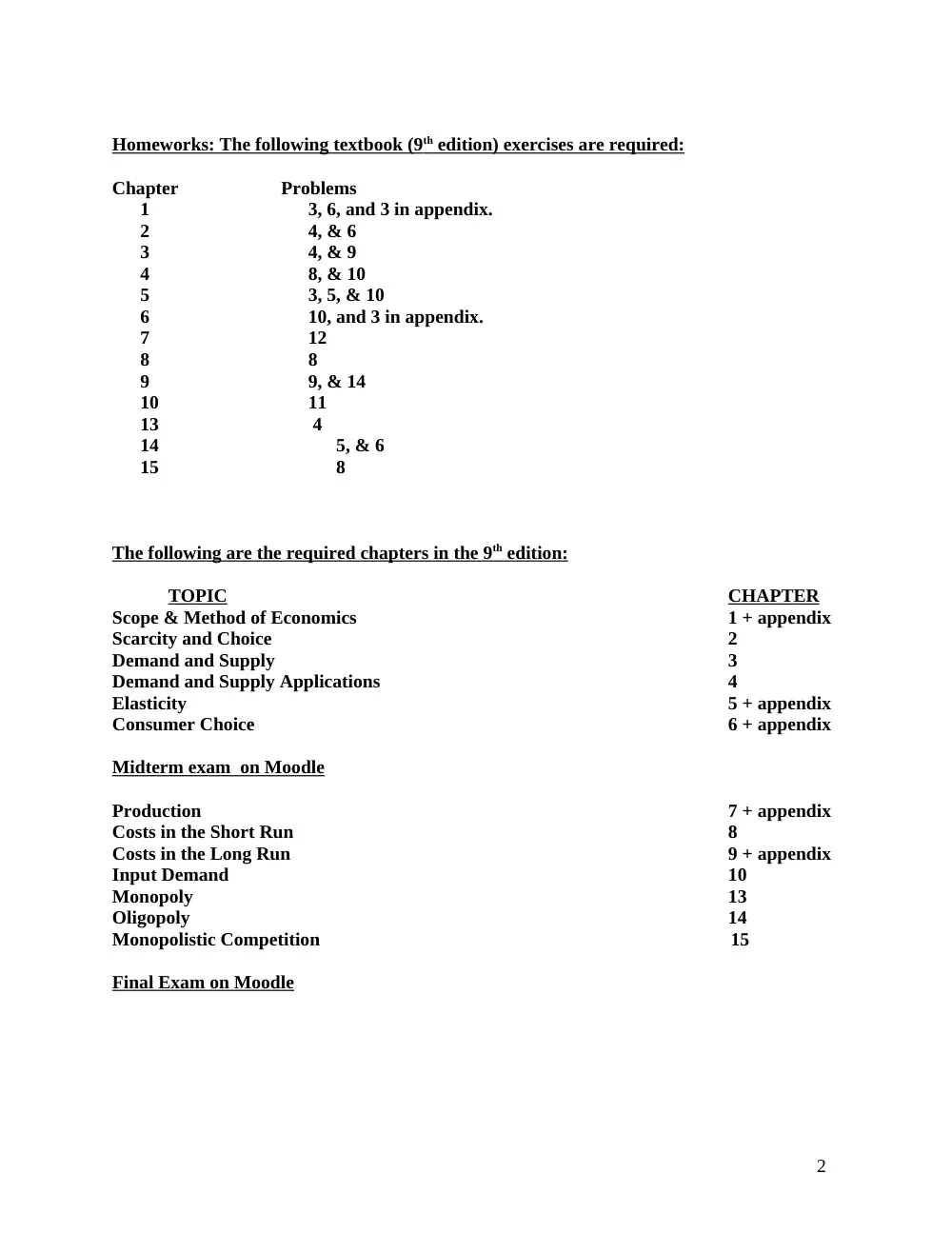
Homeworks: The following textbook (9
th edition) exercises are required:
Chapter Problems
1
3, 6, and 3 in appendix.
2
4, & 6
3
4, & 9
4
8, & 10
5
3, 5, & 10
6
10, and 3 in appendix.
7
12
8
8
9
9, & 14
10
11
13 4
14
5, & 6
15
8
The following are the required chapters in the 9
th edition:
TOPIC
CHAPTER
Scope & Method of Economics
1 + appendix
Scarcity and Choice
2
Demand and Supply
3
Demand and Supply Applications
4
Elasticity
5 + appendix
Consumer Choice
6 + appendix
Midterm exam on Moodle
Production
7 + appendix
Costs in the Short Run
8
Costs in the Long Run
9 + appendix
Input Demand 10
Monopoly
13
Oligopoly
14
Monopolistic Competition 15
Final Exam on Moodle
2
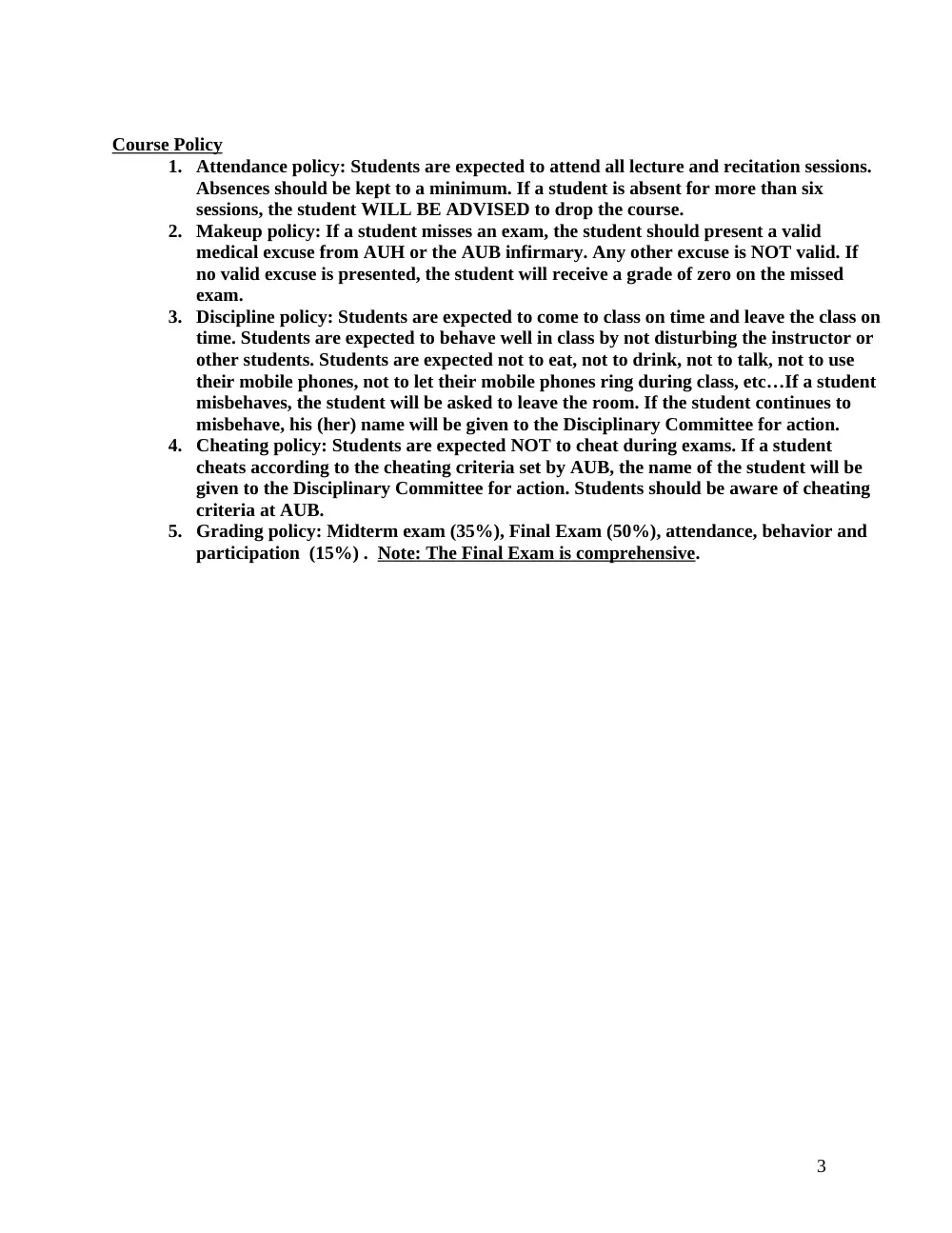
Course Policy
1. Attendance policy: Students are expected to attend all lecture and recitation sessions.
Absences should be kept to a minimum. If a student is absent for more than six
sessions, the student WILL BE ADVISED to drop the course.
2. Makeup policy: If a student misses an exam, the student should present a valid
medical excuse from AUH or the AUB infirmary. Any other excuse is NOT valid. If
no valid excuse is presented, the student will receive a grade of zero on the missed
exam.
3. Discipline policy: Students are expected to come to class on time and leave the class on
time. Students are expected to behave well in class by not disturbing the instructor or
other students. Students are expected not to eat, not to drink, not to talk, not to use
their mobile phones, not to let their mobile phones ring during class, etc…If a student
misbehaves, the student will be asked to leave the room. If the student continues to
misbehave, his (her) name will be given to the Disciplinary Committee for action.
4. Cheating policy: Students are expected NOT to cheat during exams. If a student
cheats according to the cheating criteria set by AUB, the name of the student will be
given to the Disciplinary Committee for action. Students should be aware of cheating
criteria at AUB.
5. Grading policy: Midterm exam (35%), Final Exam (50%), attendance, behavior and
participation (15%) . Note: The Final Exam is comprehensive.
3