
EDUC 230 Final, Fall 2010
American University of Beirut · Instructional Procedures · 10 pages




More EDUC 230 files
Show the text of this final exam
.
Educ230 EXAMINATION
Answer all questions on the accompanying answer sheet. Where a list of options is given, each
option should be used only once.
(1) Mass public schooling in Europe came about mainly because
(a) of the need for educated bureaucrats.
(b) education came to be seen as a public good.
(c) of the growing need for a technical cadre in industry.
(d) religious institutions wanted to train more clergy.
List for Questions (2)-(5):
(a) Stage of Formalism
(b) Dame School Stage
(c) Stage of Meaning
(d) Stage of Transition
(2) High-stakes examinations emerge during this stage as a means of controlling the flow of pupils to
the next educational level.
(3) The professionalisation of teaching tends to create tensions with the State authorities during this
stage.
(4) This stage is characterised by a wide range of curricula to suit every learner’s needs.
(5) At this stage, curricula are rudimentary and the educational experience tends to be weakly
structured.
(6) In applying the Skinnerian model of conditioning to classroom teaching and learning, a question
asked by a teacher is a(n)
(a) stimulus.
(b) response.
(c) reinforcement.
(d) association.
(7) Which topic would lend itself most to the use of simple operant conditioning-based methods?
(a) spelling
(b) balancing chemical equations
(c) interpreting poetry
(d) presenting statistics
(8) An example of a symbolic reward in a primary school classroom is
(a) giving children sweets when they finish their work.
(b) letting the children play quietly for the last ten minutes of the period when they have worked
well.
(c) telling the class a funny story which makes them laugh.
(d) writing ‘Excellent’ on a child’s workbook when they have done a good job.
(9) A class has been unsettled during a maths period and the teacher decides to keep them in during
recess. From a conditioning perspective, it is inadvisable for her to
(a) make them sit quietly doing nothing.
(b) spend the time lecturing them about their behaviour.
(c) set them extra maths work during this time.
(d) threaten to keep them in again if they do not behave well next time.
Match the language skills in Questions (10)-(13) with these Piagetian stages:
(a) concrete operational stage
(b) formal operational stage
(c) sensorimotor stage
(d) pre-operational stage
(10) describing a picture using simple nouns and adjectives
(11) arguing an abstract case using appropriate vocabulary
(12) applying grammatical rules systematically
(13) using rudimentary vocabulary in unstructured sentences
Match the tasks presented in Questions (14)-(17) with these Bloom levels:
(a) Level 3
(b) Level 4
(c) Level 5
(d) Level 6
(14) “From your reading of these examples, write down three characteristics of sonnets.”
(15) “Distinguish between the concepts of ‘socialism’ and ‘communism’.”
(16) “Explain the fluctuations in the price of coffee using the supply and demand model.”
(17) “From these measurements, write a conclusion for this experiment.”
(18) In the information processing model of learning, the term ‘encoding’ refers to
(a) consulting information about a topic already stored in the long-term memory.
(b) assigning a piece of new information to a particular conceptual framework.
(c) forming linkages between new information and existing knowledge.
(d) modifying existing conceptions to be able to incorporate new information.
(19) In the cognitive constructivist model, knowledge is not considered to be from external sources.
This implies that
(a) knowledge needs to be validated by consensus before it is considered valid.
(b) knowledge is only recognised as such when the learner values it.
(c) information is only considered to constitute knowledge when the learner has discovered it for
hin/herself.
(d) information is only considered to constitute knowledge when the learner has given it meaning.
(20) Getting learners to write numbers for addition in columns corresponding to the place value of
the digits is an example of an
(a) academic ritual.
(b) academic custom.
(c) institutional ethos.
(d) institutional culture.
(21) An example of a psychomotor objective would be “At the end of this lesson, students will be
able to...”
(a) apply Pythagoras’ Theorem to problems involving right-angle triangles.
(b) demonstrate the structure of hydrocarbons using ball-and-stick models.
(c) calculate the concentration of a solution from titration data.
(d) appreciate the influence that Arthur Conan Doyle had on the development of the mystery story.
(22) Which of these verbs is generally not a strong one in the context of writing learning outcomes?
(a) state
(b) recognise
(c) list
(d) identify
(23) Which of the following is an example of an informal linkage a teacher could use to introduce a
Grade 5 science lesson on the classification of vertebrates?
(a) The teacher reminds the pupils of what they learned in Grade 4 about animals.
(b) The teacher asks pupils about their last visit to the zoo.
(c) The teacher shows the pupils a video clip from an educational nature series.
(d) The teacher explains to pupils how people have been making use of animals for centuries.
Categorise the Goal Statements in Questions (23)-(26) using this list:
(a) Direct Instruction.
(b) Inductive Method.
(c) Lecture-Discussion.
(d) Concept Attainment.
(24) “Last day, we learned how to make secondary colours. But two purples or greens may not quite
look the same. Today, you are going to find out about shades of secondary colours.”
(25) “Today, you are going to find out by studying maps what types of vegetation are associated with
particular climates.”
(26) “We are going to look today at the development of the model of the atom over the past two
hundred years. I will explain to you how advances in technology affected this process, and then we’ll
get into groups and try to interpret some of the early experiments.”
(27) “Today, you are going to be introduced to how unemployment rates are calculated. Then, you’ll
be applying that method to some sets of figures from various countries.”
Match these descriptors with the preceding list also.
(28) Closure tends to be very short and focuses on highlighting main points of the lesson.
(29) The teacher Presentation tends to be lengthy and usually with a low level of student input.
(30) A prior generalisation is extended or modified in this kind of lesson.
(31) This type of lesson moves from a brief teacher introduction to a student investigation.
(32) The principal function of a summative test is to
(a) supply learners with feedback about their performance so that they can improve in future.
(b) supply teachers with feedback about their students’ performance so they can devise remedial
teaching programmes.
(c) decide whether students have met the academic criteria for passing a unit of work.
(d) decide whether students can be promoted to the next level of formal education.
(33) Which of these is associated with a good diagnostic test?
(a) a very high average score
(b) many students being unable to finish the test in the time given
(c) the students reporting that the test was hard
(d) the significant occurrence of systematic errors
(34) The least useful question type for a diagnostic test is
(a) true-false
(b) multiple choice
(c) short answers
(d) paragraph answers
(35) Which of the following is not advisable when devising a marking key for a topic test?
(a) the use of half marks
(b) awarding 2 or 3 marks for a correct multiple choice answer
(c) awarding partial mark credit for near-correct alternative answers
(d) multiplying the test score by a correcting factor to get a percentage
(36) Which of the following is the principal consideration when evaluating the usefulness of a
foreign textbook for a school following the Lebanese system?
(a) the book having a Teacher’s Edition
(b) the level of curriculum validity
(c) the readability of the text
(d) the presence of student exercises and activities
(37) Which of the following is not related to a textbook’s durability?
(a) binding
(b) cover
(c) paper type
(d) text density
(38) In preparing a passage for a Cloze test, which should never be deleted?
(a) the first word of a sentence
(b) scientific or technical words
(c) any words in the first sentence of a new paragraph
(d) a word central to the meaning of the passage
(39) An example of an entry routine is
(a) pupils placing their bags in a designated spot when coming into the classroom.
(b) teachers beginning a period by checking the attendance register.
(c) making pupils stand when an adult comes into the classroom during the lesson.
(d) writing objectives on the chalkboard for pupils to copy at the start of a lesson.
(40) A teacher who is approached by a student about serious personal problems would be best
advised to practise ‘professional care’ by
(a) refusing to discuss the matter with the student.
(b) telling nobody about the matter.
(c) referring the case to a counsellor or psychologist.
(d) trying to resolve the problem with the student’s family.
(41) The term ‘overfamiliarity’ would be exemplified by a teacher
(a) being on first-name terms with senior students.
(b) having dealings with some students outside the school in the context of community activities.
(c) being related to a student.
(d) having social interactions with a student’s parents.
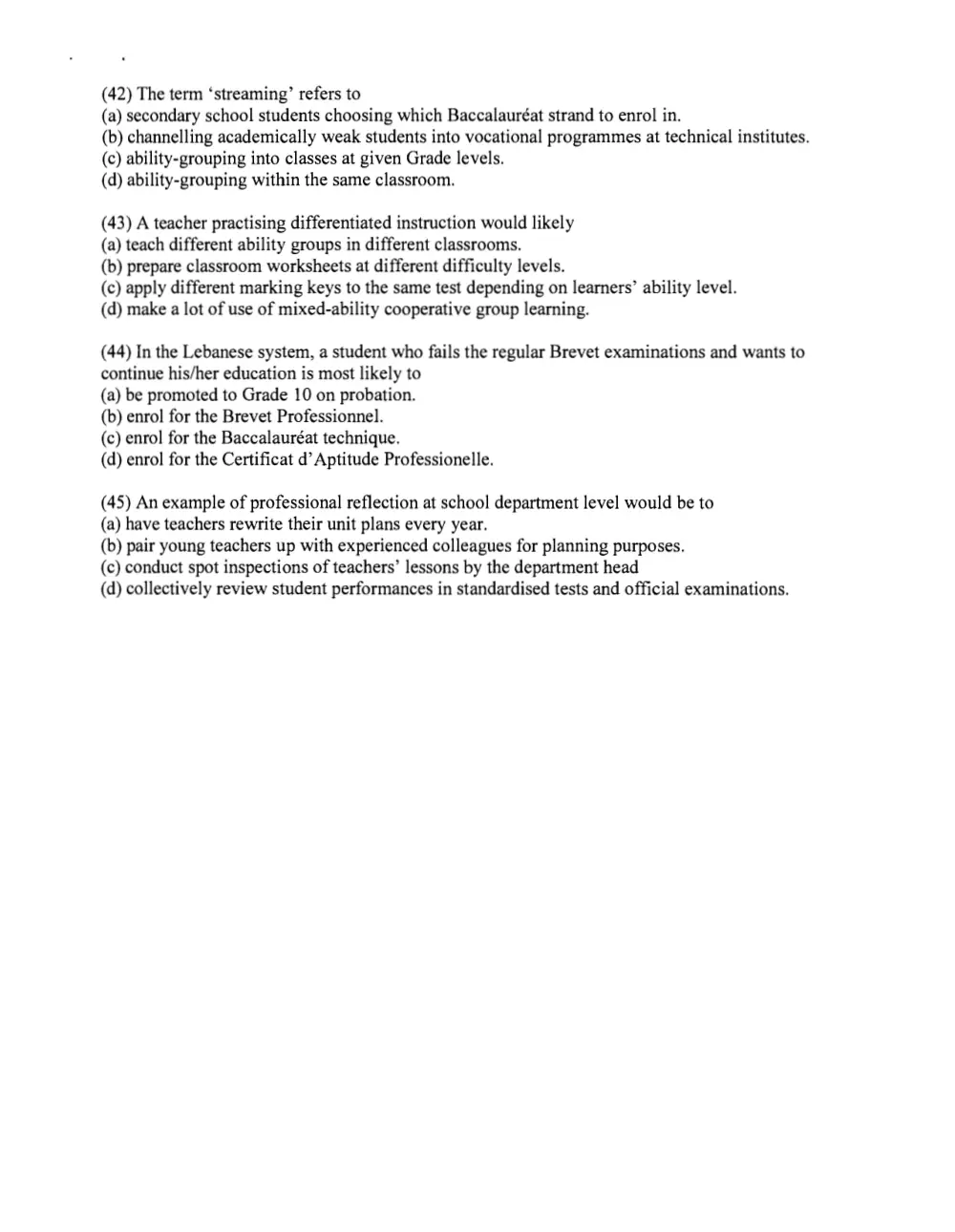
(42) The term ‘streaming’ refers to
(a) secondary school students choosing which Baccalauréat strand to enrol in.
(b) channelling academically weak students into vocational programmes at technical institutes.
(c) ability-grouping into classes at given Grade levels.
(d) ability-grouping within the same classroom.
(43) A teacher practising differentiated instruction would likely
(a) teach different ability groups in different classrooms.
(b) prepare classroom worksheets at different difficulty levels.
(c) apply different marking keys to the same test depending on learners’ ability level.
(d) make a lot of use of mixed-ability cooperative group learning.
(44) In the Lebanese system, a student who fails the regular Brevet examinations and wants to
continue his/her education is most likely to
(a) be promoted to Grade 10 on probation.
(b) enrol for the Brevet Professionnel.
(c) enrol for the Baccalauréat technique.
(d) enrol for the Certificat d’ Aptitude Professionelle.
(45) An example of professional reflection at school department level would be to
(a) have teachers rewrite their unit plans every year.
(b) pair young teachers up with experienced colleagues for planning purposes.
(c) conduct spot inspections of teachers’ lessons by the department head
(d) collectively review student performances in standardised tests and official examinations.
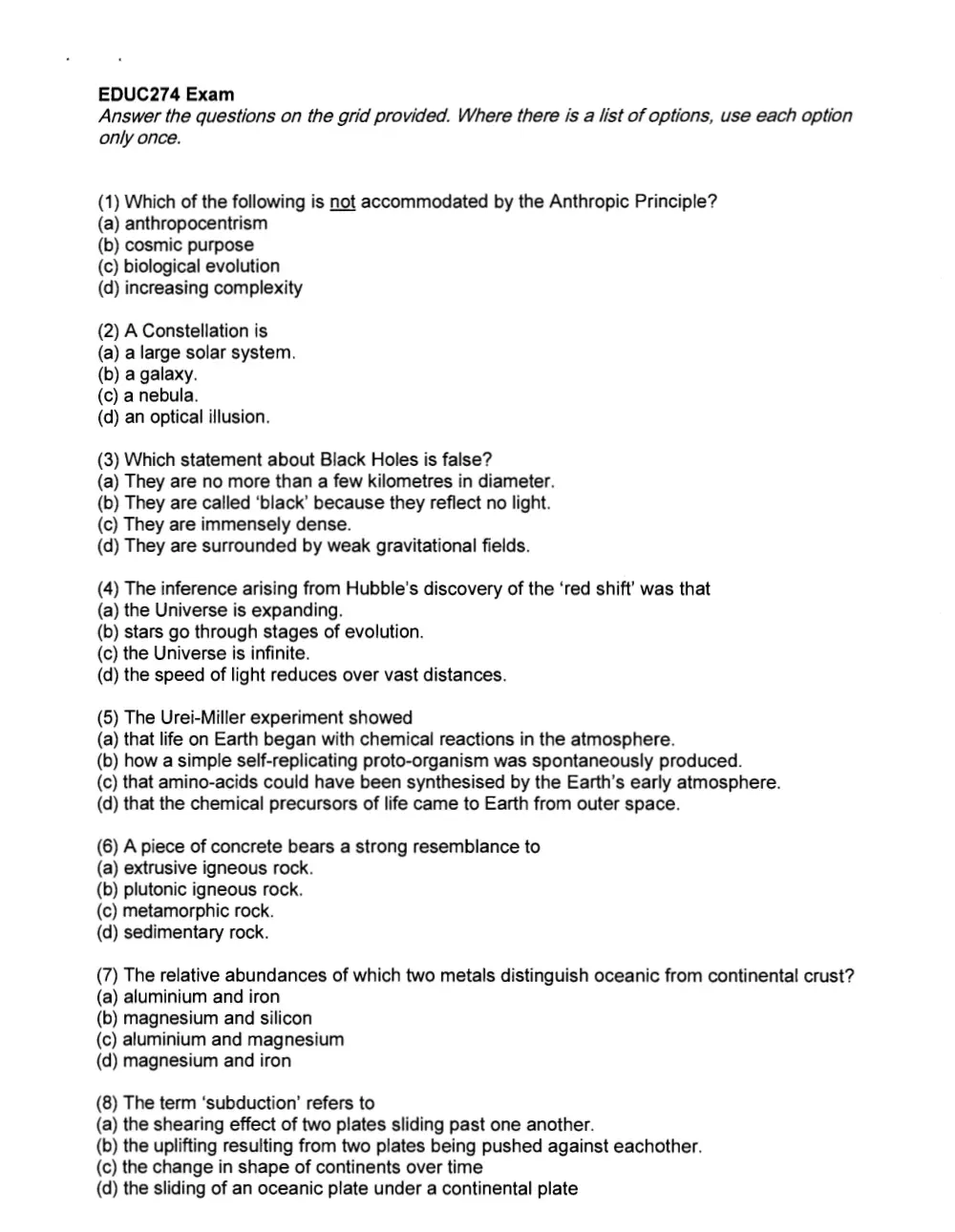
EDUC274 Exam
Answer the questions on the grid provided. Where there is a list of options, use each option
only once.
(1) Which of the following is not accommodated by the Anthropic Principle?
(a) anthropocentrism
(b) cosmic purpose
(c) biological evolution
(d) increasing complexity
(2) A Constellation is
(a) a large solar system.
(b) a galaxy.
(c) a nebula.
(d) an optical illusion.
(3) Which statement about Black Holes is false?
(a) They are no more than a few kilometres in diameter.
(b) They are called ‘black’ because they reflect no light.
(c) They are immensely dense.
(d) They are surrounded by weak gravitational fields.
(4) The inference arising from Hubble's discovery of the ‘red shift’ was that
(a) the Universe is expanding.
(b) stars go through stages of evolution.
(c) the Universe is infinite.
(d) the speed of light reduces over vast distances.
(5) The Urei-Miller experiment showed
(a) that life on Earth began with chemical reactions in the atmosphere.
(b) how a simple self-replicating proto-organism was spontaneously produced.
(c) that amino-acids could have been synthesised by the Earth’s early atmosphere.
(d) that the chemical precursors of life came to Earth from outer space.
(6) A piece of concrete bears a strong resemblance to
(a) extrusive igneous rock.
(b) plutonic igneous rock.
(c) metamorphic rock.
(d) sedimentary rock.
(7) The relative abundances of which two metals distinguish oceanic from continental crust?
(a) aluminium and iron
(b) magnesium and silicon
(c) aluminium and magnesium
(d) magnesium and iron
)
) the shearing effect of two plates sliding past one another.
) the uplifting resulting from two plates being pushed against eachother.
) the change in shape of continents over time
) the sliding of an oceanic plate under a continental plate
(9) Seafloor spreading occurs at
(a) mid-ocean ridges in the middle of plates.
(b) oceanic trenches in the middle of plates.
(c) mid-ocean ridges at the edge of plates.
(d) oceanic trenches at the edge of plates.
(10) Which of the following is not evidence of continental drift?
(a) the presence of related plant and animal species in continents separated by oceans
(b) the similarity of soil types in different continents
(c) the measurable growth of some oceans and shrinkage of others
(d) the complementarity of the outlines of Africa and South America
(11) Which of the following descriptors is wrongly matched with the Képpen classification?
(a) Type A — wet tropical
(b) Type B — hot deserts
(c) Type C — humid temperate
(d) Type D — polar regions
(12) Typical Mediterranean clouds are made up of
(a) water vapour.
(b) ice crystals.
(c) condensed droplets.
(d) snow flakes.
(13) In the context of the water cycle, ‘transpiration’ is the water that evaporates from
(a) bare ground.
(b) animal skins.
(c) plant leaves.
(d) lakes and rivers.
(14) Which of these is not a physical weathering process?
(a) mass movement
(b) solution of soluble minerals
(c) sand-blasting
(d) action of carbonic acid on minerals.
(15) The highest concentration of humus in a soil profile is found in the
(a) topsoil.
(b) subsoil.
(c) weathering zone.
(d) parent material.
(16) A vertosol is very high in
(a) sand.
(b) clay.
(c) silt.
(d) humus.
(17) A student writes, “Fauitflies an scientifically lle Drosophila Melanogaster. ”
This way this statement is written is
(a) correct.
(b) wrong because ‘Drosophila’ should not be capitalised.
(c) wrong because ‘Melanogaster’ should not be capitalised.
(d) wrong because the name of the species should be underlined.
LIST for questions (18)-(21):
(a) Gymnosperms__(b) Bryophytes (c) Angiosperms _ (d) Pteridophytes
(18) These plants are non-vascular.
(19) The sexual phase of these plants is an independent organism.
(20) These plants include monocotyledons and dicotyledons.
(21) These plants produce cones as sexual structures.
LIST for questions (22)-(25):
(a) Arthropods (b) Annelids (c) Coelenterates (d) Molluscs
(22) This Phylum includes jellyfish.
(23) This Phylum includes octopi.
(24) This Phylum includes millipedes.
(25) This Phylum includes earthworms.
LIST for questions (26)-(29):
(a) Amphibia (b) Mammalia (c) Reptilia (d) Aves
(26) Bats are examples of this Class.
(27) Toads are examples of this Class.
(28) Lizards are examples of this Class.
(29) Ostriches are examples of this Class.
LIST for questions (30)-(33):
(a) taiga (b) deciduous forest (c) sclerophyllous forest (d) savanna
(30
(31
(32
(33
This biome is dominated by tall fibrous grasses.
This biome is dominated by tall coniferous trees.
This biome is dominated by shrubs and small trees with leathery leaves.
This biome is dominated by trees which drop their leaves in autumn.
Sera
(34) A plant with leaves reduced to spines and water-storing tissues in the stem would likely
bea
(a) mesophyte.
(b) halophyte.
(c) xerophyte.
(d) hygrophyte.
(35) The statement, “The whale shark inhabits warm pelagic waters” describes this species’
(a) habitat.
(b) community.
(c) ecosystem.
(d) niche.
(36) Enzymes are examples of
(a) carbohydrates.
(b) lipids.
(c) proteins.
(d) porphyrins.
(37) The food chain grass — cow<« human < flea
(a) is correct.
(b) is wrong because the arrows are the wrong way round.
(c) is wrong because cows eat foods other than grass.
(d) is wrong because there should not be a parasite in a food chain.
(38) An ecologist estimating the green biomass of trees in a dense forest over a period of
time is probably trying to gain a measure of
(a) producer biomass.
(b) consumer biomass.
(Cc) gross primary production.
(d) net primary production.
(39) In the Carbon Cycle, the main reservoir from which carbon enters food chains is
(a) carbon dioxide in air and water
(b) hydrocarbons in fossil fuels
(c) carbohydrates in plant tissues.
(d) proteinaceous compounds in microbes.
(40) Which of the following is not an aspect of the Kyoto Protocol?
(a) a halt to industrial expansion
(b) lowering CO2 emissions to 1990 levels
(c) the trading of carbon credits
(d) emissions of greenhouse gases other than CO2 such as methane
(41) Which of the following stages of the Nitrogen Cycle involves the action of
chemoautotropic micro-organisms?
(a) the synthesis of nitrate in moist air by lightning
(b) the conversion of nitrogen gas to amino-acids in legume roots
(c) the decomposition of organic material to produce ammonia
(d) the transfer of organic nitrogen compounds from plants to animals
(42) For which of the following organisms would density be a more useful indicator of
population size than actual number?
(a) mosquitoes
(b) camels
(c) elephants
(d) cedars
(43) A seagull population is estimated at 20,000 at the start of a measurement period of one
year. About 4000 chicks are hatched during the breeding season. Total mortality for the
population is about 5000 birds. The natural growth rate of this population is about
(a) 20%
(b) 5%
(c) -5%
(d) -25%
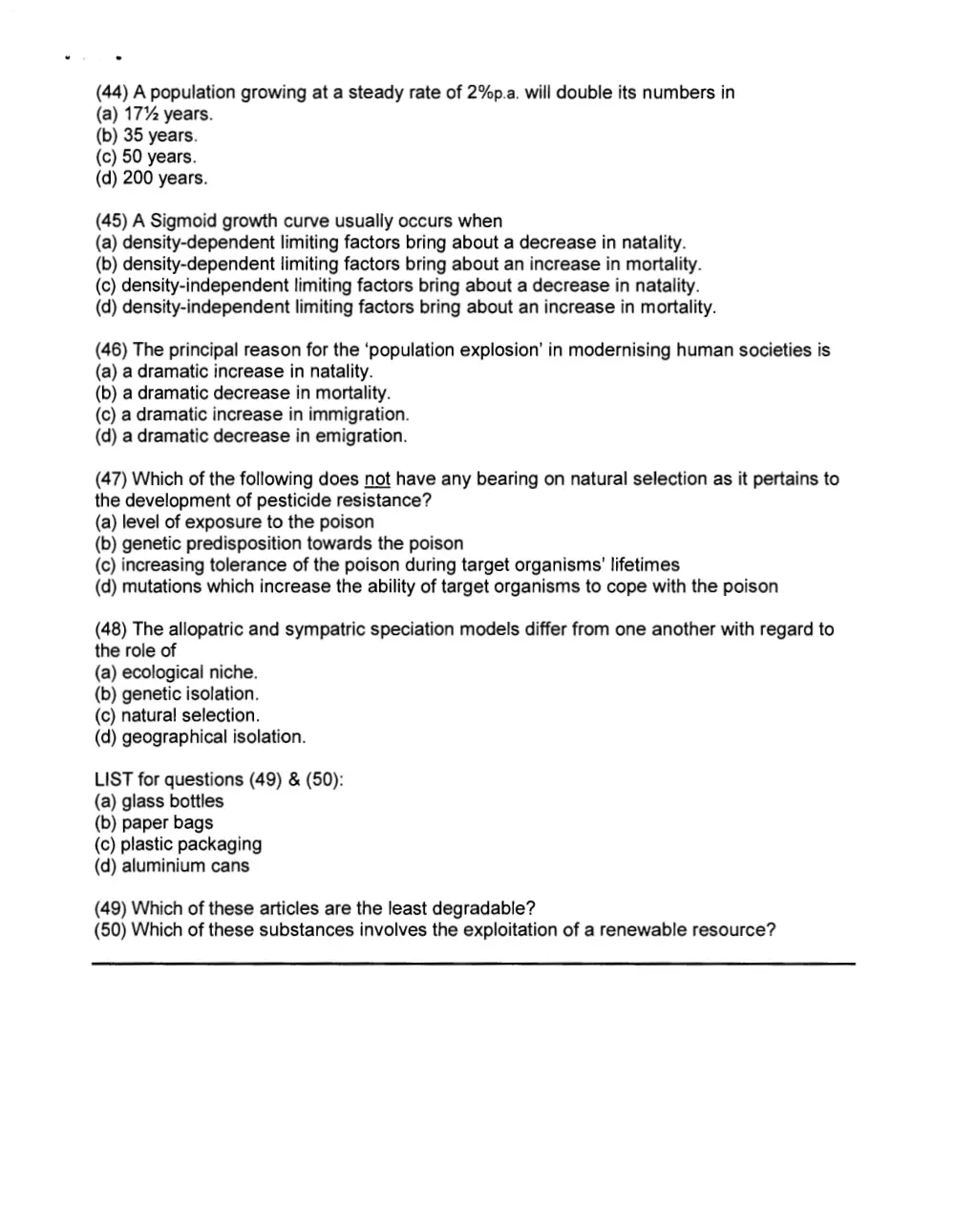
(44) A population growing at a steady rate of 2%p.a. will double its numbers in
(a) 17% years.
(b) 35 years.
(c) 50 years.
(d) 200 years.
(45) A Sigmoid growth curve usually occurs when
(a) density-dependent limiting factors bring about a decrease in natality.
(b) density-dependent limiting factors bring about an increase in mortality.
(c) density-independent limiting factors bring about a decrease in natality.
(d) density-independent limiting factors bring about an increase in mortality.
(46) The principal reason for the ‘population explosion’ in modernising human societies is
(a) a dramatic increase in natality.
(b) a dramatic decrease in mortality.
(c) a dramatic increase in immigration.
(d) a dramatic decrease in emigration.
(47) Which of the following does not have any bearing on natural selection as it pertains to
the development of pesticide resistance?
(a) level of exposure to the poison
(b) genetic predisposition towards the poison
(c) increasing tolerance of the poison during target organisms’ lifetimes
(d) mutations which increase the ability of target organisms to cope with the poison
(48) The allopatric and sympatric speciation models differ from one another with regard to
the role of
(a) ecological niche.
(b) genetic isolation.
(c) natural selection.
(d) geographical isolation.
LIST for questions (49) & (50):
(a) glass bottles
(b) paper bags
(c) plastic packaging
(d) aluminium cans
(49) Which of these articles are the least degradable?
(50) Which of these substances involves the exploitation of a renewable resource?