
EDUC 230 Final, Fall 2010
American University of Beirut · Instructional Procedures · 7 pages

More EDUC 230 files
Show the text of this final exam
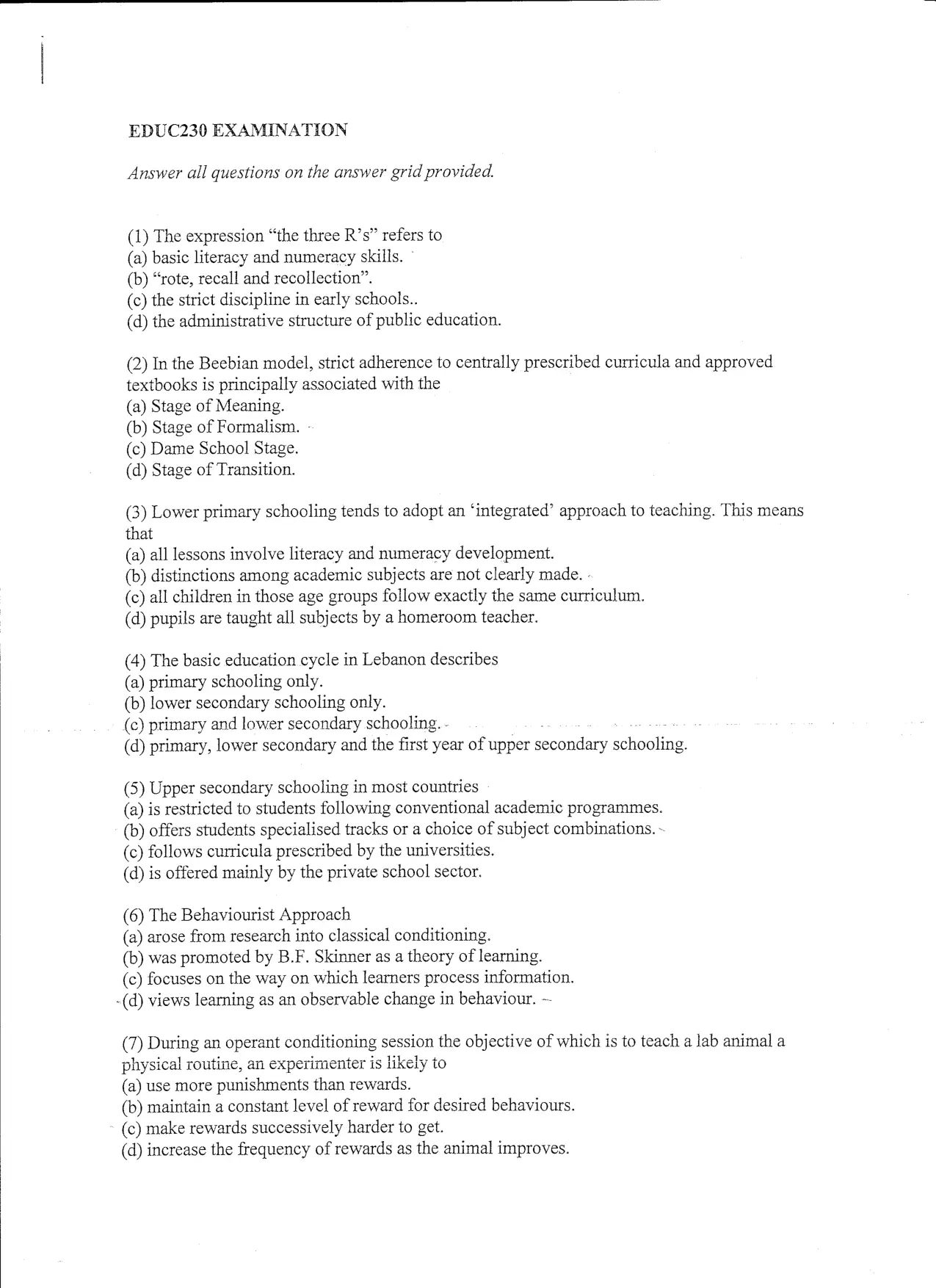
EDUC230 EXAMINATION
Answer all questions on the answer grid provided.
(1) The expression “the three R’s” refers to
(a) basic literacy and numeracy skills. ©
(b) “rote, recall and recollection”.
(c) the strict discipline in early schools..
(d) the administrative structure of public education.
2) In the Beebian model, strict adherence to centrally prescribed curricula and approved
textbooks is principally associated with the
a) Stage of Meaning.
b) Stage of Formalism. ~
c) Dame School Stage.
d) Stage of Transition.
3) Lower primary schooling tends to adopt an ‘integrated’ approach to teaching. This means
that
(a) all lessons involve literacy and numeracy development.
b) distinctions among academic subjects are not clearly made. -
(c) all children in those age groups follow exactly the same curriculum.
(d) pupils are taught all subjects by a homeroom teacher.
(4) The basic education cycle in Lebanon describes
(a) primary schooling only.
(b) lower secondary schooling only.
(c) primary and lower secondary schooling. - a.
(d) primary, lower secondary and the first year of upper secondary schooling
(5) Upper secondary schooling in most countries -
(a) is restricted to students following conventional academic programmes.
(b) offers students specialised tracks or a choice of subject combinations. ~
(c) follows curricula prescribed by the universities.
(d) is offered mainly by the private school sector.
6) The Behaviourist Approach
(a) arose from research into classical conditioning.
b) was promoted by B.F. Skinner as a theory of learning.
c) focuses on the way on which learners process information.
-(d) views learning as an observable change in behaviour. --
7) During an operant conditioning session the objective of which is to teach a Jab animal a
physical routine, an experimenter is likely to
(a) use more punishments than rewards.
(b) maintain a constant level of reward for desired behaviours.
~ (c) make rewards successively harder to get.
(d) increase the frequency of rewards as the animal improves.
(8) A child who says that a narrow tall container has more water than a wide short one even
after seeing the researcher pour the same amount of water into each is probably at the
Piagetian
(a) formal operational stage.
(b) sensorimotor stage.
(c) concrete operational stage.
--(d) preoperational stage.
Answer options for Questions (9) ~ (12): (using the revised taxonomy; each may be used only
once) A
(a) Bloom 3°."
(b) Bloom 4. *
(c) Bloom 5 =
(d) Bloom 6
Classify these tasks:
(9) Does the portrayal of the main female character in Thomas Hardy’s “Far From the
Madding Crowd” conform to the stereotype of the submissive Victorian woman?
(10) Use the longitude/latitude coordinate system to describe the locations of these cities. ~
(11) Add captions to these cartoons so that they tell a story.
(12) Use these maps of climatic zones and vegetation zones to work out which vegetation
type generally goes with which climatic type.
(13) In the revised Bloom taxonomy, being able to relate an observation to a discrete cause is
an instance of
(a) Understanding.
(b) Application.
(c) Analysis.
(d) Evaluation.
(14) Which order of events in the cognitive processing model is correct?
(a) retrieval — perception — assimilation — encoding
(b) perception ~ retrieval — encoding — assimilation
(c) encoding — perception -- retrieval — assimilation
(d) assimilation ~ retrieval —perception — encoding
(15) In the constructivist model, information becomes ‘knowledge’ only when
(a) linkages have been formed between it and information acquired previously.
(b) the learner gives the new information meaning.
(c) the ‘mental model’ into which the information is assimilated is not an Alternative
Framework.
(d) the learner’s conceptual framework has undergone accommodation. *,
(16) The “customs, social and cultural, of a particular community and its ways of operating”
describe
(a) the institutional ethos of a school as an academic community.
(b) behavioural norms associated with specific school subjects. «.
(c) a community of practice.
(d) cooperative group learning.
me
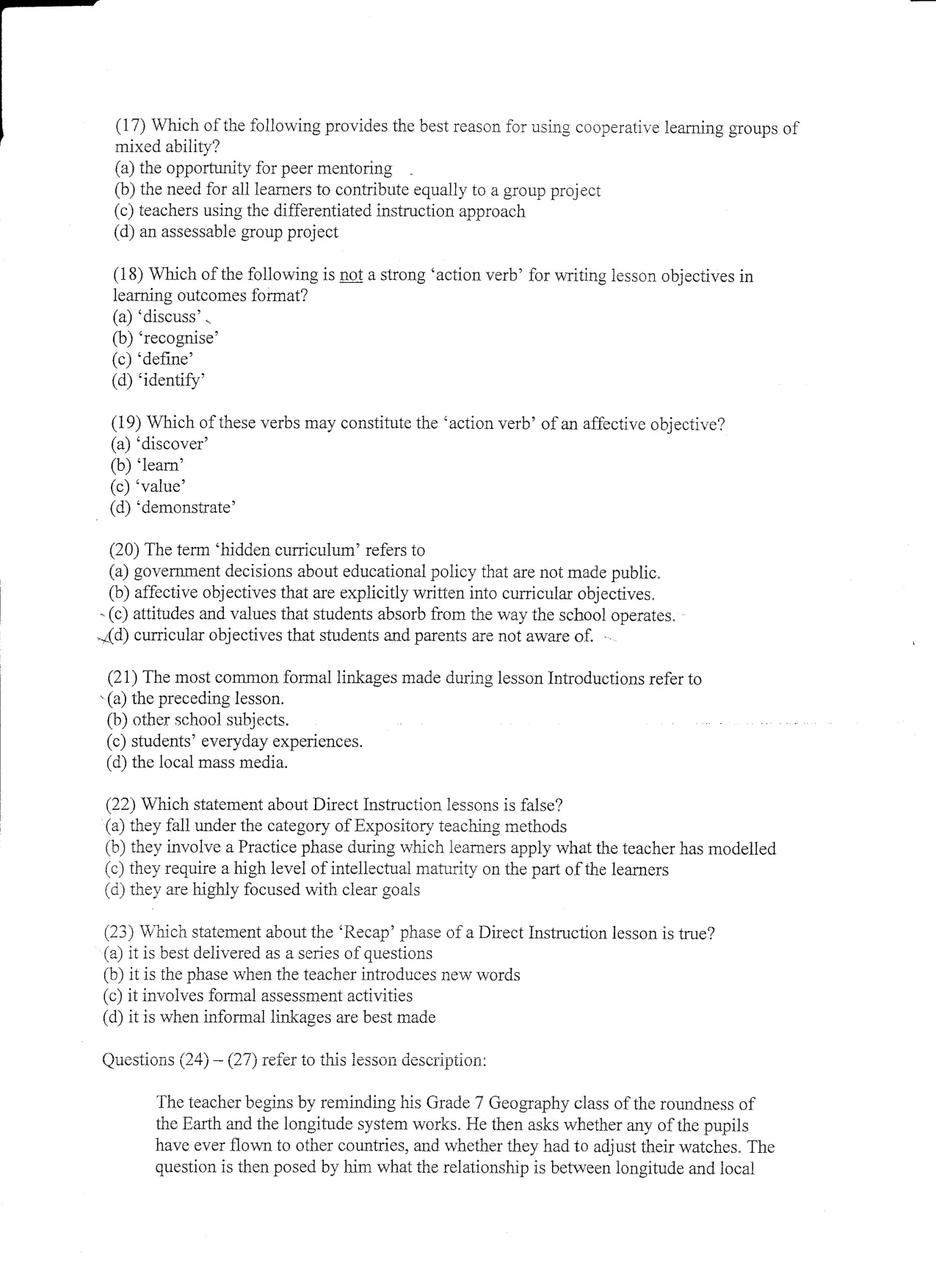
(17) Which of the following provides the best reason for using cooperative learning groups of
mixed ability?
(a) the opportunity for peer mentoring
(b) the need for all learners to contribute equally to a group project
(c) teachers using the differentiated instruction approach
(d) an assessable group project
(18) Which of the following is not a strong ‘action verb’ for writing lesson objectives in
learning outcomes format?
(a) ‘discuss’ .
(b) ‘recognise’
(c) ‘define’
(d) ‘identify’
(19) Which of these verbs may constitute the ‘action verb’ of an affective objective?
(a) ‘discover’
(b) ‘learn’
(c) ‘value’
(d) ‘demonstrate’
20) The term ‘hidden curriculum’ refers to
a) government decisions about educational policy that are not made public.
(b) affective objectives that are explicitly written into curricular objectives.
c) attitudes and values that students absorb from the way the school operates. -
4d) curricular objectives that students and parents are not aware of. -..
21) The most common formal linkages made during lesson Introductions refer to
~(a) the preceding lesson.
(b) other school subjects.
(c) students’ everyday experiences.
(d) the local mass media.
(22) Which statement about Direct Instruction lessons is false?
(a) they fall under the category of Expository teaching methods
(b) they involve a Practice phase during which learners apply what the teacher has modelled
(c) they require a high level of intellectual maturity on the part of the learners
(d) they are highly focused with clear goals
(23) Which statement about the ‘Recap’ phase of a Direct Instruction lesson is true?
(a) it is best delivered as a series of questions
(b) it is the phase when the teacher introduces new words
(c) it involves formal assessment activities
(d) it is when informal linkages are best made
Questions (24) — (27) refer to this lesson description:
The teacher begins by reminding his Grade 7 Geography class of the roundness of
the Earth and the longitude system works. He then asks whether any of the pupils
have ever flown to other countries, and whether they had to adjust their watches. The
question is then posed by him what the relationship is between longitude and local
time. The students are put into cooperative learning groups and are given local times
for a series of cities across the globe. The task sheet requires them to draw up a table
of longitudes and local times and then asks them to work out a formula for local time
based on the 0° longitude meridian. After a while, the teacher questions groups about
their findings. Through class discussion, the conclusion is reached that time is added
when travelling east and subtracted when travelling west, and that every 15° of
longitude involves a time change of 1 hour. The teacher finally introduces the class
to the GMT (Greenwich Mean Time) system and regional time zones.
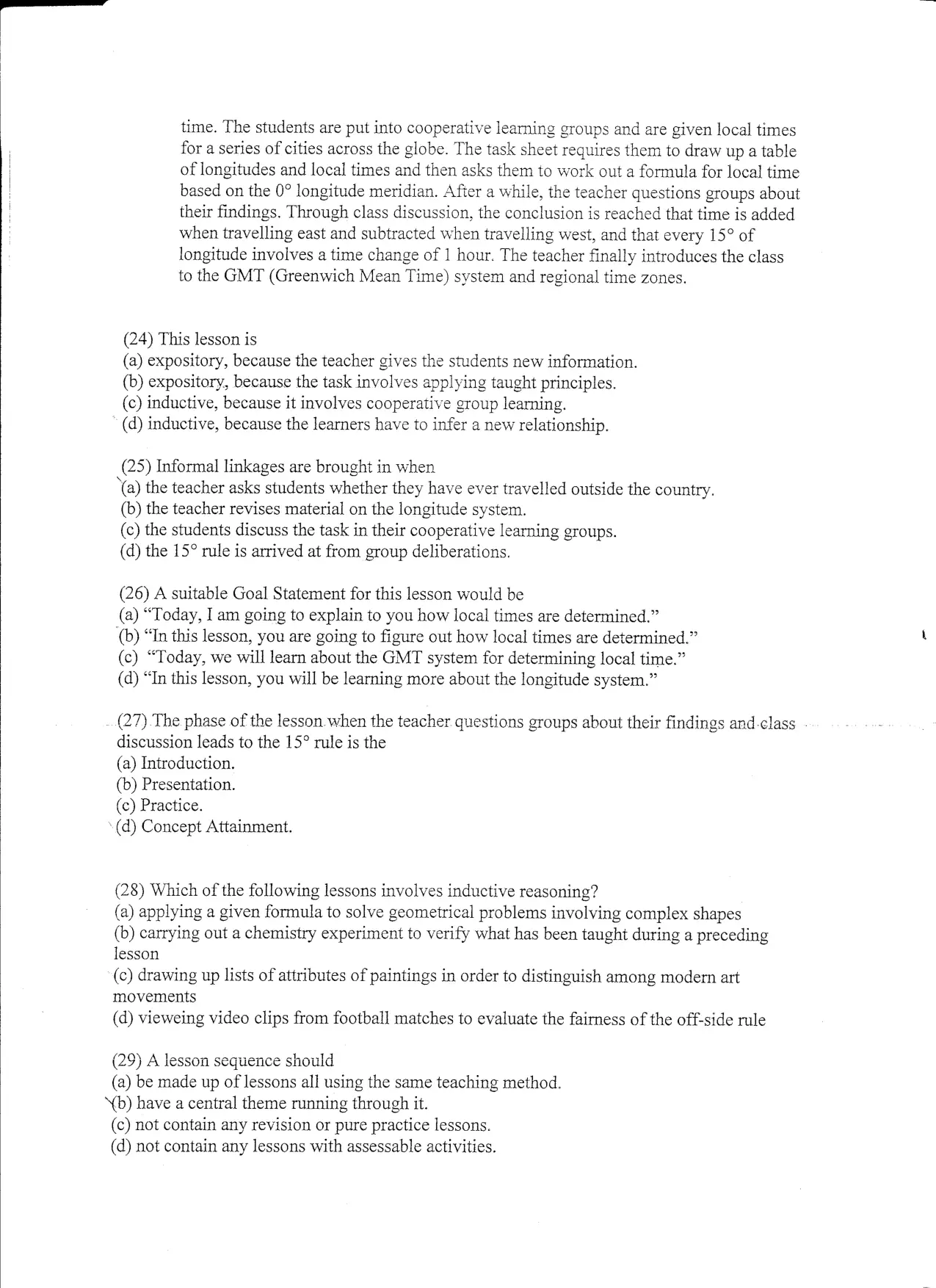
(24) This lesson is
(a) expository, because the teacher gives the students new information.
(b) expository, because the task involves applying taught principles.
(c) inductive, because it involves cooperative group learning.
' (d) inductive, because the learners have to infer a new relationship.
(25) Informal linkages are brought in when
‘(a) the teacher asks students whether they have ever travelled outside the country.
(b) the teacher revises material on the longitude system.
(c) the students discuss the task in their cooperative learning groups.
(d) the 15° rule is arrived at from group deliberations.
(26) A suitable Goal Statement for this lesson would be
(a) “Today, I am going to explain to you how local times are determined.”
(b) “In this lesson, you are going to figure out how local times are determined.”
(c) “Today, we will learn about the GMT system for determining local time.”
(d) “In this lesson, you will be learning more about the longitude system.”
. (27).The phase of the lesson. when the teacher questions groups about their findings and-class -
discussion leads to the 15° rule is the
(a) Introduction.
(b) Presentation.
(c) Practice.
“(d) Concept Attainment.
(28) Which of the following lessons involves inductive reasoning?
(a) applying a given formula to solve geometrical problems involving complex shapes
(b) carrying out a chemistry experiment to verify what has been taught during a preceding
lesson
(c) drawing up lists of attributes of paintings in order to distinguish among modern art
movements
(d) vieweing video clips from football matches to evaluate the fairness of the off-side rule
(29) A lesson sequence should
(a) be made up of lessons all using the same teaching method.
\(b) have a central theme running through it.
(c) not contain any revision or pure practice lessons.
(d) not contain any lessons with assessable activities.
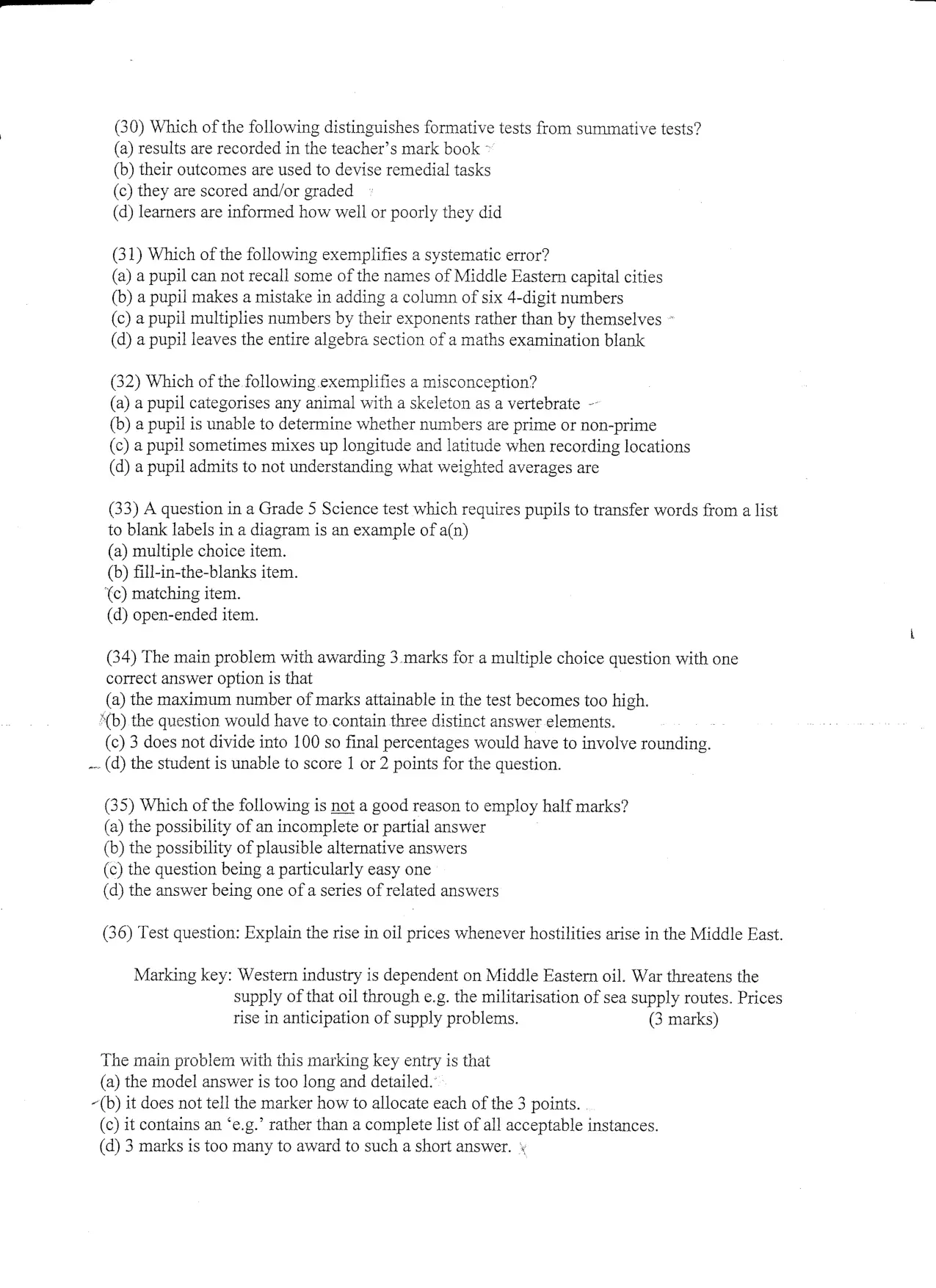
(30) Which of the following distinguishes formative tests from summative tests?
(a) results are recorded in the teacher’s mark book *
(b) their outcomes are used to devise remedial tasks
(c) they are scored and/or graded
(d) learners are informed how well or poorly they did
(31) Which of the following exemplifies a systematic error?
(a) a pupil can not recall some of the names of Middle Eastern capital cities
(b) a pupil makes a mistake in adding a column of six 4-digit numbers
(c) a pupil multiplies numbers by their exponents rather than by themselves ~
(d) a pupil leaves the entire algebra section of a maths examination blank
(32) Which of the following exemplifies a misconception?
(a) a pupil categorises any animal with a skeleton as a vertebrate -
(b) a pupil is unable to determine whether numbers are prime or non-prime
(c) a pupil sometimes mixes up longitude and latitude when recording locations
(d) a pupil admits to not understanding what weighted averages are
(33) A question in a Grade 5 Science test which requires pupils to transfer words from a list
to blank labels in a diagram is an example of a(n)
(a) multiple choice item.
(b) fill-in-the-blanks item.
‘(c) matching item.
(d) open-ended item.
(34) The main problem with awarding 3.marks for a multiple choice question with one
correct answer option is that
(a) the maximum number of marks attainable in the test becomes too high.
*(b) the question would have to contain three distinct answer elements.
(c) 3 does not divide into 100 so final percentages would have to involve rounding.
.- (d) the student is unable to score | or 2 points for the question.
(35) Which of the following is not a good reason to employ half marks?
(a) the possibility of an incomplete or partial answer
(b) the possibility of plausible alternative answers
(c) the question being a particularly easy one
(d) the answer being one ofa series of related answers
(36) Test question: Explain the rise in oil prices whenever hostilities arise in the Middle East.
Marking key: Western industry is dependent on Middle Eastern oil. War threatens the
supply of that oil through e.g. the militarisation of sea supply routes. Prices
rise in anticipation of supply problems. (3 marks)
The main problem with this marking key entry is that
(a) the model answer is too long and detailed.’
~(b) it does not tell the marker how to allocate each of the 3 points. .
(c) it contains an ‘e.g.’ rather than a complete list of all acceptable instances.
(d) 3 marks is too many to award to such a short answer. ¥
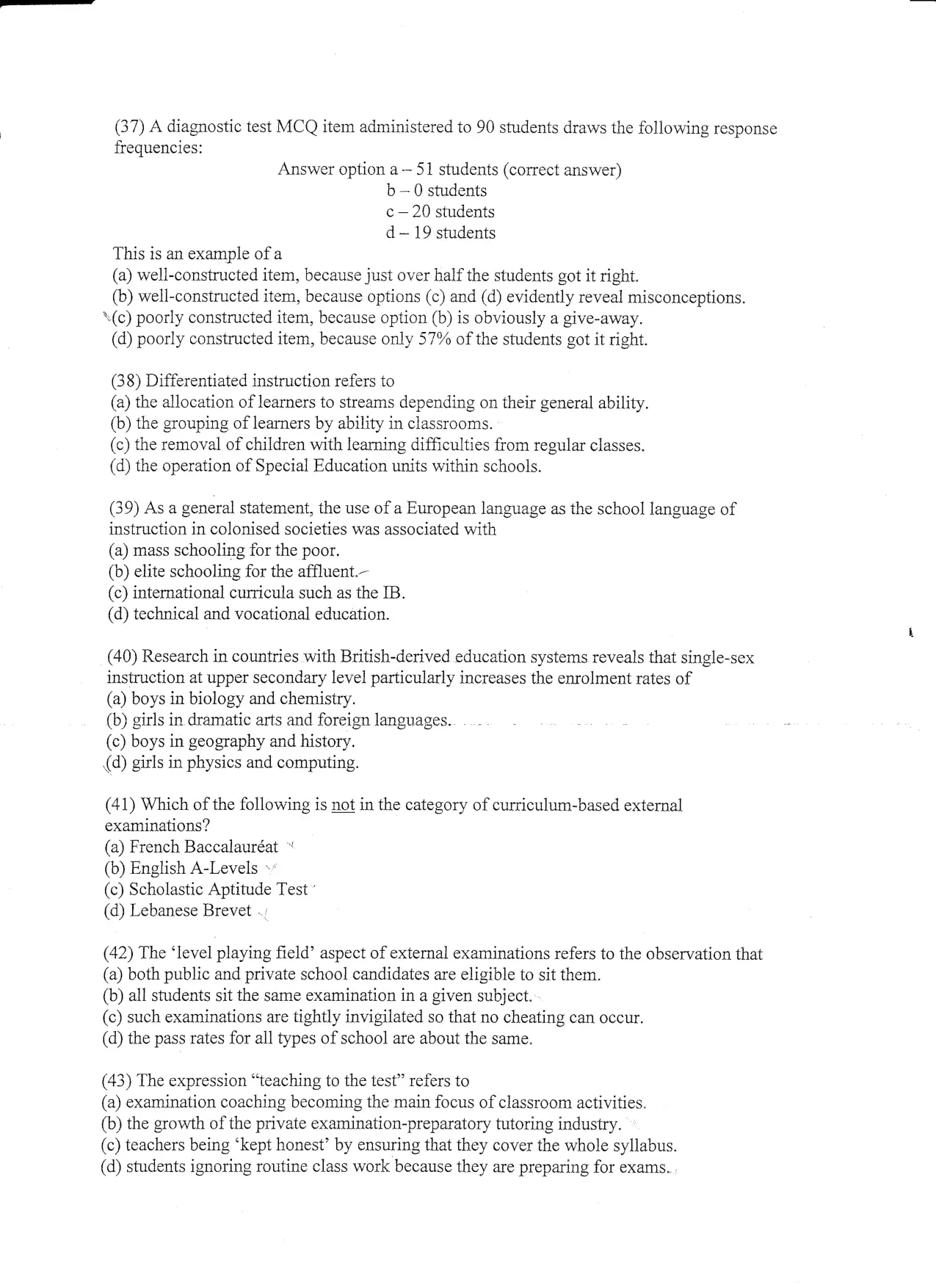
(37) A diagnostic test MCQ item administered to 90 students draws the following response
frequencies:
Answer option a-- 51 students (correct answer)
b — 0 students
c — 20 students
d— 19 students
This is an example ofa
(a) well-constructed item, because just over half the students got it right.
b) well-constructed item, because options (c) and (d) evidently reveal misconceptions.
\(c) poorly constructed item, because option (b) is obviously a give-away.
d) poorly constructed item, because only 57% of the students got it right.
38) Differentiated instruction refers to
a) the allocation of learners to streams depending on their general ability.
(b) the grouping of learners by ability in classrooms. :
(c) the removal of children with learning difficulties from regular classes.
(d) the operation of Special Education units within schools.
(39) As a general statement, the use of a European language as the school language of
instruction in colonised societies was associated with
(a) mass schooling for the poor.
(b) elite schooling for the affluent.—
(c) international curricula such as the IB.
(d) technical and vocational education.
(40) Research in countries with British-derived education systems reveals that single-sex
instruction at upper secondary level particularly increases the enrolment rates of
(a) boys in biology and chemistry.
(b) girls in dramatic arts and foreign languages. ....
(c) boys in geography and history.
(d) girls in physics and computing.
(41) Which of the following is not in the category of curriculum-based external
examinations?
(a) French Baccalauréat
(b) English A-Levels +’
(c) Scholastic Aptitude Test °
(d) Lebanese Brevet .:
42) The ‘level playing field’ aspect of external examinations refers to the observation that
a) both public and private school candidates are eligible to sit them.
b) all students sit the same examination in a given subject. .
(c) such examinations are tightly invigilated so that no cheating can occur.
d) the pass rates for all types of school are about the same.
43) The expression “teaching to the test” refers to
(a) examination coaching becoming the main focus of classroom activities.
b) the growth of the private examination-preparatory tutoring industry.
c) teachers being ‘kept honest’ by ensuring that they cover the whole syllabus.
d) students ignoring routine class work because they are preparing for exams...
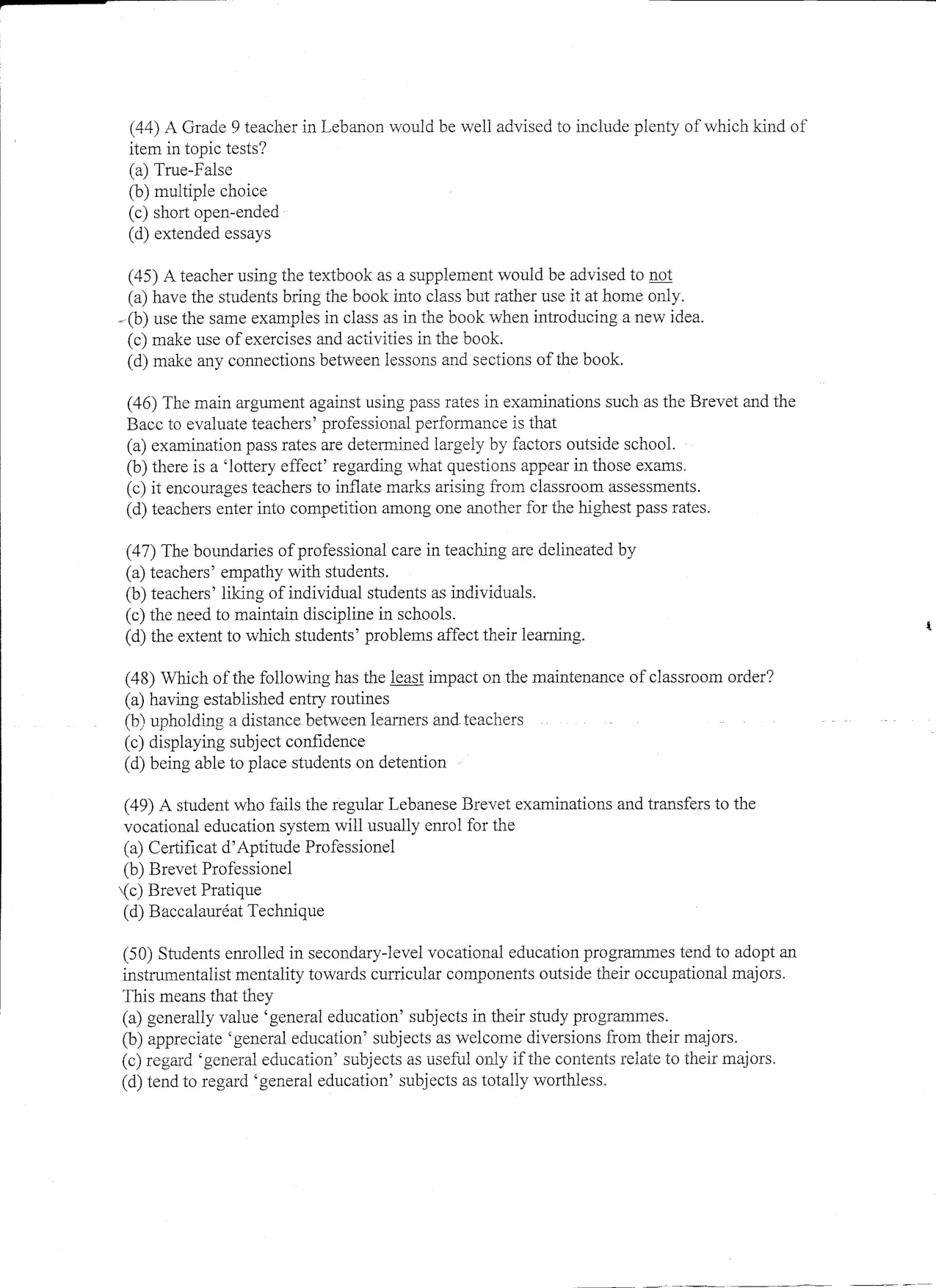
(44) A Grade 9 teacher in Lebanon would be well advised to include plenty of which kind of
item in topic tests?
(a) True-False
(b) multiple choice
(c) short open-ended -
(d) extended essays
(45) A teacher using the textbook as a supplement would be advised to not
(a) have the students bring the book into class but rather use it at home only.
-(b) use the same examples in class as in the book when introducing a new idea.
(c) make use of exercises and activities in the book.
(d) make any connections between lessons and sections of the book.
(46) The main argument against using pass rates in examinations such as the Brevet and the
Bacc to evaluate teachers’ professional performance is that
a) examination pass rates are determined largely by factors outside school. ©
b) there is a ‘lottery effect’ regarding what questions appear in those exams.
c) it encourages teachers to inflate marks arising from classroom assessments.
d) teachers enter into competition among one another for the highest pass rates.
(47) The boundaries of professional care in teaching are delineated by
a) teachers’ empathy with students.
(b) teachers’ liking of individual students as individuals.
c) the need to maintain discipline in schools.
(d) the extent to which students’ problems affect their learning.
(48) Which of the following has the least impact on the maintenance of classroom order?
(a) having established entry routines
(b) upholding a distance between learners and teachers
(c) displaying subject confidence
(d) being able to place students on detention -
(49) A student who fails the regular Lebanese Brevet examinations and transfers to the
vocational education system will usually enrol for the
(a) Certificat d’ Aptitude Professionel
(b) Brevet Professionel
\(c) Brevet Pratique
(d) Baccalauréat Technique
(50) Students enrolled in secondary-level vocational education programmes tend to adopt an
instrumentalist mentality towards curricular components outside their occupational majors.
This means that they
(a) generally value ‘general education’ subjects in their study programmes.
(b) appreciate ‘general education’ subjects as welcome diversions from their majors.
(c) regard ‘general education’ subjects as useful only if the contents relate to their majors.
(d) tend to regard ‘general education’ subjects as totally worthless.