
EECE 200 Homework 2 Solution, Fall 2010
American University of Beirut · Introduction to Electrical and Computer Engineering · 7 pages · with solution


More EECE 200 files
- Homework 2 · Fall 2014HomeworkView
- Homework 1 · Fall 2014HomeworkView
- Homework 1 Sol · Fall 2014Homework · with solutionView
- Homework 1 with Solution · Fall 2014Homework · with solutionView
- Homework 2 Sol · Fall 2014Homework · with solutionView
- Homework 2 with Solution · Fall 2014Homework · with solutionView
- Homework 1 · Fall 2013HomeworkView
- Homework 1 Solution (Fall 2013 · Fall 2013Homework · with solutionView
Show the text of this homework
EECE 200 Homework (2)
Samer Hodroj 201100607
Exercise 1:
a- IEEE main mission is to encourage technological achievements and developments for
the best of the humanity.
IEEE vision: it will play a big role in the world technical community and professional and
will be worldwide known for participating in some technological projects as well as
ameliorating some global conditions.
b- IEEE has more than 395000 members in 160 countries. It has almost 2000 student
branches all over the world in 80 countries.
c- IEEE plays a role in advancing technology for humanity by encouraging projects and
supporting them. It favors the share of ideas and new information and standards
between its members all over the world and organizes regional and worldwide
conferences for research and development. For example, the 2010 IEEE/ACM
International Conference on Computer-Aided Design (ICCAD) covered CAD topics,
including CAD for supporting post-complementary metal oxide semiconductor
(CMOS) design. Moreover it publishes every new development and achievement like, for
example, the IEEE Spectrum Magazine, a magazine that brings out every single new
development.
a- From the IEEE code of ethics:
-
To reject bribery in all its form.
For example, an engineer should refuse to do a harmful or illegal project even if he
would receive certain bribery or a financial benefit.
-
To seek, accept and offer honest criticism of technical work, to acknowledge and
correct errors and to credit properly the contribution of others.
For example, an engineer who is responsible of a project has to accept critics as to
ameliorate the effectiveness of his work and remove any fault. Moreover, if his
assistant has discovered something very important during solving this project, he
has to acclaim this and not being selfish so everyone would be encouraged to work
more.
Exercise 2:
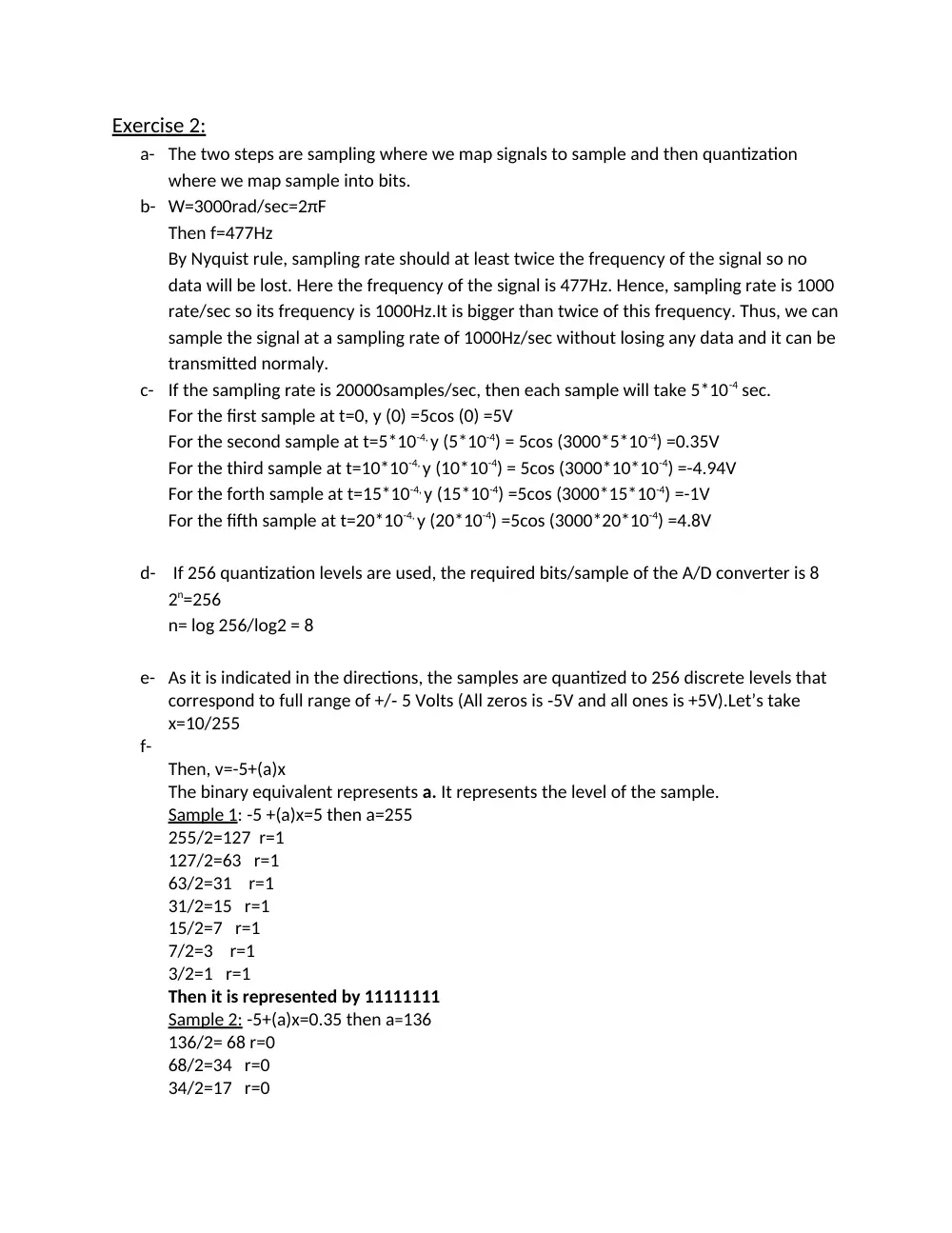
a- The two steps are sampling where we map signals to sample and then quantization
where we map sample into bits.
b- W=3000rad/sec=2πF
Then f=477Hz
By Nyquist rule, sampling rate should at least twice the frequency of the signal so no
data will be lost. Here the frequency of the signal is 477Hz. Hence, sampling rate is 1000
rate/sec so its frequency is 1000Hz.It is bigger than twice of this frequency. Thus, we can
sample the signal at a sampling rate of 1000Hz/sec without losing any data and it can be
transmitted normaly.
c- If the sampling rate is 20000samples/sec, then each sample will take 5*10-4 sec.
For the first sample at t=0, y (0) =5cos (0) =5V
For the second sample at t=5*10-4, y (5*10-4) = 5cos (3000*5*10-4) =0.35V
For the third sample at t=10*10-4, y (10*10-4) = 5cos (3000*10*10-4) =-4.94V
For the forth sample at t=15*10-4, y (15*10-4) =5cos (3000*15*10-4) =-1V
For the fifth sample at t=20*10-4, y (20*10-4) =5cos (3000*20*10-4) =4.8V
d- If 256 quantization levels are used, the required bits/sample of the A/D converter is 8
2n=256
n= log 256/log2 = 8
e- As it is indicated in the directions, the samples are quantized to 256 discrete levels that
correspond to full range of +/ ‐ 5 Volts (All zeros is ‐5V and all ones is +5V).Let’s take
x=10/255
f-
Then, v=-5+(a)x
The binary equivalent represents a. It represents the level of the sample.
Sample 1: -5 +(a)x=5 then a=255
255/2=127 r=1
127/2=63 r=1
63/2=31 r=1
31/2=15 r=1
15/2=7 r=1
7/2=3 r=1
3/2=1 r=1
Then it is represented by 11111111
Sample 2: -5+(a)x=0.35 then a=136
136/2= 68 r=0
68/2=34 r=0
34/2=17 r=0
17/2=8 r=1
8/2=4 r=0
4/2=2 r=0
2/2=1 r=0
½=0 r =1
then its binary representation is 10001000
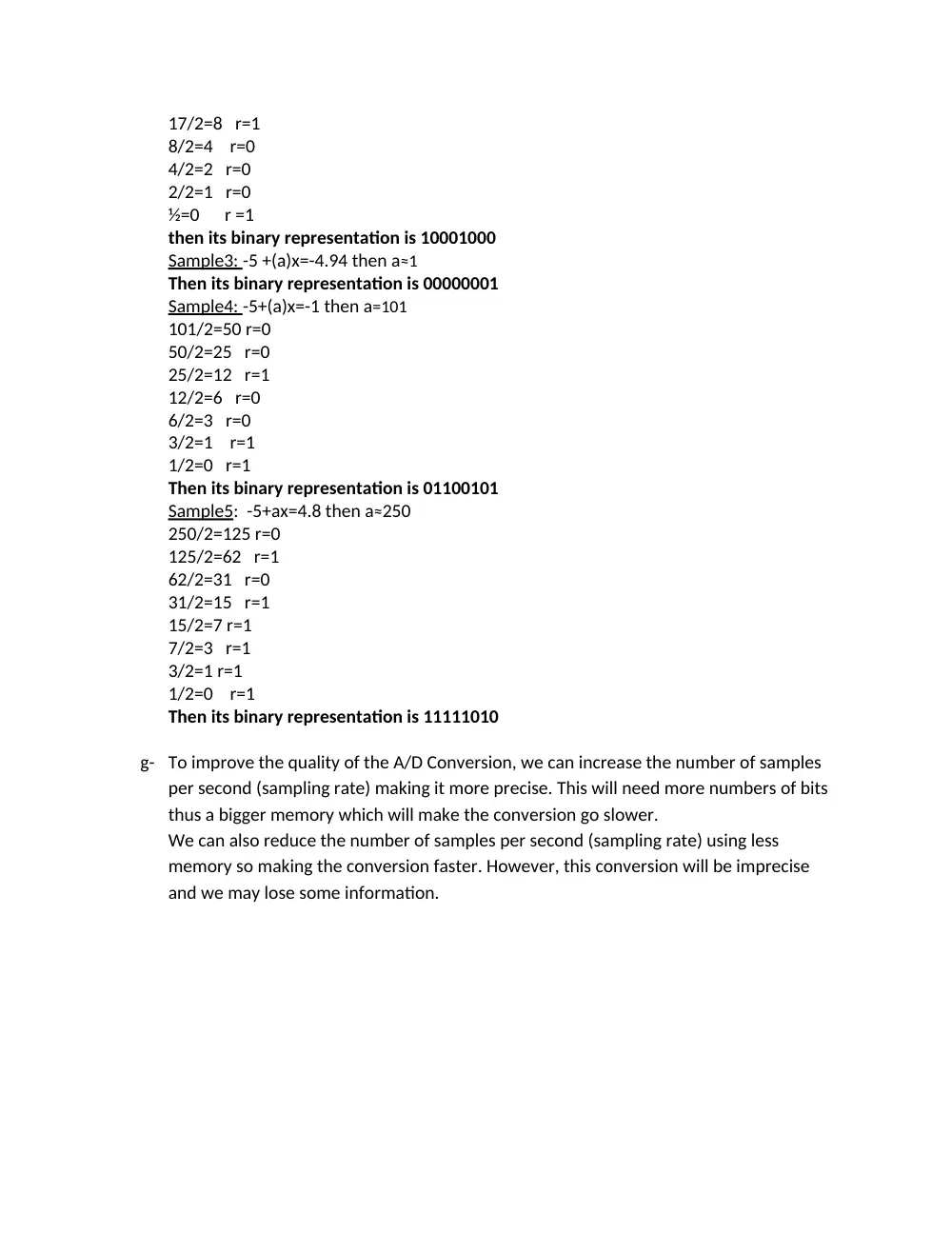
Sample3: -5 +(a)x=-4.94 then a≈1
Then its binary representation is 00000001
Sample4: -5+(a)x=-1 then a=101
101/2=50 r=0
50/2=25 r=0
25/2=12 r=1
12/2=6 r=0
6/2=3 r=0
3/2=1 r=1
1/2=0 r=1
Then its binary representation is 01100101
Sample5: -5+ax=4.8 then a≈250
250/2=125 r=0
125/2=62 r=1
62/2=31 r=0
31/2=15 r=1
15/2=7 r=1
7/2=3 r=1
3/2=1 r=1
1/2=0 r=1
Then its binary representation is 11111010
g- To improve the quality of the A/D Conversion, we can increase the number of samples
per second (sampling rate) making it more precise. This will need more numbers of bits
thus a bigger memory which will make the conversion go slower.
We can also reduce the number of samples per second (sampling rate) using less
memory so making the conversion faster. However, this conversion will be imprecise
and we may lose some information.
Exercise 3:
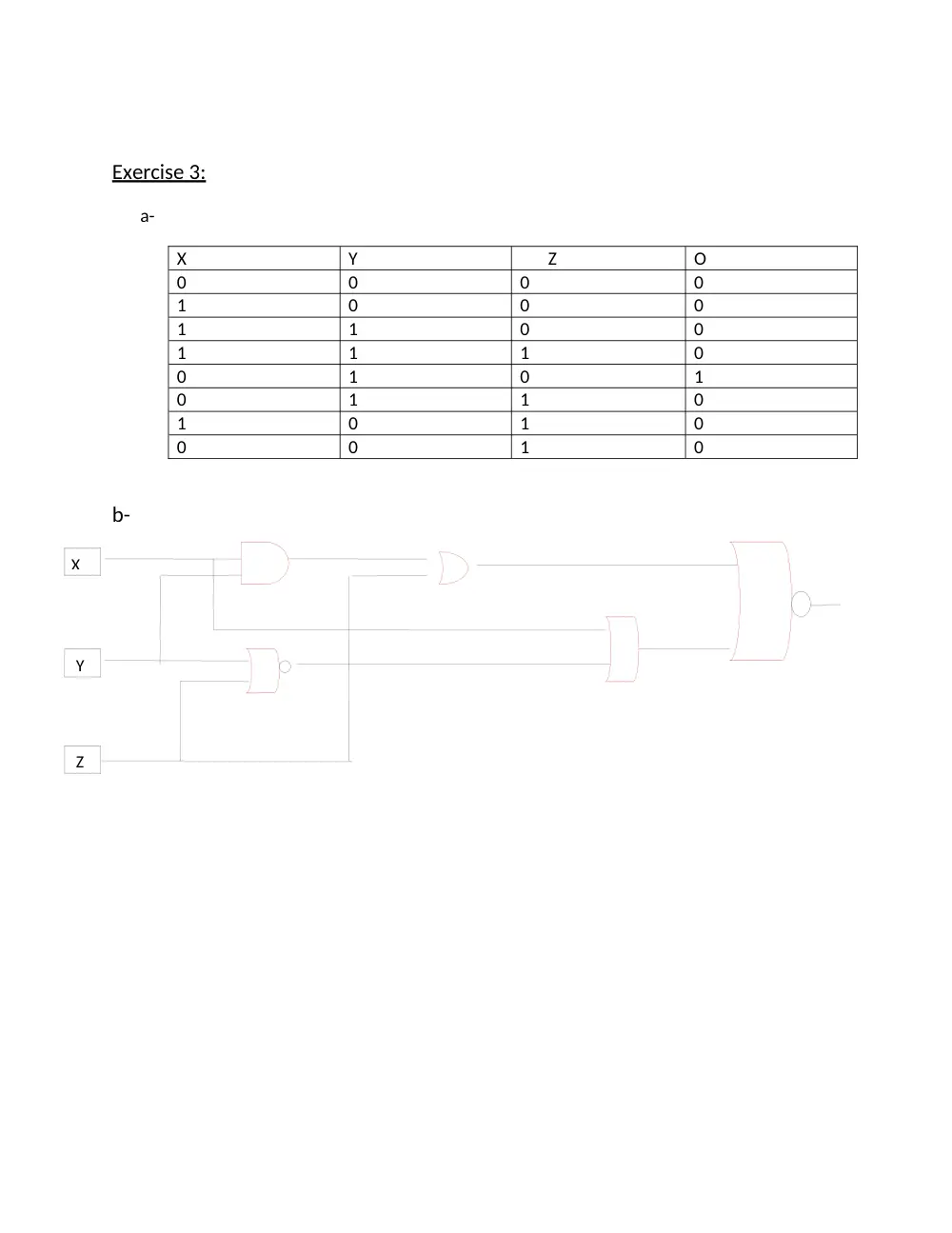
a-
X
Y
Z
O
0
0
0
0
1
0
0
0
1
1
0
0
1
1
1
0
0
1
0
1
0
1
1
0
1
0
1
0
0
0
1
0
b-
X
Y
Z
Exercise 4:
a-
b- Paths: N-I-K-M : 27Days
A-D-F-J-L-M: 34 Days
A-D-I-K-M: 33 Days
A-D-F-J-M: 26 Days
A-B-J-M: 26 Days
A-B-J-L-M: 34 Days
A-C-E-H: 25 Days
A-C-E-G: 27Days
A-B-E-G: 29Days
A-B-E-H: 27Days
c- A : ES= 0 EF= 7
N: ES= 0 EF= 6
B: ES= 7 EF= 16
C: ES= 7 EF= 14
D: ES= 7 EF= 12
E: ES= 16 EF= 24
F: ES= 12 EF= 16
G: ES= 24 EF= 29
H: ES= 24 EF=27
I: ES= 12 EF= 22
J: ES= 16 EF=22
K: ES= 22 EF=28
Start
N 6
A 7
D 5
C 7
B 9
E 8
F 4
G 5
H 3
J 5
I 10
K 6
L 8
M 5
Finish
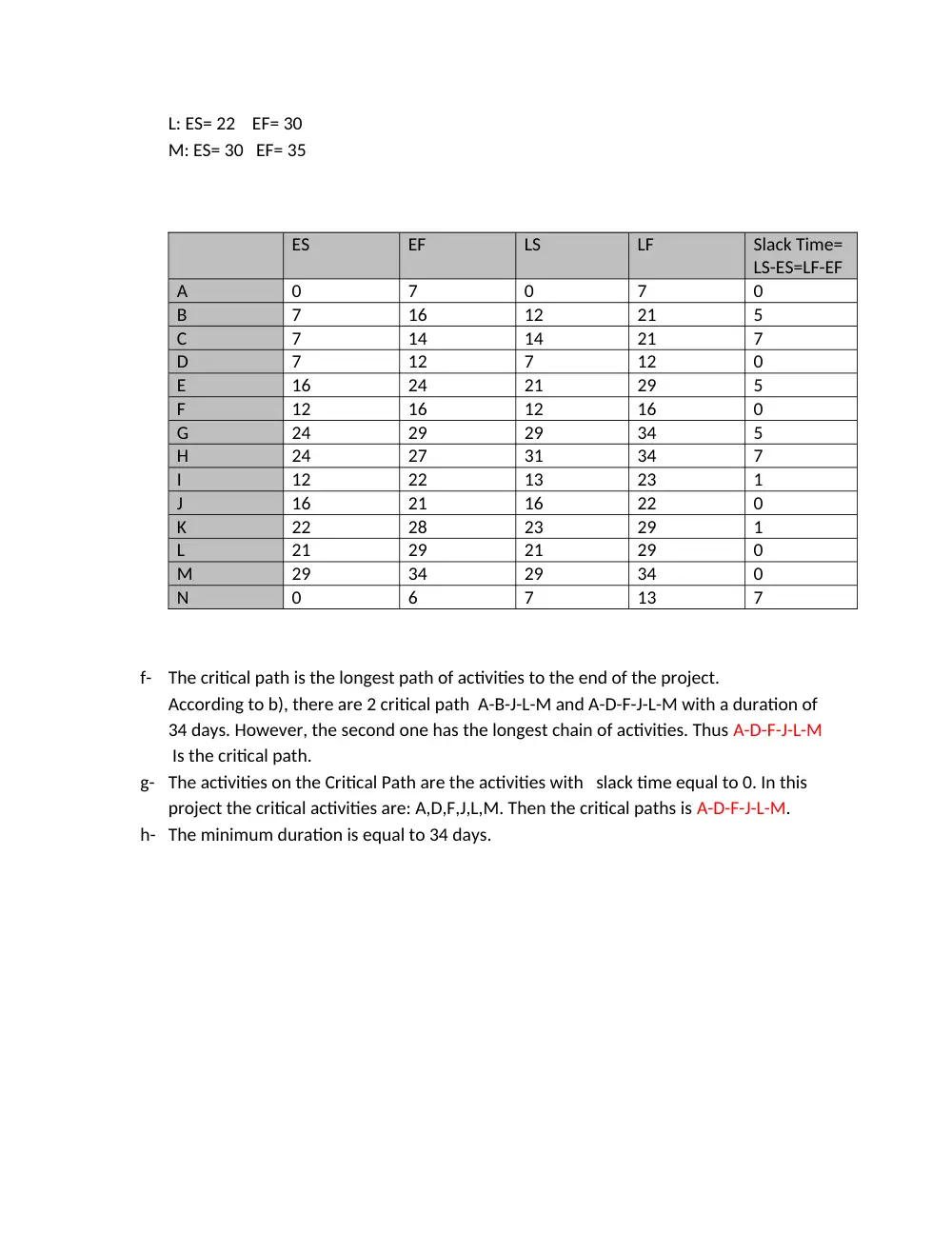
L: ES= 22 EF= 30
M: ES= 30 EF= 35
ES
EF
LS
LF
Slack Time=
LS-ES=LF-EF
A
0
7
0
7
0
B
7
16
12
21
5
C
7
14
14
21
7
D
7
12
7
12
0
E
16
24
21
29
5
F
12
16
12
16
0
G
24
29
29
34
5
H
24
27
31
34
7
I
12
22
13
23
1
J
16
21
16
22
0
K
22
28
23
29
1
L
21
29
21
29
0
M
29
34
29
34
0
N
0
6
7
13
7
f-
The critical path is the longest path of activities to the end of the project.
According to b), there are 2 critical path A-B-J-L-M and A-D-F-J-L-M with a duration of
34 days. However, the second one has the longest chain of activities. Thus A-D-F-J-L-M
Is the critical path.
g- The activities on the Critical Path are the activities with slack time equal to 0. In this
project the critical activities are: A,D,F,J,L,M. Then the critical paths is A-D-F-J-L-M.
h- The minimum duration is equal to 34 days.
Exercise 5:
a- Complementary metal–oxide–semiconductor (CMOS) is a technological device that plays
an important role in constructing integrated circuits. CMOS technology is used in
microprocessors, microcontrollers, static RAM, and other digital logic circuits. This
technology is also implanted in analog circuits such as image sensors, data converters
and many other devices... Frank Wanlass created and patented CMOS in 1967.
Reference: http://en.wikipedia.org/wiki/CMOS
BJT stands for bipolar junction transistor. It’s an electronically device with 3 terminals
constructed of semiconductor material and may be used in amplifying or switching
applications.
Reference: http://en.wikipedia.org/wiki/Bipolar_junction_transistor
The metal-oxide-semiconductor field-effect (MOSFET) conductor is used for amplifying
or switching electronic signals. It has been introduced Julius Edgard Lilienfeld in 1925. In
this device, a voltage created on the electrode a conductor channel between the drain
and the source (the two other contacts). It is a transistor used a lot in digital and analog
circuits.
Reference: http://en.wikipedia.org/wiki/MOSFET
b- We know that in 2005, the Pentium chip has 25 million transistors .By Moore’s Law, the
number of transistors will double every two years.
Then, to find the year 2005+2n in which we will reach the 1.6billions f transistors, we’ll
do: 1.6*109=25000000*2n
2n=64
n=lo64/log2=6
This will occur in 2017.
c- If the Moore’s Law says that the number of transistor will triple every 2 years then we
will have in 2040k transistors:
2040 -2005- 2n=0 than n=17.5
k=25000000*3n=5.6*1015 transistors