
EECE 200 Homework 2 Solution, Fall 2011
American University of Beirut · Introduction to Electrical and Computer Engineering · 3 pages · Prof. Karim Kabalan · with solution
More EECE 200 files
- Homework 2 · Fall 2014HomeworkView
- Homework 1 · Fall 2014HomeworkView
- Homework 1 Sol · Fall 2014Homework · with solutionView
- Homework 1 with Solution · Fall 2014Homework · with solutionView
- Homework 2 Sol · Fall 2014Homework · with solutionView
- Homework 2 with Solution · Fall 2014Homework · with solutionView
- Homework 1 · Fall 2013HomeworkView
- Homework 1 Solution (Fall 2013 · Fall 2013Homework · with solutionView
Show the text of this homework
EECE 200 ID:201203616
Homework 1
Problem 1:
a-
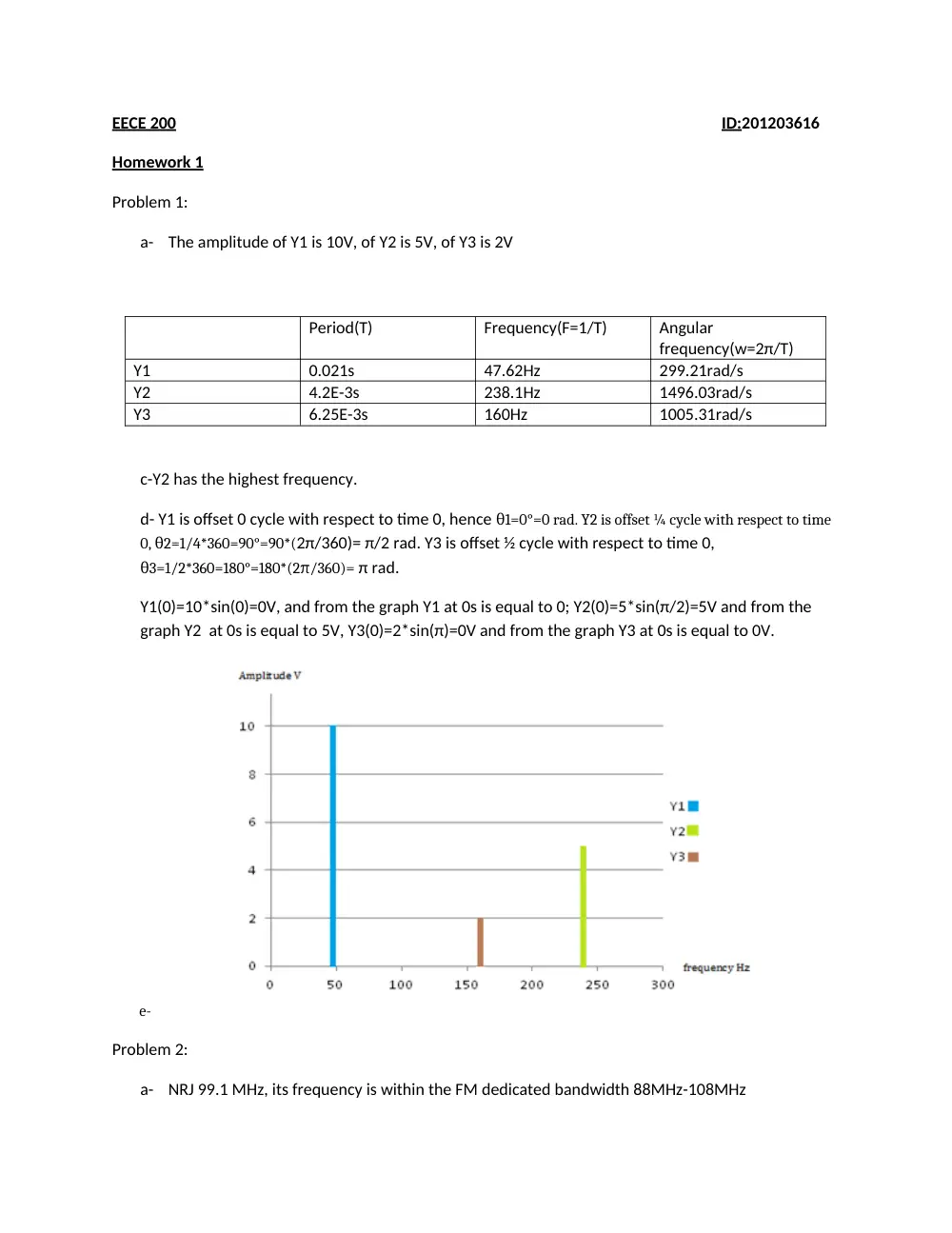
The amplitude of Y1 is 10V, of Y2 is 5V, of Y3 is 2V
c-Y2 has the highest frequency.
d- Y1 is offset 0 cycle with respect to time 0, hence 1=0°=0 rad. Y2 is offset ¼ cycle with respect to time
θ
0, 2=1/4*360=90°=90*(
θ
2π/360)= π/2 rad. Y3 is offset ½ cycle with respect to time 0,
θ3=1/2*360=180°=180*(2 /360)=
π
π rad.
Y1(0)=10*sin(0)=0V, and from the graph Y1 at 0s is equal to 0; Y2(0)=5*sin(π/2)=5V and from the
graph Y2 at 0s is equal to 5V, Y3(0)=2*sin(π)=0V and from the graph Y3 at 0s is equal to 0V.
e-
Problem 2:
a-
NRJ 99.1 MHz, its frequency is within the FM dedicated bandwidth 88MHz-108MHz
Period(T)
Frequency(F=1/T)
Angular
frequency(w=2π/T)
Y1
0.021s
47.62Hz
299.21rad/s
Y2
4.2E-3s
238.1Hz
1496.03rad/s
Y3
6.25E-3s
160Hz
1005.31rad/s
b-
Each station is assigned a 10KHz bandwidth the total bandwidth dedicated to AM radio ranges
from 530 to 1700 KHz, so the number of radio stations that the AM dedicated bandwidth can
afford in Lebanon is (1700-530)/10= 117 stations
c-
The bandwidth of a tv station is bigger than the bandwidth of a fm station because not only
voice is transmitted but also image, and image is produced by a large number of pixels, so the
bandwidth of a tv station is in MHz.
d-
The bandwidth of a black and white tv station is bigger than a color station because the
bandwidth of a black and white tv station is found by dividing the number of pixels per seconds
by 2, but for a colored tv we divided by more than 2 so we get a smaller bandwidth.
Problem 3:
a-
The dimensions are 5*5= 25 pixels
b-
There are four different levels of grey so we can use 2 bits per pixel to represent them. 00 for
black, 01 for dark grey, 10 for light grey, 11 for white.
c-
[0 3 2 3 0
2 3 1 3 3
0 3 2 3 2
3 3 3 1 3
2 0 1 3 0]
d-
If the image is composed of 25 pixels so 50 bits, and it’s a part of a movie that is playing at a rate
of 30 frames per second, so 30*50=1500 bits per second. The size of the folder if we record 2.5
minutes of the movie is going to be 1500*(2.5*60)=225000 bits= 28125 bytes= 0.026822 Mb
Problem 4:
a-
10011101.0111012=
(1*2^7)+(0*2^6)+(0*2^5)+(1*2^4)+(1*2^3)+(1*2^2)+(0*2^1)+(1*2^0)+(0*2^-1)+(1*2^-
2)+(1*2^-3)+(1*2^-4)+(0*2^-5)+(1*2^-
6)=128+0+0+16+8+4+0+1+0+0.25+0.125+0.0625+0+0.015625=157.45312510
b-
485.2310
Div
Quo.
Rem.
Binary number
485/2
242
1
1
242/2
121
0
01
121/2
60
1
101
60/2
30
0
0101
30/2
15
0
00101
15/2
7
1
100101
7/2
3
1
1100101
3/2
1
1
11100101
½
0
1
111100101
0.23*2=0.46; 0.46*2=0.92; 0.46*2=0.92, 0.92*2=1.84; 0.84*2=1.68; 0.68*2=1.36, 0.68*2=1.36;
0.36*2=1.72;0.36*2=1.72;0.72*2=1.44;0.44*2=0.88;0.88*2=1.76;0.76*2=1.52;0.52*2=0.04;0.04*2=0.08;
0.08*2=0.16;0.16*2=0.32;0.32*2=0.64;0.64*2=1.28;0.28*2=0.56;0.56*2=1.12;0.12*2=0.24;
0.24*2=0.48;0.48*2=0.96;0.96*2=1.92
0.92 was repeated twice, the binary representation: 10011101. 00111110110000010100012
c-
1 in binary is 001, 5 is 101, 7 is 111, 4 is 100 so 15748 in binary is 0011011111002
d-
Split binary numbers into group of 4 and convert each group to corresponding hexadecimal
1000 is 8, 1111 is F, 1 is 1 so 1000111112=8F116
e-
1 is converted into 0001, C into 1011, 8 into 1000, B into 1010 so the binary representation is
00011011100010102