
EECE 200 Homework 2 with Solution, Fall 2010
American University of Beirut · Introduction to Electrical and Computer Engineering · 6 pages · with solution
More EECE 200 files
- Homework 2 · Fall 2014HomeworkView
- Homework 1 · Fall 2014HomeworkView
- Homework 1 Sol · Fall 2014Homework · with solutionView
- Homework 1 with Solution · Fall 2014Homework · with solutionView
- Homework 2 Sol · Fall 2014Homework · with solutionView
- Homework 2 with Solution · Fall 2014Homework · with solutionView
- Homework 1 · Fall 2013HomeworkView
- Homework 1 Solution (Fall 2013 · Fall 2013Homework · with solutionView
Show the text of this homework
Homework 2‐ Solution EECE 200
Fall 2010‐2011
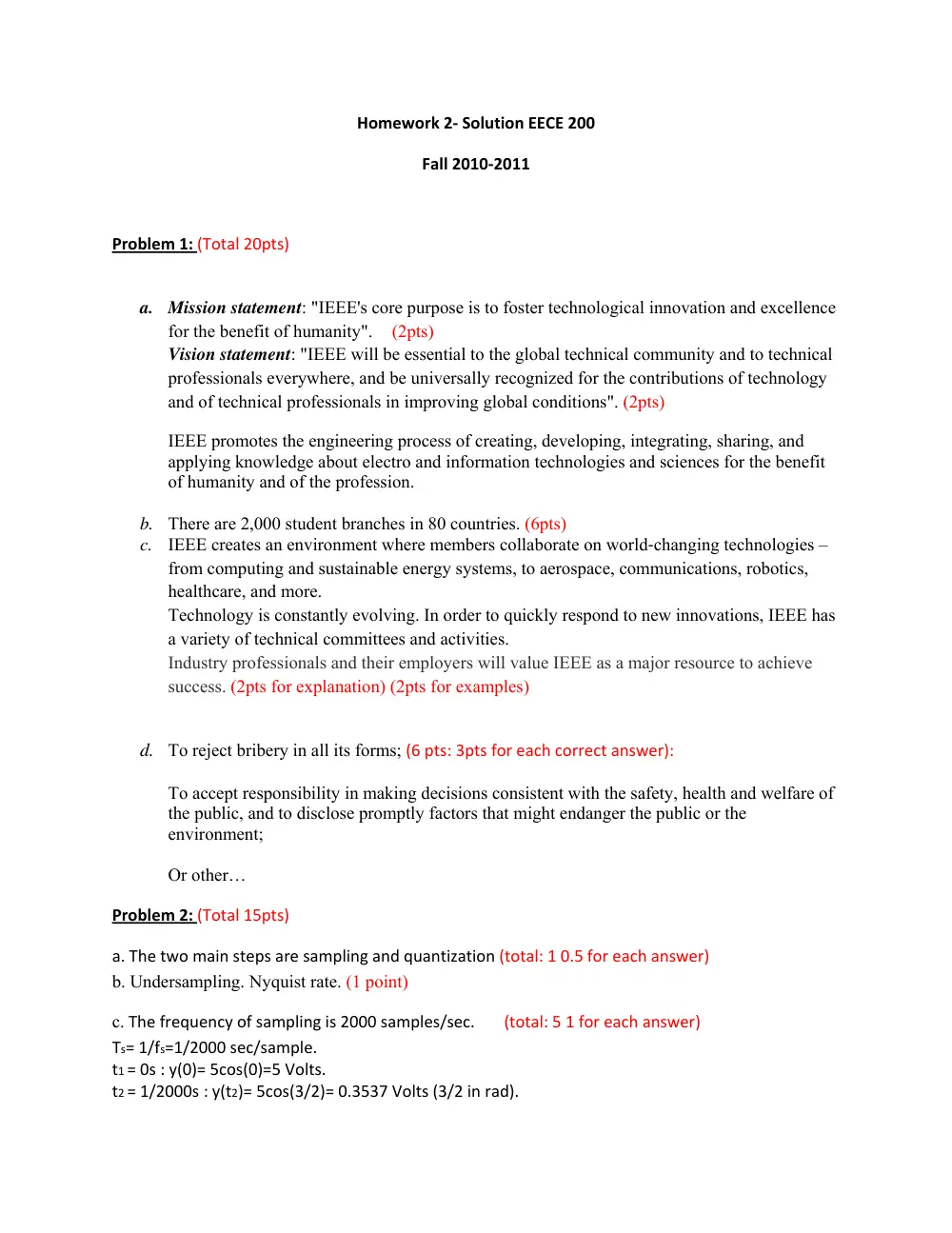
Problem 1: (Total 20pts)
a. Mission statement: "IEEE's core purpose is to foster technological innovation and excellence
for the benefit of humanity". (2pts)
Vision statement: "IEEE will be essential to the global technical community and to technical
professionals everywhere, and be universally recognized for the contributions of technology
and of technical professionals in improving global conditions". (2pts)
IEEE promotes the engineering process of creating, developing, integrating, sharing, and
applying knowledge about electro and information technologies and sciences for the benefit
of humanity and of the profession.
b. There are 2,000 student branches in 80 countries. (6pts)
c. IEEE creates an environment where members collaborate on world‐changing technologies –
from computing and sustainable energy systems, to aerospace, communications, robotics,
healthcare, and more.
Technology is constantly evolving. In order to quickly respond to new innovations, IEEE has
a variety of technical committees and activities.
Industry professionals and their employers will value IEEE as a major resource to achieve
success. (2pts for explanation) (2pts for examples)
d. To reject bribery in all its forms; (6 pts: 3pts for each correct answer):
To accept responsibility in making decisions consistent with the safety, health and welfare of
the public, and to disclose promptly factors that might endanger the public or the
environment;
Or other…
Problem 2: (Total 15pts)
a. The two main steps are sampling and quantization (total: 1 0.5 for each answer)
b. Undersampling. Nyquist rate. (1 point)
c. The frequency of sampling is 2000 samples/sec.
(total: 5 1 for each answer)
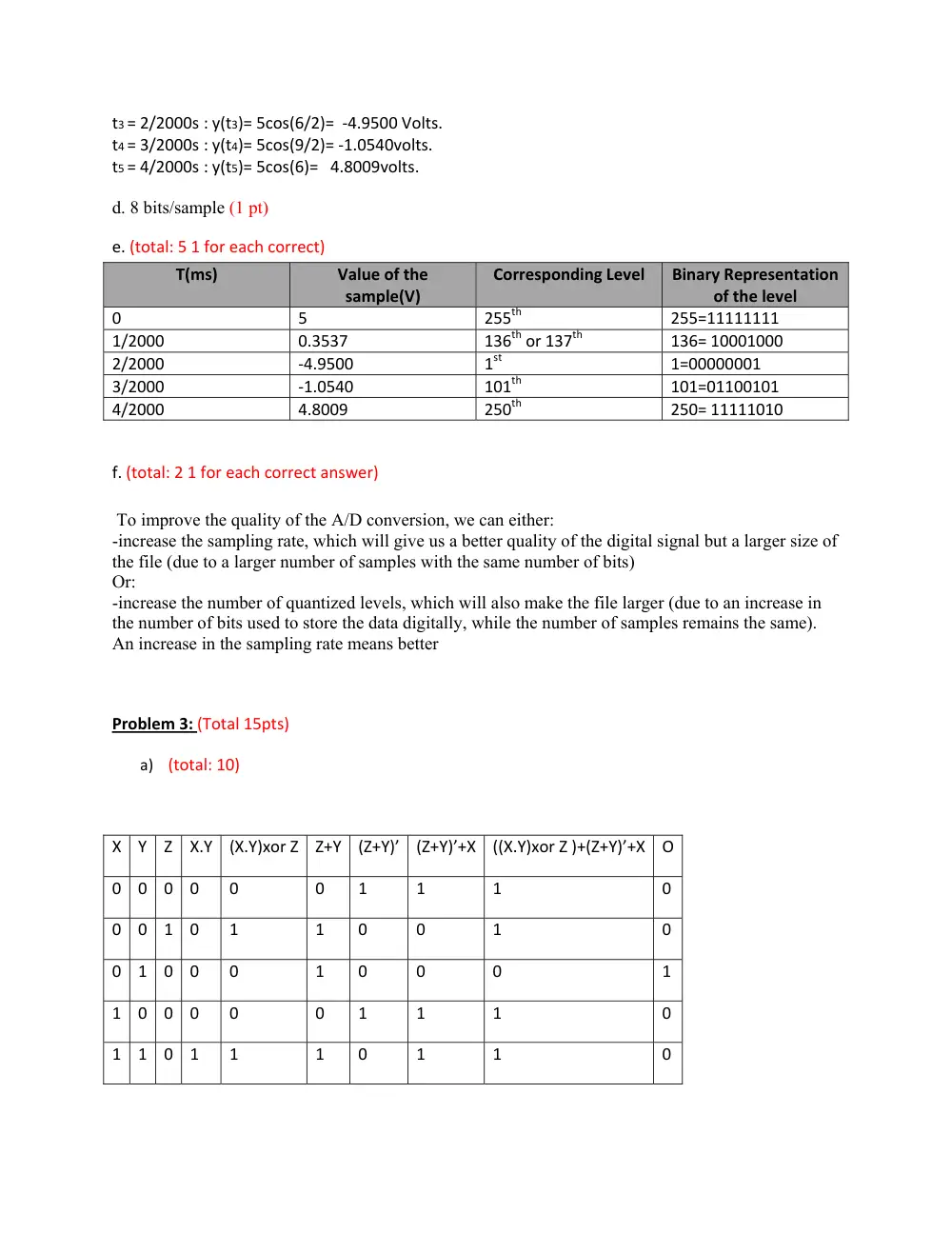
Ts= 1/fs=1/2000 sec/sample.
t1 = 0s : y(0)= 5cos(0)=5 Volts.
t2 = 1/2000s : y(t2)= 5cos(3/2)= 0.3537 Volts (3/2 in rad).
t3 = 2/2000s : y(t3)= 5cos(6/2)= ‐4.9500 Volts.
t4 = 3/2000s : y(t4)= 5cos(9/2)= ‐1.0540volts.
t5 = 4/2000s : y(t5)= 5cos(6)= 4.8009volts.
d. 8 bits/sample (1 pt)
e. (total: 5 1 for each correct)
T(ms)
Value of the
sample(V)
Corresponding Level
Binary Representation
of the level
0
5
255th
255=11111111
1/2000
0.3537
136th or 137th
136= 10001000
2/2000
‐4.9500
1st
1=00000001
3/2000
‐1.0540
101th
101=01100101
4/2000
4.8009
250th
250= 11111010
f. (total: 2 1 for each correct answer)
To improve the quality of the A/D conversion, we can either:
-increase the sampling rate, which will give us a better quality of the digital signal but a larger size of
the file (due to a larger number of samples with the same number of bits)
Or:
-increase the number of quantized levels, which will also make the file larger (due to an increase in
the number of bits used to store the data digitally, while the number of samples remains the same).
An increase in the sampling rate means better
Problem 3: (Total 15pts)
a) (total: 10)
X Y Z X.Y (X.Y)xor Z Z+Y (Z+Y)’
(Z+Y)’+X
((X.Y)xor Z )+(Z+Y)’+X
O
0 0 0 0
0
0
1
1
1
0
0 0 1 0
1
1
0
0
1
0
0 1 0 0
0
1
0
0
0
1
1 0 0 0
0
0
1
1
1
0
1 1 0 1
1
1
0
1
1
0
0 1 1 0
1
1
0
0
1
0
1 0 1 0
1
1
0
1
1
0
1 1 1 1
0
1
0
1
1
0
b) (total: 5points)
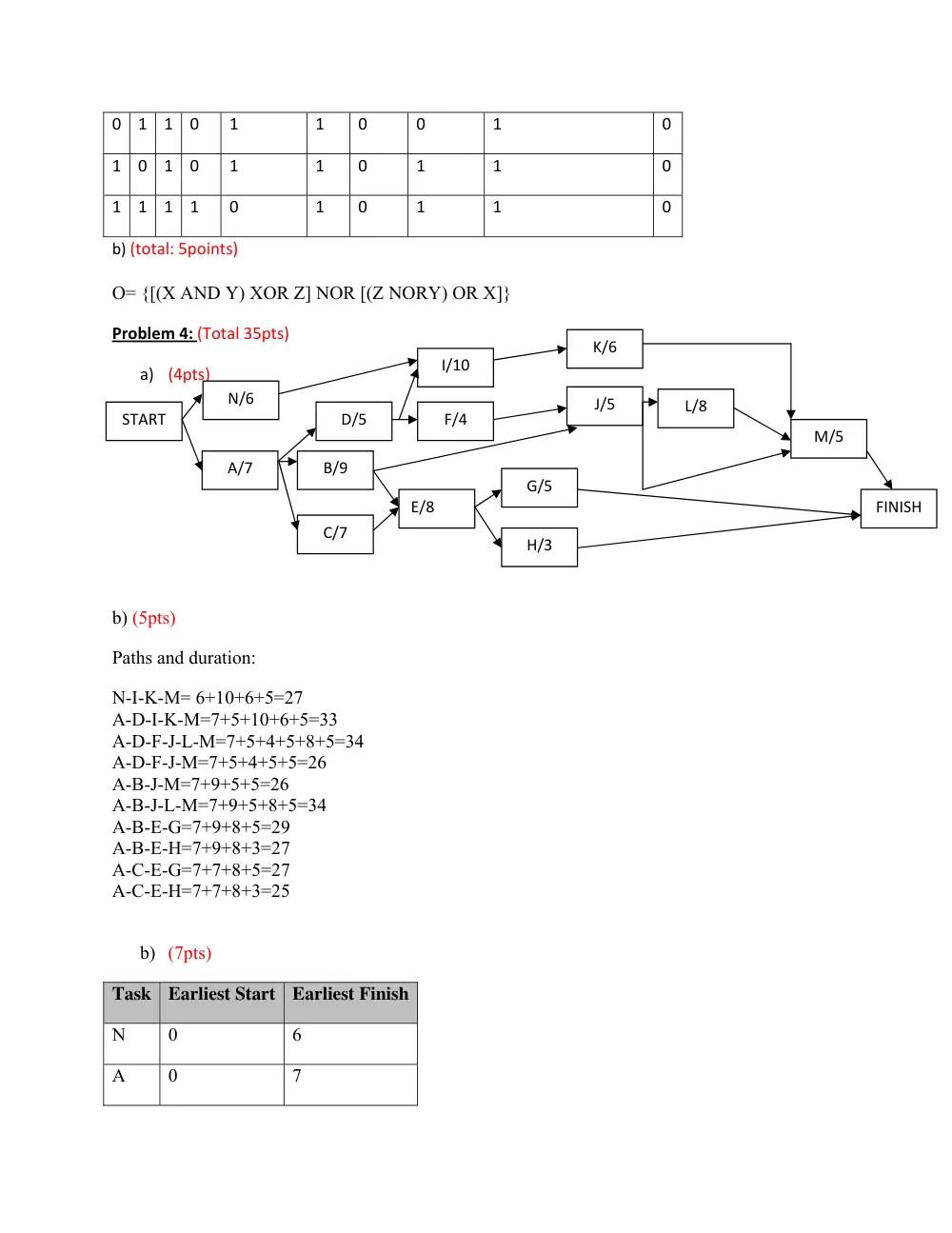
O= {[(X AND Y) XOR Z] NOR [(Z NORY) OR X]}
Problem 4: (Total 35pts)
a) (4pts)
b) (5pts)
Paths and duration:
N-I-K-M= 6+10+6+5=27
A-D-I-K-M=7+5+10+6+5=33
A-D-F-J-L-M=7+5+4+5+8+5=34
A-D-F-J-M=7+5+4+5+5=26
A-B-J-M=7+9+5+5=26
A-B-J-L-M=7+9+5+8+5=34
A-B-E-G=7+9+8+5=29
A-B-E-H=7+9+8+3=27
A-C-E-G=7+7+8+5=27
A-C-E-H=7+7+8+3=25
b) (7pts)
Task Earliest Start Earliest Finish
N
0
6
A
0
7
START
N/6
A/7
B/9
C/7
D/5
F/4
E/8
G/5
H/3
I/10
J/5
K/6
L/8
M/5
FINISH
B
7
16
C
7
14
D
7
12
E
16
24
F
12
16
G
24
29
H
24
27
I
12
22
J
16
21
K
22
28
L
21
29
M
29
34
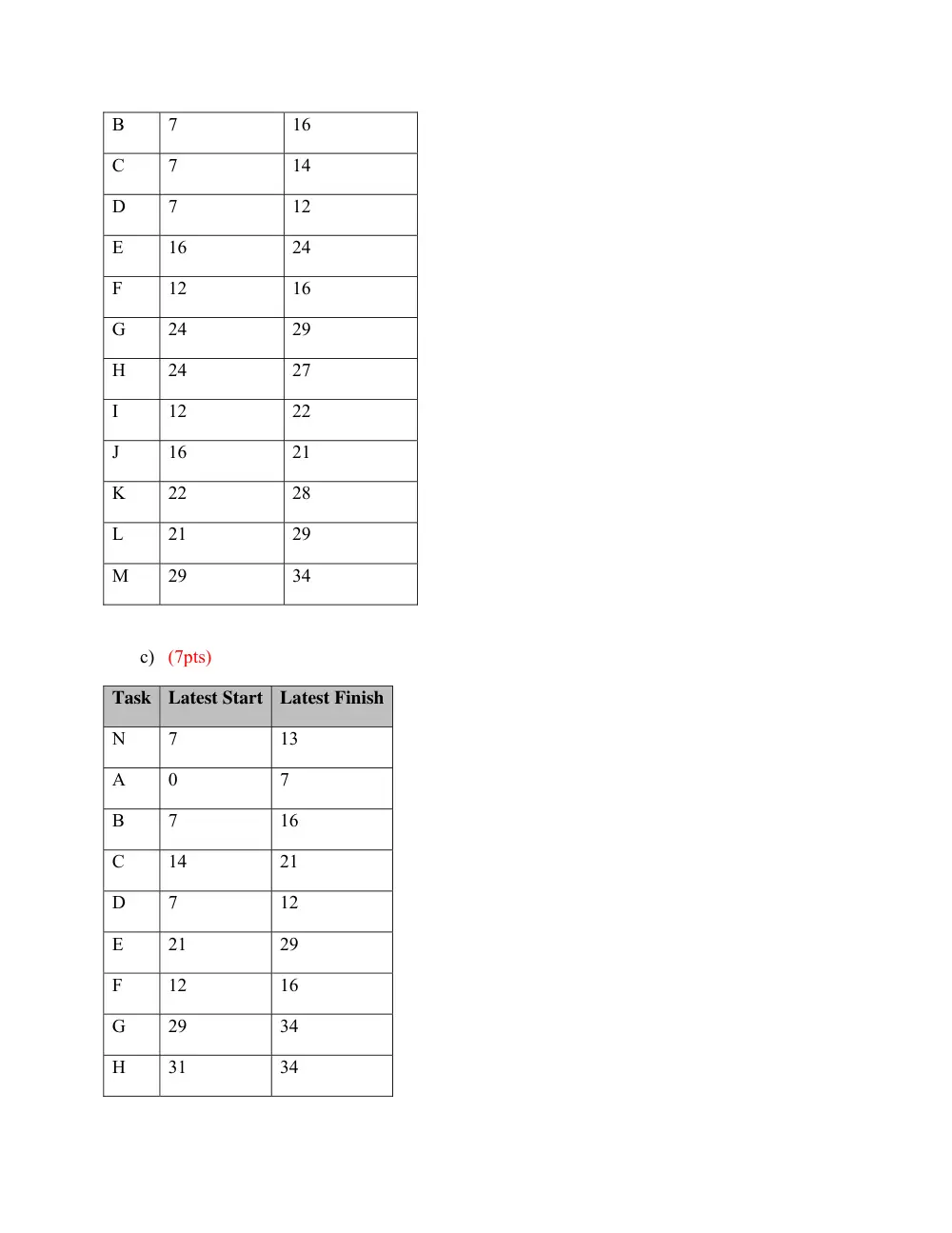
c) (7pts)
Task Latest Start Latest Finish
N
7
13
A
0
7
B
7
16
C
14
21
D
7
12
E
21
29
F
12
16
G
29
34
H
31
34
I
13
23
J
16
21
K
22
28
L
21
29
M
29
34
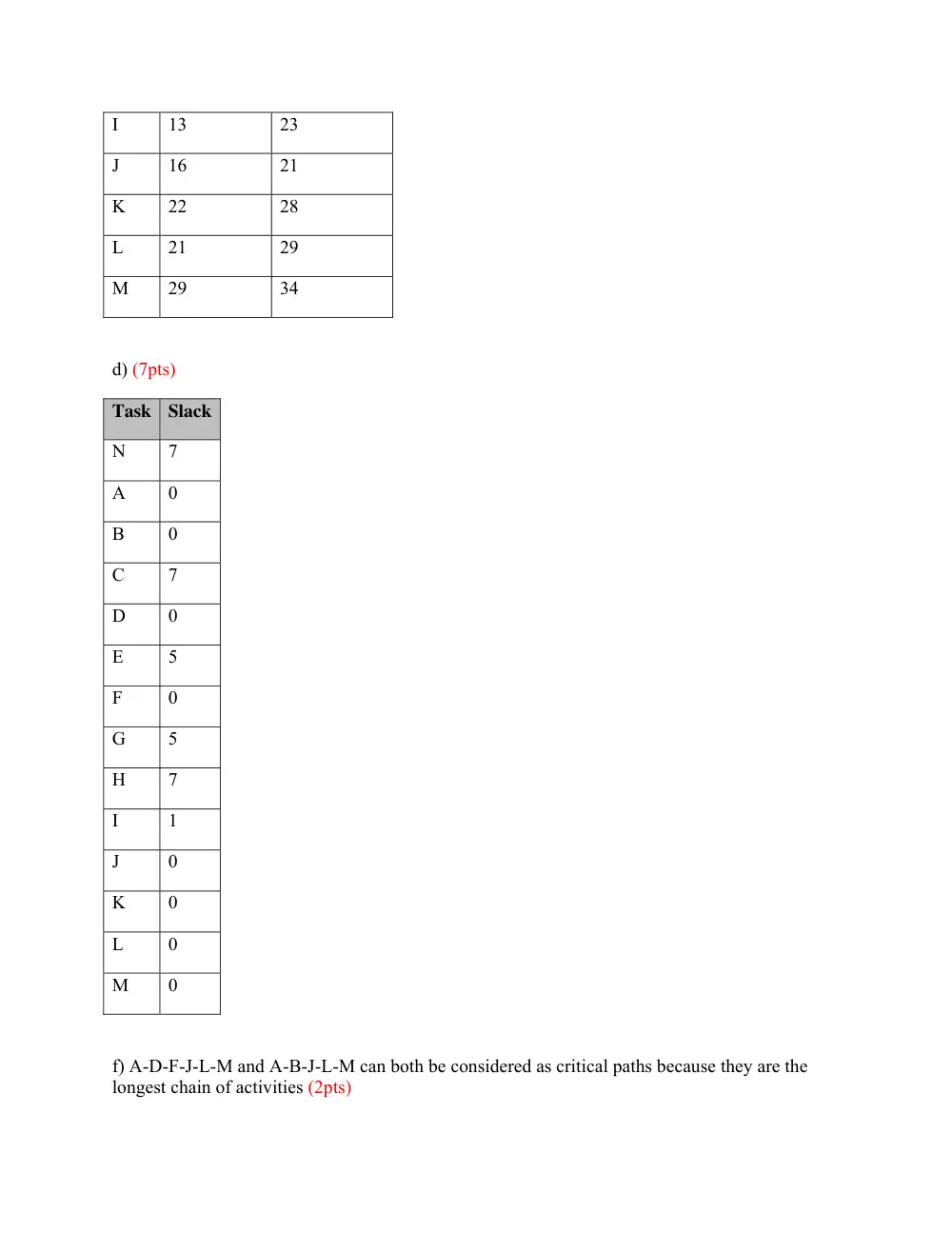
d) (7pts)
Task Slack
N
7
A
0
B
0
C
7
D
0
E
5
F
0
G
5
H
7
I
1
J
0
K
0
L
0
M
0
f) A-D-F-J-L-M and A-B-J-L-M can both be considered as critical paths because they are the
longest chain of activities (2pts)
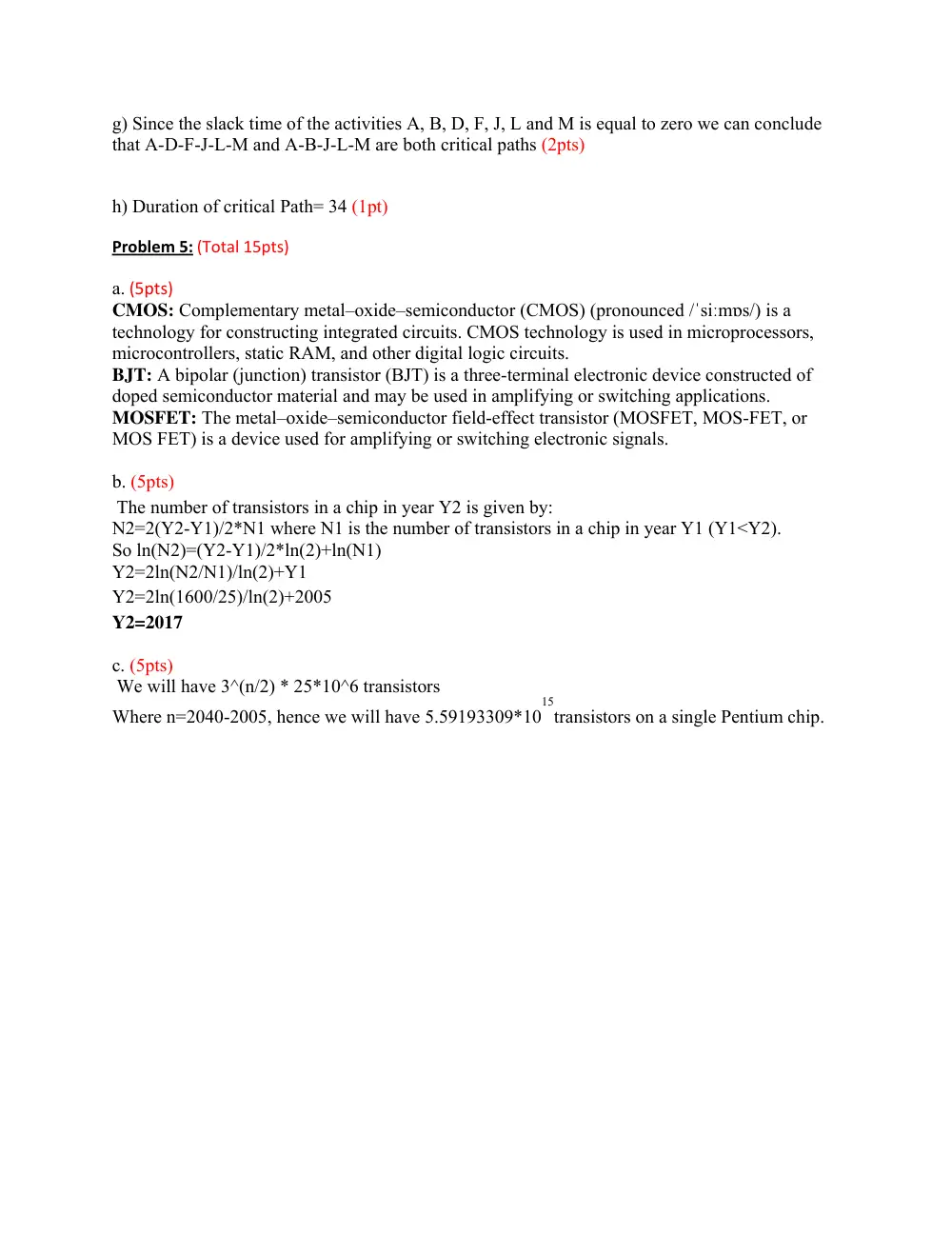
g) Since the slack time of the activities A, B, D, F, J, L and M is equal to zero we can conclude
that A-D-F-J-L-M and A-B-J-L-M are both critical paths (2pts)
h) Duration of critical Path= 34 (1pt)
Problem 5: (Total 15pts)
a. (5pts)
CMOS: Complementary metal–oxide–semiconductor (CMOS) (pronounced /ˈsiːmɒs/) is a
technology for constructing integrated circuits. CMOS technology is used in microprocessors,
microcontrollers, static RAM, and other digital logic circuits.
BJT: A bipolar (junction) transistor (BJT) is a three-terminal electronic device constructed of
doped semiconductor material and may be used in amplifying or switching applications.
MOSFET: The metal–oxide–semiconductor field-effect transistor (MOSFET, MOS-FET, or
MOS FET) is a device used for amplifying or switching electronic signals.
b. (5pts)
The number of transistors in a chip in year Y2 is given by:
N2=2(Y2-Y1)/2*N1 where N1 is the number of transistors in a chip in year Y1 (Y1<Y2).
So ln(N2)=(Y2-Y1)/2*ln(2)+ln(N1)
Y2=2ln(N2/N1)/ln(2)+Y1
Y2=2ln(1600/25)/ln(2)+2005
Y2=2017
c. (5pts)
We will have 3^(n/2) * 25*10^6 transistors
Where n=2040-2005, hence we will have 5.59193309*10
15
transistors on a single Pentium chip.