
EECE 200 Homework, Spring 2008
American University of Beirut · Introduction to Electrical and Computer Engineering · 7 pages

More EECE 200 files
- Homework 2 · Fall 2014HomeworkView
- Homework 1 · Fall 2014HomeworkView
- Homework 1 Sol · Fall 2014Homework · with solutionView
- Homework 1 with Solution · Fall 2014Homework · with solutionView
- Homework 2 Sol · Fall 2014Homework · with solutionView
- Homework 2 with Solution · Fall 2014Homework · with solutionView
- Homework 1 · Fall 2013HomeworkView
- Homework 1 Solution (Fall 2013 · Fall 2013Homework · with solutionView
Show the text of this homework
American University of Beirut
ECE 200, Introduction to Electrical and Computer Engineering
Homework 2
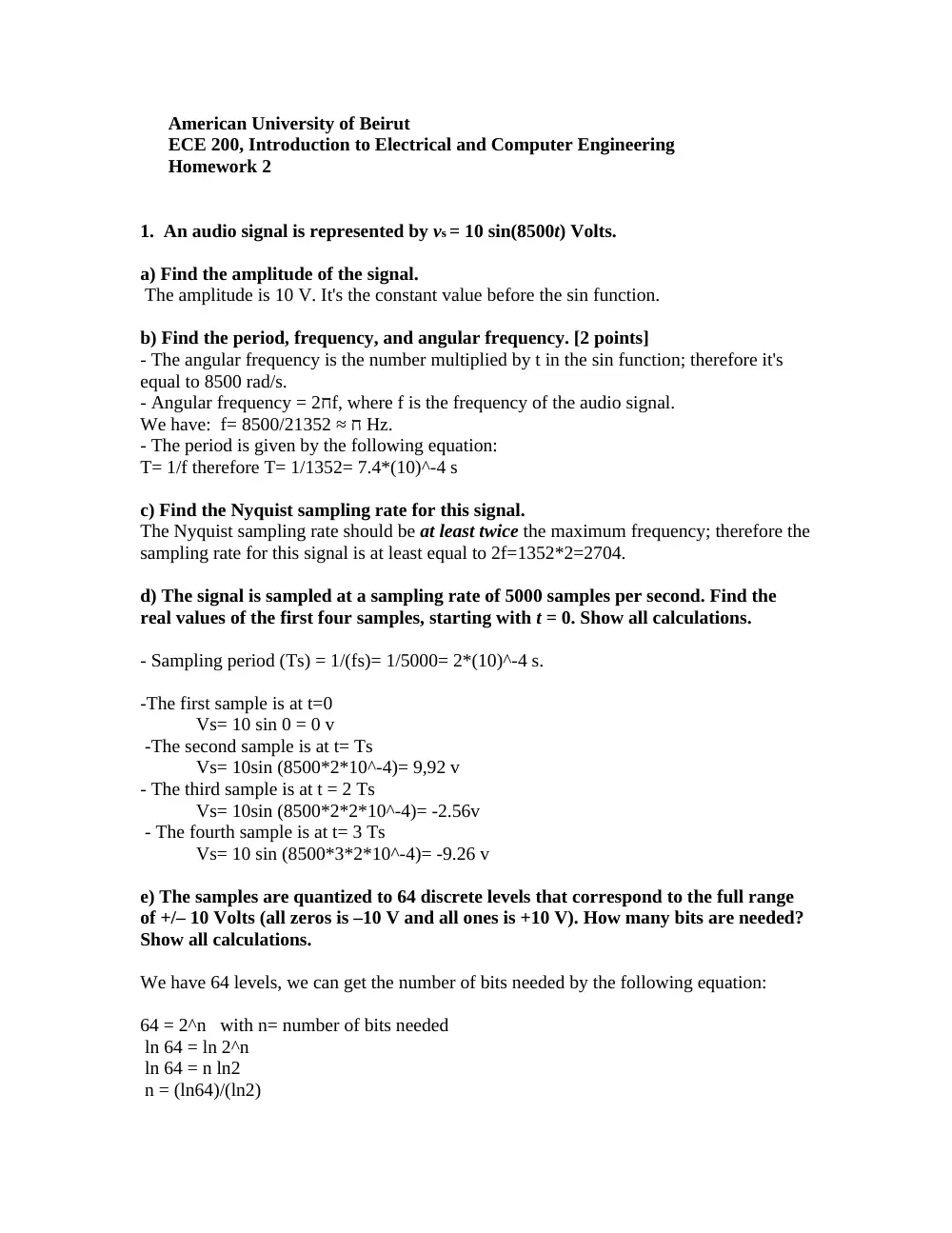
1. An audio signal is represented by vs = 10 sin(8500t) Volts.
a) Find the amplitude of the signal.
The amplitude is 10 V. It's the constant value before the sin function.
b) Find the period, frequency, and angular frequency. [2 points]
- The angular frequency is the number multiplied by t in the sin function; therefore it's
equal to 8500 rad/s.
- Angular frequency = 2חf, where f is the frequency of the audio signal.
We have: f= 8500/2ח ≈1352 Hz.
- The period is given by the following equation:
T= 1/f therefore T= 1/1352= 7.4*(10)^-4 s
c) Find the Nyquist sampling rate for this signal.
The Nyquist sampling rate should be at least twice the maximum frequency; therefore the
sampling rate for this signal is at least equal to 2f=1352*2=2704.
d) The signal is sampled at a sampling rate of 5000 samples per second. Find the
real values of the first four samples, starting with t = 0. Show all calculations.
- Sampling period (Ts) = 1/(fs)= 1/5000= 2*(10)^-4 s.
-The first sample is at t=0
Vs= 10 sin 0 = 0 v
-The second sample is at t= Ts
Vs= 10sin (8500*2*10^-4)= 9,92 v
- The third sample is at t = 2 Ts
Vs= 10sin (8500*2*2*10^-4)= -2.56v
- The fourth sample is at t= 3 Ts
Vs= 10 sin (8500*3*2*10^-4)= -9.26 v
e) The samples are quantized to 64 discrete levels that correspond to the full range
of +/– 10 Volts (all zeros is –10 V and all ones is +10 V). How many bits are needed?
Show all calculations.
We have 64 levels, we can get the number of bits needed by the following equation:
64 = 2^n with n= number of bits needed
ln 64 = ln 2^n
ln 64 = n ln2
n = (ln64)/(ln2)
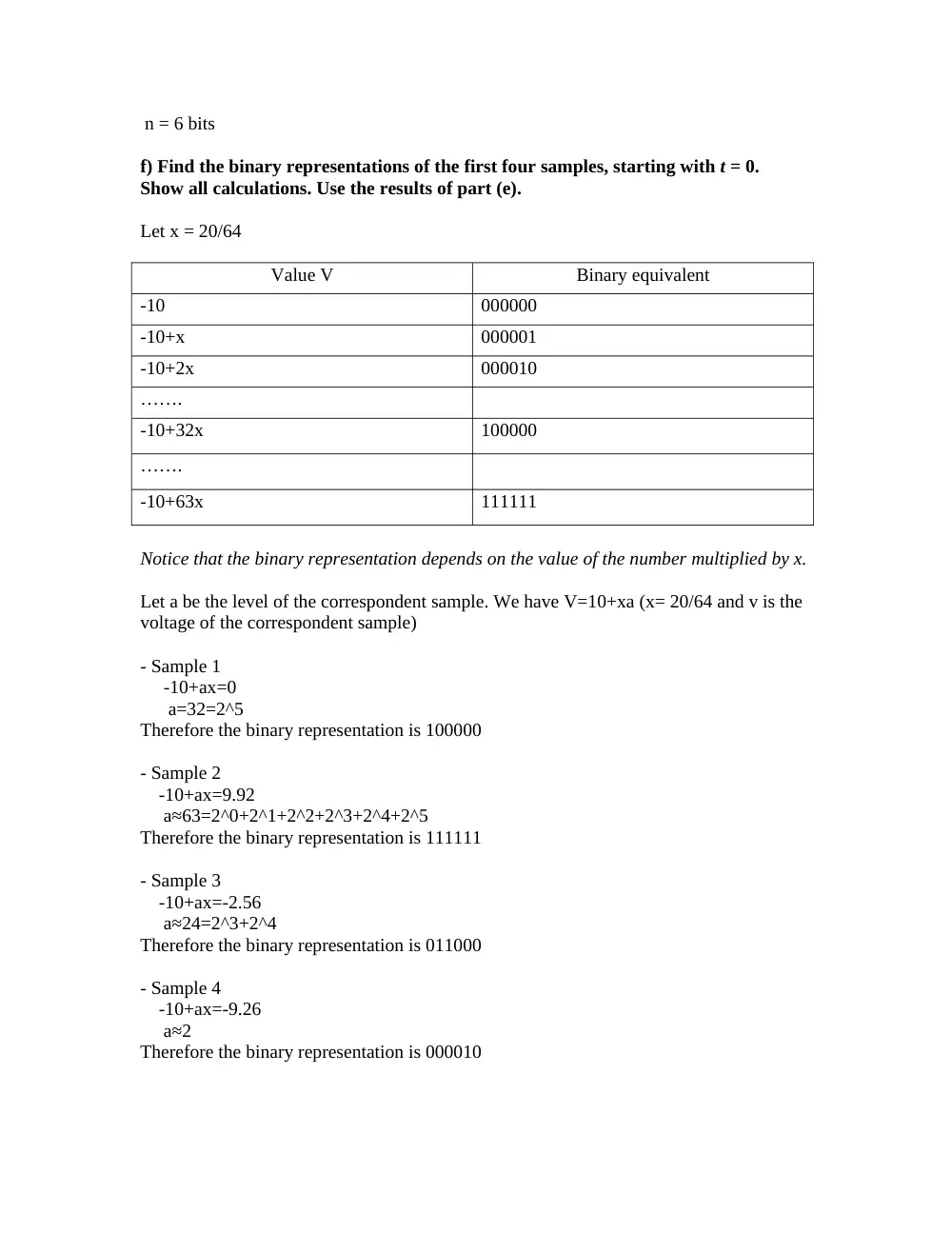
n = 6 bits
f) Find the binary representations of the first four samples, starting with t = 0.
Show all calculations. Use the results of part (e).
Let x = 20/64
Value V
Binary equivalent
-10
000000
-10+x
000001
-10+2x
000010
…….
-10+32x
100000
…….
-10+63x
111111
Notice that the binary representation depends on the value of the number multiplied by x.
Let a be the level of the correspondent sample. We have V=10+xa (x= 20/64 and v is the
voltage of the correspondent sample)
- Sample 1
-10+ax=0
a=32=2^5
Therefore the binary representation is 100000
- Sample 2
-10+ax=9.92
a≈63=2^0+2^1+2^2+2^3+2^4+2^5
Therefore the binary representation is 111111
- Sample 3
-10+ax=-2.56
a≈24=2^3+2^4
Therefore the binary representation is 011000
- Sample 4
-10+ax=-9.26
a≈2
Therefore the binary representation is 000010
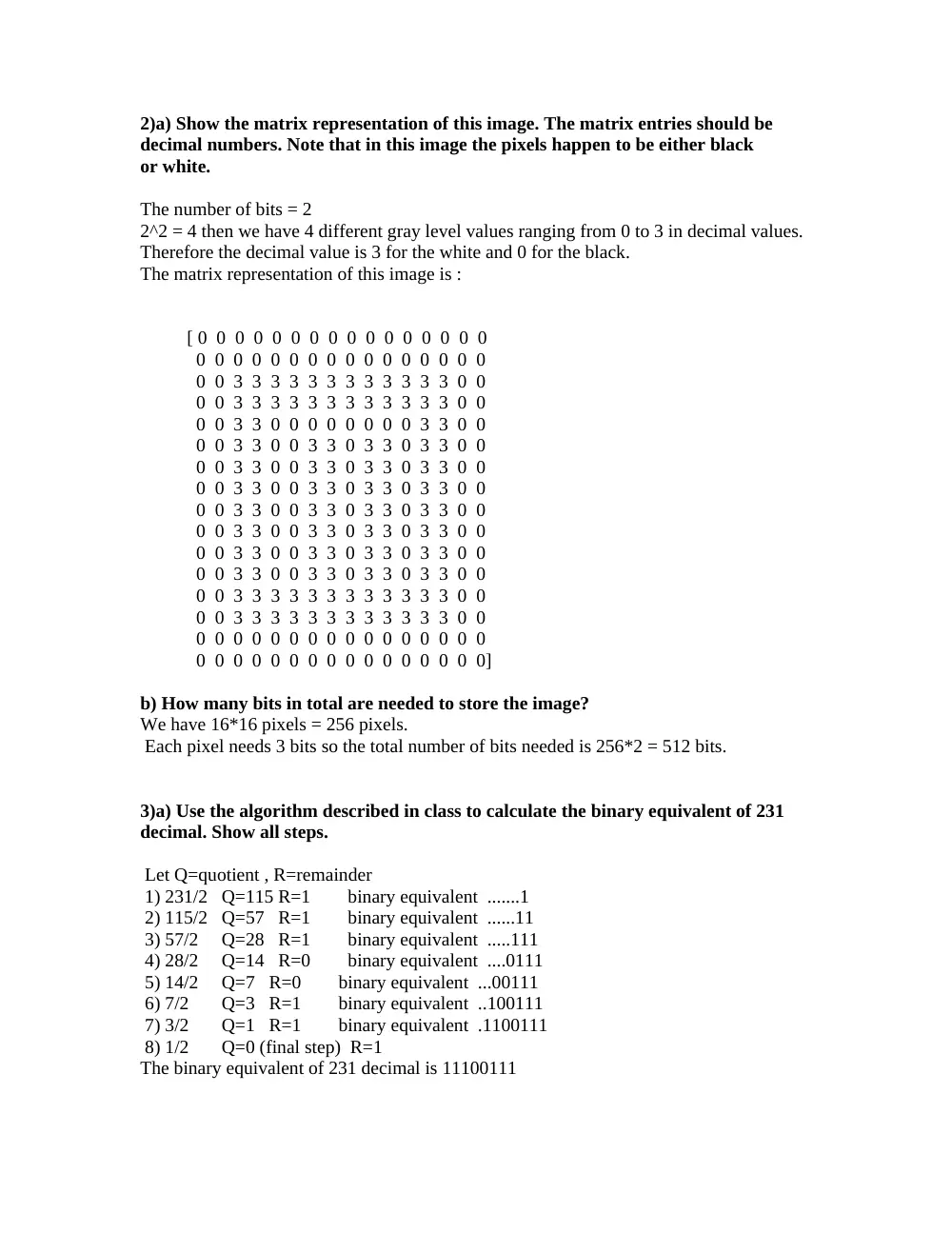
2)a) Show the matrix representation of this image. The matrix entries should be
decimal numbers. Note that in this image the pixels happen to be either black
or white.
The number of bits = 2
2^2 = 4 then we have 4 different gray level values ranging from 0 to 3 in decimal values.
Therefore the decimal value is 3 for the white and 0 for the black.
The matrix representation of this image is :
[ 0 0 0 0 0 0 0 0 0 0 0 0 0 0 0 0
0 0 0 0 0 0 0 0 0 0 0 0 0 0 0 0
0 0 3 3 3 3 3 3 3 3 3 3 3 3 0 0
0 0 3 3 3 3 3 3 3 3 3 3 3 3 0 0
0 0 3 3 0 0 0 0 0 0 0 0 3 3 0 0
0 0 3 3 0 0 3 3 0 3 3 0 3 3 0 0
0 0 3 3 0 0 3 3 0 3 3 0 3 3 0 0
0 0 3 3 0 0 3 3 0 3 3 0 3 3 0 0
0 0 3 3 0 0 3 3 0 3 3 0 3 3 0 0
0 0 3 3 0 0 3 3 0 3 3 0 3 3 0 0
0 0 3 3 0 0 3 3 0 3 3 0 3 3 0 0
0 0 3 3 0 0 3 3 0 3 3 0 3 3 0 0
0 0 3 3 3 3 3 3 3 3 3 3 3 3 0 0
0 0 3 3 3 3 3 3 3 3 3 3 3 3 0 0
0 0 0 0 0 0 0 0 0 0 0 0 0 0 0 0
0 0 0 0 0 0 0 0 0 0 0 0 0 0 0 0]
b) How many bits in total are needed to store the image?
We have 16*16 pixels = 256 pixels.
Each pixel needs 3 bits so the total number of bits needed is 256*2 = 512 bits.
3)a) Use the algorithm described in class to calculate the binary equivalent of 231
decimal. Show all steps.
Let Q=quotient , R=remainder
1) 231/2 Q=115 R=1 binary equivalent .......1
2) 115/2 Q=57 R=1 binary equivalent ......11
3) 57/2 Q=28 R=1 binary equivalent .....111
4) 28/2 Q=14 R=0 binary equivalent ....0111
5) 14/2 Q=7 R=0 binary equivalent ...00111
6) 7/2 Q=3 R=1 binary equivalent ..100111
7) 3/2 Q=1 R=1 binary equivalent .1100111
8) 1/2 Q=0 (final step) R=1
The binary equivalent of 231 decimal is 11100111
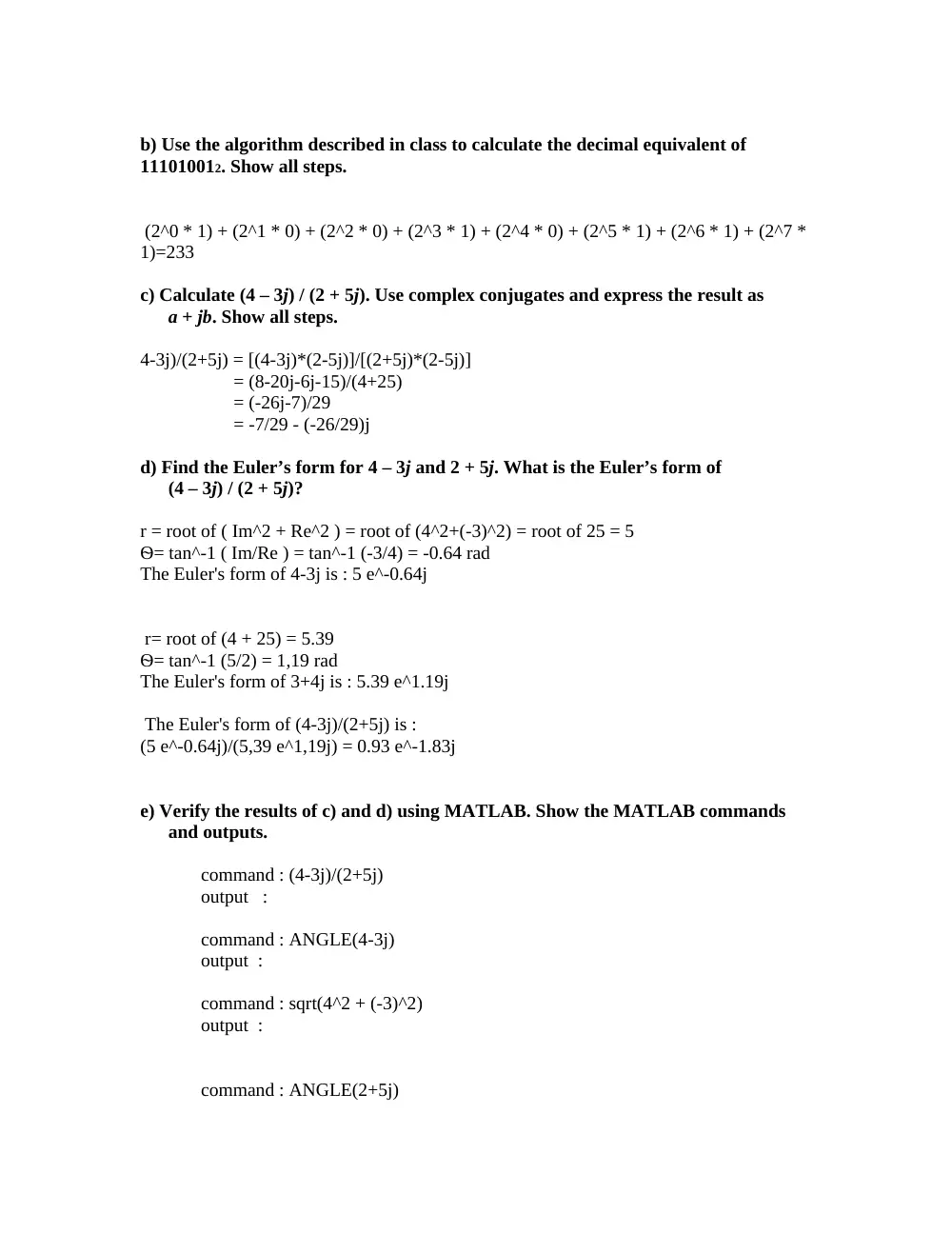
b) Use the algorithm described in class to calculate the decimal equivalent of
111010012. Show all steps.
(2^0 * 1) + (2^1 * 0) + (2^2 * 0) + (2^3 * 1) + (2^4 * 0) + (2^5 * 1) + (2^6 * 1) + (2^7 *
1)=233
c) Calculate (4 – 3j) / (2 + 5j). Use complex conjugates and express the result as
a + jb. Show all steps.
4-3j)/(2+5j) = [(4-3j)*(2-5j)]/[(2+5j)*(2-5j)]
= (8-20j-6j-15)/(4+25)
= (-26j-7)/29
= -7/29 - (-26/29)j
d) Find the Euler’s form for 4 – 3j and 2 + 5j. What is the Euler’s form of
(4 – 3j) / (2 + 5j)?
r = root of ( Im^2 + Re^2 ) = root of (4^2+(-3)^2) = root of 25 = 5
Ѳ= tan^-1 ( Im/Re ) = tan^-1 (-3/4) = -0.64 rad
The Euler's form of 4-3j is : 5 e^-0.64j
r= root of (4 + 25) = 5.39
Ѳ= tan^-1 (5/2) = 1,19 rad
The Euler's form of 3+4j is : 5.39 e^1.19j
The Euler's form of (4-3j)/(2+5j) is :
(5 e^-0.64j)/(5,39 e^1,19j) = 0.93 e^-1.83j
e) Verify the results of c) and d) using MATLAB. Show the MATLAB commands
and outputs.
command : (4-3j)/(2+5j)
output :
command : ANGLE(4-3j)
output :
command : sqrt(4^2 + (-3)^2)
output :
command : ANGLE(2+5j)
output :
command : sqrt(2^2 + 5^2)
output :
command : (5 e^-0.64j)/(5,39 e^1,19j)
output :
4. Engineering Design
Apply the engineering design steps discussed in class to the development of a new
portable DVD player. Be as specific as possible about each step in the design
algorithm.
Step 1 : Define problem and determine requirements:
We need to design a new portable DVD player. It has to have an easy program system so
that all people will be able to deal with it without difficulties. It has to be also cheap,
medium size , providing multiple activities (acoustic system, blue ray lens, battery life
with high performance, time machine system, tv tuner…)
Step 2 : Generate alternative designs:
-Design 1 :
Rounded form, 15 inches lcd screen, 680 wats, 2 hours battery life .0.9 kg,
-Design 2 :
Rectangular form, 17,1 inches, can be supplied with two batteries each of life 1.5 hours.
Weight 2kg . speakers of 1000wats usb port and a memory card reader
-Design 3 :
Designed specially for kids. Ultra slim form, with funny forms. 9.1 inches with 500 wats
speakers. 2.5 hours battery life.
Step 3 : Decide on a final design:
After many studies, the first design seems to be the most convincing design. With a the
best opportunity cost for customers. It represents a mid point between quality and
cheapness.
Step 4 : Build/test the design:
Build the design with taking in concern the use of high-tech tools that last for a long time.
Step 5 : Evaluate the design:
The design may need some changes especially in decreasing its cost.
5. a. Exercise 1.3.24 in textbook
-Development in sound system: you can adjust the base, fade.
-Purify singer’s voice.
- Playback, recording, composition, storage, and performance.
the application of technology, most recently digital technology, to the practice of
music, either creatively—that is, in music composition and live performance—or in
the storage and transmission of music and sound.
to more complex music software for composition and notation, sound sampling
software, audio mixing equipment, synthesizers, and DJ turntables.
b. Exercise 1.3.25 in textbook
- Creating images using animation techniques or special effects.
the invention of more sophisticated filmstocks and lenses
6.Assume that the Pentium chip had 50 million transistors in 2002.
a) Suppose that at some time in the future, a Pentium chip is released with 14
billion transistors. In what year does this occur?
Y(1) = 2002 Y(2)= ???
N(1) = 50000000 N(2)= 14000000000
N(2) = {2^[(Y(2)-Y(1))/2]*N(1)
ln (N(2)/N(1)) = ln 2^[(Y(2)-Y(1))/2]
ln (N(2)/N(1)) = (Y(2)-Y(1))/2 * ln2
Y(2)= ln (N(2)/N(1))*2/ln(2) + Y1
Y(2) ≈ 2018
b) If Moore’s Law said that the number of transistors would triple every three
years, how many transistors would be on a Pentium chip in the year 2014?
Y(1)=2002 Y(2)=2014
N(1)=50000000 N(2)= ???
N(2)= {3^[(Y(2)-Y(1))/2]}*N(1)
= [3^((2014-2002)/2)]*50000000
= 729*50000000
= 3.645 * (10)^10 transistors