
EECE 200 Homework, Spring 2008
American University of Beirut · Introduction to Electrical and Computer Engineering · 2 pages

More EECE 200 files
- Homework 2 · Fall 2014HomeworkView
- Homework 1 · Fall 2014HomeworkView
- Homework 1 Sol · Fall 2014Homework · with solutionView
- Homework 1 with Solution · Fall 2014Homework · with solutionView
- Homework 2 Sol · Fall 2014Homework · with solutionView
- Homework 2 with Solution · Fall 2014Homework · with solutionView
- Homework 1 · Fall 2013HomeworkView
- Homework 1 Solution (Fall 2013 · Fall 2013Homework · with solutionView
Show the text of this homework
American University of Beirut
Department of Electrical and Computer Engineering
EECE 200 – Introduction to Electrical and Computer Engineering
Homework #2
Due Monday November 17, 2008 at 3:00 PM
Submit your homework in box facing Room 404 in RGB
Write your answers neatly or type using a word processor
1. [20 points] An audio signal is represented by vs = 10 sin(8500t) Volts.
a) Find the amplitude of the signal. [2 points]
b) Find the period, frequency, and angular frequency. [2 points]
c) Find the Nyquist sampling rate for this signal. [1 point]
d) The signal is sampled at a sampling rate of 5000 samples per second. Find the
real values of the first four samples, starting with t = 0. Show all calculations.
[4 points]
e) The samples are quantized to 64 discrete levels that correspond to the full
range of +/– 10 Volts (all zeros is –10 V and all ones is +10 V). How many
bits are needed? Show all calculations. [3 points]
f) Find the binary representations of the first four samples, starting with t = 0.
Show all calculations. Use the results of part (e). [8 points]
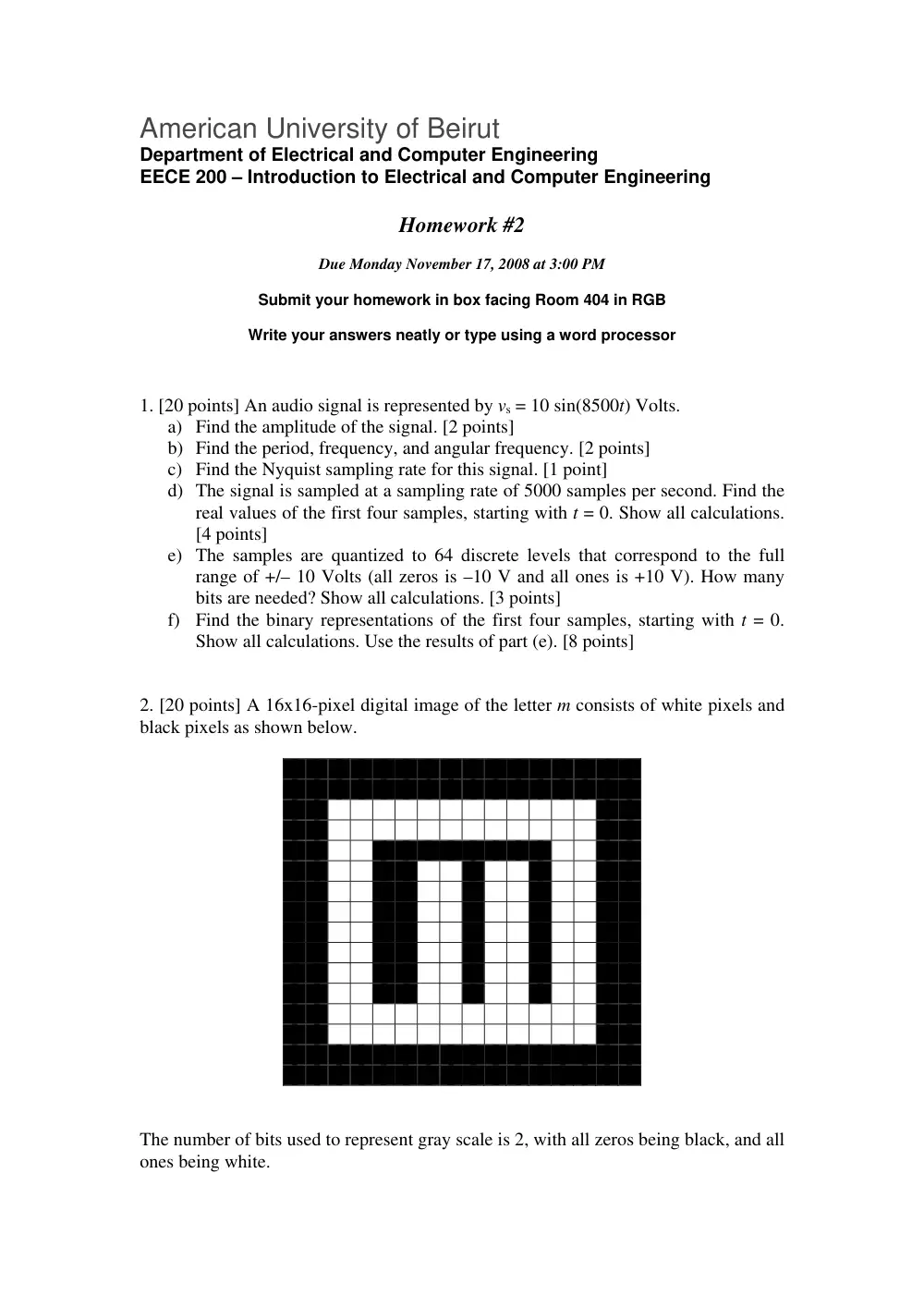
2. [20 points] A 16x16-pixel digital image of the letter m consists of white pixels and
black pixels as shown below.
The number of bits used to represent gray scale is 2, with all zeros being black, and all
ones being white.
a) Show the matrix representation of this image. The matrix entries should be
decimal numbers. Note that in this image the pixels happen to be either black
or white. [12 points]
b) How many bits in total are needed to store the image? [8 points]
3. [20 points]
a) Use the algorithm described in class to calculate the binary equivalent of 231
decimal. Show all steps. [4 points]
b) Use the algorithm described in class to calculate the decimal equivalent of
111010012. Show all steps. [4 points]
c) Calculate (4 – 3j) / (2 + 5j). Use complex conjugates and express the result as
a + jb. Show all steps. [4 points]
d) Find the Euler’s form for 4 – 3j and 2 + 5j. What is the Euler’s form of
(4 – 3j) / (2 + 5j)? [4 points]
e) Verify the results of c) and d) using MATLAB. Show the MATLAB commands
and outputs. [4 points]
4. Engineering Design [20 points]
Apply the engineering design steps discussed in class to the development of a new
portable DVD player. Be as specific as possible about each step in the design
algorithm.
5. [10 points]
a. Exercise 1.3.24 in textbook [5 points]
b. Exercise 1.3.25 in textbook [5 points]
6. [10 points]
Assume that the Pentium chip had 50 million transistors in 2002.
a) Suppose that at some time in the future, a Pentium chip is released with 14
billion transistors. In what year does this occur?
[5 points]
b) If Moore’s Law said that the number of transistors would triple every three
years, how many transistors would be on a Pentium chip in the year 2014?
[5 points]