
EECE 210C Lecture, Fall 2006
American University of Beirut · Electric Circuits for Civil Engineers · 10 pages
More EECE 210C files
Show the text of this lab
6
Inductance, Capacitance, and Mutual
Inductance
Assessment Problems
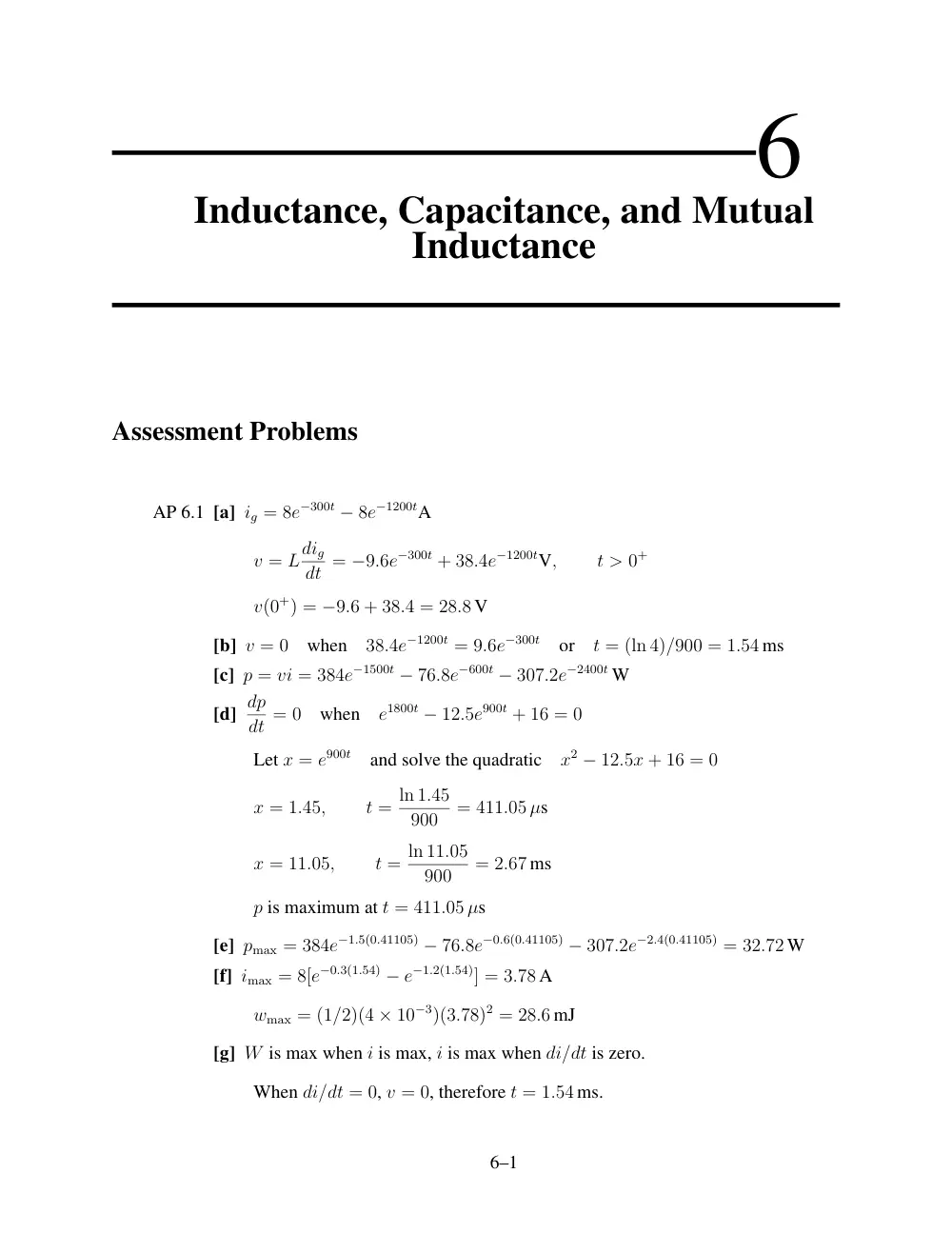
AP 6.1 [a] ig = 8e−300t − 8e−1200tA
v = Ldig
dt = −9.6e−300t + 38.4e−1200tV,
t > 0+
v(0+) = −9.6 + 38.4 = 28.8 V
[b] v = 0
when
38.4e−1200t = 9.6e−300t
or
t = (ln 4)/900 = 1.54 ms
[c] p = vi = 384e−1500t − 76.8e−600t − 307.2e−2400t W
[d] dp
dt = 0
when
e1800t − 12.5e900t + 16 = 0
Let x = e900t
and solve the quadratic
x2 − 12.5x + 16 = 0
x = 1.45,
t = ln 1.45
900
= 411.05 µs
x = 11.05,
t = ln 11.05
900
= 2.67 ms
p is maximum at t = 411.05 µs
[e] pmax = 384e−1.5(0.41105) − 76.8e−0.6(0.41105) − 307.2e−2.4(0.41105) = 32.72 W
[f] imax = 8[e−0.3(1.54) − e−1.2(1.54)] = 3.78 A
wmax = (1/2)(4 × 10−3)(3.78)2 = 28.6 mJ
[g] W is max when i is max, i is max when di/dt is zero.
When di/dt = 0, v = 0, therefore t = 1.54 ms.
6–1
6–2
CHAPTER 6. Inductance, Capacitance, and Mutual Inductance
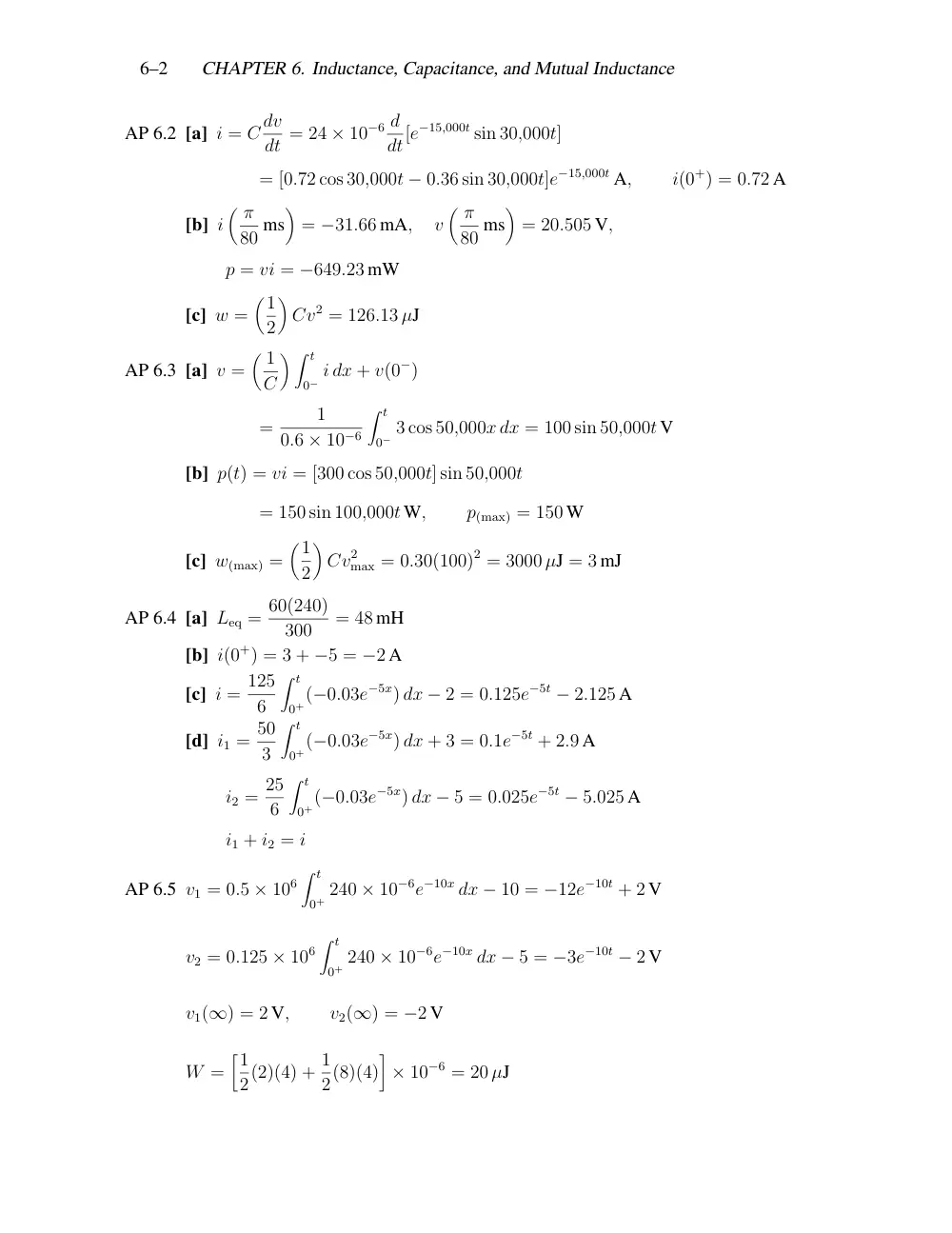
AP 6.2 [a] i = C dv
dt = 24 × 10−6 d
dt[e−15,000t sin 30,000t]
= [0.72 cos 30,000t − 0.36 sin 30,000t]e−15,000t A,
i(0+) = 0.72 A
[b] i
� π
80 ms
�
= −31.66 mA,
v
� π
80 ms
�
= 20.505 V,
p = vi = −649.23 mW
[c] w =
�1
2
�
Cv2 = 126.13 µJ
AP 6.3 [a] v =
� 1
C
� � t
0− i dx + v(0−)
=
1
0.6 × 10⁻⁶
� t
0− 3 cos 50,000x dx = 100 sin 50,000t V
[b] p(t) = vi = [300 cos 50,000t] sin 50,000t
= 150 sin 100,000t W,
p(max) = 150 W
[c] w(max) =
�1
2
�
Cv2
max = 0.30(100)2 = 3000 µJ = 3 mJ
AP 6.4 [a] Leq = 60(240)
300
= 48 mH
[b] i(0+) = 3 + −5 = −2 A
[c] i = 125
6
� t
0+(−0.03e−5x) dx − 2 = 0.125e−5t − 2.125 A
[d] i1 = 50
3
� t
0+(−0.03e−5x) dx + 3 = 0.1e−5t + 2.9 A
i2 = 25
6
� t
0+(−0.03e−5x) dx − 5 = 0.025e−5t − 5.025 A
i1 + i2 = i
AP 6.5 v1 = 0.5 × 10⁶
� t
0+ 240 × 10−6e−10x dx − 10 = −12e−10t + 2 V
v2 = 0.125 × 10⁶
� t
0+ 240 × 10−6e−10x dx − 5 = −3e−10t − 2 V
v1(∞) = 2 V,
v2(∞) = −2 V
W =
�1
2(2)(4) + 1
2(8)(4)
�
× 10−6 = 20 µJ
Problems
6–3
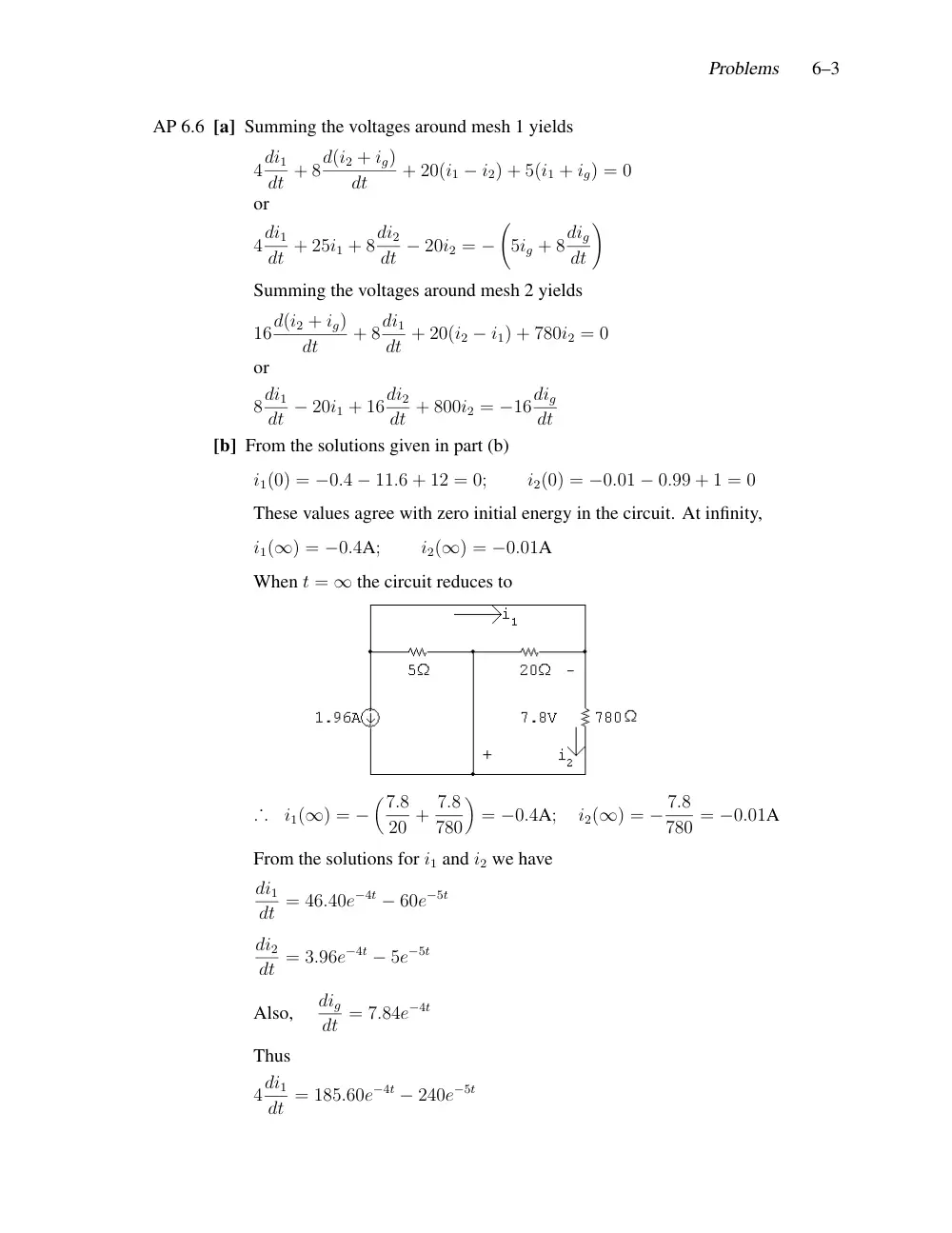
AP 6.6 [a] Summing the voltages around mesh 1 yields
4di1
dt + 8d(i2 + ig)
dt
+ 20(i1 − i2) + 5(i1 + ig) = 0
or
4di1
dt + 25i1 + 8di2
dt − 20i2 = −
�
5ig + 8dig
dt
�
Summing the voltages around mesh 2 yields
16d(i2 + ig)
dt
+ 8di1
dt + 20(i2 − i1) + 780i2 = 0
or
8di1
dt − 20i1 + 16di2
dt + 800i2 = −16dig
dt
[b] From the solutions given in part (b)
i1(0) = −0.4 − 11.6 + 12 = 0;
i2(0) = −0.01 − 0.99 + 1 = 0
These values agree with zero initial energy in the circuit. At infinity,
i1(∞) = −0.4A;
i2(∞) = −0.01A
When t = ∞ the circuit reduces to
·. .
i1(∞) = −
�7.8
20 + 7.8
780
�
= −0.4A;
i2(∞) = − 7.8
780 = −0.01A
From the solutions for i1 and i2 we have
di1
dt = 46.40e−4t − 60e−5t
di2
dt = 3.96e−4t − 5e−5t
Also,
dig
dt = 7.84e−4t
Thus
4di1
dt = 185.60e−4t − 240e−5t
6–4
CHAPTER 6. Inductance, Capacitance, and Mutual Inductance
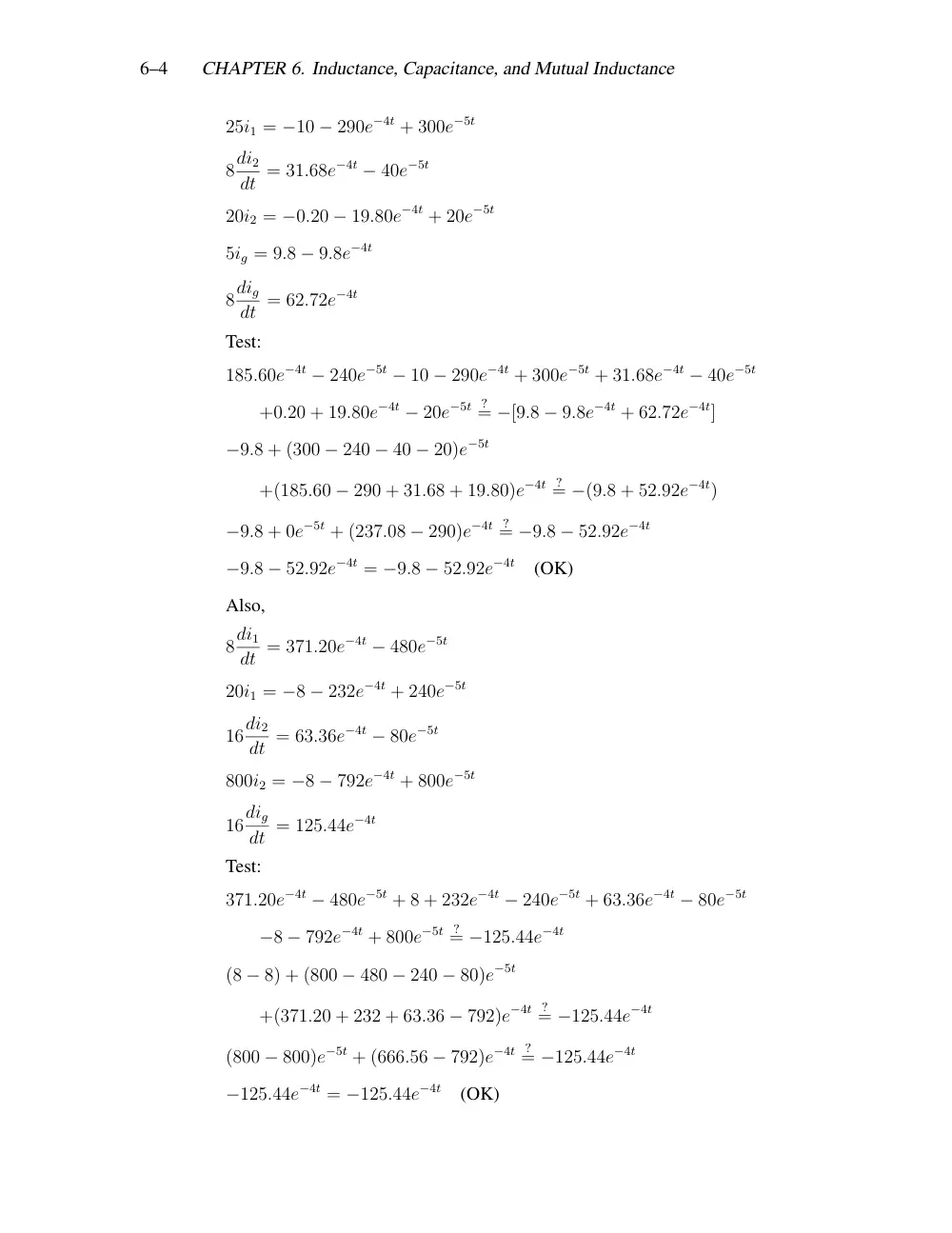
25i1 = −10 − 290e−4t + 300e−5t
8di2
dt = 31.68e−4t − 40e−5t
20i2 = −0.20 − 19.80e−4t + 20e−5t
5ig = 9.8 − 9.8e−4t
8dig
dt = 62.72e−4t
Test:
185.60e−4t − 240e−5t − 10 − 290e−4t + 300e−5t + 31.68e−4t − 40e−5t
+0.20 + 19.80e−4t − 20e−5t
?= −[9.8 − 9.8e−4t + 62.72e−4t]
−9.8 + (300 − 240 − 40 − 20)e−5t
+(185.60 − 290 + 31.68 + 19.80)e−4t
?= −(9.8 + 52.92e−4t)
−9.8 + 0e−5t + (237.08 − 290)e−4t
?= −9.8 − 52.92e−4t
−9.8 − 52.92e−4t = −9.8 − 52.92e−4t
(OK)
Also,
8di1
dt = 371.20e−4t − 480e−5t
20i1 = −8 − 232e−4t + 240e−5t
16di2
dt = 63.36e−4t − 80e−5t
800i2 = −8 − 792e−4t + 800e−5t
16dig
dt = 125.44e−4t
Test:
371.20e−4t − 480e−5t + 8 + 232e−4t − 240e−5t + 63.36e−4t − 80e−5t
−8 − 792e−4t + 800e−5t
?= −125.44e−4t
(8 − 8) + (800 − 480 − 240 − 80)e−5t
+(371.20 + 232 + 63.36 − 792)e−4t
?= −125.44e−4t
(800 − 800)e−5t + (666.56 − 792)e−4t
?= −125.44e−4t
−125.44e−4t = −125.44e−4t
(OK)
Problems
6–5
Problems
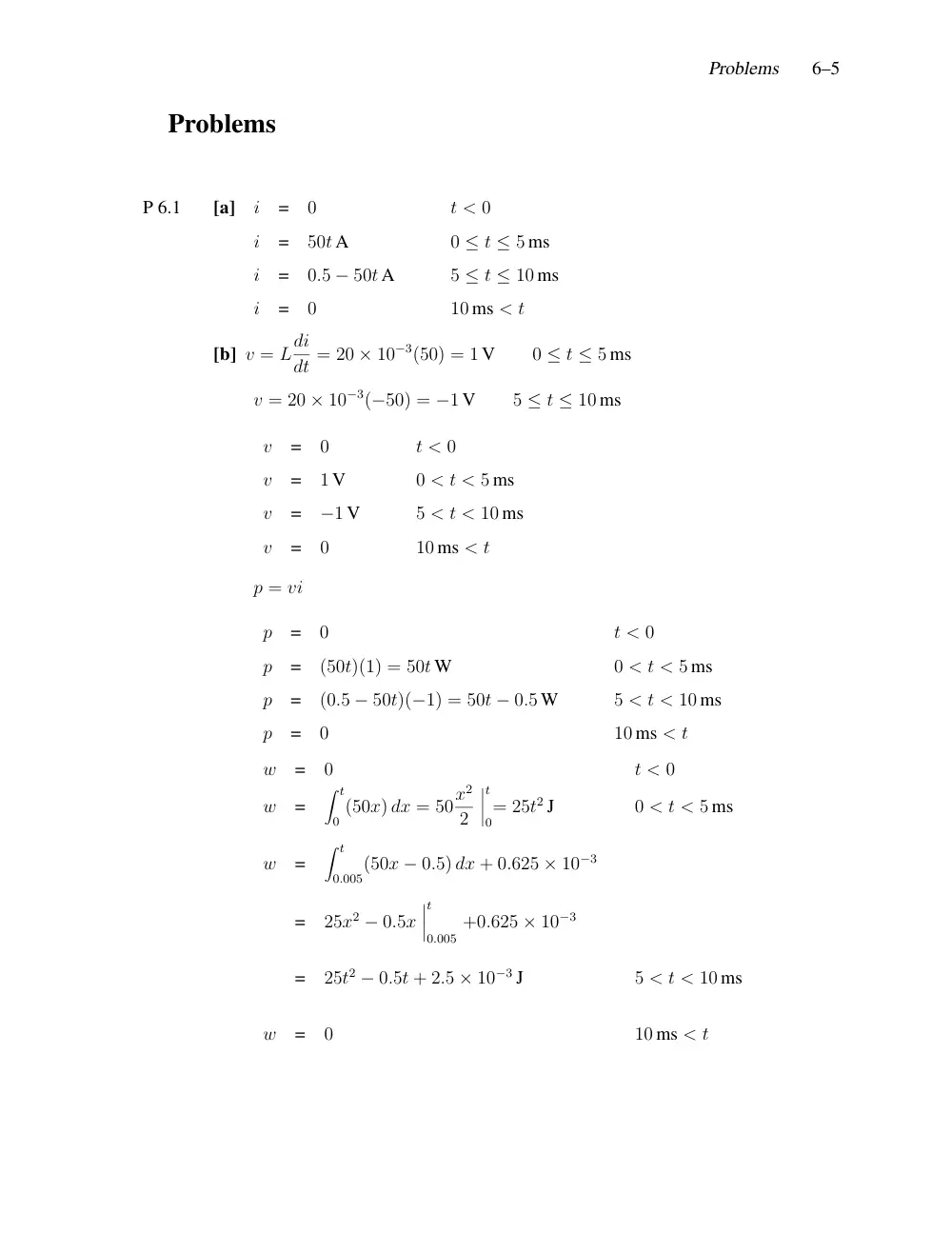
P 6.1
[a]
i
=
0
t < 0
i
=
50t A
0 ≤ t ≤ 5 ms
i
=
0.5 − 50t A
5 ≤ t ≤ 10 ms
i
=
0
10 ms < t
[b] v = Ldi
dt = 20 × 10−3(50) = 1 V
0 ≤ t ≤ 5 ms
v = 20 × 10−3(−50) = −1 V
5 ≤ t ≤ 10 ms
v
=
0
t < 0
v
=
1 V
0 < t < 5 ms
v
=
−1 V
5 < t < 10 ms
v
=
0
10 ms < t
p = vi
p
=
0
t < 0
p
=
(50t)(1) = 50t W
0 < t < 5 ms
p
=
(0.5 − 50t)(−1) = 50t − 0.5 W
5 < t < 10 ms
p
=
0
10 ms < t
w
=
0
t < 0
w
=
� t
0 (50x) dx = 50x2
2
����
t
0= 25t2 J
0 < t < 5 ms
w
=
� t
0.005(50x − 0.5) dx + 0.625 × 10−3
=
25x2 − 0.5x
����
t
0.005 +0.625 × 10−3
=
25t2 − 0.5t + 2.5 × 10⁻³ J
5 < t < 10 ms
w
=
0
10 ms < t
6–6
CHAPTER 6. Inductance, Capacitance, and Mutual Inductance
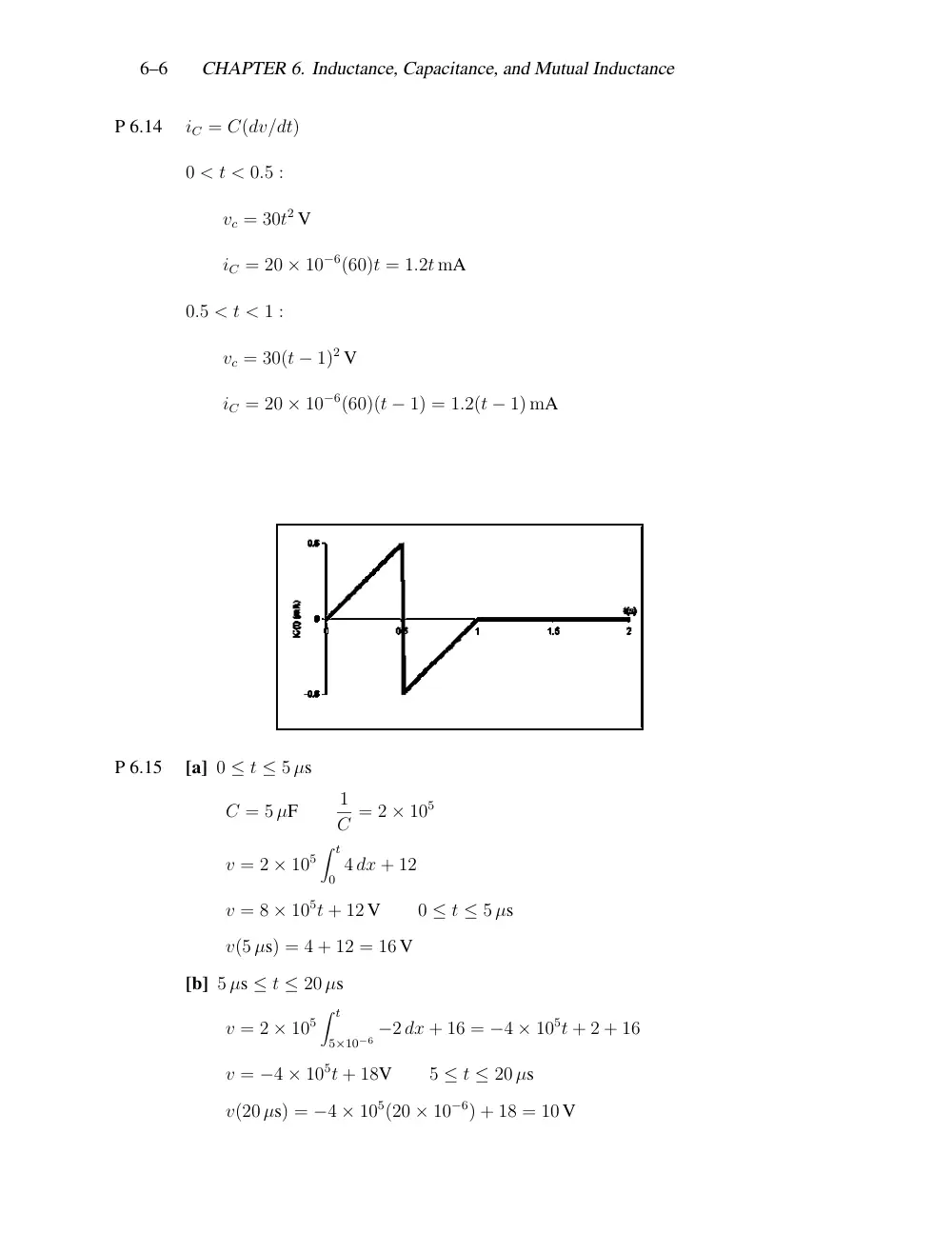
P 6.14
iC = C(dv/dt)
0 < t < 0.5 :
vc = 30t2 V
iC = 20 × 10−6(60)t = 1.2t mA
0.5 < t < 1 :
vc = 30(t − 1)2 V
iC = 20 × 10−6(60)(t − 1) = 1.2(t − 1) mA
P 6.15
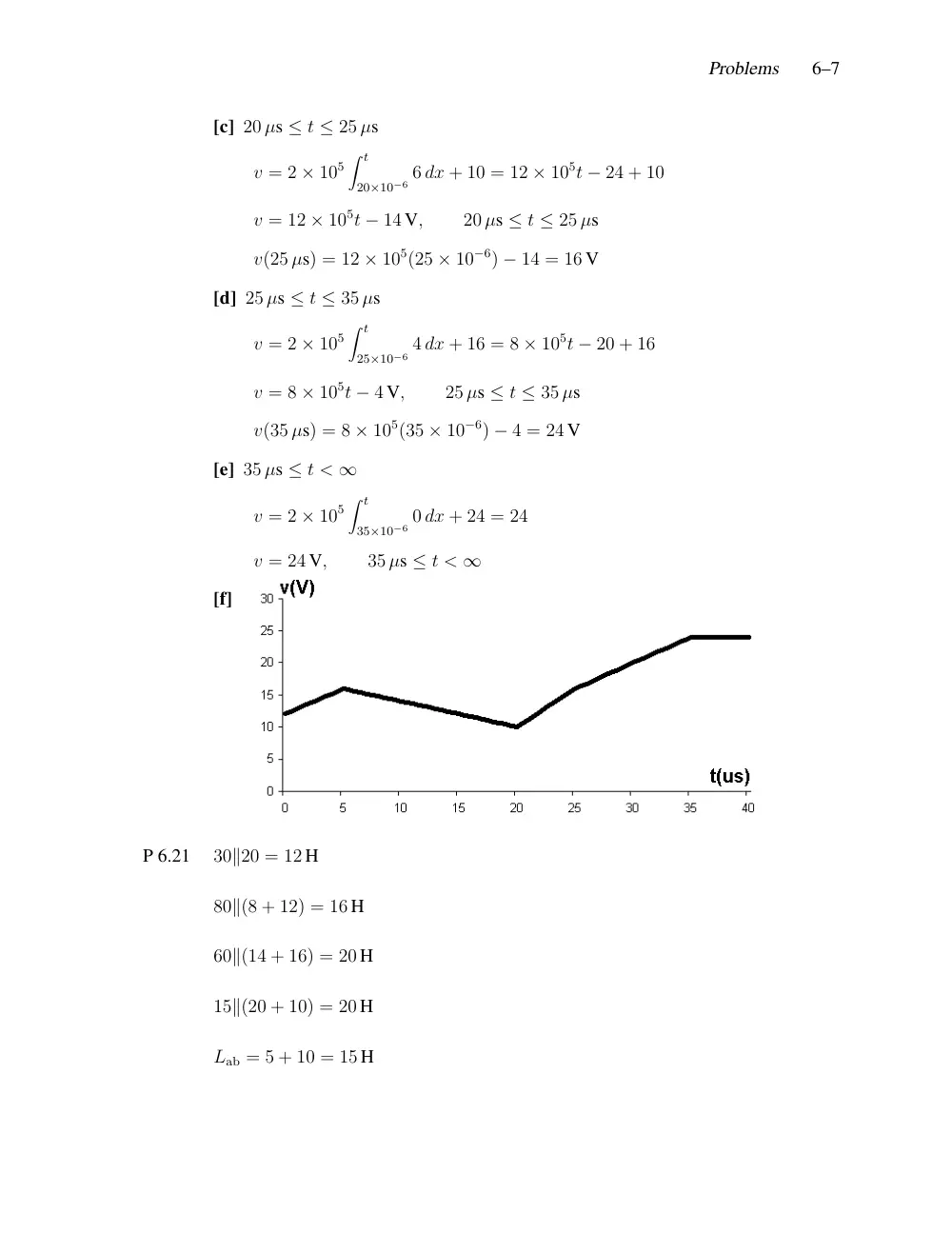
[a] 0 ≤ t ≤ 5 µs
C = 5 µF
1
C = 2 × 10⁵
v = 2 × 10⁵
� t
0 4 dx + 12
v = 8 × 10⁵t + 12 V
0 ≤ t ≤ 5 µs
v(5 µs) = 4 + 12 = 16 V
[b] 5 µs ≤ t ≤ 20 µs
v = 2 × 10⁵
� t
5×10⁻⁶ −2 dx + 16 = −4 × 10⁵t + 2 + 16
v = −4 × 10⁵t + 18V
5 ≤ t ≤ 20 µs
v(20 µs) = −4 × 10⁵(20 × 10−6) + 18 = 10 V
Problems
6–7
[c] 20 µs ≤ t ≤ 25 µs
v = 2 × 10⁵
� t
20×10−6 6 dx + 10 = 12 × 105t − 24 + 10
v = 12 × 105t − 14 V,
20 µs ≤ t ≤ 25 µs
v(25 µs) = 12 × 105(25 × 10−6) − 14 = 16 V
[d] 25 µs ≤ t ≤ 35 µs
v = 2 × 10⁵
� t
25×10−6 4 dx + 16 = 8 × 10⁵t − 20 + 16
v = 8 × 10⁵t − 4 V,
25 µs ≤ t ≤ 35 µs
v(35 µs) = 8 × 10⁵(35 × 10−6) − 4 = 24 V
[e] 35 µs ≤ t < ∞
v = 2 × 10⁵
� t
35×10−6 0 dx + 24 = 24
v = 24 V,
35 µs ≤ t < ∞
[f]
P 6.21
30∥20 = 12 H
80∥(8 + 12) = 16 H
60∥(14 + 16) = 20 H
15∥(20 + 10) = 20 H
Lab = 5 + 10 = 15 H
6–8
CHAPTER 6. Inductance, Capacitance, and Mutual Inductance
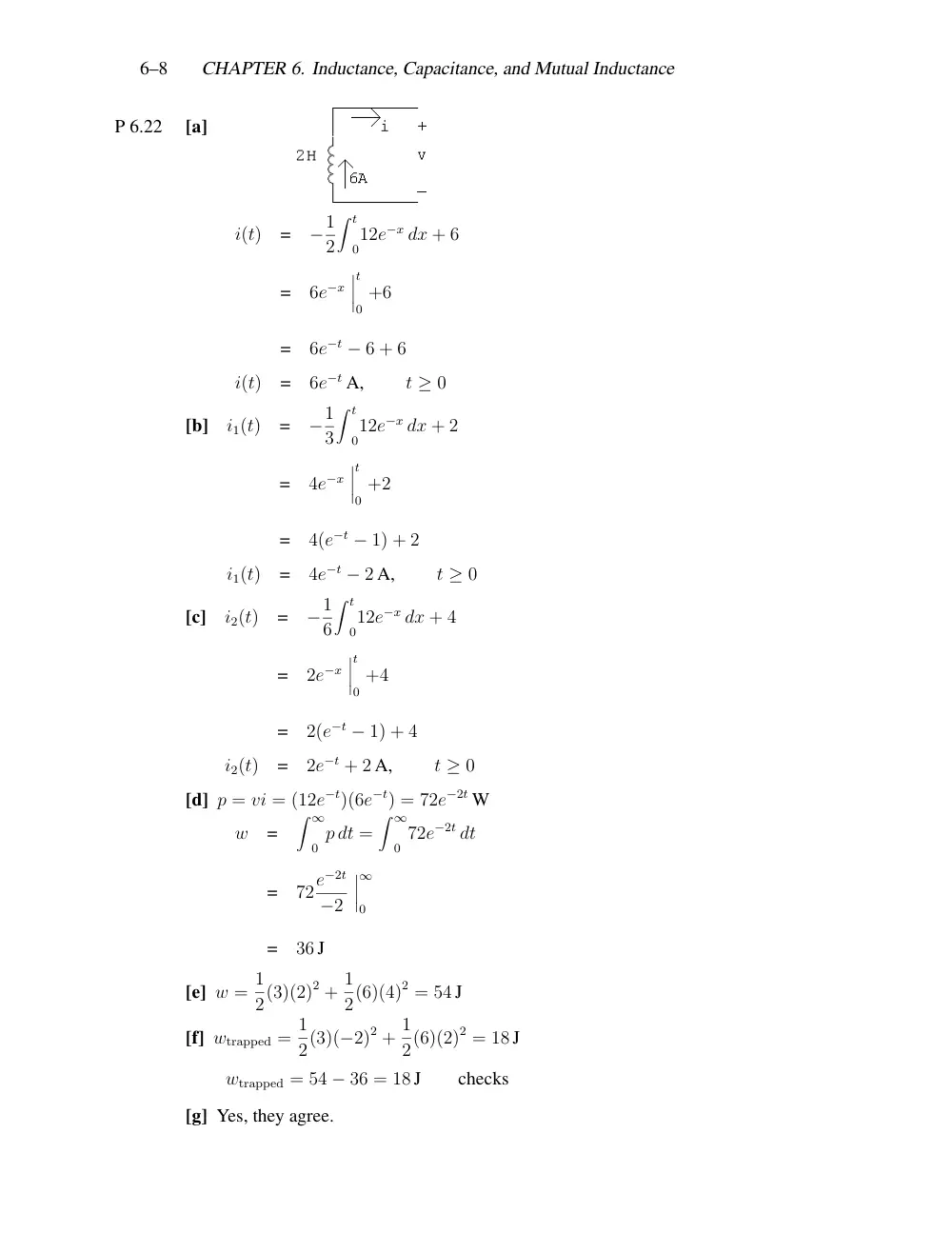
P 6.22
[a]
i(t)
=
−1
2
� t
012e−x dx + 6
=
6e−x
����
t
0 +6
=
6e−t − 6 + 6
i(t)
=
6e−t A,
t ≥ 0
[b]
i1(t)
=
−1
3
� t
012e−x dx + 2
=
4e−x
����
t
0 +2
=
4(e−t − 1) + 2
i1(t)
=
4e−t − 2 A,
t ≥ 0
[c]
i2(t)
=
−1
6
� t
012e−x dx + 4
=
2e−x
����
t
0 +4
=
2(e−t − 1) + 4
i2(t)
=
2e−t + 2 A,
t ≥ 0
[d] p = vi = (12e−t)(6e−t) = 72e−2t W
w
=
� ∞
0 p dt =
� ∞
0 72e−2t dt
=
72e−2t
−2
����
∞
0
=
36 J
[e] w = 1
2(3)(2)2 + 1
2(6)(4)2 = 54 J
[f] wtrapped = 1
2(3)(−2)2 + 1
2(6)(2)2 = 18 J
wtrapped = 54 − 36 = 18 J
checks
[g] Yes, they agree.
Problems
6–9
P 6.26
Work from the right hand side of the circuit, simplifying step by step:
1. 48 µF in series with 16 µF :
1/C = 1/16 µ + 1/48 µ
·. .
C = 12 µF
The voltages add in series, so the 12 µF capacitor has a voltage of 20 V,
negative at the top.
2. Previous 12 µF in parallel with 3 µF :
C = 12 µ + 3 µ = 15 µF
The voltage is 20 V, negative at the top.
3. Previous 15 µF in series with 30 µF :
1/C = 1/15 µ + 1/30 µ
·. .
C = 10 µF
The voltages add in series, so the 10 µF capacitor has a voltage of 10 V,
positive at the right.
4. Previous 10 µF in parallel with 10 µF :
C = 10 µ + 10 µ = 20 µF
The voltage is 10 V, negative at the top.
5. Previous 20 µF in series with 5 µF and 4 µF :
1/C = 1/20 µ + 1/5 µ + 1/4 µ
·. .
C = 2 µF
The voltages in series add:
5V − 10V + 30V = 25V
positive at the top.
The equivalent capacitance is 2 µF with a voltage of 25 V, positive at the top.
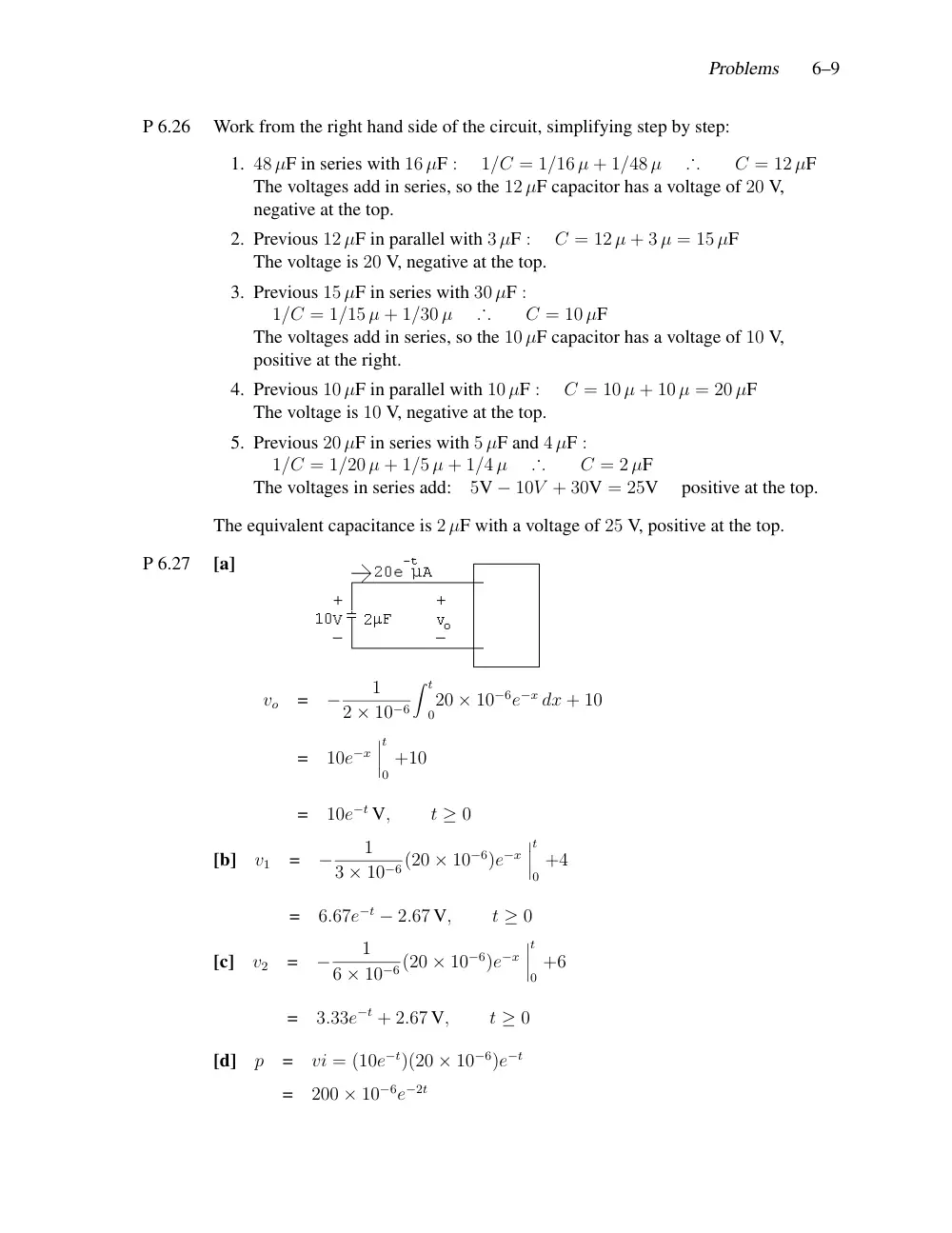
P 6.27
[a]
vo
=
−
1
2 × 10⁻⁶
� t
020 × 10−6e−x dx + 10
=
10e−x
����
t
0 +10
=
10e−t V,
t ≥ 0
[b]
v1
=
−
1
3 × 10⁻⁶(20 × 10−6)e−x
����
t
0 +4
=
6.67e−t − 2.67 V,
t ≥ 0
[c]
v2
=
−
1
6 × 10⁻⁶(20 × 10−6)e−x
����
t
0 +6
=
3.33e−t + 2.67 V,
t ≥ 0
[d]
p
=
vi = (10e−t)(20 × 10−6)e−t
=
200 × 10−6e−2t
6–10
CHAPTER 6. Inductance, Capacitance, and Mutual Inductance
w
=
� ∞
0 200 × 10−6e−2t dt
=
200 × 10−6e−2t
−2
����
∞
0
=
−100 × 10−6(0 − 1) = 100 µJ
[e]
w
=
1
2(3 × 10⁻⁶)(4)2 + 1
2(6 × 10⁻⁹)(6)2
=
132 µJ
[f]
wtrapped
=
1
2(3 × 10⁻⁶)(8/3)2 + 1
2(6 × 10⁻⁶)(8/3)2
=
32 µJ
CHECK: 100 + 32 = 132 µJ
[g] Yes, they agree.
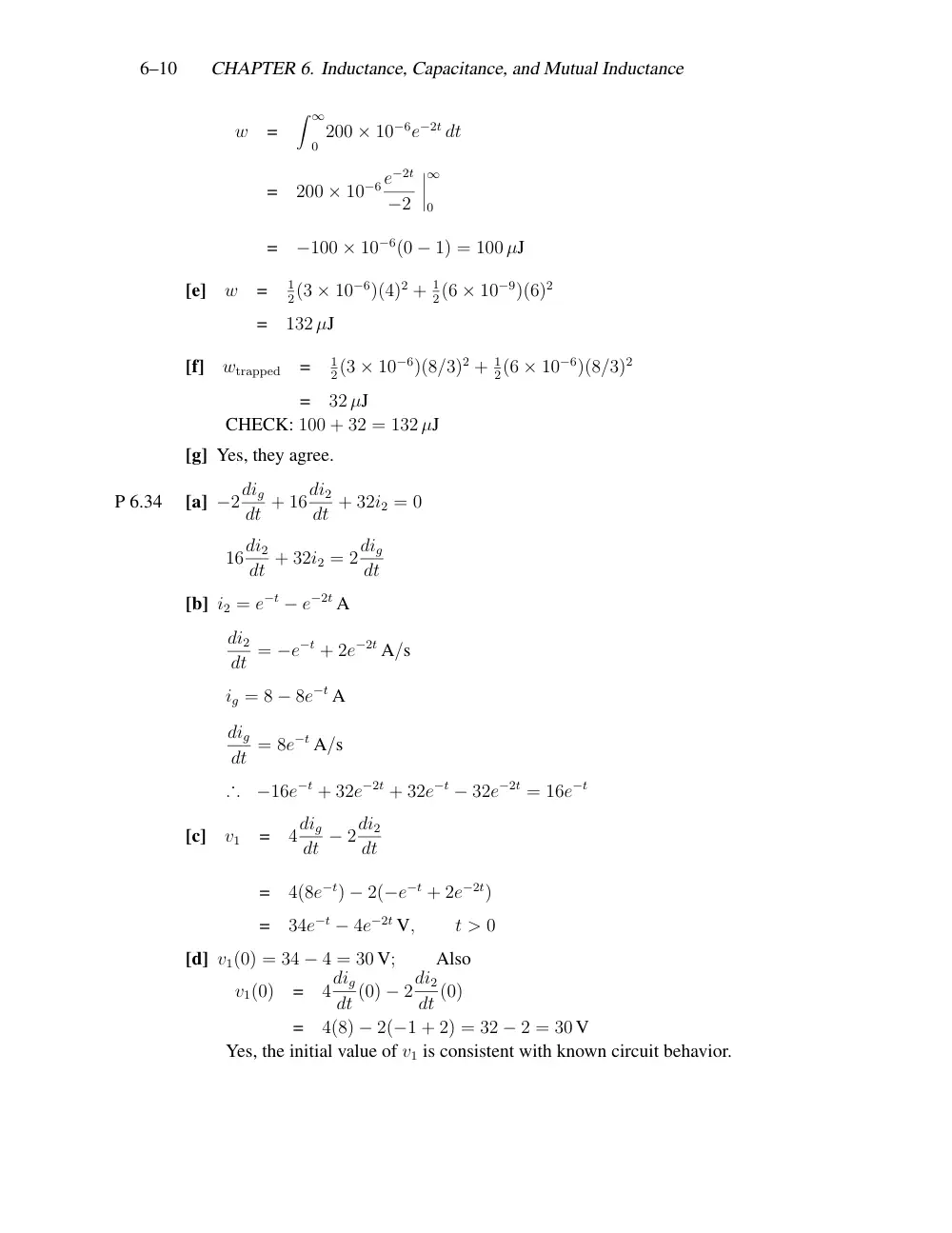
P 6.34
[a] −2dig
dt + 16di2
dt + 32i2 = 0
16di2
dt + 32i2 = 2dig
dt
[b] i2 = e−t − e−2t A
di2
dt = −e−t + 2e−2t A/s
ig = 8 − 8e−t A
dig
dt = 8e−t A/s
·. .
−16e−t + 32e−2t + 32e−t − 32e−2t = 16e−t
[c]
v1
=
4dig
dt − 2di2
dt
=
4(8e−t) − 2(−e−t + 2e−2t)
=
34e−t − 4e−2t V,
t > 0
[d] v1(0) = 34 − 4 = 30 V;
Also
v1(0)
=
4dig
dt (0) − 2di2
dt (0)
=
4(8) − 2(−1 + 2) = 32 − 2 = 30 V
Yes, the initial value of v1 is consistent with known circuit behavior.