
EECE 210C Lecture, Fall 2008
American University of Beirut · Electric Circuits for Civil Engineers · 57 pages
Showing the first 10 of 57 pages. Download the PDF to see all of it.
More EECE 210C files
Show the text of this lab
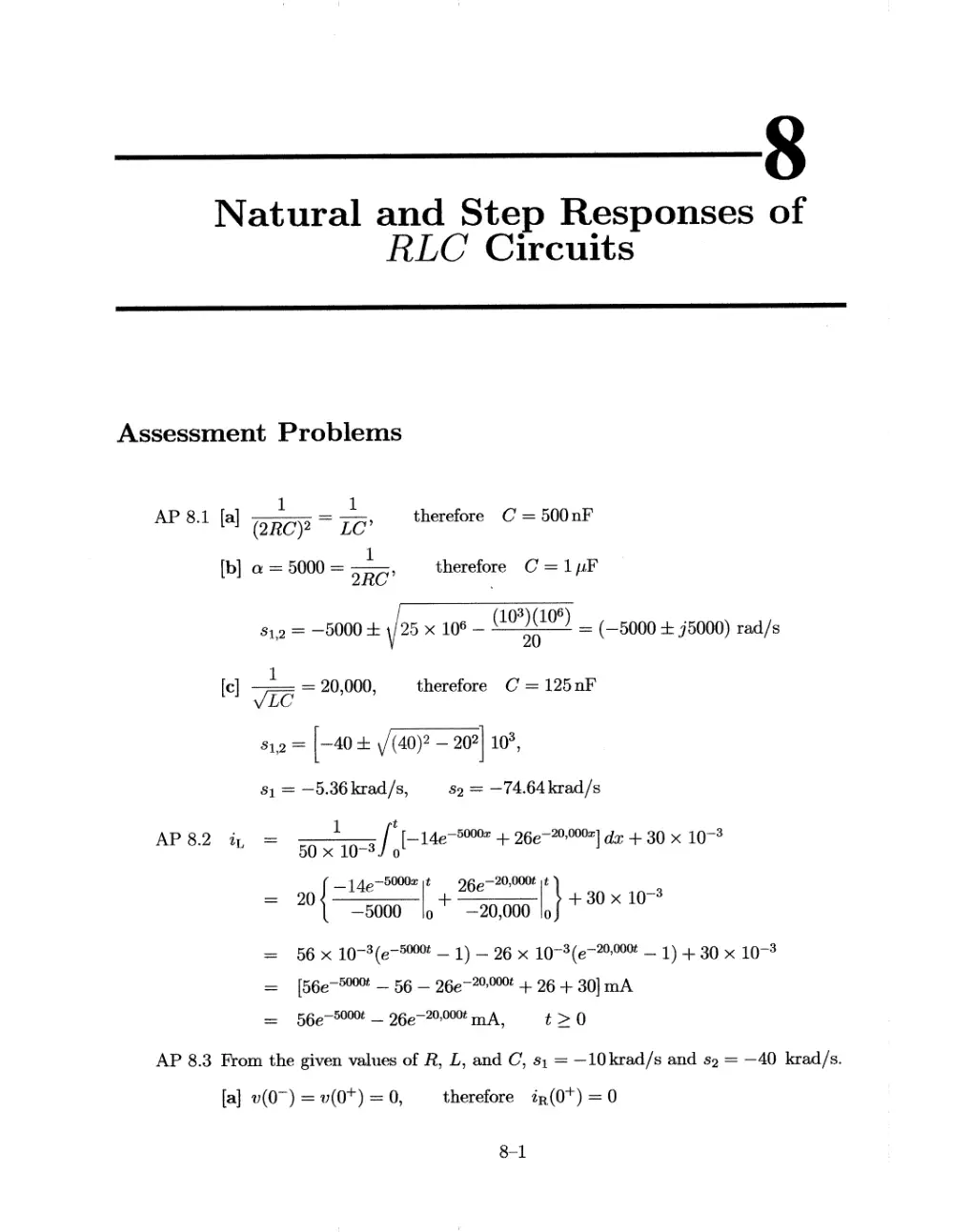
8
Natural and Step Responses of
RLC Circuits
Assessment Problems
1 1
= = 500nF
AP 8.1 [a] (RCP ~ LC’ therefore C = 500n
1
[b] a = 5000 = ORO therefore C=1,F
3) (106
$12 = —5000 + ys x 106 — ony") = (—5000 + 75000) rad/s
[c] yaa = 20,000, therefore C = 125nF
S12 = [-40 + (40)? — 20| 10°,
$1=—5.36krad/s, sy = —74.64krad/s
AP82 i, = —t+— | " [140-5000 4 26¢-20.0002) dr + 30 x 10-8
50 x 10-3/ 0
—14e—5000¢ t 26 e-20,000t t
= 2 10-8
of —5000 lo’ —20,000 } + 30x 10
= 56 x 10-3(e~890 — 1) — 96 x 10-8(e-20.000" _ 1) + 30 x 1078
[56e—5000% _ 56 — 26e~20,000 + 26 + 30] mA
= §6e75000 _ 2G e-20,000t m A, t>0
AP 8.3 From the given values of R, L, and C, s; = —10krad/s and sz = —40 krad/s.
[a] v(0~) = v(0*) =0, therefore ig(0t) =0
8-1
8-2 CHAPTER 8. Natural and Step Responses of RLC Circuits
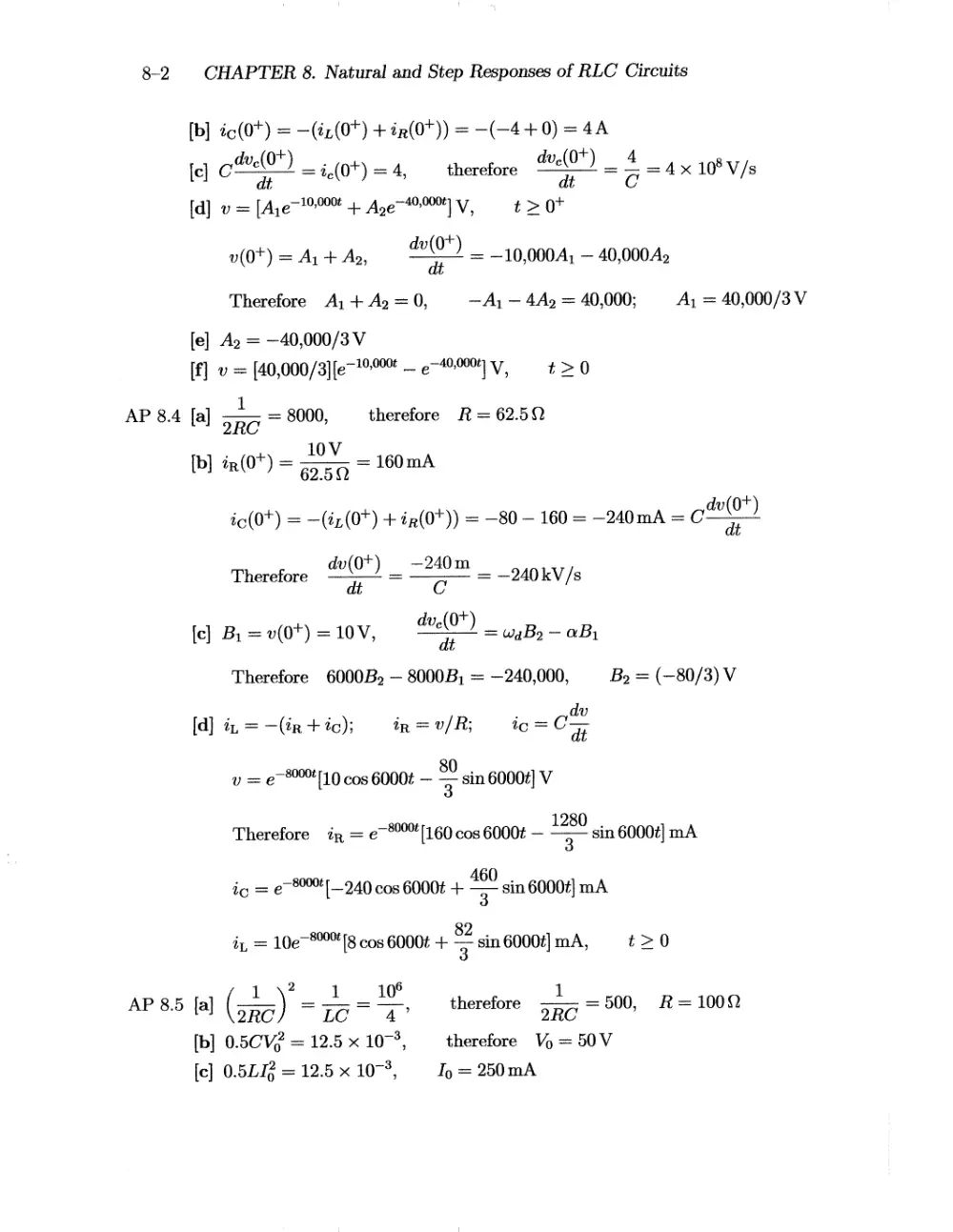
[b] ic(0*) = —(iz(0*) + in(0")) = -(-4+0) =4A
du(0t) aay dv(0*) 4 _ 847 J
[ce] C a i,(0*) = 4, therefore a OF 4x 10°V/s
[d] v = [Aye710 00 4. Ape 400004], t>0r
+
v(0*) = A, + Ad, =“ ) _ _10,000A; — 40,0004,
Therefore A, + Ag = 0, —A, — 4A> = 40,000; A; = 40,000/3 V
[e] Ay = —40,000/3 V
[f] v = [40,000/3] [e720 — eA V, £0
1
AP 8.4 [a] aRG = 8000, therefore R= 62.52
10V
« (Q+) = — =
[b] tp(0") = 6259 160mA
dv(0*)
dt
ig(O0t) = —(iz(0*) + ig(0*)) = —80 — 160 = —240mA =C
dv(0t) — —240m
dé Cc
dv,(0*)
dt
Therefore 6000B2 — 8000B, = —240,000, By = (-80/3)V
Therefore = —240kV/s
[c] B, = v(0*) = 10V,
= wg Bo _ aB,
d
[d] iL = —(ig + ic); ig = v/R; ig = OF
v = e 810 cos 6000t — . sin 6000¢] V
1280 .
Therefore ip = e~®[160 cos 6000¢ — sin 6000¢] mA
ig = e780" 240 cos 6000t + = sin 6000¢] mA
iz, = 10e78 [8 cos 60008 + = sin 6000¢] mA, t>0
1\2 1 ~~ 108 1
AP 8.5 [a] (sz) = TE= a therefore aRG 7 500, R=1002
[b] 0.5CV2 =12.5x 10⁷%, — therefore Vo = 50V
[c] 0.5217 =12.5x 10³, Ip =250mA
Problems 8-3
du(ot
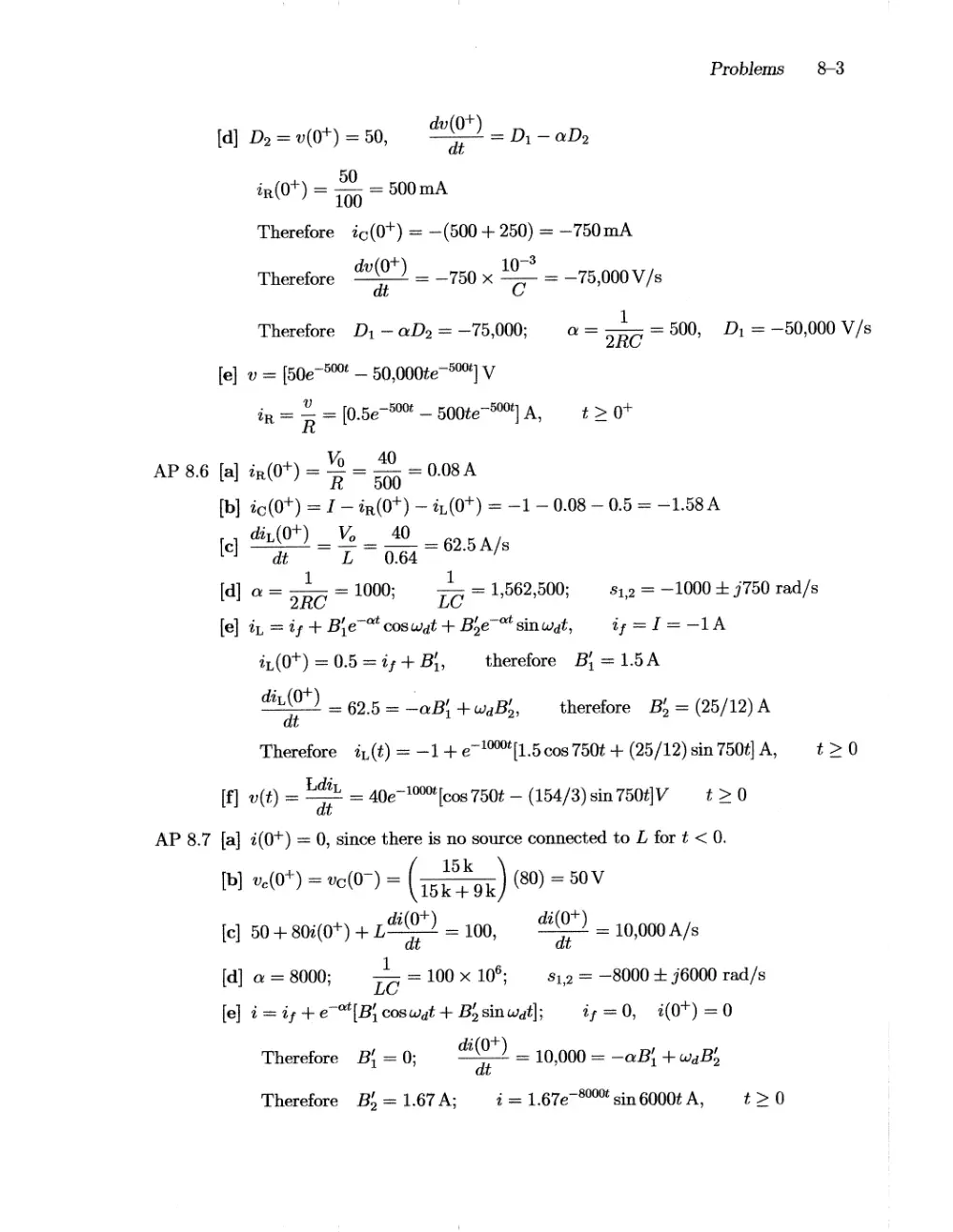
[d] Do = v(0*) = 50, uC ) = D, _ aD»
50
ty — 00 _
in(0*) = Fe = 500mA
Therefore ic¢(0*) = —(500 + 250) = —750mA
+ -3
Therefore 2%") _ _750 x 19 = ~75,000V/s
dt Cc
Therefore D, — aD, = —75,000; a= —_ = 500, D, = —50,000 V/s
fe] v = [50e75° — 50,000te °°] V
in = z = [0.5e7°°% — 500te™"] A, t > OF
. Vo 40
y+) — —— See
AP 8.6 [a] ip(0*) = R = 500 0.08 A
b] ic(0*) = I — ig(Ot) — 4, (0+) = —1 — 0.08 — 0.5 = —1.58A
di,(0t) Ve 40
=~ = — =62. 5
dt L = 064 7 8254/8
1 1 .
d] a= RO 7 1000; le 1,562,500; 51,2 = —1000 + 7750 rad/s
e] ip = ip + Bie coswat + Bye sin wt, ij =I=-1A
it (0*) = 0.5 = if + Bi, therefore BY, =1.5A
diy,(0*)
dt
Therefore iz, (¢) = —1 + e70"[1.5 cos 750¢ + (25/12) sin 750¢]A, t2>0
Ldiz,
dt
AP 8.7 [a] i(0*+) = 0, since there is no source connected to L for t < 0.
b ne(0*) = ve(0) = ( 15k
= 62.5 = —aB, + waBs, therefore By = (25/12) A
f] v(t) = = 40e7 10" [cos 750t — (154/3) sin 7504]V t > 0
15k+9k
di(0*) di(0*)
+
c] 50+ 802(0T) + L a a
1
d] a = 8000; 55 = 100 x 10°; 8. = —8000 + j6000 rad/s
e] i= is +e ™ |B) coswyt + By sin wat]; if =0, (Ot) =0
di(0*)
dt
Therefore Bl =1.67A; i1=1.67e%sin6000tA, t20
) (80) = 50V
= 100,
= 10,000 A/s
Therefore Bi = 0;
= 10,000 = —aB! + waBy,
8-4 CHAPTER 8. Natural and Step Responses of RLC Circuits
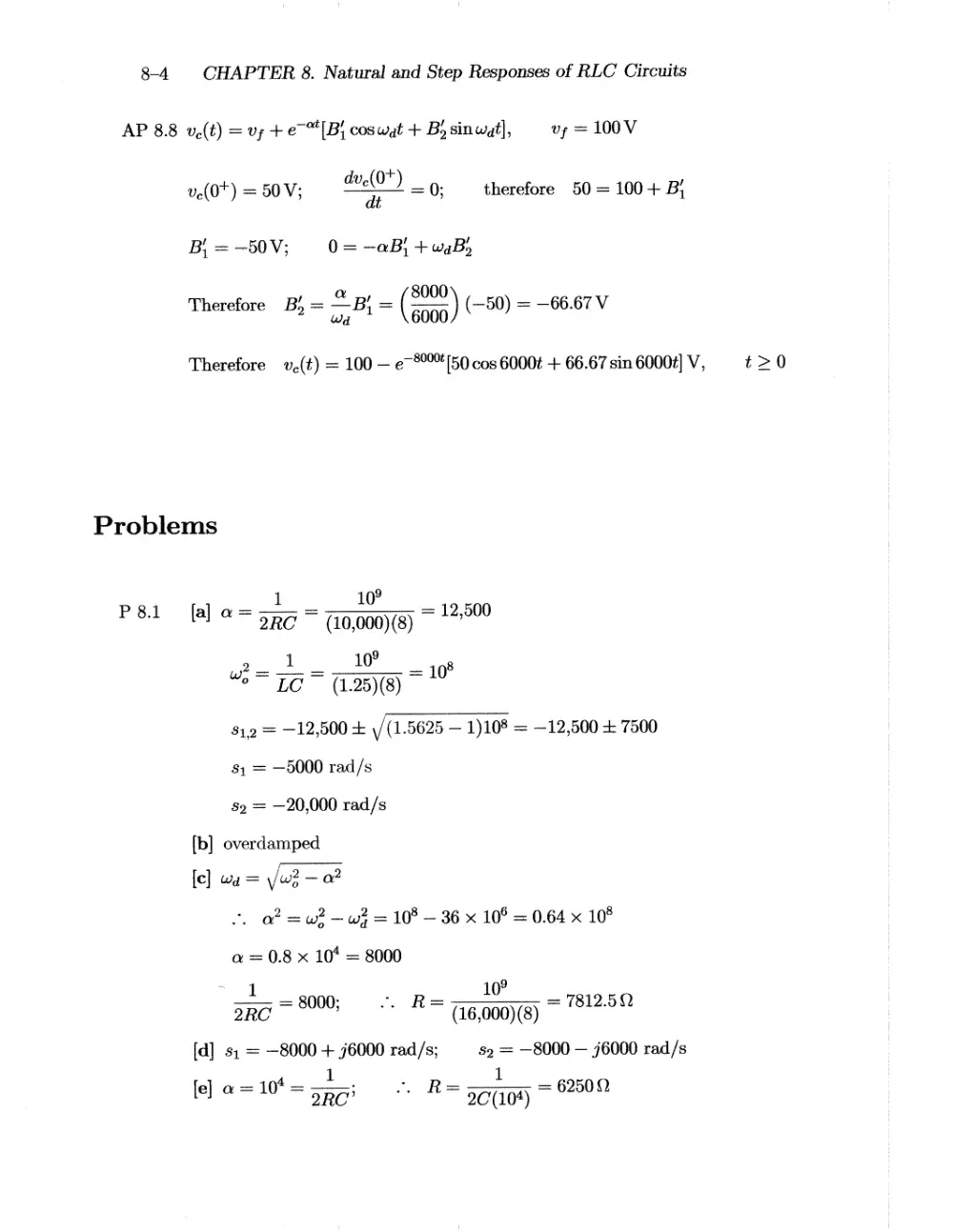
AP 8.8 u,(t) = vp + eo ™ [Bi coswat + By sin wat], vz = 100V
dv,(0*) _
+) .
ve(0*) = 50V; di
0; therefore 50 = 100+ By
BL =-50V; 0 = —aBi+waB,
a 8000
Therefore By = “Bi = (Fos) (—50) = —66.67V
Therefore v,(#) = 100 — e~ 8 [50 cos 6000¢ + 66.67 sin 60004] V,
Problems
1 10°
1 10°
2_ = ____=j0°
“o= TG = Gas) 1°
81,2 = —12,500 + \/ (1.5625 — 1)108 = —12,500 + 7500
8, = —5000 rad/s
S82 = —20,000 rad/s
[b] overdamped
[e] wa = we — 0?
a? = w? — w2 = 10° — 36 x 10° = 0.64 x 10⁸
a = 0.8 x 10* = 8000
1 _ goo, R= e250
2RC , “7 (16,000)(8) .
[d] s; = —8000 + 76000 rad/s; 82 = —8000 — 76000 rad/s
1
fe] a = 10* = R=) = 62500
2RO 20 (104)
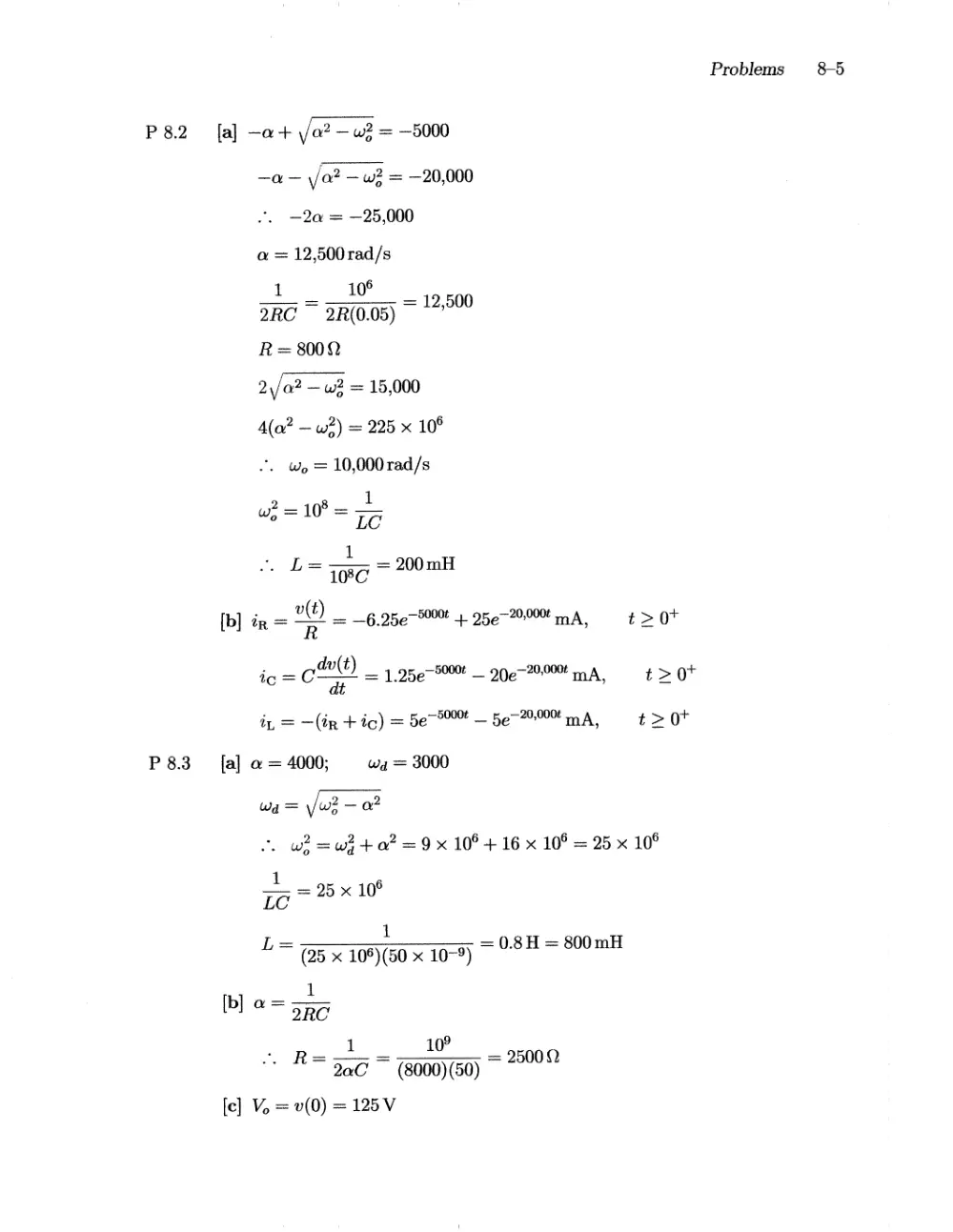
P82 fa] —a+ \/a? —w? = —5000
—a — \/a? —w?2 = —20,000
—2a = —25,000
a: = 12,500 rad/s
1 10°
2RC 2R(0.05) 12,500
R=8002
2\/a? — w? = 15,000
A(a? — w?) = 225 x 10°
*. Wo = 10,000 rad/s
1
2_ 198 —
we = 10° = 7G;
1
{b] tz = wo) = —6.25e7 5008 4 95 e720,000 mA, = t > OF
ott) = 1,25 e700 _ 29 ¢-20:000 mA > OF
y= —(ig +ic) = be
ig=C
50008 __ 5 e—20,0008 mn A | t>0r
P83 = [a] a = 4000; wa = 3000
wg = \/w? — a?
wi =wita? =9 x 10° + 16 x 10° = 25 x 10°
1 6
7g = 25x 10
1
U = Bs x 10(50 x 10-8) ~ OSH = 800mH
1
Ib] ¢ = oa
9
r= 2 = = 25000
2aC (8000)(50)
[ce] Vo = v(0) = 125V
Problems 8-5
8-6 CHAPTER 8. Natural and Step Responses of RLC Circuits
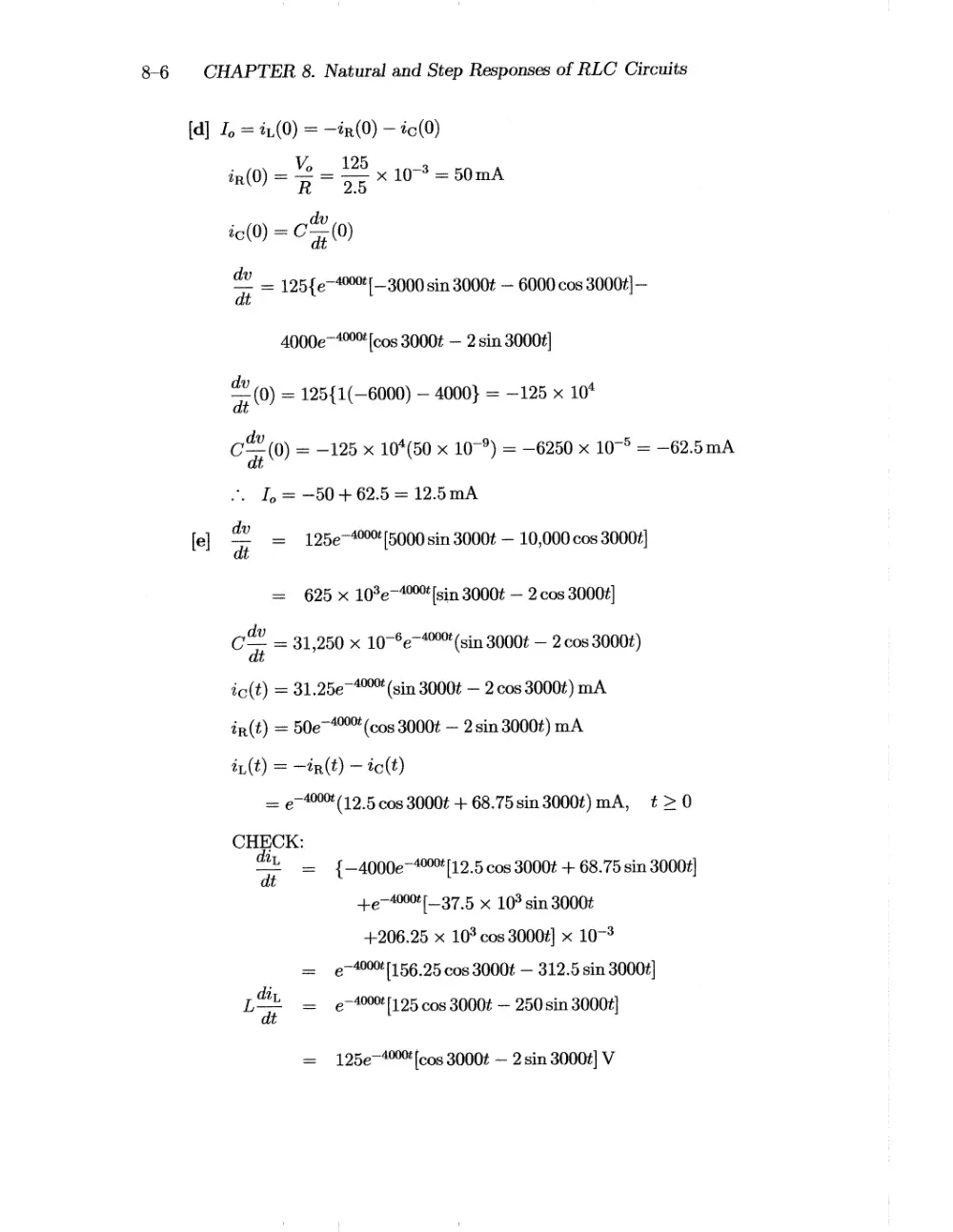
[d] Io = ix (0) = —in(0) — ic(0)
Vy 125
in(0) = 3 = 55 * 10-3 = 50mA
. du
ic(0) = C5, (0)
a = 125{e~4[ 3000 sin 3000¢ — 6000 cos 30004] —
4000e~4% [cos 3000t — 2.sin 3000#]
“(0) = 125{1(—6000) — 4000} = —125 x 104
of) = —125 x 104(50 x 10-°) = —6250 x 107° = —62.5mA
I, = —50 + 62.5 = 12.5mA
fe] “ = 125e740%[5000 sin 3000¢ — 10,000 cos 3000¢]
= 625 x 10%e-4 [sin 3000¢ — 2 cos 30001]
oF = 31,250 x 107-Fe4™ (sin 3000¢ — 2 cos 30004)
ig(t) = 31.25e~4™ (sin 3000 — 2.cos 3000t) mA
ip(t) = 50e~ 4 (cos 3000¢ — 2 sin 3000¢) mA
in (t) = —in(t) — tc(t)
= e100 (12.5 cos 3000t + 68.75 sin 3000¢)mA, t>0
CHECK:
=z = {—4000e~ 4012.5 cos 3000t + 68.75 sin 30001]
+e7 400 _37.5 x 10° sin 3000¢
+206.25 x 10% cos 3000¢] x 107%
= 67 1000/1 56.25 cos 3000¢ — 312.5 sin 30004]
Lee = e~ 400/125 cos 3000¢ — 250 sin 3000¢]
= 125¢~40 (cos 3000¢ — 2 sin 30002] V
i
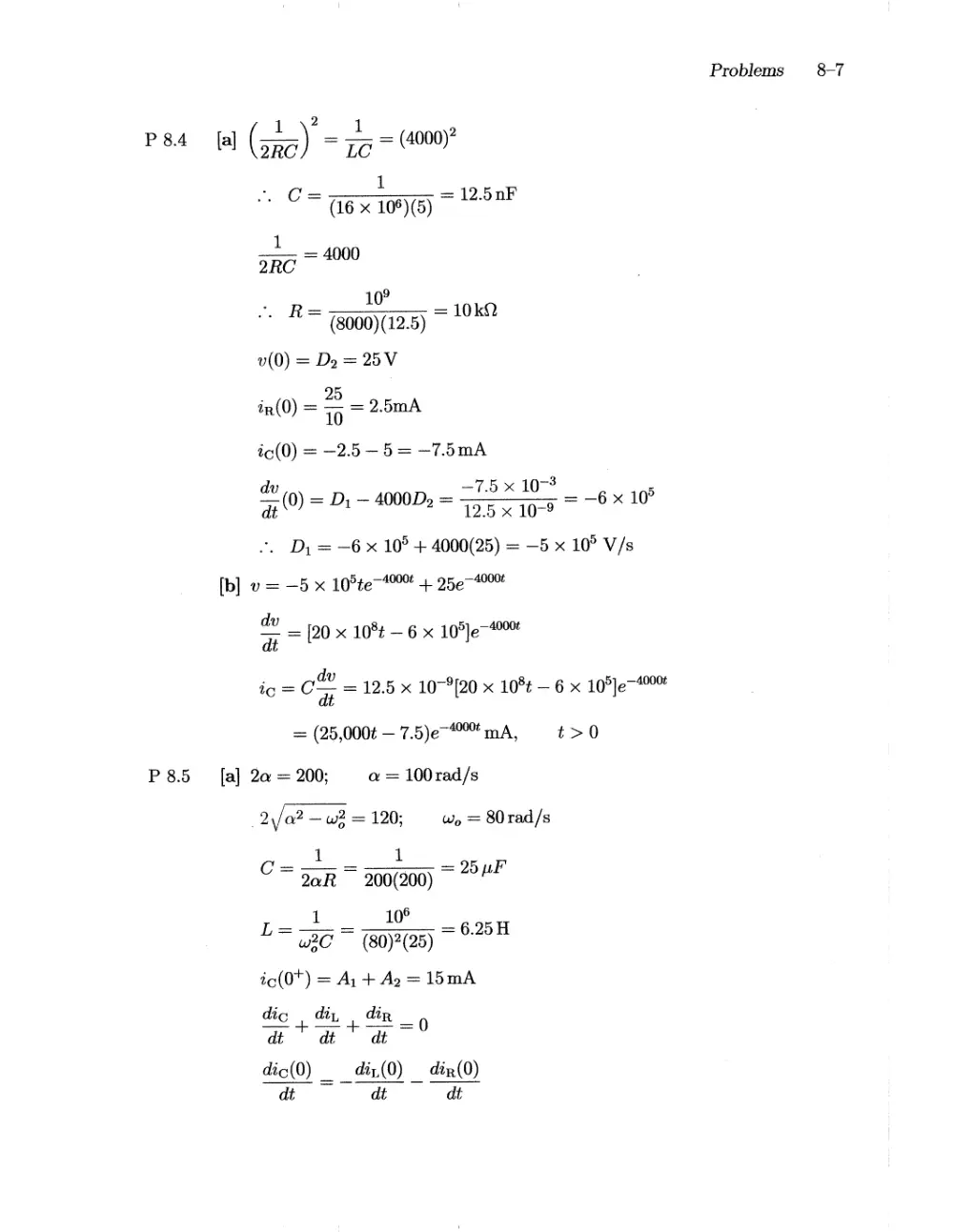
P84 [al (sha) | _ (4000)
2RC LC
1
1
oRO 4000
10°
= ——_____- = 1]
R= Tep00)(12.5) ~ LOK
v(0) = D2 = 25V
25
i = — =2.5mA
in(0) = = 25
ic(0) = -2.5 -5 = -7.5mA
du -7.5 x 1073 5
D, = —6 x 10° + 4000(25) = —5 x 10° V/s
[b] v = —5 x 10°te 40 4. 25e~ 400%
“ = [20 x 10°t — 6 x 10°]Je40™
ig = cf = 12.5 x 1079/20 x 108t — 6 x 10°Je“40"
= (25,000t — 7.5)e4" mA, +t>0
P85 [a] 2a = 200; a = 100rad/s
2\/a? —w? = 120; — w, = 80rad/s
1 1
C= dar ~ 300200) ~ 22K
6
L=4 10 _6.25H
= WC (80)2(25)
ig(0*) = Ay + Ap = 15mA
dig diy, . din _
ata ta
dic(0) __diz(0) __ dé (0)
dt dt dt
Problems
8-7
8-8 CHAPTER 8. Natural and Step Responses of RLC' Circuits
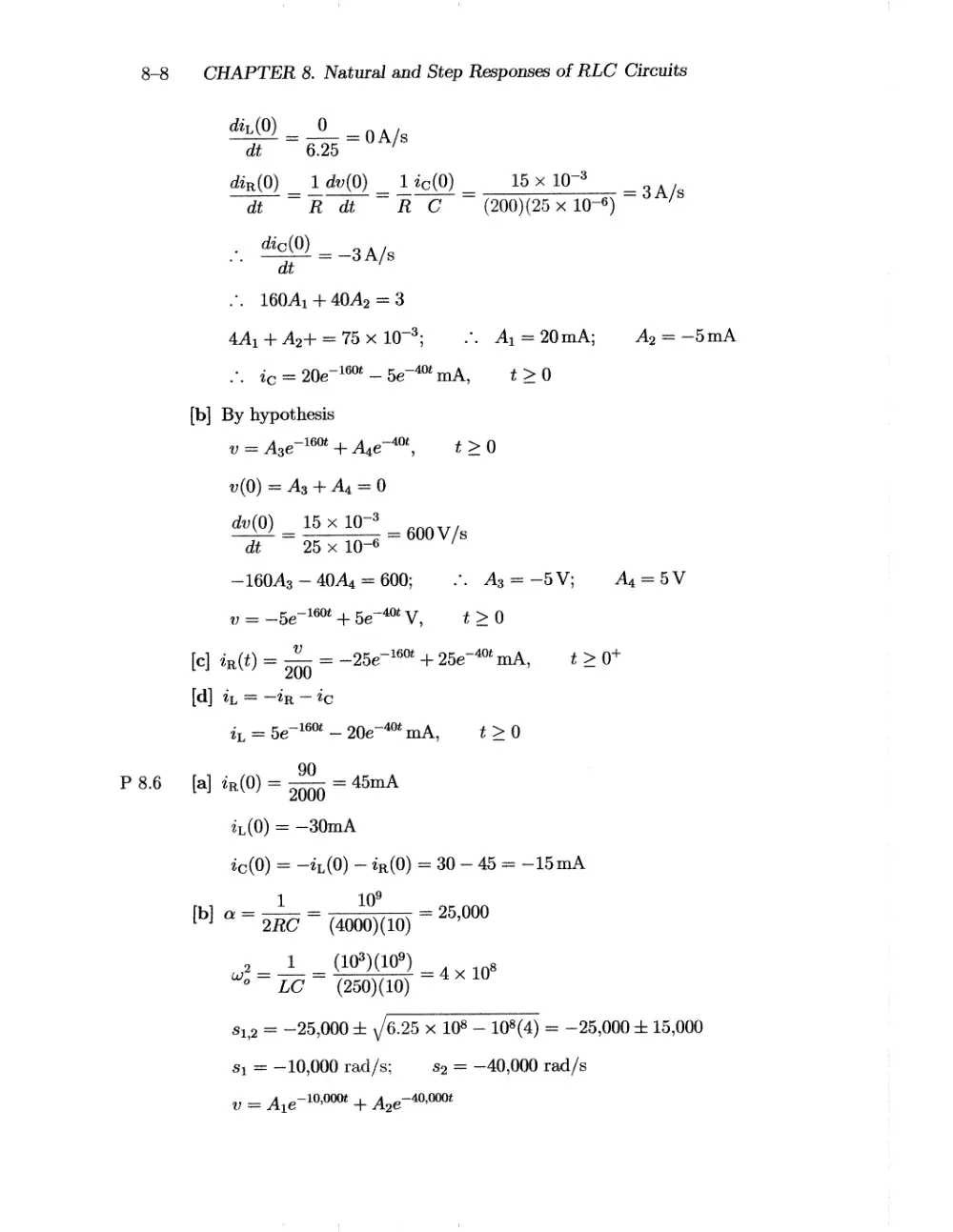
di(0) 0 _
dt 7 6.257 A/S
din(0) _1dv(0)_ 1ic(0) 15x 10% 3A/s
dt R dt RC (200)(25x 10-6) —
dic(0) _
i 3A/s
160A; + 40A_ = 3
4A, + Ag+ = 75 x 107%; <. A, =20mA; Ag = —5mA
"tig = 200710 — 5e 4! mA, t>0
[b] By hypothesis
v = Age! 4. Aye, t>0
v(0) = Ag + Ay = 0
dv(0) _ 15x 107%
dt 25 x 10-6
= 600V/s
v = —5e7 160 4 Ge AV, t>0
[ec] ig(t) = 500 = ~25e716 4 25e-4% mA, —- t > OF
[d] i, = —tz — tc
iz, = Se 16% _ 20e-4 mA, t>0
P86 [a] in(0) = aia = 45mA
i,(0) = -30mA
ic(0) = —i,(0) — éa(0) = 30 — 45 = —15mA
9
[b] a= 2. =? _ = 95,000
2RC (4000)(10)
9 1 _ (10°) (10°)
°~ LC (250)(10)
$1,2 = —25,000 + \/6.25 x 108 — 10°(4) = —25,000 + 15,000
8, = —10,000 rad/s; s2 = —40,000 rad/s
w =4~x 108
v = Aje™ 10,000 4. 4, 40,0008
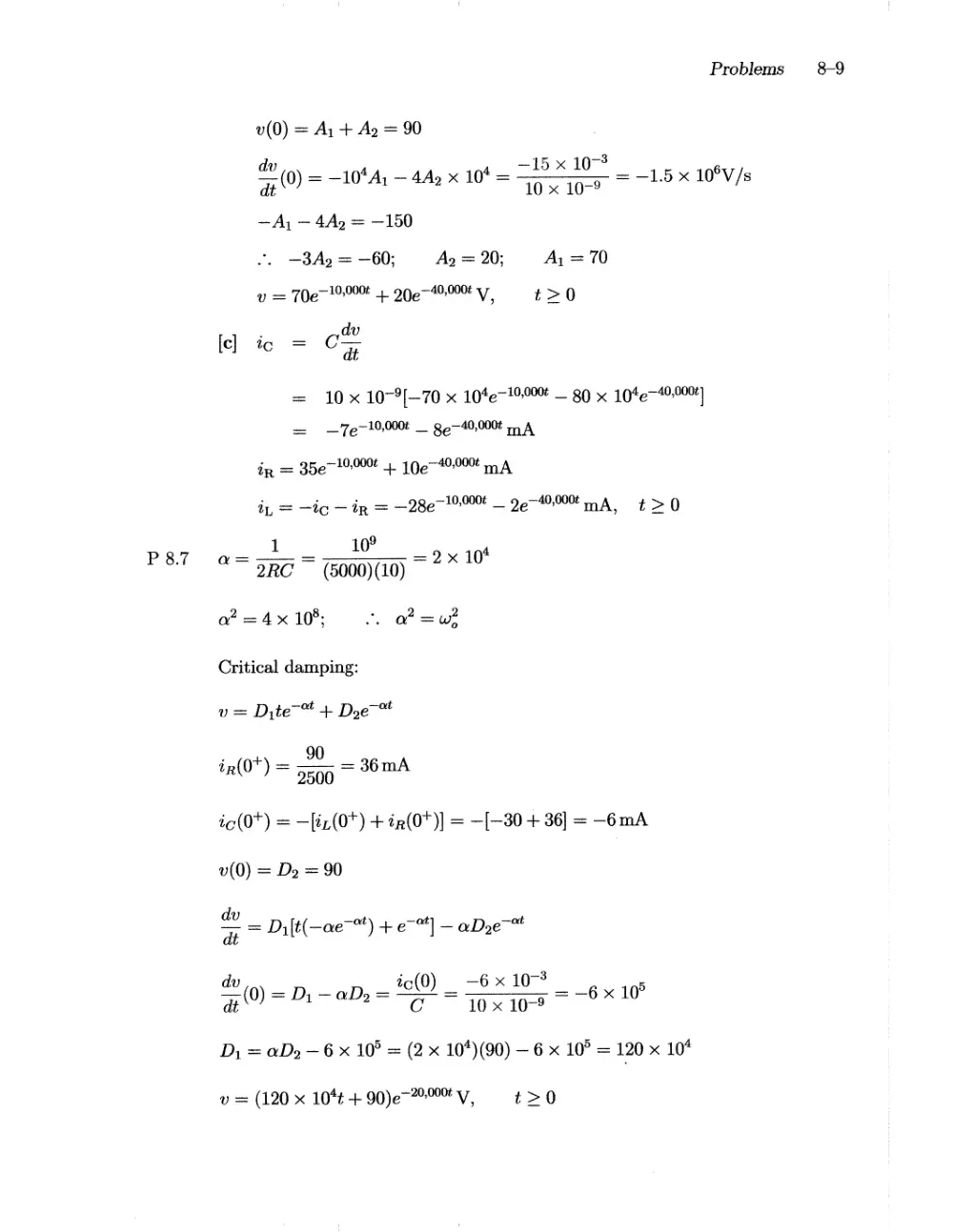
P 8.7
Problems
v(0) = A; + A = 90
—15 3
“(0) _ ~10'A, — 4A, x 10* = 15 x 10™ =-15~x 10°V/s
10 x 10-°
—A — 4Ag = —150
—3A_ = —60; Ag = 20; A; = 70
v = 70e7 10,000 4+ 20 ¢~ 400008 V7 t>0
d
[ce] ic = ce
= 10x 10-[—70 x 104e710.00% _ 89 x 104e— 40.000)
—7e~10,000¢ _ 8e—40,000¢ mA
i
ip = 35e7 100008 4. 4 Qe 40,0008 mm A
iy, = ig — tg = —28e7 1000 _ Qe40,000% mA t>0
1 10°
a=— =
——~ = 2x 10*
DRC ~ (000)(10) ~ 2 * 1°
a? =4 x 10⁸; v= uP
Critical damping:
v= Dyte~™ + Doe~**
. 90
ir(0*) = 2500 = 36mA
ic(0*) = —[i,(0*) +zp(0*)] = —[-30 + 36] = -6mA
v(0) = D2 = 90
dv _ ie(0) _ -6 x 10⁻³
(0) = Di = Da = Or = Fo 109
=-6x 10°
D, = aD» — 6 x 10° = (2 x 10*)(90) — 6 x 10° = 120 x 104
v = (120 x 104#+ 90)e™"' V,_ t D0
8-9
8-10
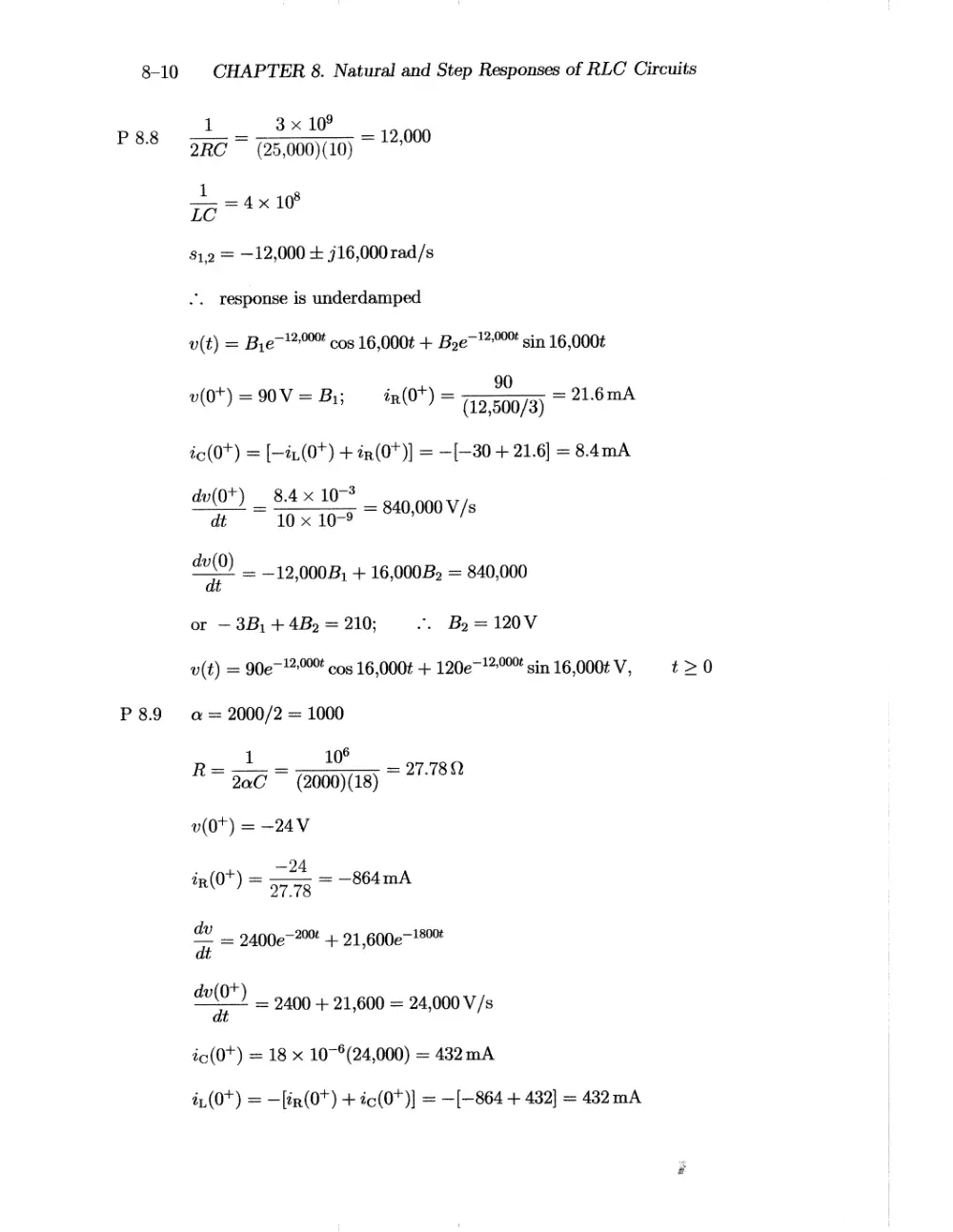
P 8.8
P 8.9
CHAPTER 8. Natural and Step Responses of RLC' Circuits
1 3 x 10°
2RC (25,000)(10) 12,000
1 8
To 74x10
$12 = —12,000 + 716,000 rad/s
*, response is underdamped
v(t) = Bye 1? cos 16,000¢ + Boe 1? sin 16,000¢
90
y+) — = ; i +) — ss .
v(0t) = 90V = B,; in(0T) (13,500/3) 21.6mA
ic(O*) = [-i1(0*) + én(0t)] = —[-30 + 21.6] = 8.4mA
dv(0t) 84x10 |
al) = —12,000B, + 16,000B, = 840,000
or — 3B, +4Bo = 210; -. By =120V
v(t) = 90e7 12000 cos 16,000¢ + 120e7 12 sin 16,000t V, t>0
a = 2000/2 = 1000
1 10°
R= 56 = Bm) 727-789
v(0t) = —24V
-24
. +) =—
ip (0*) 78 864mA
a = 2400-2 +4 21,60007180%
+
aut ) _ 2400 + 21,600 = 24,000V/s
ic(Ot) = 18 x 10-6(24,000) = 432 mA
ip (0*) = —[in(Ot) + ic(0*)] = —[-864 + 432] = 432mA