
EECE 230 Chapter 6- Functions, Spring 2012
American University of Beirut · Introduction to Programming · 38 pages





Showing the first 10 of 38 pages. Download the PDF to see all of it.
More EECE 230 files
- Homework Chapter 1- Multiple Problems · Spring 2015ChapterView
- Chapter 2- Control Structure II · Spring 2012ChapterView
- Chapter 4- Control Structures I · Spring 2012ChapterView
- Final Exam · Spring 2020Final examView
- Exam 1 Quiz 1 Questions · Spring 2019ProblemsView
- Exam 1 Solutions from Dr.Bazzi · Spring 2019Exam · with solutionView
- Exam 2 Questions · Spring 2019ProblemsView
- Exam 1 Quiz 1 Spring 18 · Spring 2019ExamView
Show the text of this chapter
Chapter 6:
Functions
C++ Programming: Program Design Including Data Structures, Second Edition
2
Objectives
In this chapter you will:
• Learn about standard (predefined) functions
• Learn about user-defined functions
• Examine value-returning functions, including actual
and formal parameters
• Discover the difference between value and reference
parameters
• Learn about the scope of an identifier
C++ Programming: Program Design Including Data Structures, Second Edition
3
Objectives
• Examine the difference between local and
global identifiers
• Discover static variables
• Learn function overloading
• Explore functions with default parameters
C++ Programming: Program Design Including Data Structures, Second Edition
4
Functions
• Functions are like building blocks, Called
modules
• They allow complicated programs to be
divided into manageable pieces
C++ Programming: Program Design Including Data Structures, Second Edition
5
Predefined Functions
• Some of the predefined mathematical functions
are:
− sqrt(x)
− pow(x,y)
• Predefined functions are organized into
separate libraries
• I/O functions are in iostream header
• Math functions are in cmath header
C++ Programming: Program Design Including Data Structures, Second Edition
6
The Power and sqrt Functions
•
pow(x,y) calculates xy, pow(2,3) = 8.0
•
pow returns a value of the type double
•
x and y are called the parameters (or arguments) of the function
pow
•
The square root function sqrt(x)
− Calculates the non-negative square root of x, for x >= 0.0
− sqrt(2.25) is 1.5
− Type double and has only one parameter
C++ Programming: Program Design Including Data Structures, Second Edition
8
Value-Returning Functions
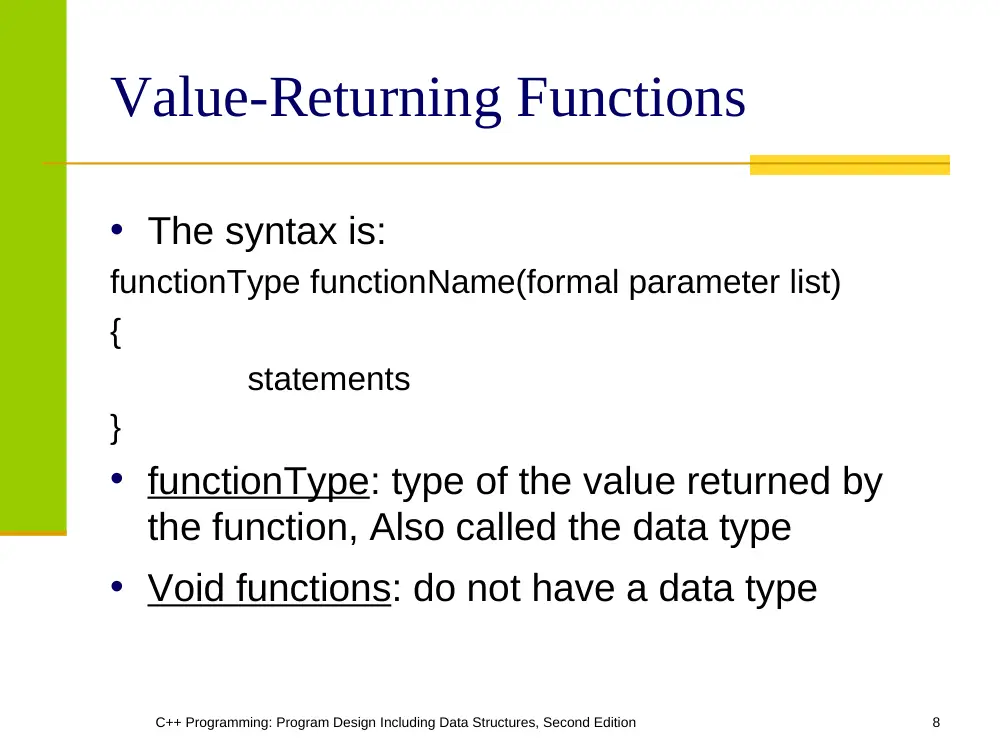
• The syntax is:
functionType functionName(formal parameter list)
{
statements
}
• functionType: type of the value returned by
the function, Also called the data type
• Void functions: do not have a data type
C++ Programming: Program Design Including Data Structures, Second Edition
9
Value-Returning Functions
(continued)
• Heading: first line
• Formal Parameter: variable declared in the
heading
• Actual Parameter: variable or expression
listed in a call to a function
A function call in a program results in the
execution of the body of the called function
C++ Programming: Program Design Including Data Structures, Second Edition
10
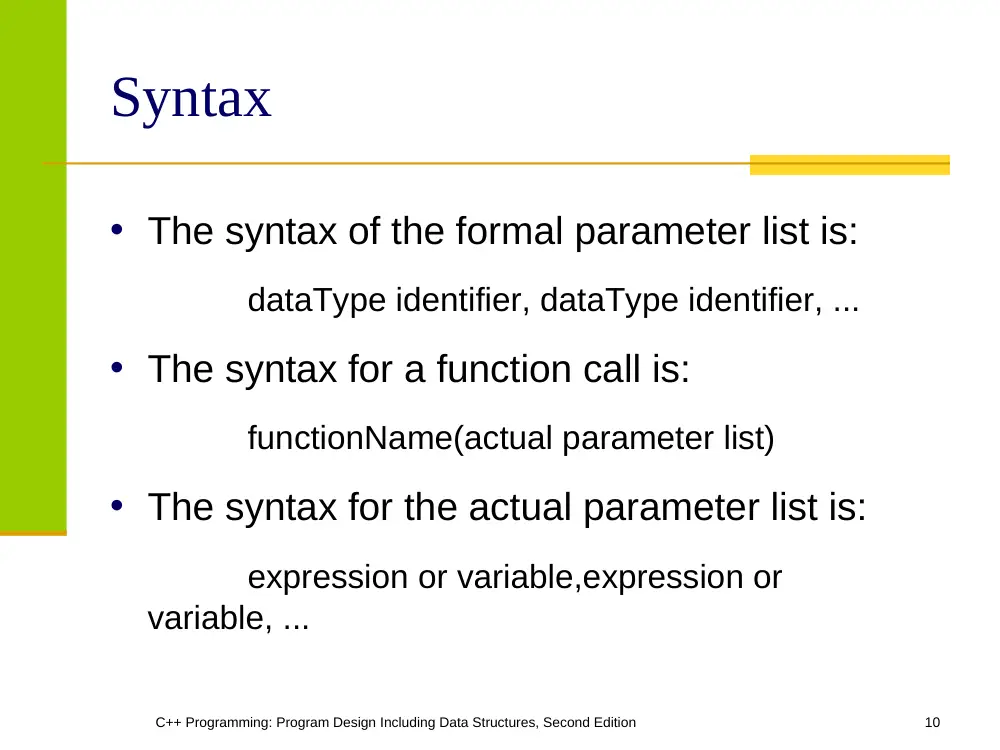
Syntax
• The syntax of the formal parameter list is:
dataType identifier, dataType identifier, ...
• The syntax for a function call is:
functionName(actual parameter list)
• The syntax for the actual parameter list is:
expression or variable,expression or
variable, ...
C++ Programming: Program Design Including Data Structures, Second Edition
11
Functions
• The formal parameter list can be empty
• functionType functionName()
• functionType functionName(void)
• The call is: functionName()
C++ Programming: Program Design Including Data Structures, Second Edition
12
The return Statement
• Once the function computes the value, the
function returns the value via the return
statement
• The syntax of the return statement is:
return expression or variable;
• When a return statement executes
− Function immediately terminates
− Control goes back to the caller
• When a return statement executes in the
function main, the program terminates
C++ Programming: Program Design Including Data Structures, Second Edition
13
Function Prototype
• Function Prototype: function heading without the
body of the function
• The syntax is:
functionType functionName(parameter list);
• Function prototypes appear before any function
definition
• It is not necessary to specify the variable name in the
parameter list
• The data type of each parameter must be specified
C++ Programming: Program Design Including Data Structures, Second Edition
14
Function Overloading
• If several functions have the same name,
every function must have:
− A different set of parameters
− If the number of formal parameters is the
same, then the data type of the formal
parameters, in the order you list, must differ in
at least one position
• Overloading a function refers to the creation
of several functions with the same name
C++ Programming: Program Design Including Data Structures, Second Edition
15
Flow of Execution
• A function call statement results in
− Transfer of control to the first statement in the
body of the called function
• After the last statement of the called function
is executed
− Control is passed back to the point
immediately following the function call
C++ Programming: Program Design Including Data Structures, Second Edition
16
Flow of Execution
• A value-returning function returns a value
• After executing the function
− The value that the function returns replaces
the function call statement
C++ Programming: Program Design Including Data Structures, Second Edition
17
Recursion
• Recursive functions
− Functions that call themselves
• Example: factorial
n! = n * ( n – 1 ) * ( n – 2 ) * … * 1
− Recursive relationship ( n! = n * ( n – 1 )! )
5! = 5 * 4!
4! = 4 * 3!…
− Base case (1! = 0! = 1)
C++ Programming: Program Design Including Data Structures, Second Edition
18
Recursion (continued)
• Fibonacci series: 0, 1, 1, 2, 3, 5, 8...
− Each number sum of two previous ones
− Example of a recursive formula:
• fib(n) = fib(n-1) + fib(n-2)
C++ Programming: Program Design Including Data Structures, Second Edition
19
Recursion: Towers of Hanoi
− N disks of different diameters are placed on peg A so that a
larger disk is always below a smaller disk.
− Only the top disk on any peg may be moved to any other
peg, and a larger disk may never rest on a smaller one.
− Problem: move the n disks to peg c using peg b as an
auxiliary:
• it can be solved for n=1
• we suppose it can be solved for n-1 then show it can be solved
for n
Solution:
− n=1: move the single disk from A to C.
− n: move the top n-1 disks from A to B using C as the
auxiliary
− move the remaining disk from A to C
− move the n-1 disks from B to C using A as the auxiliary
C++ Programming: Program Design Including Data Structures, Second Edition
20
Inline Functions
• Inline functions
− Keyword inline before function
− Asks the compiler to copy code into program
instead of making function call
• Reduce function-call overhead
• Compiler can ignore inline
− Good for small, often-used functions
C++ Programming: Program Design Including Data Structures, Second Edition
21
Value Parameters
• If a formal parameter is a value parameter
− The value of the corresponding actual
parameter is copied into it
• The value parameter has its own copy of the
data
• During program execution
− The value parameter manipulates the data
stored in its own memory space
C++ Programming: Program Design Including Data Structures, Second Edition
22
Reference Variables as Parameters
• If a formal parameter is a reference
parameter
− It receives the address of the corresponding
actual parameter
• A reference parameter stores the address of
the corresponding actual parameter
C++ Programming: Program Design Including Data Structures, Second Edition
23
Reference Variables as Parameters
(continued)
• During program execution to manipulate the
data
− The address stored in the reference parameter
directs it to the memory space of the
corresponding actual parameter
C++ Programming: Program Design Including Data Structures, Second Edition
24
Reference Variables as Parameters
(continued)
A reference parameter receives the address
of the actual parameter
Reference parameters can:
Pass one or more values from a function
Change the value of the actual parameter
C++ Programming: Program Design Including Data Structures, Second Edition
25
Reference Variables as Parameters
(continued)
Reference parameters are useful in three
situations:
Returning more than one value
Changing the actual parameter
When passing the address would save
memory space and time
C++ Programming: Program Design Including Data Structures, Second Edition
26
Parameters & Memory Allocation
• When a function is called
− Memory for its formal parameters and
variables declared in the body of the function
(called local variables) is allocated in the
function data area
• In the case of a value parameter
− The value of the actual parameter is copied
into the memory cell of its corresponding
formal parameter
C++ Programming: Program Design Including Data Structures, Second Edition
27
Parameters & Memory Allocation
(continued)
• In the case of a reference parameter
− The address of the actual parameter passes to
the formal parameter
• Content of the formal parameter is an address
C++ Programming: Program Design Including Data Structures, Second Edition
28
Parameters & Memory Allocation
(continued)
• During execution, changes made by the
formal parameter permanently change the
value of the actual parameter
• Stream variables (for example, ifstream and
ofstream) should be passed by reference to a
function
C++ Programming: Program Design Including Data Structures, Second Edition
29
Scope of an Identifier
• The scope of an identifier refers to where in
the program an identifier is accessible
• Local identifier - identifiers declared within a
function (or block), accessible only within the
block until the end of the block
• Global identifier – identifiers declared outside
of every function definition accessible
everywhere in the program from the point it is
declared
C++ Programming: Program Design Including Data Structures, Second Edition
30
Scope of an Identifier
• Nested blocks: With nested blocks, if a
variable in an inner block has the same name
as the outer block, the outer is hidden until
the inner block terminates
C++ Programming: Program Design Including Data Structures, Second Edition
31
Global Variables
• The operator :: is called the scope resolution
operator
• By using the scope resolution operator
− A global variable declared before the definition
of a function (block) can be accessed by the
function (or block) even if the function (or
block) has an identifier with the same name as
the variable
C++ Programming: Program Design Including Data Structures, Second Edition
32
Side Effects of Global Variables
• Using global variables has side effects
• Any function that uses global variables
− Is not independent
− Usually it cannot be used in more than one
program
C++ Programming: Program Design Including Data Structures, Second Edition
33
Side Effects of Global Variables
(continued)
• If more than one function uses the same
global variable and something goes wrong
− It is difficult to find what went wrong and where
• Problems caused by global variables in one
area of a program might be misunderstood as
problems caused in another area
C++ Programming: Program Design Including Data Structures, Second Edition
34
Static and Automatic Variables
• Automatic variable - memory is allocated at block
entry and deallocated at block exit
• Static variable - memory remains allocated as
long as the program executes
• Variables declared outside of any block are static
variables
• By default variables declared within a block are
automatic variables
• Declare a static variable within a block by using
the reserved word static
C++ Programming: Program Design Including Data Structures, Second Edition
35
Static and Automatic Variables
(continued)
• The syntax for declaring a static variable is:
static dataType identifier;
• The statement
static int x;
declares x to be a static variable of the type int
• Static variables declared within a block are
local to the block
• Their scope is the same as any other local
identifier of that block
C++ Programming: Program Design Including Data Structures, Second Edition
36
Functions with Default Parameters
• When a function is called
− The number of actual and formal parameters
must be the same
• C++ relaxes this condition for functions with
default parameters
• You specify the value of a default parameter
when the function name appears for the first
time, such as in the prototype
C++ Programming: Program Design Including Data Structures, Second Edition
37
Functions with Default Parameters
(continued)
• If you do not specify the value of a default
parameter
− The default value is used
• All of the default parameters must be the
rightmost parameters of the function
• In a function call where the function has more
than one default parameter and a value to a
default parameter is not specified
− You must omit all of the arguments to its right
C++ Programming: Program Design Including Data Structures, Second Edition
38
Functions with Default Parameters
(continued)
• Default values can be constants, global
variables, or function calls
• The caller has the option of specifying a value
other than the default for any default
parameter
• You cannot assign a constant value as a
default value to a reference parameter