
EECE 230 Lab Classes, Fall 2012
American University of Beirut · Introduction to Programming · 3 pages


More EECE 230 files
- Lecture Slides Program Efficiency · Spring 2019LabView
- Syllabus · Spring 2019LabView
- Lecture Slides Files, Exceptions, Plotting, and Monte Carlo · Spring 2019LabView
- Lab Assignment Inheritence · Spring 2012LabView
- Lab Assignment 10 · Spring 2012LabView
- Lab Pointers · Fall 2012LabView
- Lecture Recursion 1 · Fall 2011LabView
- Lab Report · Spring 2008LabView
Show the text of this lab
EECE 230 INTRODUCTION TO PROGRAMMING
Lab Assignment 8
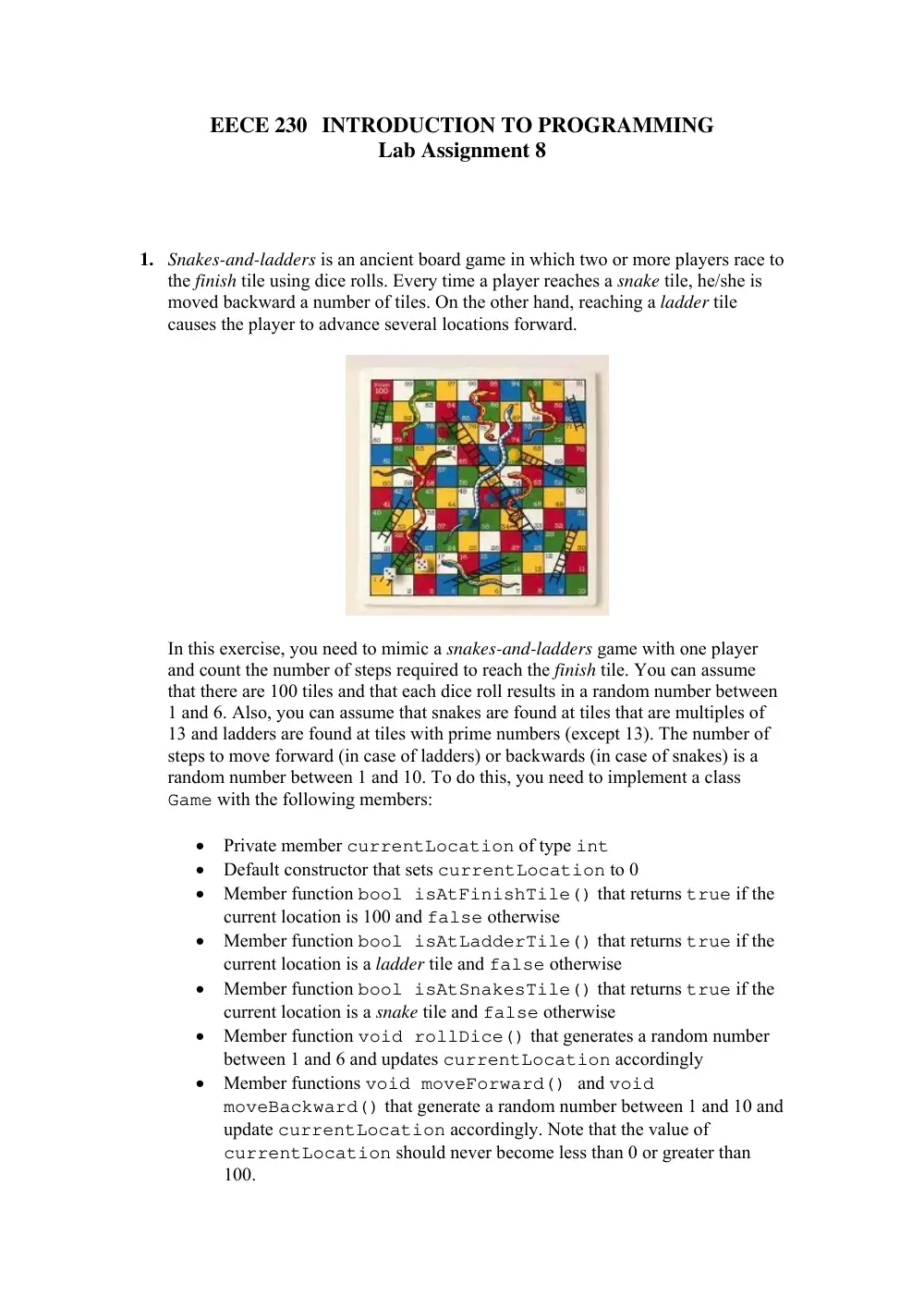
1. Snakes-and-ladders is an ancient board game in which two or more players race to
the finish tile using dice rolls. Every time a player reaches a snake tile, he/she is
moved backward a number of tiles. On the other hand, reaching a ladder tile
causes the player to advance several locations forward.
In this exercise, you need to mimic a snakes-and-ladders game with one player
and count the number of steps required to reach the finish tile. You can assume
that there are 100 tiles and that each dice roll results in a random number between
1 and 6. Also, you can assume that snakes are found at tiles that are multiples of
13 and ladders are found at tiles with prime numbers (except 13). The number of
steps to move forward (in case of ladders) or backwards (in case of snakes) is a
random number between 1 and 10. To do this, you need to implement a class
Game with the following members:
• Private member currentLocation of type int
• Default constructor that sets currentLocation to 0
• Member function bool isAtFinishTile() that returns true if the
current location is 100 and false otherwise
• Member function bool isAtLadderTile() that returns true if the
current location is a ladder tile and false otherwise
• Member function bool isAtSnakesTile() that returns true if the
current location is a snake tile and false otherwise
• Member function void rollDice() that generates a random number
between 1 and 6 and updates currentLocation accordingly
• Member functions void moveForward() and void
moveBackward() that generate a random number between 1 and 10 and
update currentLocation accordingly. Note that the value of
currentLocation should never become less than 0 or greater than
100.
Also, you need to write a main that instantiates an object of type Game and keeps
rolling the dice until the player reaches the finish tile. Of course, every time the
player reaches a ladder tile or a snake tile, the appropriate action must be done.
The program must print the intermediate locations as well as the total number of
steps taken to reach the finish tile.
2. In this exercise you are going to develop a simple system to manage a DVD rental
store.
a. Implement a class DVDType with the following members:
• Private members: title (of type string), genre (of type
string), and nbCopiesAvailable (of type int)
• Default constructor that sets title and genre to “” and
nbCopiesAvailable to 0
• Member functions: string getTitle(), string
getGenre(), and int getNbCopiesAvailable()
• Member function void set(string, string, int) that
sets title, genre, and nbCopiesAvailable to the values
specified as parameters
• Member function void rentDVD() which decrements the
number of copies available
• Member function void returnDVD() which increments the
number of copies available
b. Write a program to manage the information related to the DVD store as
follows:
• Declare a named constant maxSize as a global variable to
represent the max number of DVDs in the store and initialize it to
1000. Note that the number of DVDs might be much less than that.
• Write a function void loadData(DVDType A[]) that reads
the information about the DVDs from a file called “dvds.txt” and
stores it in an array A whose size is equal to maxSize. If the
number of DVDs is less than maxSize, then the remaining
(rightmost) cells in A will be considered empty. Each line in the
file contains information about one dvd using the following format
title
genre
nbCopiesAvailable
You can assume that the title and the genre contain no spaces.
• Write a function void saveData(DVDType A[]) that stores
the data of A in “dvds.txt” using the format described above. Note
that you need to discard the empty cells.
• Write a function int searchByTitle(string str,
DVDType A[]) that returns the index of the DVD in A whose
title is equal to str. It returns -1 if the DVD doesn’t exist
• Write a function void displayByGenre(string str,
DVDType A[]) that displays all DVDs in A whose genre is equal
to str.
• At the beginning of main, you need to declare an array of
DVDType and read the information from “dvds.txt” using
loadData. Then, you should repeatedly ask the manager to select
one of the following functionalities:
1. Search by title: read a title from the manager and tell
whether the corresponding DVD exists in the store
2. Display by genre: read a genre from the manager and
display the titles of all DVDs of that genre
3. Rent DVD: read a title from the manager and decrement
the number of copies of the corresponding DVD. If the title
doesn’t exist or if there are no available copies, an error
message should be generated.
4. Return DVD: read a title from the manager and increment
the number of copies of the corresponding DVD. If the title
doesn’t exist or if there are no available copies, an error
message should be generated.
5. Exit: exit the loop.
• After the main exits the loops and right before termination, the
program should save the updated data in “dvds.txt” using
saveData.
3. You are required to redo exercise 1 of assignment 4 using object oriented
methodology. As such, you need to do the following:
a. Implement class Point that has the following members:
• Private variables x and y of type double that represent the
coordinates of the point.
• Default constructor that initializes x and y to random values
between 0 and 1.
• Setters and getters
b. Implement class Circle with the following members:
• Private variables x and y of type double that represent the
coordinates of the center.
• Private variable R of type double that represents the length of the
radius.
• Default constructor that initializes x and y to 0 and R to 1.
• Function bool containsPoint(Point p) that return true
if p lies inside the circle and false otherwise.
c. Write a main that reads a positive integer N from the user and prints an
estimate of π using N random points. That is, you have to create one
instance of class Circle with center (0,0) and radius 1 and N instances of
class Point. For each point you create, you check whether it lies inside the
unit circle and update the counter accordingly. If M points lie inside the
circle, then the estimate of π would be 4 �
�
�.