
EECE 230 Lecture Recursion 1, Fall 2011
American University of Beirut · Introduction to Programming · 35 pages




Showing the first 10 of 35 pages. Download the PDF to see all of it.
More EECE 230 files
- Lecture Slides Program Efficiency · Spring 2019LabView
- Syllabus · Spring 2019LabView
- Lecture Slides Files, Exceptions, Plotting, and Monte Carlo · Spring 2019LabView
- Lab Assignment Inheritence · Spring 2012LabView
- Lab Pointers · Fall 2012LabView
- Lab Assignment 10 · Spring 2012LabView
- Lab Classes · Fall 2012LabView
- Lab Report · Spring 2008LabView
Show the text of this lab
C++ Programming:
Program Design Including
Data Structures
Recursion: Part I [Chap 16]
C++ Programming: Program Design Including Data Structures
2
Objectives
In this chapter you will:
• Learn about recursive definitions
• Explore the base case and the general case
of a recursive definition
• Discover what is a recursive algorithm
• Learn about recursive functions
• Explore how to use recursive functions to
implement recursive algorithms
C++ Programming: Program Design Including Data Structures
3
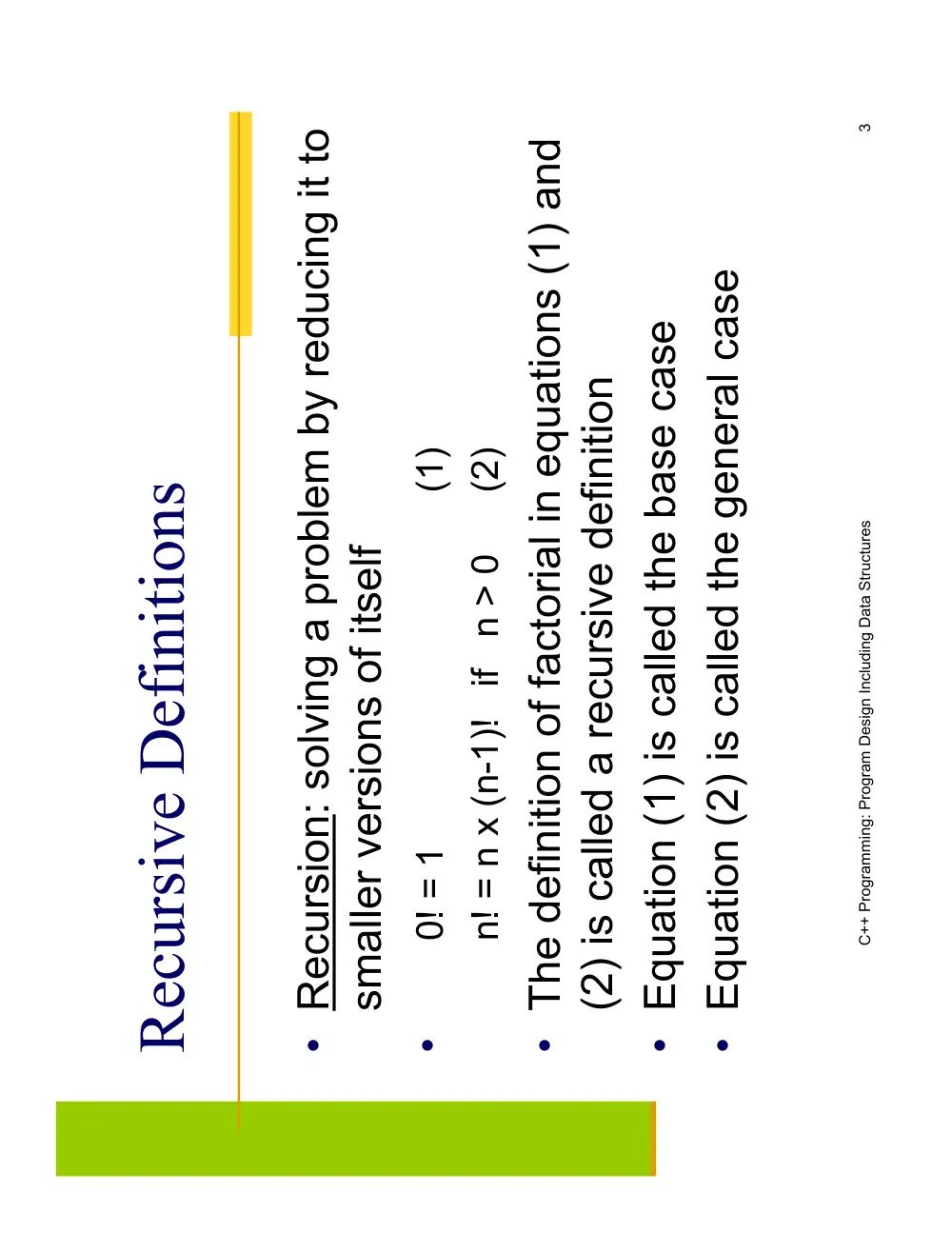
Recursive Definitions
• Recursion: solving a problem by reducing it to
smaller versions of itself
•
0! = 1
(1)
n! = n x (n-1)! if n > 0
(2)
• The definition of factorial in equations (1) and
(2) is called a recursive definition
• Equation (1) is called the base case
• Equation (2) is called the general case
C++ Programming: Program Design Including Data Structures
4
Recursive Definitions (continued)
• Recursive definition: defining a problem in
terms of a smaller version of itself
− Every recursive definition must have one (or
more) base cases
− The general case must eventually reduce to a
base case
− The base case stops the recursion
C++ Programming: Program Design Including Data Structures
5
Recursive Algorithms
• Recursive algorithm: finds a solution by
reducing problem to smaller versions of itself
− Must have one (or more) base cases
• General solution must eventually reduce to a
base case
• Recursive function: a function that calls itself
• Recursive algorithms are implemented using
recursive functions
C++ Programming: Program Design Including Data Structures
6
Recursive Functions
• Think of a recursive function as having many
copies of itself
• Every call to a recursive function has
− Its own code
− Its own set of parameters and local variables
• After completing a particular recursive call
− Control goes back to the calling environment,
which is the previous call
C++ Programming: Program Design Including Data Structures
7
Recursive Functions (continued)
• The current (recursive) call must execute
completely before control goes back to the
previous call
• Execution in the previous call begins from the
point immediately following the recursive call
C++ Programming: Program Design Including Data Structures
8
Example: the factorial function
int fact(int num) // num is nonegative integer
{
if(num==0)
return 1;
else {
int x = fact(num-1);
return x*num;
}
}
C++ Programming: Program Design Including Data Structures
9
Alternative implementation
int fact(int num) // num is nonegative integer
{
if(num==0)
return 1;
else
return num*fact(num-1);
}
C++ Programming: Program Design Including Data Structures
11
Direct and Indirect Recursion
• Directly recursive: a function that it calls
itself
• Indirectly recursive: a function that calls
another function and eventually results in
the original function call
C++ Programming: Program Design Including Data Structures
12
Infinite Recursion
• Infinite recursion: every recursive call results in
another recursive call
− In theory, infinite recursion executes forever
• Because computer memory is finite:
− Function executes until the system runs out of
memory
− Results in an abnormal program termination
C++ Programming: Program Design Including Data Structures
13
Tracking the recursion process
example
• Consider the function
void f(int n) { cout<<n<<“ “;
if(n>=1) f(n-1);}
•
Consider calling it from main via:
f(10);
• What do we get? Track recursion
• Answer: 10 9 8 7 6 5 4 3 2 1 0
C++ Programming: Program Design Including Data Structures
14
Tracking the recursion process
example (Continued)
• Consider swapping the if and the cout
statements, i.e., consider the function g:
void g(int n) {if(n>=1) g(n-1);
cout<<n<<“ “; }
•
Consider calling it from main via:
g(10);
• What do we get? Track recursion
• Answer: 0 1 2 3 4 5 6 7 8 9 10
C++ Programming: Program Design Including Data Structures
15
Number of recursive branches
• Recursive factorial (and the above
examples f and g): one recursive call
• Next: an example of of a function with 2
recursive calls
C++ Programming: Program Design Including Data Structures
16
Fibonacci numbers
• Defined recursively:
a1 = 1
a2 = 1
an = an-1 + an-2 , if n≥3
• 1, 1, 2, 3, 5, 8, 13, 21, 34, …
• Problem: given n, compute the n’th Fibonacci
number an
C++ Programming: Program Design Including Data Structures
17
Iterative function
int FibNum(int n)
{
if(n==1 || n==2) return 1;
int previous1=1, previous2=1, current;
for(int i=3;i<=n;i++) {
current = previous1+previous2;
previous2 = previous1;
previous1 = current;
}
return current;
}
C++ Programming: Program Design Including Data Structures
18
Arrays version (new/delete review)
int FibNumArraysVersion(int n)
{
if(n==1 || n==2) return 1;
int* A = new int[n];
A[0] = 1; A[1] = 1;
for(int i=2;i<n;i++)
A[i] =A[i-1]+A[i-2];
int answer = A[n-1];
delete [] A;
return answer;
}
C++ Programming: Program Design Including Data Structures
19
Recursive function
int rFibNum(int n)
{
if(n==1 || n==2) return 1; // base case
else {
int prev1 = rFibNum(n-1); // 1st recursive call
int prev2 = rFibNum(n-2); // 2nd recursive call
return prev1 + prev2;
}
}
C++ Programming: Program Design Including Data Structures
20
Compact form of the recursive
function
int rFibNum(int n)
{
if(n==1 || n==2)
return 1;
else
return rFibNum(n-1)+rFibNum(n-2);
}
C++ Programming: Program Design Including Data Structures
21
Flow of execution
• Track the exectution of
cout << rFibNum(5);
• Draw recursion tree
C++ Programming: Program Design Including Data Structures
22
rFibNum versus FibNum
• The recursive function rFibNum is not efficient
at all compared the iterative function
FibNum!!!
• Why?
C++ Programming: Program Design Including Data Structures
23
rFibNum versus FibNum (Continued)
• Many repeated sub-problems
• The recursive function rFibNum solves the
same sub-problem more than once (typically
a huge number of times)
• That was just an illustrative example of a
recursive function that calls itself more than
once (twice)
• More interesting examples next lecture:
Merge Sort & Tower of Hanoi
C++ Programming: Program Design Including Data Structures
24
Designing a Recursive Function
• To design a recursive function:
− Understand problem requirements
− Determine limiting conditions
− Identify base cases and provide a direct solution
to each base case
− Identify general cases and provide a solution to
each general case in terms of smaller versions
of itself
C++ Programming: Program Design Including Data Structures
25
Problem Solving Using Recursion
• Consider the Array Largest problem:
Given an array list[0…n-1],find the largest
element in list.
• Recall the iterative algorithm
• Now a recursive algorithm
C++ Programming: Program Design Including Data Structures
26
Array Largest recursive algorithm:
idea
• To find the largest element in list[0 … n-1]
− Find largest element in list[1 … n-1] recursively
and call it max
− Compare the elements list[0] and max
if (list[0] >= max)
the largest element in list[0 … n-1] is list[0]
otherwise
the largest element in list[0 … n-1] is max
• Base case: We stop the recursion when list size = 1
C++ Programming: Program Design Including Data Structures
27
Array Largest recursive algorithm
(Continued)
• The second recursive call is on list[1…n-1]
• The third on list[2 .. n-1]
• Thus it is convenient (and essential) to write a
recursive function to solve the following version of te
Array Largest problem:
Given an array list (passed by reference) and two
indicies a (the lower index) and b (the upper index),
find the largest elemet in list[a…b].
• When calling the function, we set a=0 and b=n-1
• This techinque is useful for almost all recursive
functions with arrays parameters
C++ Programming: Program Design Including Data Structures
28
Array Largest recursive algorithm
(Continued)
• To find the largest element in list[a … b]
− Find largest element in list[a + 1 … b] and call it
max
− Compare the elements list[a] and max
if (list[a] >= max)
the largest element in list[a … b] is list[a]
otherwise
the largest element in list[a … b] is max
• Base case: List size = 1
C++ Programming: Program Design Including Data Structures
29
Array Largest function (Continued)
int largest(const int list[], int a, int b)
// to find the largest element in list[ a … b]
{
if( a == b) return list[a];
else {
int max = largest(list, a+1,b);
if(list[a]>max) return list[a];
else return max;
}
}
------------------------------------------------------------------------------------
We can call the function from main, for instance, as follows:
list[] = {5,10,12,8};
cout<< largest(list,0,3);
C++ Programming: Program Design Including Data Structures
31
Important Remark
• Since the array it is passed by
reference, it is NOT copied to
recursive subcalls. All the
copies of the function work on
the same copy of the array.
(Only a,b,and the pointer A are
copied).
C++ Programming: Program Design Including Data Structures
32
Why do it recursively?
• You are probably thinking: we can find the
largest element in array using a simple for
loop, why this recursive algorithms !!!
• You are right … this just an illustrative
example
• More interesting examples next lecture
C++ Programming: Program Design Including Data Structures
33
Summary
• The process of solving a problem by reducing it
to smaller versions of itself is called recursion
• A recursive definition defines a problem in
terms of smaller versions of itself
• Every recursive definition has one or more base
cases
• A recursive algorithm solves a problem by
reducing it to smaller versions of itself
• Every recursive algorithm has one or more
base cases
C++ Programming: Program Design Including Data Structures
34
Summary
• The solution to the problem in a base case is
obtained directly
• A function is called recursive if it calls itself
• Recursive algorithms are implemented using
recursive functions
• Every recursive function must have one or
more base cases
• The general solution breaks the problem into
smaller versions of itself
C++ Programming: Program Design Including Data Structures
35
Summary
• The general case must eventually be reduced
to a base case
• The base case stops the recursion
• Directly recursive: a function calls itself
• Indirectly recursive: A function calls another
function and eventually calls the original