
EECE 230 Lecture Slides Program Efficiency, Spring 2019
American University of Beirut · Introduction to Programming · 86 pages



Showing the first 10 of 86 pages. Download the PDF to see all of it.
More EECE 230 files
- Lecture Slides Files, Exceptions, Plotting, and Monte Carlo · Spring 2019LabView
- Syllabus · Spring 2019LabView
- Lab Assignment Inheritence · Spring 2012LabView
- Lab Pointers · Fall 2012LabView
- Lab Assignment 10 · Spring 2012LabView
- Lab Classes · Fall 2012LabView
- Lecture Recursion 1 · Fall 2011LabView
- Lab Report · Spring 2008LabView
Show the text of this lab
Introduction to Computation
and Programming
Program Efficiency, Binary Search, and
Insertion Sort
EECE 230 - Introduction to Computation and Programming
Slides prepared for EECE 230C, Fall 2018-19, MSFEA, AUB
Updated with minor edits during the offering of EECE 230, Spring 2018-19, MSFEA, AUB
Material in these slides is based on [Guttag, Chapter 9],
[CLRS, Chapters 1 and 2], and wiki.python.org
Reading: [Guttag, Chapter 9], [CLRS, Chap 1, Sections 2.1, 3.1]
[CLRS] (AUB E-book link) : “Introduction to Algorithms”, by T. H. Cormen, C. E.
Leiserson, R. L. Rivest, and C. Stein, MIT press, third edition, 2009, MIT press.
Outline
• Program efficiency, algorithmic complexity
• Asymptotic notations: Theta, Big O, little o
• Time of analysis of:
Linear search
Element distinctness
Programming Assignment 2 algorithms
• Binary Search
• Insertion Sort
• Time analysis of some list operations and methods
EECE 230 - Introduction to Computation and Programming
I
II
III
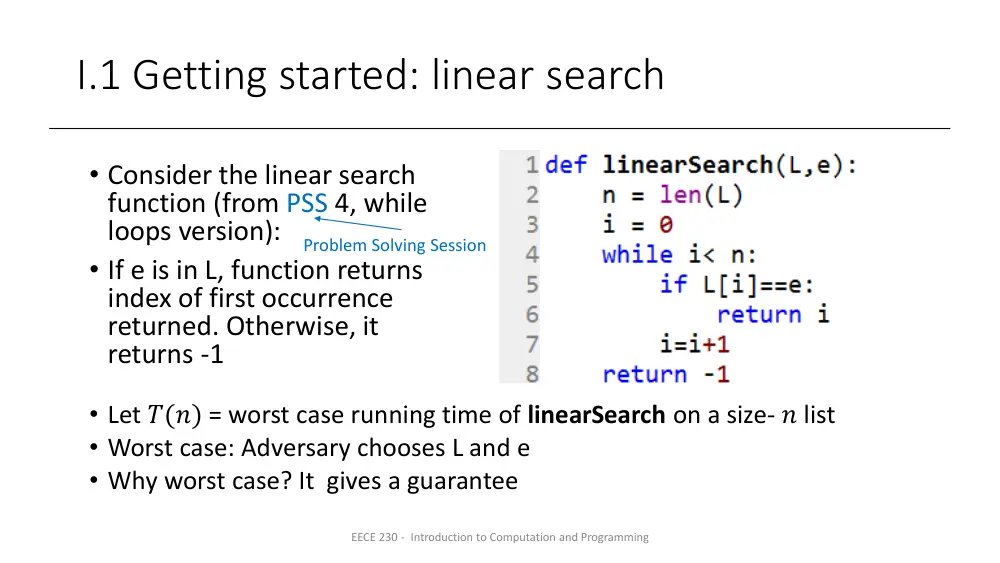
I.1 Getting started: linear search
• Let 𝑇(𝑛) = worst case running time of linearSearch on a size- 𝑛 list
• Worst case: Adversary chooses L and e
• Why worst case? It gives a guarantee
EECE 230 - Introduction to Computation and Programming
• Consider the linear search
function (from PSS 4, while
loops version):
• If e is in L, function returns
index of first occurrence
returned. Otherwise, it
returns -1
Problem Solving Session
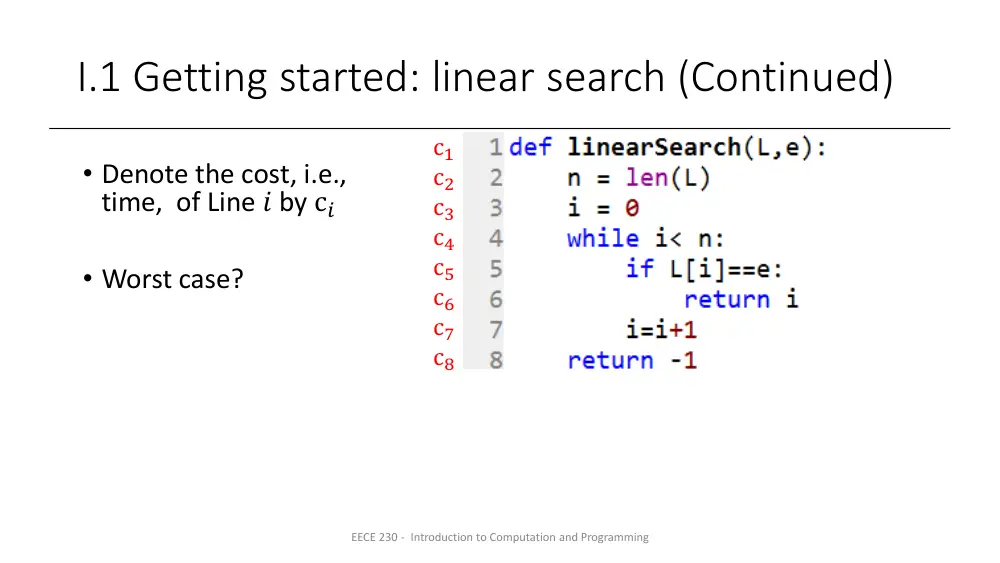
I.1 Getting started: linear search (Continued)
EECE 230 - Introduction to Computation and Programming
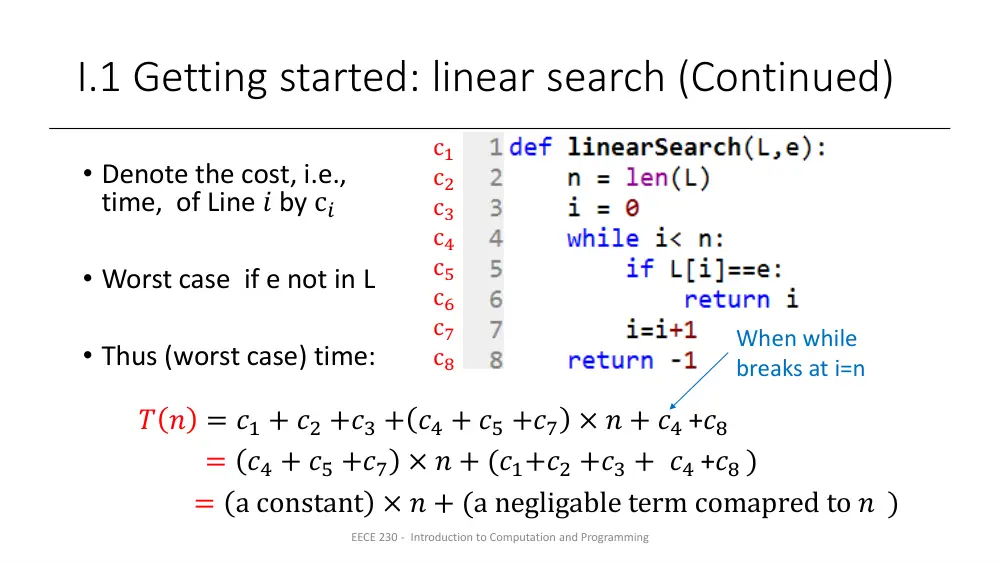
c1
c2
c3
c4
c5
c6
c7
c8
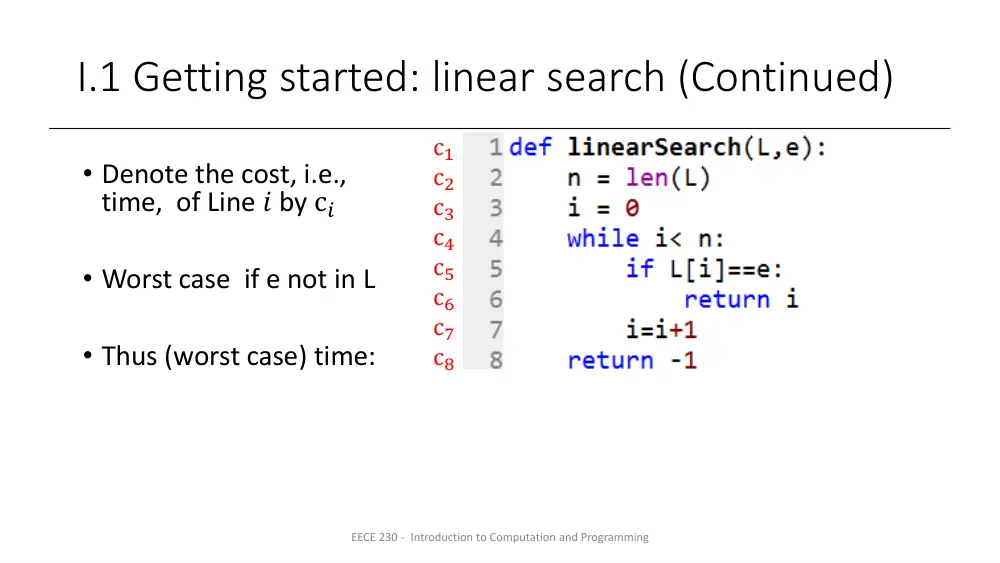
• Denote the cost, i.e.,
time, of Line 𝑖 by c𝑖
• Worst case? if e not in L
• Thus (worst case) time:
I.1 Getting started: linear search (Continued)
𝑇 𝑛 = 𝑐1 + 𝑐2 +𝑐3 + 𝑐4 + 𝑐5 +𝑐7 × 𝑛 + 𝑐4 +𝑐8
= 𝑐4 + 𝑐5 +𝑐7 × 𝑛 + (𝑐1+𝑐2 +𝑐3 + 𝑐4 +𝑐8 )
= a constant × 𝑛 + (a negligable term comapred to 𝑛 )
EECE 230 - Introduction to Computation and Programming
c1
c2
c3
c4
c5
c6
c7
c8
• Denote the cost, i.e.,
time, of Line 𝑖 by c𝑖
• Worst case if e not in L
• Thus (worst case) time:
When while
breaks at i=n
I.2 Asymptotic analysis
• We can’t measure the running exactly as it depends on
Interpreter’s implementation
Computer speed
• Solution: asymptotic analysis: look at growth of 𝑇(𝑛) as the input size
𝒏 → ∞
• How does 𝑇(𝑛) scale as input size 𝑛 doubles or gets multiplied by 10?
• Interested in the complexity of the algorithm and not its implementation
using a particular programming language or its speed on a specific machine
• Key:
Ignore constants
Ignore low order terms
EECE 230 - Introduction to Computation and Programming
I.2 Asymptotic analysis (Continued)
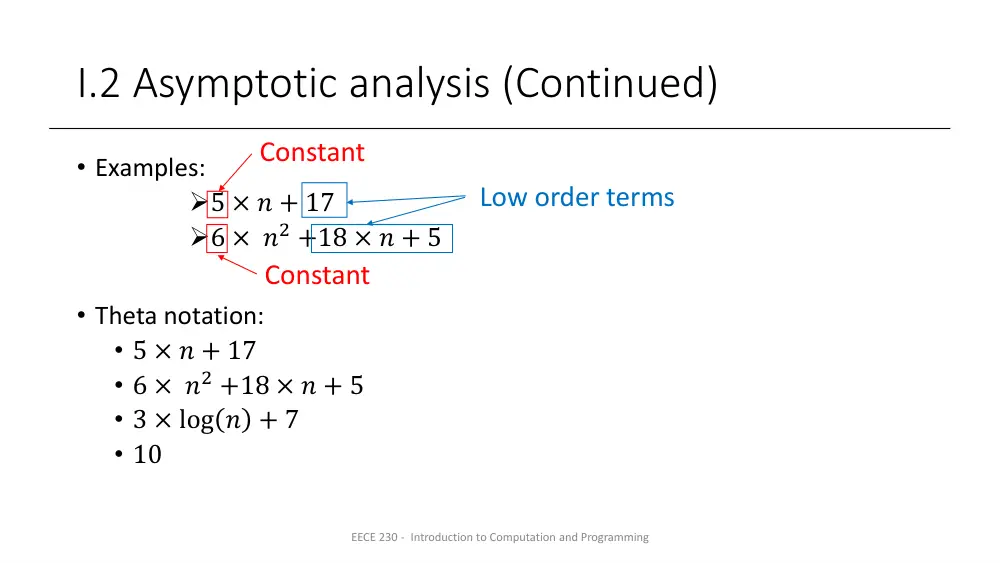
• Examples:
5 × 𝑛 + 17
6 × 𝑛2 +18 × 𝑛 + 5
• Theta notation:
• 5 × 𝑛 + 17
• 6 × 𝑛2 +18 × 𝑛 + 5
• 3 × log 𝑛 + 7
• 10
EECE 230 - Introduction to Computation and Programming
Low order terms
Constant
Constant
1.2 Asymptotic analysis (Continued)
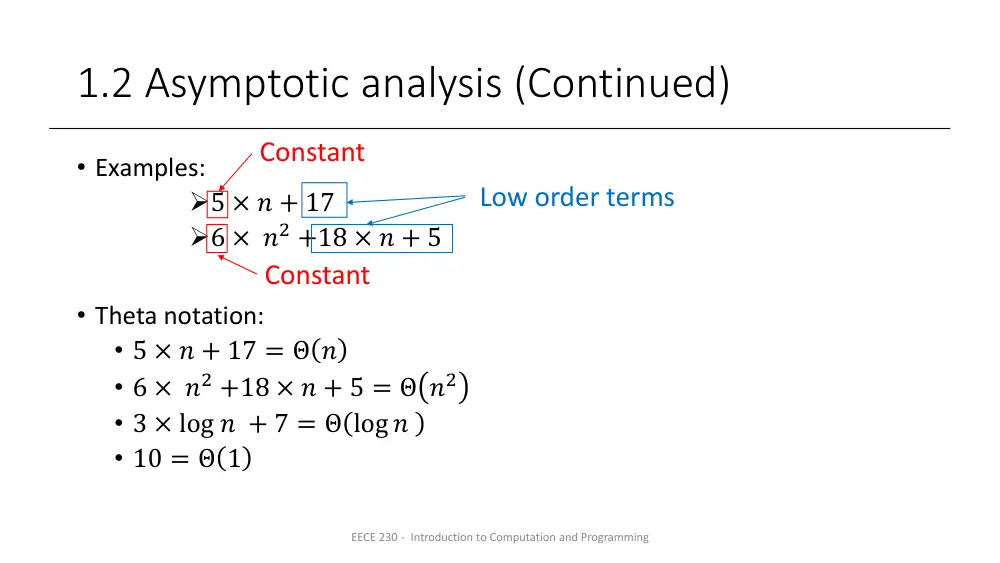
• Examples:
5 × 𝑛 + 17
6 × 𝑛2 +18 × 𝑛 + 5
• Theta notation:
• 5 × 𝑛 + 17 = Θ 𝑛
• 6 × 𝑛2 +18 × 𝑛 + 5 = Θ 𝑛2
• 3 × log 𝑛 + 7 = Θ log 𝑛
• 10 = Θ 1
EECE 230 - Introduction to Computation and Programming
Low order terms
Constant
Constant
1.3 Theta notation: formal definition
• Definition: Let f 𝑛 and g 𝑛 be functions defined on the
nonnegative integers and taking real values.
Assume that for 𝑛 large enough, f 𝑛 ≥ 0 and g 𝑛 ≥ 0.
We say that f 𝑛 = Θ 𝑔 𝑛
if
lim
𝑛→∞
𝑓 𝑛
𝑔 𝑛
= a positive constant
assuming that the limit exists.
• Check above examples:
EECE 230 - Introduction to Computation and Programming
1.3 Theta notation: formal definition
(Continued)
EECE 230 - Introduction to Computation and Programming
• Check above examples:
lim
𝑛→∞
5×𝑛+17
𝑛
= 5 > 0
=> 5 × 𝑛 + 17 = Θ 𝑛
lim
𝑛→∞
6× 𝑛2+18×𝑛+5
𝑛2
= 6 > 0 => 6 × 𝑛2 +18 × 𝑛 + 5 = Θ 𝑛2
lim
𝑛→∞
3×log 𝑛+7
log 𝑛
= 3 > 0
=> 3 × log 𝑛 + 7 = Θ log 𝑛
lim
𝑛→∞
10
1 = 10 > 0
=> 10 = Θ 1
I.4 Theta notation: more formal definition
More generally (even if limit doesn’t
exist), we say that f 𝑛 = Θ 𝑔 𝑛
if
for large values of n, f 𝑛 can be
sandwiched between two positive
constant multiples of g(n), i.e., there
exist 𝑛0 > 0 and constants c1, 𝑐2 > 0
such that for all 𝑛 > 𝑛0,
0 ≤ 𝑐1 × 𝑔 𝑛 ≤ f 𝑛 ≤ 𝑐2 × 𝑔 𝑛
EECE 230 - Introduction to Computation and Programming
[Figure 3.1 in “Introduction to Algorithms”, Cormen, Leriseron, Rivest, and Stein, 2009]
I.5 Working with Theta
Useful properties:
• f(n)=Θ 𝑔(𝑛)
⇒ 𝑔 𝑛 = Θ 𝑓(𝑛)
• Θ 𝑔1(𝑛) + Θ 𝑔2(𝑛) =
EECE 230 - Introduction to Computation and Programming
𝑓1 𝑛 + 𝑓2 𝑛 for some
𝑓1 𝑛 = Θ 𝑔1(𝑛) and 𝑓2 𝑛 = Θ 𝑔2(𝑛)
means
I.5 Working with Theta (Continued)
Useful properties:
• f(n)=Θ 𝑔(𝑛)
⇒ 𝑔 𝑛 = Θ 𝑓(𝑛)
• Θ 𝑔1(𝑛) + Θ 𝑔2(𝑛) = Θ 𝑔1 𝑛 + 𝑔2(𝑛)
• Θ 𝑔1(𝑛) × Θ 𝑔2(𝑛) =
EECE 230 - Introduction to Computation and Programming
I.5 Working with Theta (Continued)
Useful properties:
• f(n)=Θ 𝑔(𝑛)
⇒ 𝑔 𝑛 = Θ 𝑓(𝑛)
• Θ 𝑔1(𝑛) + Θ 𝑔2(𝑛) = Θ 𝑔1 𝑛 + 𝑔2(𝑛)
• Θ 𝑔1(𝑛) × Θ 𝑔2(𝑛) = Θ 𝑔1 𝑛 × 𝑔2(𝑛)
EECE 230 - Introduction to Computation and Programming
Examples:
• Θ 1 + Θ 𝑛 =
• Θ 𝑛 + Θ 𝑛
=
• Θ 1 × 𝑛 =
• Θ 𝑛 × 𝑛 =
I.5 Working with Theta (Continued)
Useful properties:
• f(n)=Θ 𝑔(𝑛)
⇒ 𝑔 𝑛 = Θ 𝑓(𝑛)
• Θ 𝑔1(𝑛) + Θ 𝑔2(𝑛) = Θ 𝑔1 𝑛 + 𝑔2(𝑛)
• Θ 𝑔1(𝑛) × Θ 𝑔2(𝑛) = Θ 𝑔1 𝑛 × 𝑔2(𝑛)
EECE 230 - Introduction to Computation and Programming
Examples:
• Θ 1 + Θ 𝑛 = Θ 𝑛
• Θ 𝑛 + Θ 𝑛
= Θ 𝑛
• Θ 1 × 𝑛 = Θ 𝑛
• Θ 𝑛 × 𝑛 = Θ 𝑛2
I.5 Working with Theta: linear Search running
time (Continued)
𝑇 𝑛 = Θ 𝑛
steps
EECE 230 - Introduction to Computation and Programming
• Instead of using
constants, use Θ
notation
• Worst case if e not in L
• Worst case running time
of linearSearch:
• Note that indexing operator L[i] takes Θ 1 time: recall for the lists
lectures that they are implemented using contiguous memory cells
• Best case running time:
I.5 Working with Theta: linear Search running
time (Continued)
𝑇 𝑛 = Θ 𝑛
steps
EECE 230 - Introduction to Computation and Programming
• Instead of using
constants, use Θ
notation
• Worst case if e not in L
• Worst case running time
of linearSearch:
• Note that indexing operator L[i] takes Θ 1 time: recall for the lists
lectures that they are implemented using contiguous memory cells
• Best case running time: Θ 1 steps (if L[0] == e)
I.5 Working with Theta: searching for two
elements
EECE 230 - Introduction to Computation and Programming
• Worst case time:
I.5 Working with Theta: searching for two
elements (Continued)
EECE 230 - Introduction to Computation and Programming
• Worst case time: Θ 𝑛 +Θ 𝑛 +Θ 1 = Θ 𝑛 steps
• Two sequential loops: Θ 𝑛 +Θ 𝑛 = Θ 𝑛
• Nesting loops costs more
Θ 𝑛
Θ 𝑛
Passing parameters to function and return
I.6 Time analysis of element distinctness
function
• From the lists lectures
(function version): start with
naive version
• Worst case ?
EECE 230 - Introduction to Computation and Programming
I.6 Time analysis of element distinctness
function (Continued)
• From the lists lectures
(function version): start with
naive version
• Worst case if all distinct
• Inner loop takes Θ 𝑛
steps
EECE 230 - Introduction to Computation and Programming
Θ 𝑛
• Thus total worst case time of naiveDistinctElements is
Θ 𝑛 + n × Θ 𝑛 = Θ 𝑛2
steps
Control of outer for, passing
parameters to function, final return
I.6 Time analysis of element distinctness
function (Continued)
• From the lists lectures
(function version): start with
naive version
• Worst case if all distinct
• Inner loop takes Θ 𝑛
steps
EECE 230 - Introduction to Computation and Programming
Θ 𝑛
• Thus total worst case time of naiveDistinctElements is
Θ 𝑛 + n × Θ 𝑛 = Θ 𝑛2
steps
• Nested loops
• Best case running time:
I.6 Time analysis of element distinctness
function (Continued)
• From the lists lectures
(function version): start with
naive version
• Worst case if all distinct
• Inner loop takes Θ 𝑛
steps
EECE 230 - Introduction to Computation and Programming
Θ 𝑛
• Thus total worst case time of naiveDistinctElements is
Θ 𝑛 + n × Θ 𝑛 = Θ 𝑛2
steps
• Nested loops
• Best case running time: Θ 1 (if L[0]==L[1])
I.6 Time analysis of element distinctness
function (Continued)
• Now consider less naive
function:
• Worst case?
EECE 230 - Introduction to Computation and Programming
I.6 Time analysis of element distinctness
function (Continued)
• Now consider less naive
function:
• Worst case if distinct, in which
case inner loop takes Θ 𝑛 − 𝑖
steps
EECE 230 - Introduction to Computation and Programming
Θ 𝑛 − 𝑖
I.6 Time analysis of element distinctness
function (Continued)
• Now consider less naive
function:
• Worst case if distinct, in which
case inner loop takes Θ 𝑛 − 𝑖
steps
EECE 230 - Introduction to Computation and Programming
Θ 𝑛 − 𝑖
• Therefore, worst case running time of distinctElements is 𝚯 𝐧𝟐 :
T n = Θ 𝑛 + σ𝑖=0
𝑛−1 Θ 𝑛 − 𝑖 = Θ( σ𝑖=0
𝑛−1 𝑛 − 𝑖 ) = Θ n2
(since σ𝑖=0
𝑛−1 𝑛 − 𝑖 = 𝑛 + 𝑛 − 1 + ⋯ + 1 =
𝑛 𝑛+1
2
)
• That is, the speedup trick (𝑗 ≥ 𝑖 + 1) only changed T(n) by a constant
I.7 Other asymptotic notations (Continued)
Theta: f n = Θ g n
f(n) is asymptotically like
g(n)
Big O: f n = O g n
f(n) is asymptotically like
g(n) or weaker than g(n)
There exist c > 0 and 𝑛0 >
0 such that for all 𝑛 > 𝑛0,
0 ≤ 𝑓 𝑛 ≤ 𝑐 × 𝑔(𝑛)
Little o: f n = o g n
f(n) is asymptotically
weaker than g(n)
lim
𝑛→∞
𝑓 𝑛
𝑔 𝑛 = 0
EECE 230 - Introduction to Computation and Programming
• Note: f n = O g n
and g n = O f n
f n = Θ g n
• Notational difference compared to [Guttag]:
• f = O g
in [Guttag] means f = Θ g
here
• f ∈ O g
in [Gutta] means f = O g
here
I.7 Other asymptotic notations: examples
(Continued)
EECE 230 - Introduction to Computation and Programming
• 5 × 𝑛2 + 1000 × 𝑛 + 17 = Θ 𝑛2
• 5 × 𝑛2 + 1000 × 𝑛 + 17 = O 𝑛2
• 5 × 𝑛2 + 1000 × 𝑛 + 17 ≠ o 𝑛2
• 5 × 𝑛2 + 1000 × 𝑛 + 17 ≠ Θ 𝑛3
• 5 × 𝑛2 + 1000 × 𝑛 + 17 = O n3
• 5 × 𝑛2 + 1000 × 𝑛 + 17 = o n3
• 5 × 𝑛2 + 1000 × 𝑛 + 17 ≠ Θ 𝑛
• 5 × 𝑛2 + 1000 × 𝑛 + 17 ≠ O 𝑛
• 5 × 𝑛2 + 1000 × 𝑛 + 17 ≠ o(𝑛)
I.7 Other asymptotic notations (Continued)
EECE 230 - Introduction to Computation and Programming
• Say that you have an algorithm with worst case running time T(n)
• What does T(n) = Θ g n
mean? The worst case running time grows
like g(n), i.e., g(n) is an asymptotic worst case guarantee which is
attainable.
• What does T(n) = O g n
mean? The worst case running time grows
like g(n) or is weaker than g(n), i.e., g(n) is an asymptotic worst case
guarantee which may or may not be attainable.
• What does T(n) = o g n
mean? The algorithm is asymptotically
much faster than g(n)
I.8 Common growth rates
• Θ(1) is called constant running time
• Θ(log n ) is called logarithmic running time
• Θ(n) is called linear running time
• Θ(n log n ) is called log-linear running time
• Θ n2 is called quadratic running time
• Θ(nk),where 𝑘 > 0 is a constant, is called polynomial running time
• Θ(𝑐𝑛), where c > 1 is a constant, is called exponential running time
EECE 230 - Introduction to Computation and Programming
I.9 Comparison of common growth rates
EECE 230 - Introduction to Computation and Programming
[Guttag, 2016, Chapter 9]
I.9 Comparison of common growth rates
(Continued)
EECE 230 - Introduction to Computation and Programming
[Guttag, 2016, Chapter 9]
I.9 Comparison of common growth rates
(Continued)
EECE 230 - Introduction to Computation and Programming
[Guttag, 2016, Chapter 9]
I.10 Examples from Programing Assignments
(PA) 1 and 2 (Continued)
• [PA1.Problem 4] Quadratic equations solver: Θ 1 time
• [PA2.Problem 1.a] Time to find the factorial of a given number n:
Θ n artithmetic operations (for large n, multiplications and
additions cost more than Θ 1 time)
• [PA2.Problem 2] Time to find the max in a sequence of 𝑛 number
entered by user: Θ n time
Space (memory): Θ 1
• [PA2.Problem 3.a] Time to check if a given number n is prime:
Θ √n time
(best known poly-log: Θ
log 𝑛 𝑐 , where c > 0 is a constant)
EECE 230 - Introduction to Computation and Programming
I.10 Examples from Programing Assignments
(PA) 1 and 2 (Continued)
• [PA1.Problem 4] Quadratic equations solver: Θ 1 time
• [PA2.Problem 1.a] Time to find the factorial of a given number n: Θ n
arithmetic operations (for large n, multiplications and additions cost more
than Θ 1 time)
• [PA2.Problem 2] Time to find the max in a sequence of 𝑛 number entered
by user: Θ n time
Space (memory): Θ 1
• [PA2.Problem 3.a] Time to check if a given number n is prime: Θ √n
arithmetic operations
(best known poly-log: Θ
log 𝑛 𝑐 , where c > 0 is a constant)
EECE 230 - Introduction to Computation and Programming
I.10 Examples from Programing Assignment
(PA) 2 (Continued)
• [PA2.Problem 4.a] Time to
check if a given number n is
square: Θ √n time
• [PA2.Problem 4.b] Time to
check if a given number n is
square using bisection
method (function version):
• Θ log 𝑛
arithmetic
operation
•
Why?
EECE 230 - Introduction to Computation and Programming
I.10 Examples from Programing Assignment
(PA) 2 (Continued)
• [PA2.Problem 4.a] Time to
check if a given number n is
square: Θ √n arithmetic
operations
• [PA2.Problem 4.b] Time to
check if a given number n is
square using bisection
method (function version):
• Θ log 𝑛
arithmetic
operations
•
Why?
EECE 230 - Introduction to Computation and Programming
I.11 Time analysis of square-root test using
bisection
• Initial search interval consists of the integers in [1, n]
• After each iteration of the while loop, the length of the search interval is
reduced by at least half
• Thus after k iterations, its length is at most 𝐧/𝟐𝐤
• Hence after at most 𝐥𝐨𝐠𝟐 𝐧 iterations, its length is at most 1
• Moreover, it is reduced by at least one integer at each iteration (as either
𝐥𝐨𝐰 is set to 𝐦𝐢𝐝 + 𝟏 or 𝐡𝐢𝐠𝐡 to 𝐦𝐢𝐝 − 𝟏 ,if 𝐦𝐢𝐝 × 𝐦𝐢𝐝 ≠ 𝐧 )
• Hence after at most 𝐥𝐨𝐠𝟐 𝐧 + 𝟏 iterations, its must be empty
• Thus, the worst case time: 𝐎( 𝐥𝐨𝐠𝟐 𝐧 + 𝟏) = 𝐎 𝐥𝐨𝐠 𝐧
arithmetic
operation (Big O in Section I.7 above)
• It is actually 𝚯 𝐥𝐨𝐠 𝐧
: worst case when n is not square
EECE 230 - Introduction to Computation and Programming
II
•Binary Search
•Insertion Sort
EECE 230 - Introduction to Computation and Programming
II.1 Binary Search: the problem of
searching sorted lists
• When we have many search queries, it is more efficient to
first sort the list and implement the search queries using a
searching algorithm smarter than linear search, which
takes linear time
• Given a list L[0…n-1] of integers sorted in non-decreasing
order and a number x, check if x is in L: if found return an
index i such that L[i]= x, otherwise return -1
EECE 230 - Introduction to Computation and Programming
II.1 Idea of Binary Search
• Same as the bisection method
• Compare x with the middle element of L
• If >, we can ignore the lower half of L since L is sorted
• If <, we can ignore the upper half of L since L is sorted
• If =, we are done (x is an element of L)
• Repeat
EECE 230 - Introduction to Computation and Programming
II.1 Try it on a example
Try it on:
a. L = [-3,-2,1,1,2,3, 5, 6, 8, 9,17] and x = 5
b. Same L with and x = 4
EECE 230 - Introduction to Computation and Programming
EECE 230C - Introduction to Computation and Programming
[-3,-2,1,1,2,3, 5, 6, 8, 9,17]
II.1.a Binary search for 5 in [-3,-2,1,1,2,3, 5, 6, 8, 9,17]
0 1 2 3 4 5 6 7 8 9 10
EECE 230C - Introduction to Computation and Programming
[-3,-2,1,1,2,3, 5, 6, 8, 9,17]
II.1.a Binary search for 5 in [-3,-2,1,1,2,3, 5, 6, 8, 9,17]
0 1 2 3 4 5 6 7 8 9 10
EECE 230C - Introduction to Computation and Programming
[-3,-2,1,1,2,3, 5, 6, 8, 9,17]
[5, 6, 8, 9,17]
II.1.a Binary search for 5 in [-3,-2,1,1,2,3, 5, 6, 8, 9,17]
0 1 2 3 4 5 6 7 8 9 10
0 1 2 3 4 5 6 7 8 9 10
Return the index 6 of 5
EECE 230C - Introduction to Computation and Programming
[-3,-2,1,1,2,3, 5, 6, 8, 9,17]
[5, 6, 8, 9,17]
[5, 6]
II.1.a Binary search for 5 in [-3,-2,1,1,2,3, 5, 6, 8, 9,17]
0 1 2 3 4 5 6 7 8 9 10
0 1 2 3 4 5 6 7 8 9 10
0 1 2 3 4 5 6 7 8 9 10
Return the index 6 of 5
EECE 230C - Introduction to Computation and Programming
[-3,-2,1,1,2,3, 5, 6, 8, 9,17]
[5, 6, 8, 9,17]
[5, 6]
II.1.a Binary search for 5 in [-3,-2,1,1,2,3, 5, 6, 8, 9,17]
0 1 2 3 4 5 6 7 8 9 10
0 1 2 3 4 5 6 7 8 9 10
0 1 2 3 4 5 6
7 8 9 10
Return the index 6 of 5
EECE 230C - Introduction to Computation and Programming
[-3,-2,1,1,2,3, 5, 6, 8, 9,17]
II.1.b Binary search for 4 in [-3,-2,1,1,2,3, 5, 6, 8, 9,17]
0 1 2 3 4 5 6 7 8 9 10
EECE 230C - Introduction to Computation and Programming
[-3,-2,1,1,2,3, 5, 6, 8, 9,17]
II.1.b Binary search for 4 in [-3,-2,1,1,2,3, 5, 6, 8, 9,17]
0 1 2 3 4 5 6 7 8 9 10
EECE 230C - Introduction to Computation and Programming
[-3,-2,1,1,2,3, 5, 6, 8, 9,17]
[5, 6, 8, 9,17]
II.1.b Binary search for 4 in [-3,-2,1,1,2,3, 5, 6, 8, 9,17]
0 1 2 3 4 5 6 7 8 9 10
0 1 2 3 4 5 6 7 8 9 10
EECE 230C - Introduction to Computation and Programming
[-3,-2,1,1,2,3, 5, 6, 8, 9,17]
[5, 6, 8, 9,17]
[5, 6]
II.1.b Binary search for 4 in [-3,-2,1,1,2,3, 5, 6, 8, 9,17]
0 1 2 3 4 5 6 7 8 9 10
0 1 2 3 4 5 6 7 8 9 10
0 1 2 3 4 5 6 7 8 9 10
EECE 230C - Introduction to Computation and Programming
[-3,-2,1,1,2,3, 5, 6, 8, 9,17]
[5, 6, 8, 9,17]
[5, 6]
[]
II.1.b Binary search for 4 in [-3,-2,1,1,2,3, 5, 6, 8, 9,17]
0 1 2 3 4 5 6 7 8 9 10
0 1 2 3 4 5 6 7 8 9 10
0 1 2 3 4 5 6 7 8 9 10
EECE 230C - Introduction to Computation and Programming
[-3,-2,1,1,2,3, 5, 6, 8, 9,17]
[5, 6, 8, 9,17]
[5, 6]
[]
II.1.b Binary search for 4 in [-3,-2,1,1,2,3, 5, 6, 8, 9,17]
0 1 2 3 4 5 6 7 8 9 10
0 1 2 3 4 5 6 7 8 9 10
0 1 2 3 4 5 6 7 8 9 10
Empty search interval: return -1
II.1 Elaborate on idea
• We need 3 variables: low, mid, and high
• Initially: low = 0 and high = n-1
• Compute: mid = (n-1)//2
(floor of (n-1)/2, i.e., largest integer less than or equal to (n-1)/2)
• If x==A[mid], done: return mid
• If L[mid]<x, update low = mid +1 and keep high the same
• If L[mid]>x, update high = mid -1 and keep low the same
• Re-compute: mid = (low+high)//2
• Repeat this process until either x is found or low > high, in which
case return -1
EECE 230 - Introduction to Computation and Programming
II.1 Binary Search function
EECE 230 - Introduction to Computation and Programming