
EECE 290 Problems For Laplace, Spring 2008
American University of Beirut · Analog Signal Processing · 29 pages



Showing the first 10 of 29 pages. Download the PDF to see all of it.
More EECE 290 files
- Problems For Quiz I · Spring 2012ProblemsView
- Problems For Quiz 2 · Spring 2012ProblemsView
- Problems · Spring 2008ProblemsView
- Problems · Spring 2008ProblemsView
- Lecture Slides Problem Solving Active Filters · Spring 2019LabView
- Lecture Slides Problem Solving Inverse Laplace · Spring 2019LabView
- Exam 1 with Solutions · Spring 2019Exam · with solutionView
- Lecture Slides Problem Solving Complex Power 2 · Spring 2019LabView
Show the text of this problems
L -9- Find : LYE (s-1)3+(52+25-8) 4} (13)
—
_
a
a. 0.5e't?+(2/3)e'.Cosh(3t) <b._0,5e't2+(1/3)e" .Sinh(3t)’
c. 0.5e't2+(1/3)e’.Cosh(3t) 0.5e't2+(2/3)e*. Cosh(3t)
e. None of the above
Lo4-
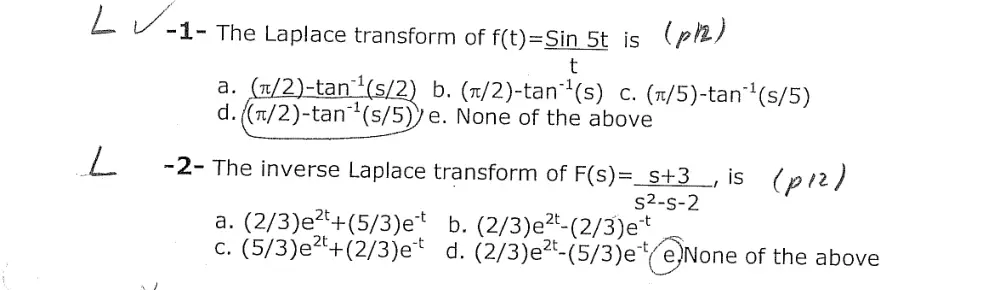
The Laplace transform of f(t)=Sin 5t is (pit)
t
a. (n/2)-tan*(s/2) b. (n/2)-tan“(s) c. (x/5)-tan"!(s/5)
d. (n/2)-tan*(s/5)) e. None of the above
L ~2- The inverse Laplace transform of F(s)=_s+3 , is (pie)
s2-s-2
a. (2/3)e*+(5/3)et b. (2/3)e?"-(2/3)e* _
c. (5/3)e*"+(2/3)e* d. (2/3)e*-(5/3)e"/e)None of the above
~~,
6 (1-e
j . *~5- Find the Laplace transform of f(t)= {t, Ost<2
{2, t>2
—_
)/s3_b. (1-s-e)/s?_¢. (1-25-€5)/s2
d~¢4--se**5)/s2_ e. None of the above
(p12)
a)e *(4Cost+2Sint)
b) e(-4Cost+2Sint)
<< e*(4Cost-2Sint)
d)-e7'(4Cost+2Sint)
e)None of the above
| 24.Find I(t) for t>0. yf
L -2- In the following circuit, the switch is opened at t=0. Find I(s). (p/4]
300hm 60H
> AAO
6
1F_|
-T™ \ S$
120V i
I | 4 1}
UL
a. 240s+120 b. 120
60s2+30s+1 s+0.46
on 40s+2 d. 4s :
(s+46)(S+0.36) ( s+0.46)(s+0.0036)
e. None of the above
L -3- In the circuit shown, the switch has been for a long time at
(prs )
position 1. At t=0, it is moved to position 3. Find I(s).
v ne
eanoyw
Y)
3
1
1000hm
+--+
2
0.4H
i(o+)=0.5A
. (0.552+1.5x10°)/(s2+10°)(s+1000)
. (10°s2)/(s+10°)(s-1000)
(s?+1.5x10°)/(s+10°)(s+1000)
. (1.5x10°)/(s2+10°)(s+1000)
None of the above
L -4- Calculate I(t) for problem 3, for t>0. (ad
a. [Sin(1000t+45°)-+e° 10} u(t)
b. [(1/V2)Sin(1000t+452°) +7007, uct)
c. [(1/V¥2)Sin(1000t-452)+e710y u(t)
d. [V¥2.Sin(1000t-45°)-e710) u(t)
e. None of the above
L -5- In the circuit shown, the switch has been for a long time at
position 3. At t=0, the switch is moved to position 1. Find V(s) P (1s)
V4
1KV @)
1
imicroF
“i
-T~ 2microF
a. 500/(s+0.1)
c. ~-1020/(s+0.155)
(g.None of the above
L -6~- Find v(t) for t>0 for problem 5.
a. 500(e°*) u(t)
e. None of the above
5000K
+
b. 1020/(s?+0.8s+0.1)
d. 500/(s2+0.8s-+0.1)
(b) 1020(@°0:545t_9-0-155t) Y(t)
Cc. -1020(e° 4°") U(t) dd. 500(e°-645t-@°0-155t) Y(t
(py
-—- \/-10-Consider the cascaded connection of 2-RC low-pass filters /
and determine the impulse response at the output. Let RC=1/ 9 /6)
R R
a. t.e u(t)
b. e‘U(t) OVW VV
c. t2.e*U(t)
Vd, t.e*U(t) Cc Cc
e.None of the above # *
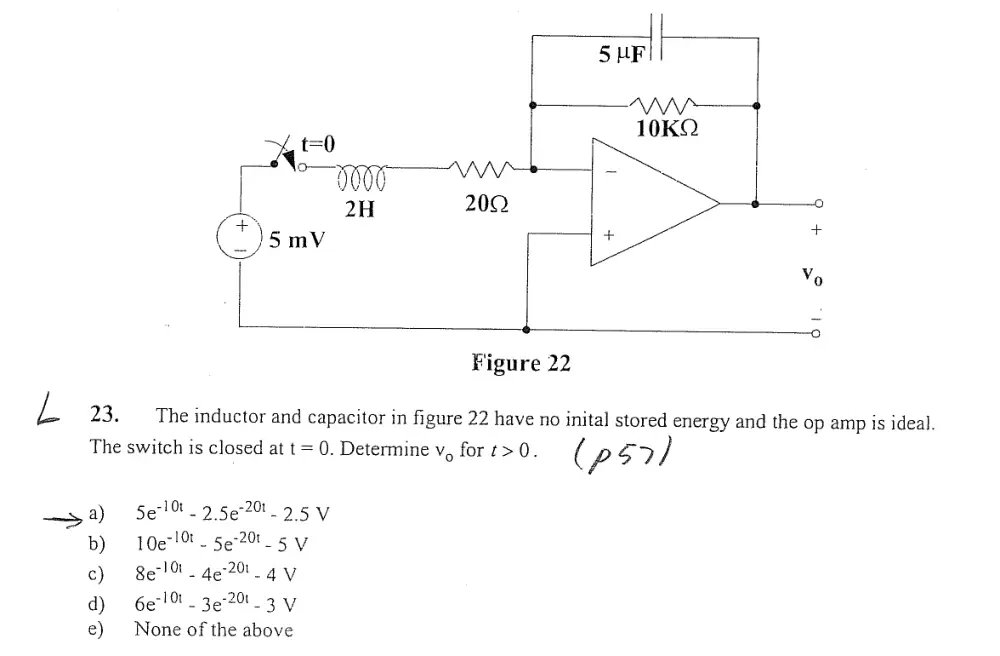
2H 200
Figure 22
L 23. The inductor and capacitor in figure 22 have no inital stored energy and the op amp is ideal.
The switch is closed at t= 0. Determine v, for ¢>0. (p S>/)
sa) Se! 2.567 2.5
b) 10e 1%. 5¢20_ 5 v
c) Be! ge? _gy
dy 6e! 367 _3y
e) None of the above
10
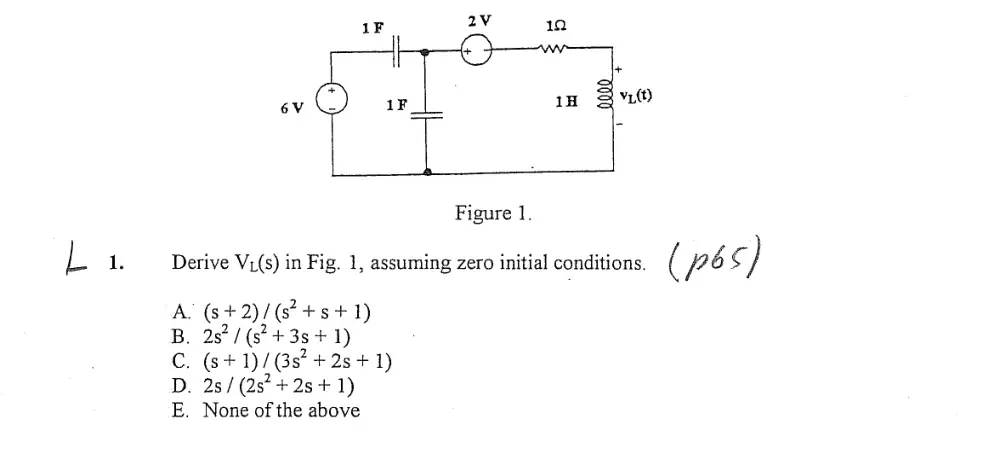
1F 2V
Q—~
II
ime
6v © 1F 18 300
Figure 1.
Derive V;(s) in Fig. 1, assuming zero initial conditions. ( P? 6¢ }
AL (s+2)/(s? +s +1)
B. 2s”/(s?+3s +1)
C. (s+ 1)/Gs +2s+1)
D. 2s/(2s’+2s+1)
E. None of the above
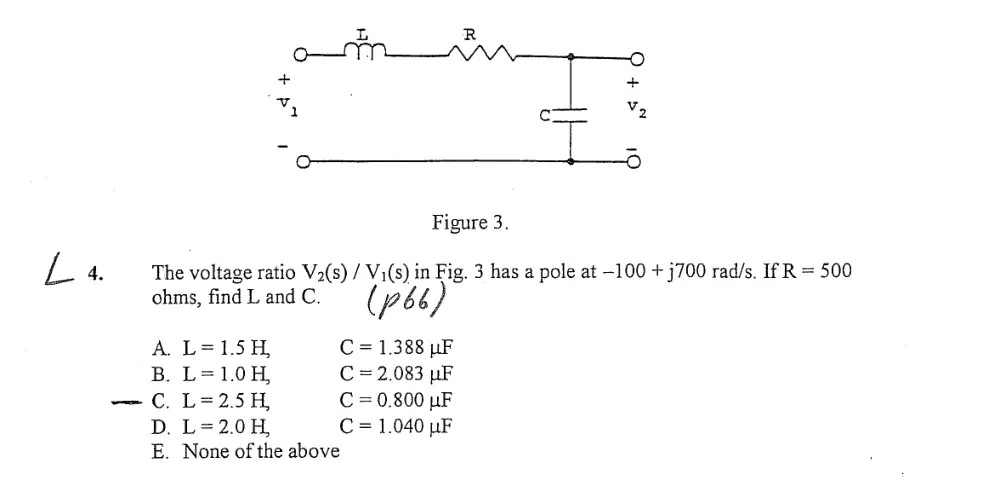
Figure 3.
The voltage ratio V2(s) / V;(s) in Fig. 3 has a pole at -100 + j700 rad/s. If R = 500
ohms, find L and C. (p66)
A. L=154H, C= 1.388 uF
B. L=10H, C= 2.083 pF
— C. L=2.5H, C=0.800 pF
D. L=2.0H, C= 1.040 uF
E. None of the above