
EECE 290 Problems For Quiz 2, Spring 2012
American University of Beirut · Analog Signal Processing · 30 pages


Showing the first 10 of 30 pages. Download the PDF to see all of it.
More EECE 290 files
- Problems For Quiz I · Spring 2012ProblemsView
- Problems · Spring 2008ProblemsView
- Problems For Laplace · Spring 2008ProblemsView
- Problems · Spring 2008ProblemsView
- Lecture Slides Problem Solving Active Filters · Spring 2019LabView
- Lecture Slides Problem Solving Inverse Laplace · Spring 2019LabView
- Exam 1 with Solutions · Spring 2019Exam · with solutionView
- Lecture Slides Problem Solving Complex Power 2 · Spring 2019LabView
Show the text of this problems
EECE 290 - Selected Problems for Quiz 2
Spring 2011-2012
Excited First-Order Circuits
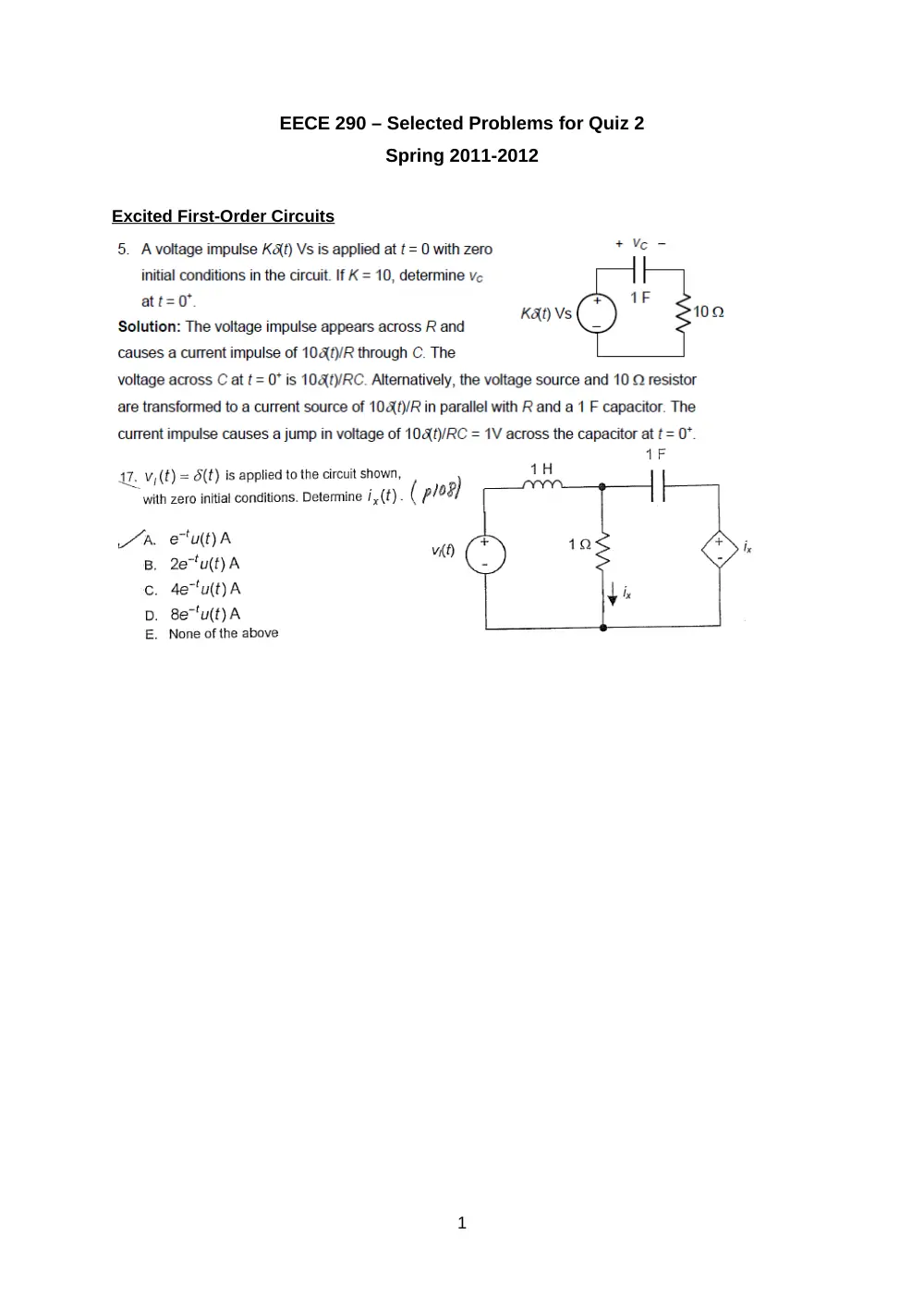
5. A voltage impulse Kt) Vs is applied at t= 0 with zero + Vo -
initial conditions in the circuit. If K = 10, determine Vc | |
at t=0". + 1F
. . Kat) Vs C) S10 Q
Solution: The voltage impulse appears across R and =
causes a current impulse of 10.4(f)/R through C. The
voltage across C at f = 0° is 104{¢)/RC. Alternatively, the voltage source and 10 © resistor
are transformed to a current source of 104(f)/R in parallel with R and a 1 F capacitor. The
current impulse causes a jump in voltage of 104f)/RC = 1V across the capacitor at f = 0°.
1F
a ' oo 4H
47. v,(t) = d(t) is applied to the circuit shown, 108) | L
with zero initial conditions. Determine /, (t) . ( P
ZA, etu(t)A vid C) 12 ix
2e*u(t) A
4eu(t)A yi
Be tu(t)A
None of the above
moo o
Switched First-Order Circuits
+
Sf.
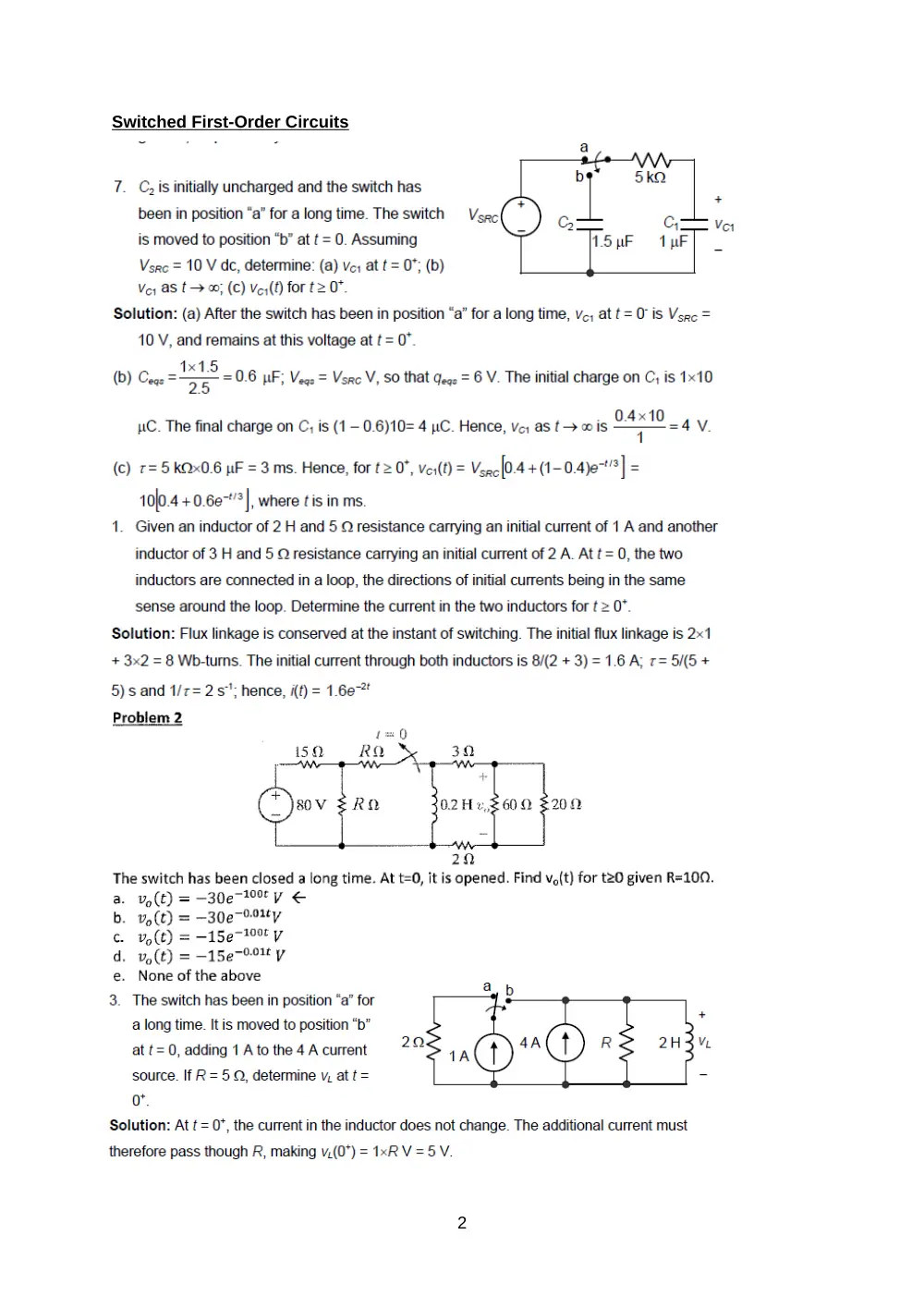
7. Cyis initially uncharged and the switch has al
been in position “a” for a long time. The switch @) io
is moved to position “b” at t= 0. Assuming 15pF iF} _
Vsre = 10 V dc, determine: (a) Vc; at t = 0°; (b) |
Voy as t > 00; (C) Vo,(f) for t= 0°.
Solution: (a) After the switch has been in position “a” for a long time, v,, at t=O" is Vspc¢ =
10 V, and remains at this voltage at t = 0°.
1x15
25
WN
5kQ
Cc
1 Ver
(Db) Cogs =
=0.6 uF; Vigs = Vere V, SO that gage = 6 V. The initial charge on C; is 1x10
0.410 -4Vv.
uC. The final charge on C; is (1 — 0.6)10= 4 wC. Hence, vc; as [> wis
(c) r= 5 kOx0.6 uF = 3 ms. Hence, for t> 0°, Voi(t) = Vege0.4+(1-0.4)e*?] =
10/0.4 +0.6e~*|, where tis in ms.
1. Given an inductor of 2 H and 5 © resistance carrying an initial current of 1 A and another
inductor of 3 H and 5 resistance carrying an initial current of 2 A. At f= 0, the two
inductors are connected in a loop, the directions of initial currents being in the same
sense around the loop. Determine the current in the two inductors for f > 0°.
Solution: Flux linkage is conserved at the instant of switching. The initial flux linkage is 2x1
+ 3x2 = 8 Wb-turns. The initial current through both inductors is 8/(2 + 3) = 1.6 A; r= 5/(5 +
5) s and 1/r=2"'; hence, i(t) = 1.6e**
Problem 2
f=
isa RQ 30
AN AWN AW
+
x0 VeRQ 02H», 2600 2200
WA
22
The switch has been closed a long time. At t=0, it is opened. Find v(t) for t20 given R=100.
Vo(t) = —30e FV €
V_(t) = —30e- ty
vy(t) = —15e7 Vv
vy (t) = —15¢e76- ty
None of the above
ganoro
3. The switch has been in position “a” for
a long time. It is moved to position “b”
2 0 1A 4A R 2H3“%
at t= 0, adding 1 A to the 4 A current
source. If R= 5, determine y, at f= =
0.
Solution: At f = 0°, the current in the inductor does not change. The additional current must
therefore pass though R, making v,(0*) = 1xRV =5V.
Both switches have been closed for a long time. At t=0, both switches open simultanously.
Find i,{t) for t20 given R=8.
ig(t) = 10.72e-*' ma
ig(t) = 10.72¢-5°° ma
i,(t) = 10e7** mA
i,(t) = 10e5° ma €
None of the above
2. Consider the circuit below. Switches K] and K2 open at t= 0, after being closed
for a long time. Find final values of voltages V1 and V2 respectively across C1 and
C2.°C1= 1p F, C2= 2uF
panes
>a) VI=+4V, V2= -4V
b) V1=+6V, V2= -6V
c) VI=+8V, V2=-8V
d) V1= 0V, V2= 0V
e) None of the above
13. An inductor L2 = 2H, an inductor L1 = 1H and a resistor R = 6Q are
connected in series to a voltage source v(t) = 2 t e“u(t). The initial energy stored
in L2 was 25J. No initial energy was stored in L1. Find the current i(t) in this
circuit at t = 0.
i(t) ere
Ee pein 12
eo
i(t) = [4 5(t) + 4e7 + 2/3 te™] ult)
i(t) =[4e7 -2/3 e*-2/3 te“) u(t)
it) =[4e7+2/3 e+ 2/3 te*] u(t)
i(@t) =[4e7 - 2/3 ej u(t)
None of the above
epa0cp
The switch in the circuit has been in position x for a long time. At t= 0,
the switch moves instantaneously to position y. Find:
a) v(t) fort >=0
b) volt) for t>= 0"
c) (ft) fort >=0°
d) The total energy dissipated in the 60 KQ resistor
10kN x
100V + 8, $240 kN $ 60 kD
05 uF - ve
a) Because the switch has been in position x for a long time, the 0.5
uF capacitor will charge to 100 V and be positive at the upper
terminal. We can replace the capacitor at t= 0° with an equivalent
resistance of 80 KQ. Hence the time constant of the circuit is:
(0.5*10°)*(80*10° )=40ms
then: v.(t)= 100 e?* V, 0
b) The easiest way to find v,(t) is to note that the resistive circuit
forms a voltage divider across the terminals of the capacitor.
Thus. vo(t) = (48 / 80 ) v(t) = 60 eV, t= 0"
vo(t) valid for t >= 0” because vo(0-) is zero. Thus we have an
instantaneous change in the voltage across the 240 KQ resistor.
c) Using ohms law: io(t) = ( vo(t) / 60*10° y= eo 'mA. t= 0"
d) The power dissipated in the 60 KQ resistor is:
Peo xo(t) = io(t) * (60*10°) = 60e°" mW, t>= 07
The total energy dissipated is:
Weoxo= Jo io(t)*( 60*10°) dt= 1.2 mJ
13. The switch closes at 0. Find v(t) in volts for t= 0, tis in
seconds.
2002
0.067"
PA. 2.25 + 0.75¢
0.033
B. 2.75 + 0.5¢
O05
C.2.5+15¢
it
D.3+2¢
E. None of the above
14. The switch opens again at t = 10sec. Find v(t) for t = 10sec.
-0.067(t - 10)
A.2-0.63e
-0.038(t— 10)
B.4-0.6e
-0.067(t- 10)
C.2.5-0.5e
-0.05(t- 10)
>D.3-0.37e
E. None of the above.
21. At time t=0 the switch move
Vi=10V. V2=20V, Ri=SKQ., :
a) V=10V
b) V.=20V
c) V=-10V
>d) V=-20V
e) None of the above
ny
Open t=6
Close t=3
Vs
0.02uf
aT Ov
R1
Ve
~ 10.06uf
R2
=
19. If V, = -9V, Ry=5KQ, R9=2KQ, R3=2KQ, then the voltage V, across the capacitors at
R1:
time t=0 is:
vic
a) V.=-9V
— Sb) V=9V
c) V.=20V
d) V.= -20V
e) None of the above
20. In the circuit shown above find in milliseconds the value of tau for the time interval
35 t<6.
>a) tau= 0.08 msec
b) tau= 0.48 msec
c) tau= 0.96 msec
d) tau= 0.64 msec
e) None of the above
The switch in the circuit has been im position | for a long time. At t =0.
the switch moves to position 2.Find
a) volt) fort >=0
b) igft) fort >= 0"
iV
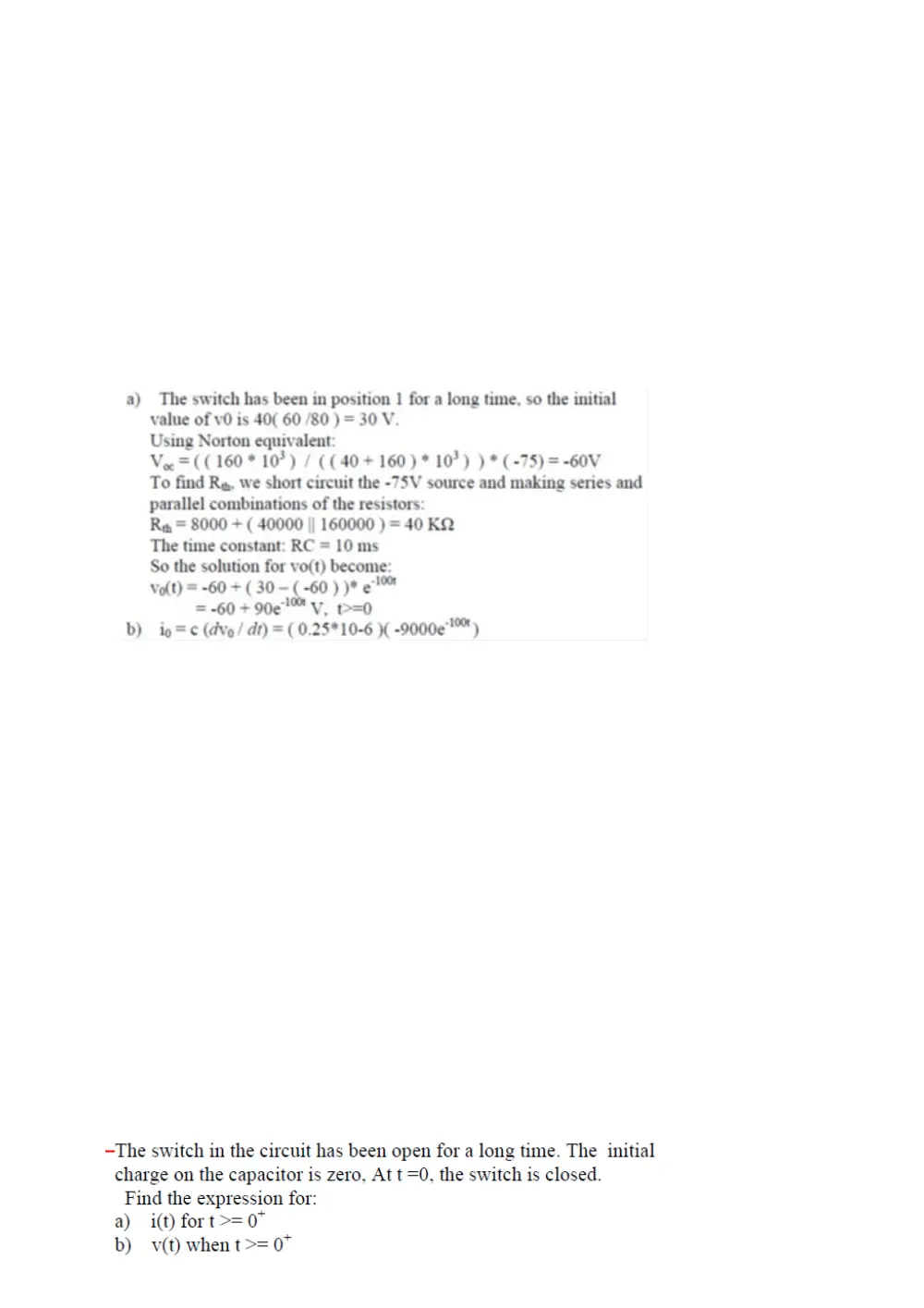
a) The switch has been in position | for a long time. so the initial
value of v0 is 40( 60/80 ) = 30 V.
Using Norton equivalent:
Vee = (( 160 * 10?) / (( 40+ 160) * 10°) ) *(-75) =-60V
To find Rg. we short circuit the -75V source and making series and
parallel combinations of the resistors:
Re = 8000 + ( 40000 || 160000 ) = 40 KQ
The time constant: RC = 10 ms
So the solution for vo(t) become:
volt) = -60 + (30 = (-60 ) jt e'™
= -60+90e™™ V, =0
b) ig =c (dv / dt) = (0.257 10-6 -9000e"™)
—The switch in the circuit has been open for a long time. The initial
charge on the capacitor is zero, At t =0, the switch is closed.
Find the expression for:
a) i(t) fort >=0”
b) v(t) when t>= 07
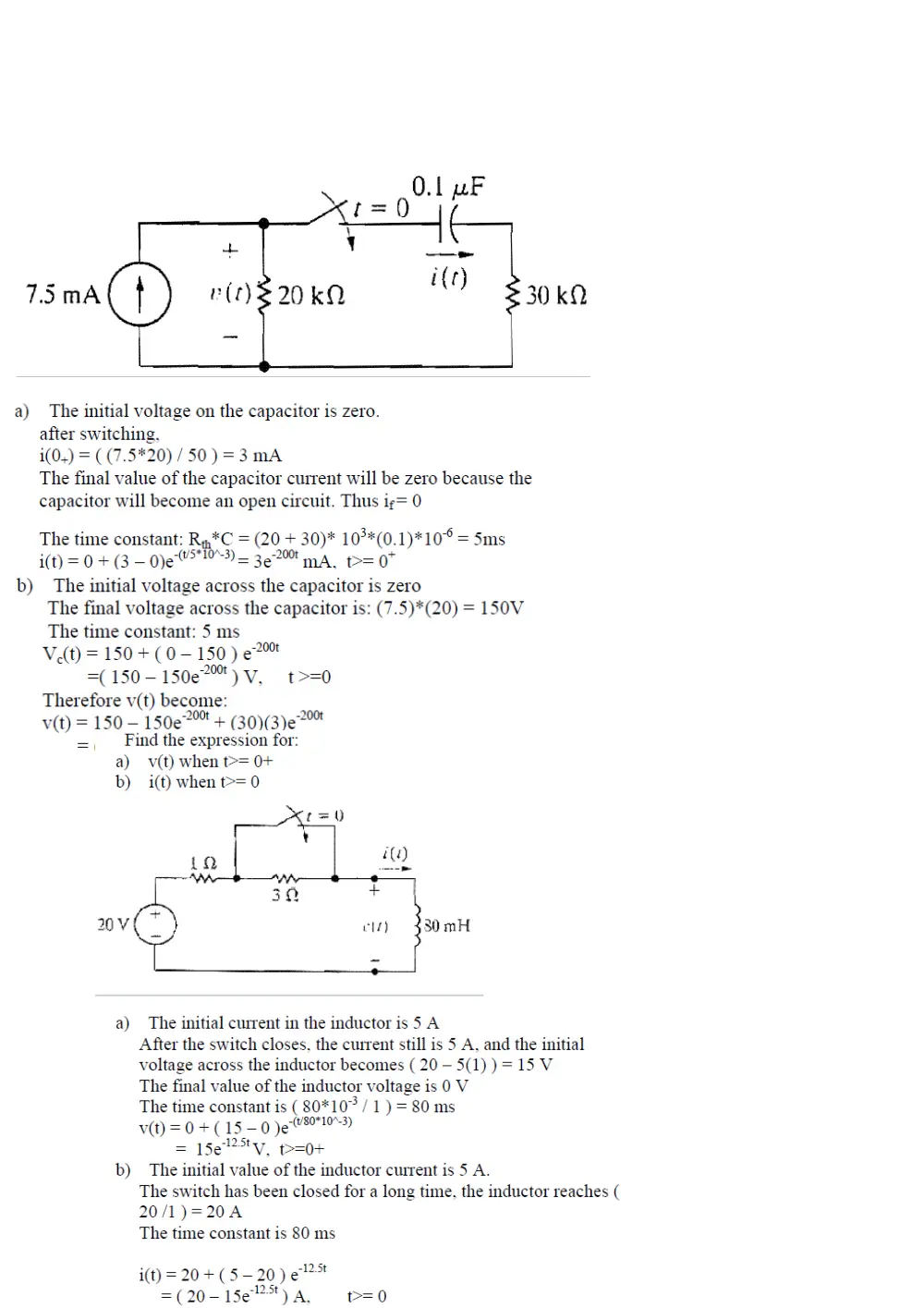
a) The initial voltage on the capacitor is zero.
after switching,
i(0.) = ( (7.5*20) /50)=3 mA
The final value of the capacitor current will be zero because the
capacitor will become an open circuit. Thus ig= 0
The time constant: Ry,*C = (20 + 30)* 10°*(0.1)*10° = Sms
i(t) =0 + 3 — Oe = 36° mA, P= 07
b) The initial voltage across the capacitor is zero
The final voltage across the capacitor is: (7.5)*(20) = 150V
The time constant: 5 ms
V(t) = 150 + (0-150) eo?
=(150—150e7") Vv, t>=0
Therefore v(t) become:
v(t) = 150 — 15027 + (30)(3)e7™
=, Find the expression for:
a) v(t) when t>= 0+
b) i(t) when = 0
it)
—
4
20v{ ” ) ci) 330mH
>.
a) The initial current in the inductor is 5 A
After the switch closes, the current still is 5 A, and the initial
voltage across the inductor becomes ( 20 - 5(1) )=15 V
The final value of the inductor voltage is 0 V
The time constant is ($0*107/ 1) = 80 ms
V(t) =0 + (15-0 eS)
= 15e ty, t=0+
b) The initial value of the inductor current is 5 A.
The switch has been closed for a long time, the inductor reaches (
20/1)=20A
The time constant is 80 ms
i(t)=20+(5-20)e?*
=(20-15eP"*) A p=0
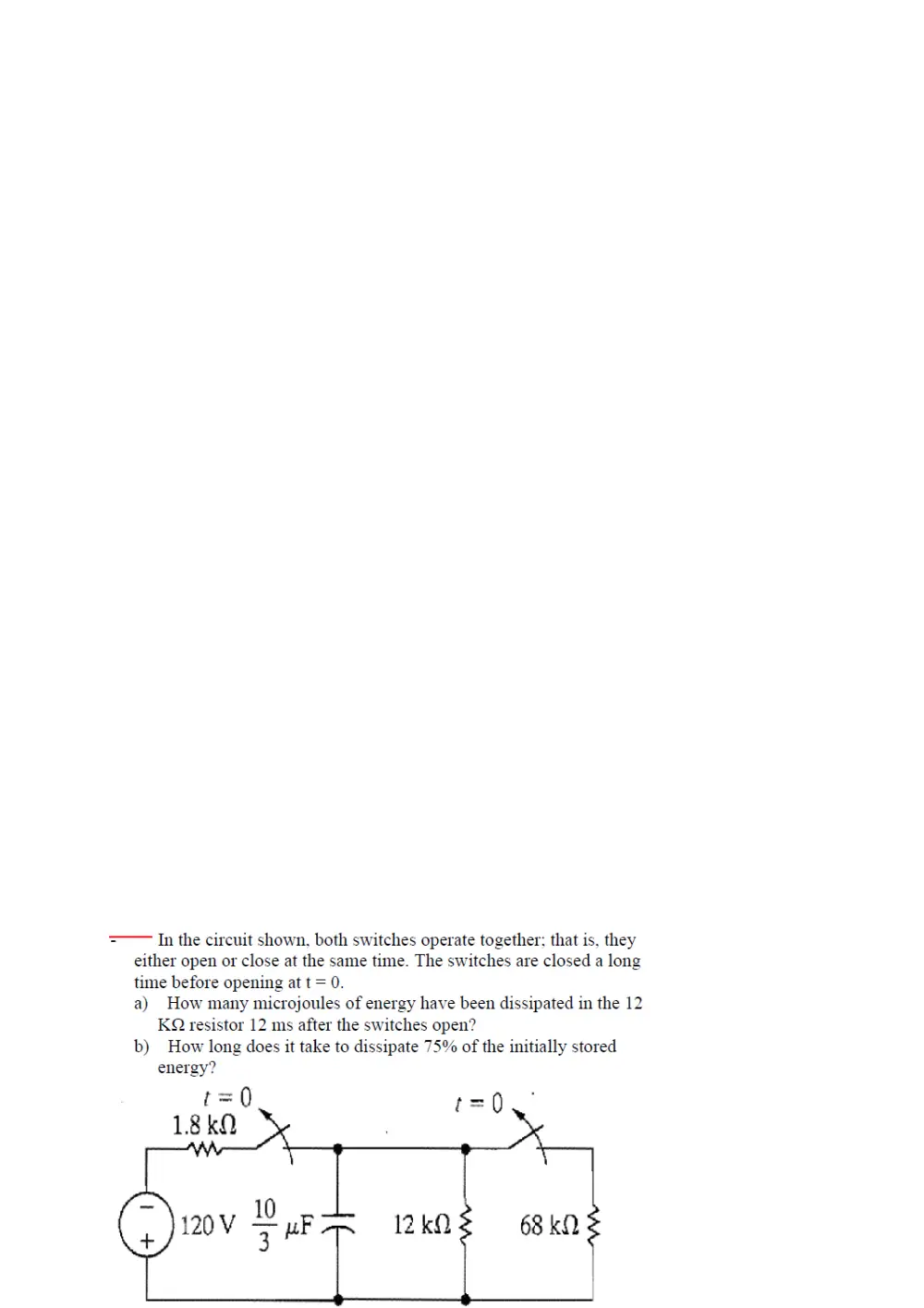
= In the circuit shown, both switches operate together: that is, they
either open or close at the same time. The switches are closed a long
time before opening at t= 0.
a) How many microjoules of energy have been dissipated in the 12
KQ resistor 12 ms after the switches open?
b) How long does it take to dissipate 75% of the initially stored
energy?
t=0 t=0
1.8 kO
68 kQ
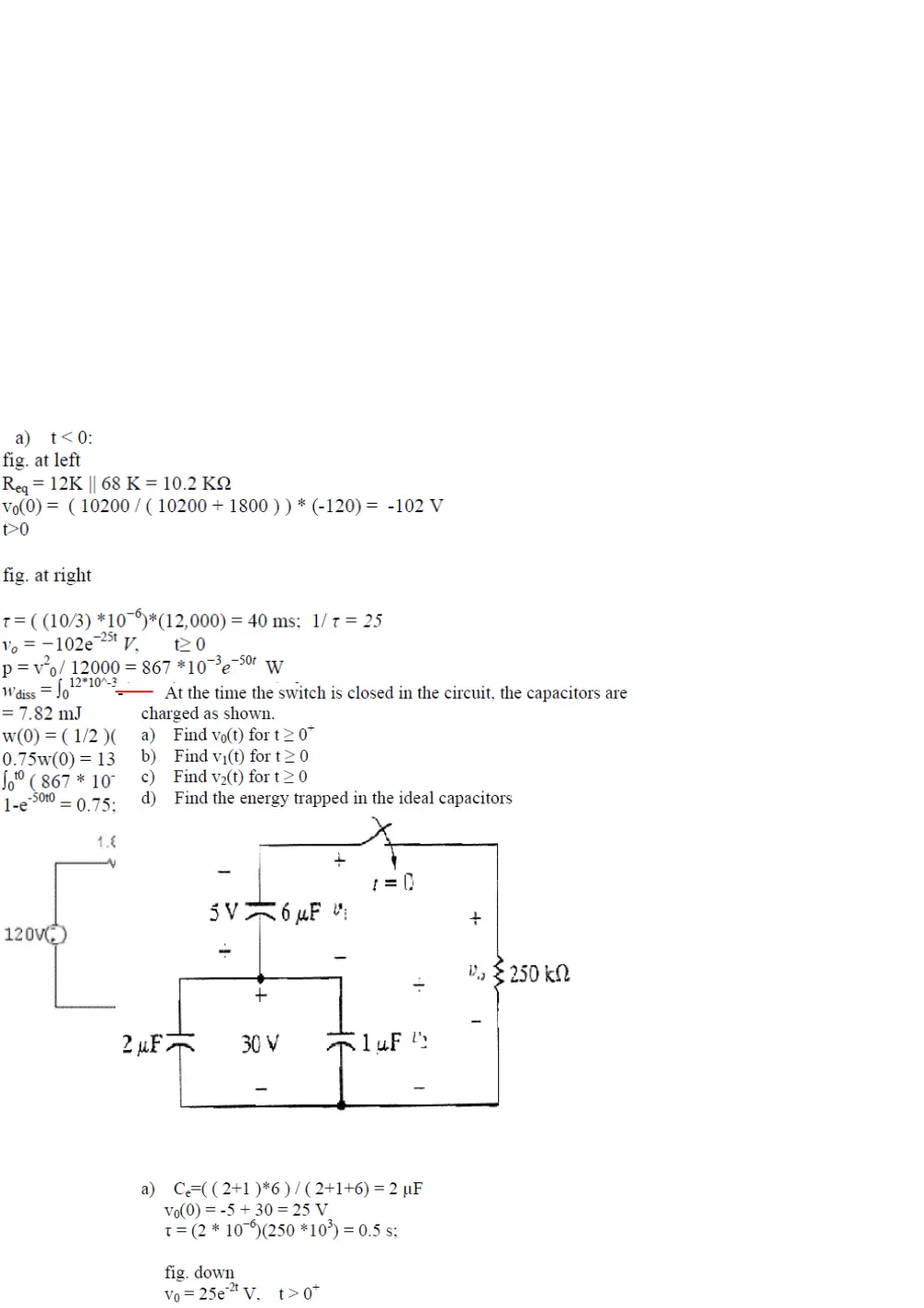
a) t<0:
fig. at left
Req = 12K || 68 K= 10.2 KQ
vo(0) = ( 10200 / ( 10200 + 1800 ) ) * (-120) = -102 V
to
fig. at right
tT=( (10/3) *10-°)*(12,000) =40 ms: 1/t=25
vo= 102 "VY PO,
p=Vo0/ 12000 = 867 *107°e"™" W
Waiss = Jo"? aa At the time the switch is closed in the circuit. the capacitors are
= 7.82 mJ charged as shown.
w(0)=(1/2)( a) Find vo(t) fort > 0"
0.75w(0)=13 6) Find v,(t) fort 0
Jot (867 * 10° c) Find v,(t) fort >0
1-220 = 975: d) Find the energy trapped in the ideal capacitors
4.¢ ————
~ iL ps0
| 3V Nb uF vi +
a) Ce=((2+1 )*6)/(2+1+6) =2 uF
vo(0) = -5 +30=25V
T= (2 * 10°°)(250 *10*) =0.5 s:
fig. down
vo=25e"%V. t>0