
EECE 290 Problems, Spring 2008
American University of Beirut · Analog Signal Processing · 10 pages


More EECE 290 files
- Problems For Quiz 2 · Spring 2012ProblemsView
- Problems For Quiz I · Spring 2012ProblemsView
- Problems · Spring 2008ProblemsView
- Problems For Laplace · Spring 2008ProblemsView
- Lecture Slides Problem Solving Active Filters · Spring 2019LabView
- Lecture Slides Problem Solving Inverse Laplace · Spring 2019LabView
- Exam 1 with Solutions · Spring 2019Exam · with solutionView
- Lecture Slides Problem Solving Complex Power 2 · Spring 2019LabView
Show the text of this problems
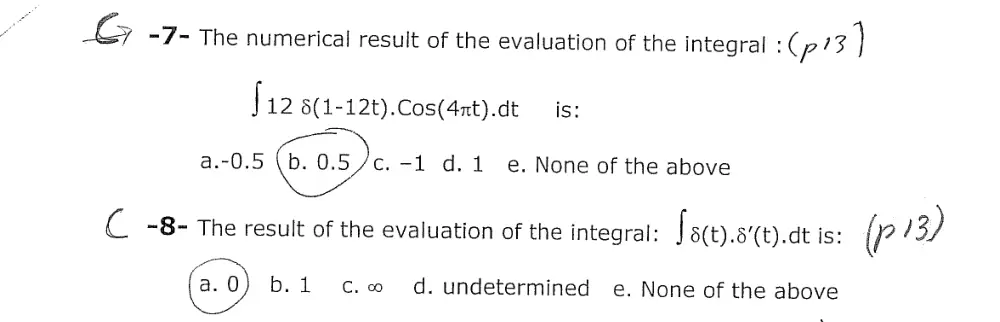
G&G ~7- The numerical result of the evaluation of the integral (p13 }
Jaz 8(1-12t).Cos(4nt).dt is:
a.-0.5 Go5ye -1 d.1_ e. None of the above
C -8- The result of the evaluation of the integral: Jacty.s(t).at iS: (7 13)
(2.9) b. 1 c.c d.undetermined e. None of the above
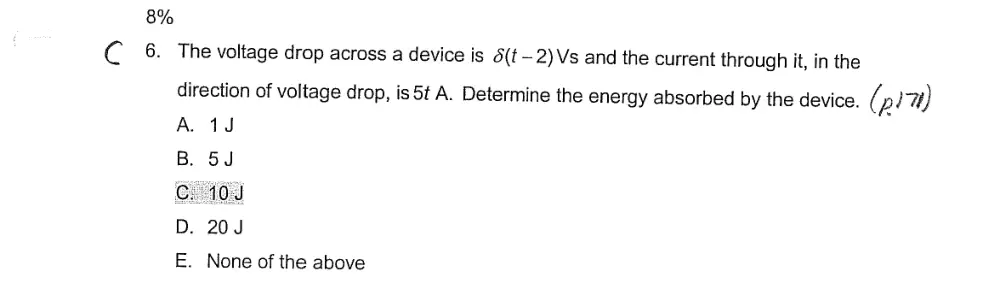
8%
C6. The voltage drop across a device is 6(t-2)Vs and the current through it, in the
direction of voltage drop, is 5¢ A. Determine the energy absorbed by the device. (pi)
A. 1J
5J
4 Od
20 J
None of the above
mo @ o
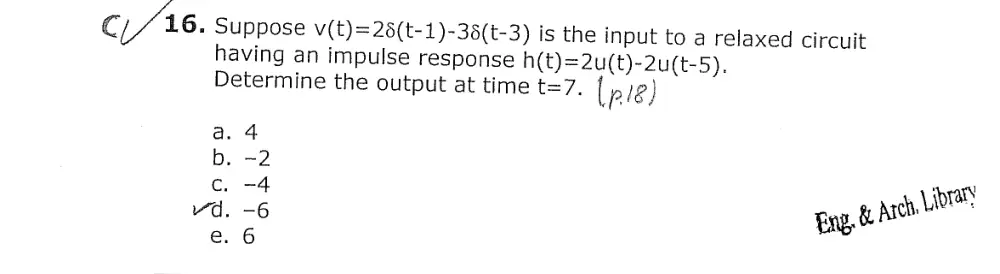
C)/16. Suppose v(t)=28(t-1)-38(t-3) is the input to a relaxed circuit
having an impulse response h(t)=2u(t)-2u(t-5).
Determine the output at time t=7, (ple)
a. 4
b. -2
c. -4
vd. -6
C 17. — The response of a circuit to an impulse at t = 0 is e“u(t). If an input e°*' has been
applied for a long time (from t = — 00), determine the output at t = 0. ( p-74)
w= A. 2
B. 4
Cc. 0
D. «
E.
None of the above
C Au. v,(t) = 6(t) is applied to the circuit shown,
with zero initial conditions. Determine /, (t)
“A. etu(t)A
B. 2e‘u(t)A
C. felt A
pb. 8eTu(t)A
E. None of the above
1F
). ( plos)
v(t) C)
r)
1
C 18. In the circuit shown, the input voltages V,=
5000
O(t) ,Vs and
3 1
Vo= 70000 o(t ~To00? Vs. What is the correct time-domain expression for Vo? ( P- 162 }
l60kr
: ;
(a) 2u(t) —3u(t — i000.” V
setts
(b) — 2u(t)-3u(t + 7000”? Vv
1
1000
1
a= (d) ~ 2u(@) ~3u(t- =) iV
(e) None of the above
(c) —25(t) -36(¢- VW
C 12. Forthe signals shown in Fig, 11, find y(t) =x(t)*h(t). ( p72)
x(t) h(t)
A A
TL
5
— |
3 3
; t
0.05 0.25 0.45 ts) 0 02 O4 = t(s)
}__—_—= y(t)
ELEG021— Final ~ Version 1
Page 5/8
pt (s)
3 (s)
0.05 . 0.25 O45 0.65 0.85
C.
E. None of the above
Cc 20. Use the convolution integral to evaluate ey) att=6s if y(t) = h() * x() and h(t) and
x(t) have the waveforms shown below. pu
ket) x(t)
18
10
a g TO a to » ©)
a) 584
b) 337.5
4<c) 108
d) 534.5
e) None of the above
Test ID 1000 7/7
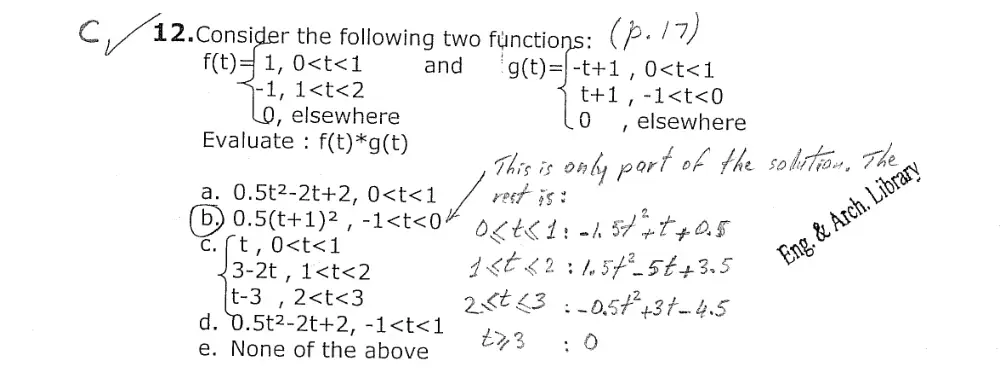
C)/12.consider the following two ftinctions: (Pp: /7)
f(t)= 1, 0<t<1 and = g(t)=/-t+1, 0<t<1
“-1, 1<t<2 t+1,-1<t<0
LO, elsewhere 0 , elsewhere
Evaluate : f(t)*g(t EA
()* a(t) This is only part of the sollifiar, 7H.
a. 0.5t2-2t+2, 0<t<1 Va is: , ~
O.5(t+1)2, -1<t<0” geped, 1, typos ye
Et, 0<t<1 teeny wpe - ws
3-2t , 1<t<2 IE 82 tN SP _ SE 435
t-3, 2<t<3 2C£3 1 _OsP 3h 4s
d. 0.5t?-2t+2, -1<t<1 2
ERQ
e. None of the above “F : 0