
EECE 310 Homework 10, Fall 2011
American University of Beirut · Electronics · 2 pages
More EECE 310 files
- Homework Spice3 Solution · Summer 2012Homework · with solutionView
- Homework Spice2 Solution · Summer 2012Homework · with solutionView
- Homework Spice1 Solution · Summer 2012Homework · with solutionView
- Homework 1 Solution · Fall 2011Homework · with solutionView
- Homework 2 Solution · Fall 2011Homework · with solutionView
- Homework 1 · Fall 2011HomeworkView
- Homework 1 · Fall 2011HomeworkView
- Homework 1 Solution · Fall 2011Homework · with solutionView
Show the text of this homework
American University of Beirut
DEPARTMENT OF ELECTRICAL AND COMPUTER ENGINEERING
EECE 310 – Electronics
Fall 2011 – 2012
Due Wednesday January 11, 2012 at 9:00 am
Homework 10
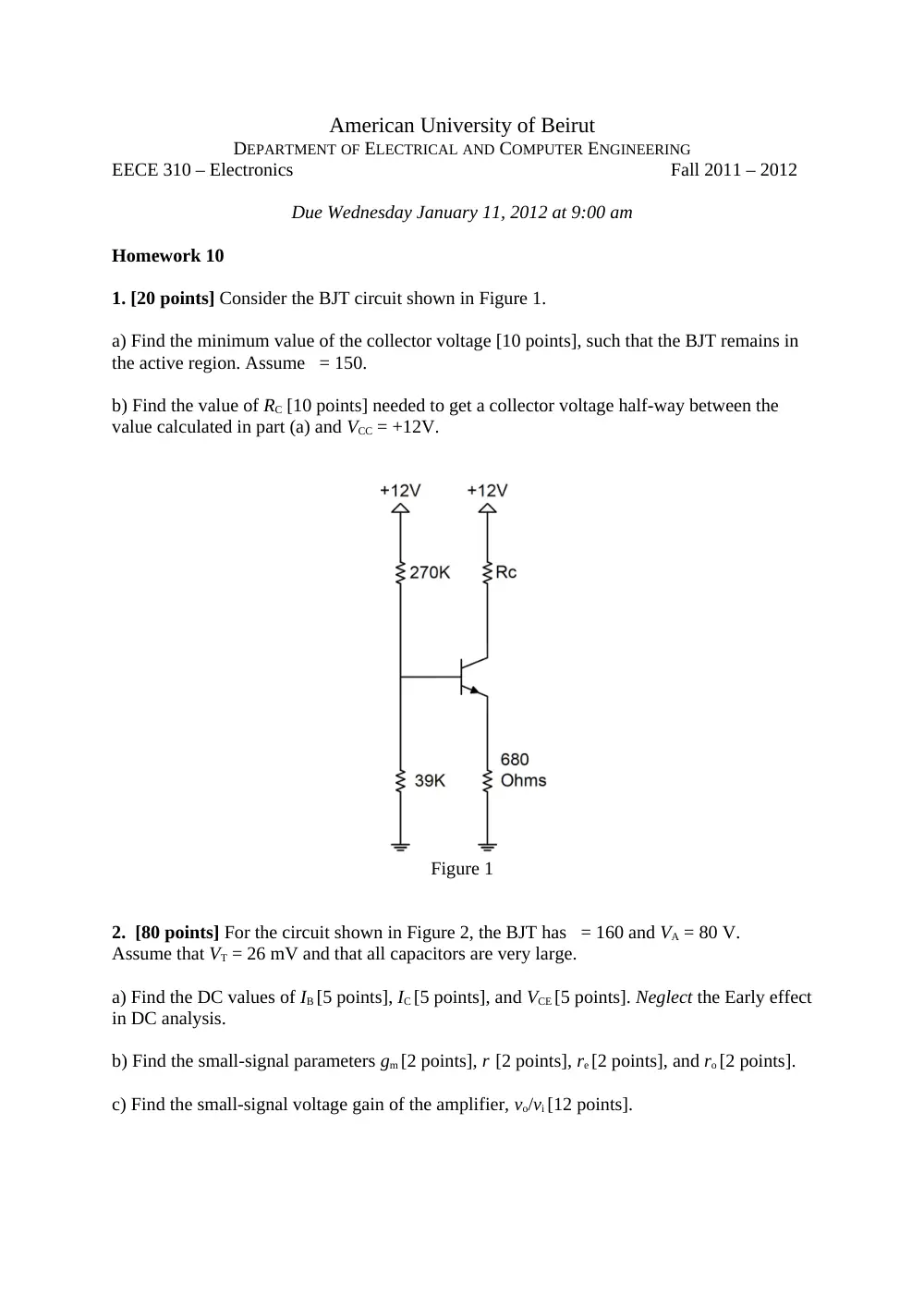
1. [20 points] Consider the BJT circuit shown in Figure 1.
a) Find the minimum value of the collector voltage [10 points], such that the BJT remains in
the active region. Assume = 150.
b) Find the value of RC [10 points] needed to get a collector voltage half-way between the
value calculated in part (a) and VCC = +12V.
Figure 1
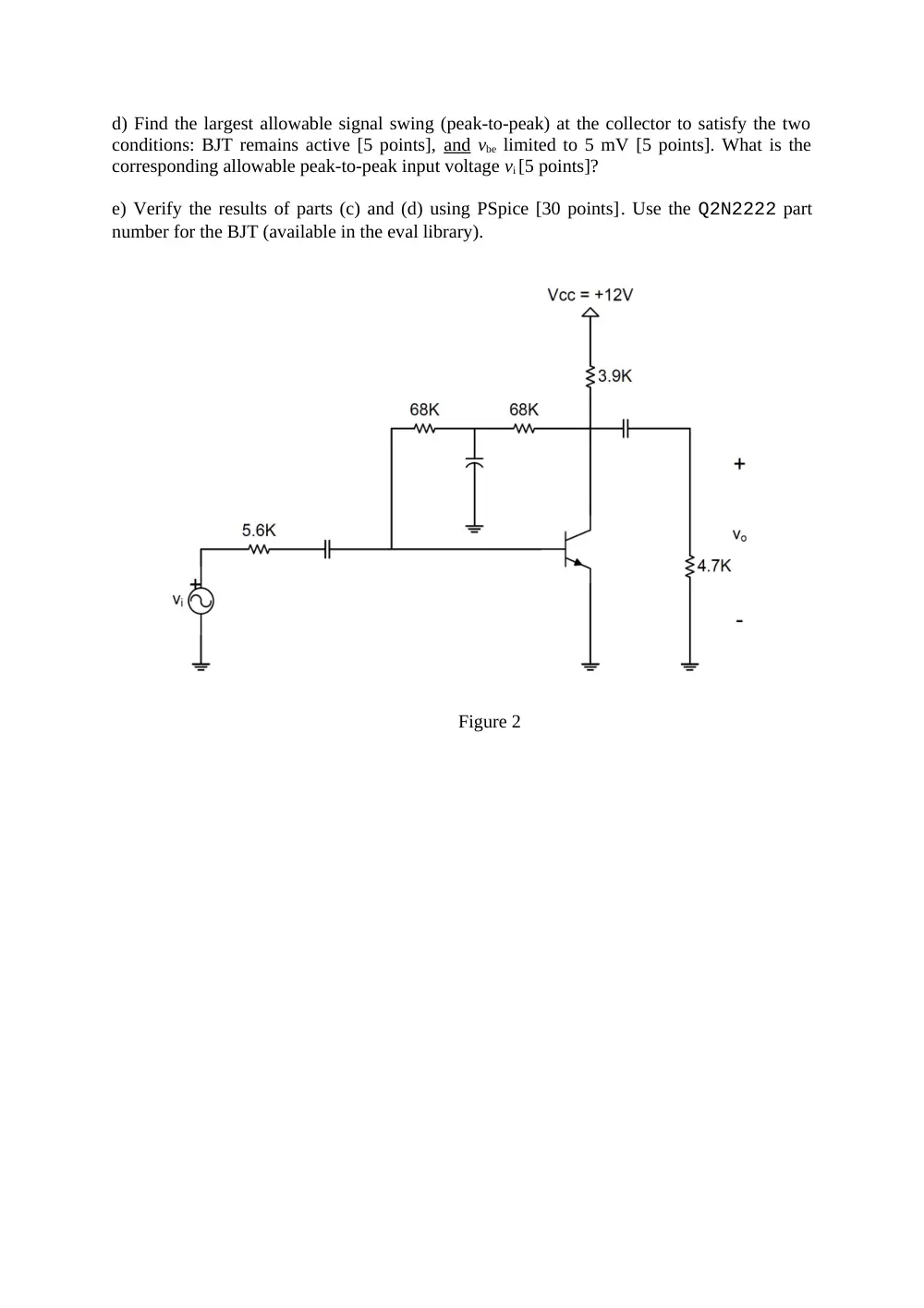
2. [80 points] For the circuit shown in Figure 2, the BJT has = 160 and VA = 80 V.
Assume that VT = 26 mV and that all capacitors are very large.
a) Find the DC values of IB [5 points], IC [5 points], and VCE [5 points]. Neglect the Early effect
in DC analysis.
b) Find the small-signal parameters gm [2 points], r
[2 points], re [2 points], and ro [2 points].
c) Find the small-signal voltage gain of the amplifier, vo/vi [12 points].
d) Find the largest allowable signal swing (peak-to-peak) at the collector to satisfy the two
conditions: BJT remains active [5 points], and vbe limited to 5 mV [5 points]. What is the
corresponding allowable peak-to-peak input voltage vi [5 points]?
e) Verify the results of parts (c) and (d) using PSpice [30 points]. Use the Q2N2222 part
number for the BJT (available in the eval library).
Figure 2