
EECE 310 Homework 5, Fall 2011
American University of Beirut · Electronics · 2 pages

More EECE 310 files
- Homework Spice3 Solution · Summer 2012Homework · with solutionView
- Homework Spice2 Solution · Summer 2012Homework · with solutionView
- Homework Spice1 Solution · Summer 2012Homework · with solutionView
- Homework 1 Solution · Fall 2011Homework · with solutionView
- Homework 2 · Fall 2011HomeworkView
- Homework 1 · Fall 2011HomeworkView
- Homework 1 · Fall 2011HomeworkView
- Homework 1 Solution · Fall 2011Homework · with solutionView
Show the text of this homework
American University of Beirut
DEPARTMENT OF ELECTRICAL AND COMPUTER ENGINEERING
EECE 310 – Electronics
Fall 2011 – 2012
Due Wednesday November 2, 2011 at 9:00 am
Homework 5
1. [50 points]
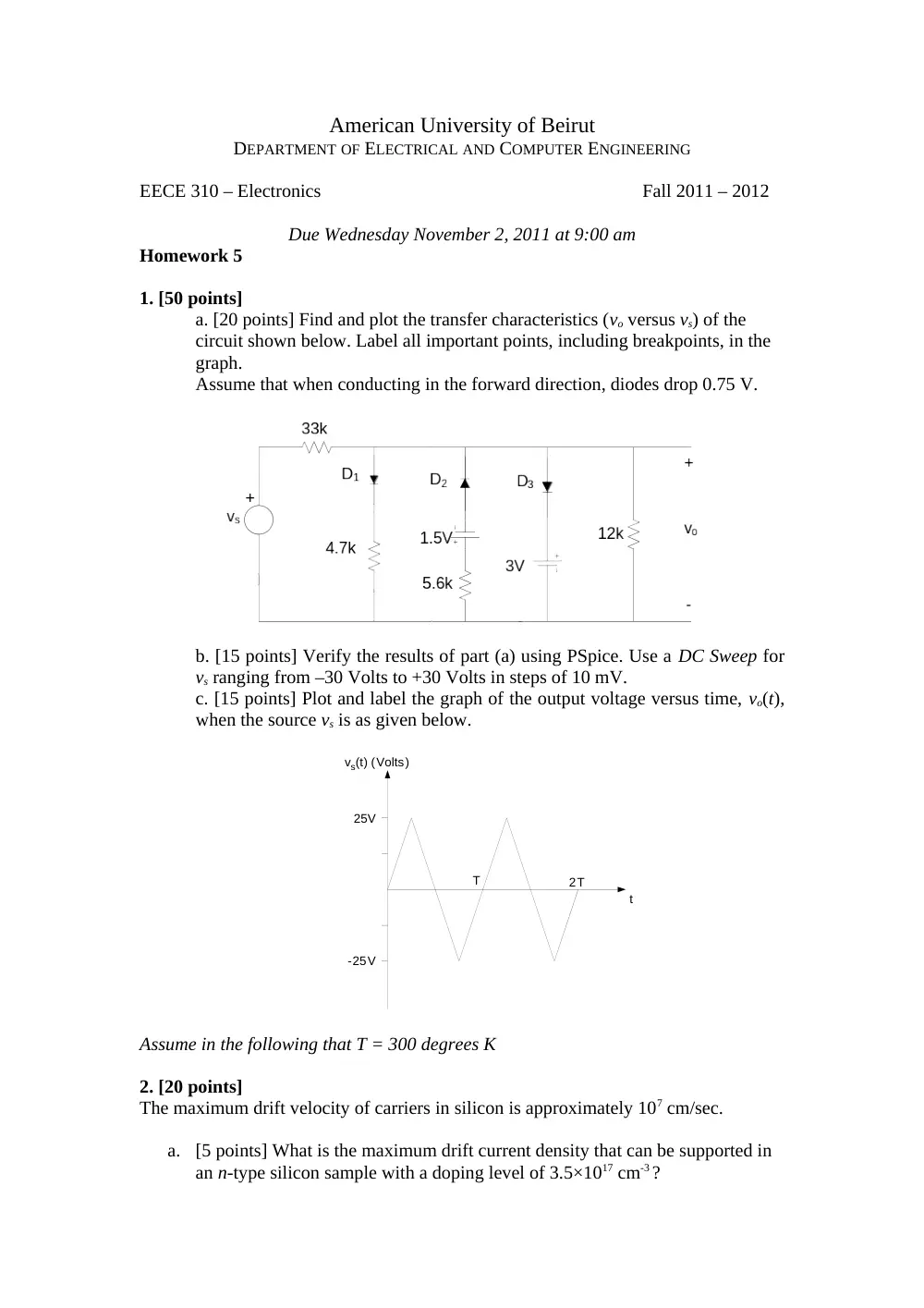
a. [20 points] Find and plot the transfer characteristics (vo versus vs) of the
circuit shown below. Label all important points, including breakpoints, in the
graph.
Assume that when conducting in the forward direction, diodes drop 0.75 V.
b. [15 points] Verify the results of part (a) using PSpice. Use a DC Sweep for
vs ranging from –30 Volts to +30 Volts in steps of 10 mV.
c. [15 points] Plot and label the graph of the output voltage versus time, vo(t),
when the source vs is as given below.
Assume in the following that T = 300 degrees K
2. [20 points]
The maximum drift velocity of carriers in silicon is approximately 107 cm/sec.
a.
[5 points] What is the maximum drift current density that can be supported in
an n-type silicon sample with a doping level of 3.5×1017 cm-3 ?
2T
T
25V
-
V
25
s t( ) (Volts)
v
t
b. [10 points] What is the conductivity of the silicon sample? What is its
resistivity? Assume that the mobility of electrons is 950 cm2/V.sec.
c.
[5 points] What is the corresponding voltage drop across the sample if it has a
length of 15 cm?
3. [15 points]
The free electron concentration in a silicon sample is described by:
free electrons per cm3 with Ln equal to 2.5 m.
a.
[10 points] Find the diffusion current density for electrons as a function of
distance if Dn = 13 cm2/sec.
b. [5 points] What is the diffusion current at x = 0.75Ln if the cross sectional area
is 5000 m2 ?
4. [15 points]
A PN junction diode is doped with NA = 2×1017 cm-3 on the p side and
ND = 7×1015 cm-3 on the n side.
a.
[5 points] What are the hole densities in the p-type and in the n-type regions?
b. [5 points] What are the free electron densities in the p-type and in the n-type
regions?
c.
[5 points] What is the built-in potential barrier?