
EECE 321 Midterm, Spring 2004
American University of Beirut · Computer Organization · 11 pages

Showing the first 10 of 11 pages. Download the PDF to see all of it.
More EECE 321 files
Show the text of this exam
M. MANSOUR
FACULTY OF ENGINEERING AND ARCHITECTURE
AMERICAN UNIVERSITY OF BEIRUT
SPRING TERM 2004
MIDTERM I
EE/CCE 2006
EECE 321 - MICROPROCESSOR SYTEMS
APRIL 8, 2004
NAME: _____________________
ID: _____________________
Section: 9 AM or 10 AM
OPEN BOOK/OPEN NOTES (3 Hours)
WRITE YOUR NAME AND ID NUMBER IN THE SPACE PROVIDED ABOVE.
PROVIDE YOUR ANSWERS IN THE SPACE PROVIDED ON THE QUESTION SHEET.
THE SCRATCH BOOKLET WILL NOT BE CONSIDERED IN GRADING.
BE AS CLEAR AND AS NEAT AS POSSIBLE.
WRITE COMMENTS NEXT TO YOUR MIPS INSTRUCTIONS.
PAGE 2 LISTS SOME COMMON MIPS INSTRUCTIONS YOU CAN USE
CIRCLE YOUR SECTION TIME.
____________________________________________________________________
Problem
Points
Over
1
20
2
20
3
20
4
20
5
20
6
20
7
20
8
20
Total
160
1
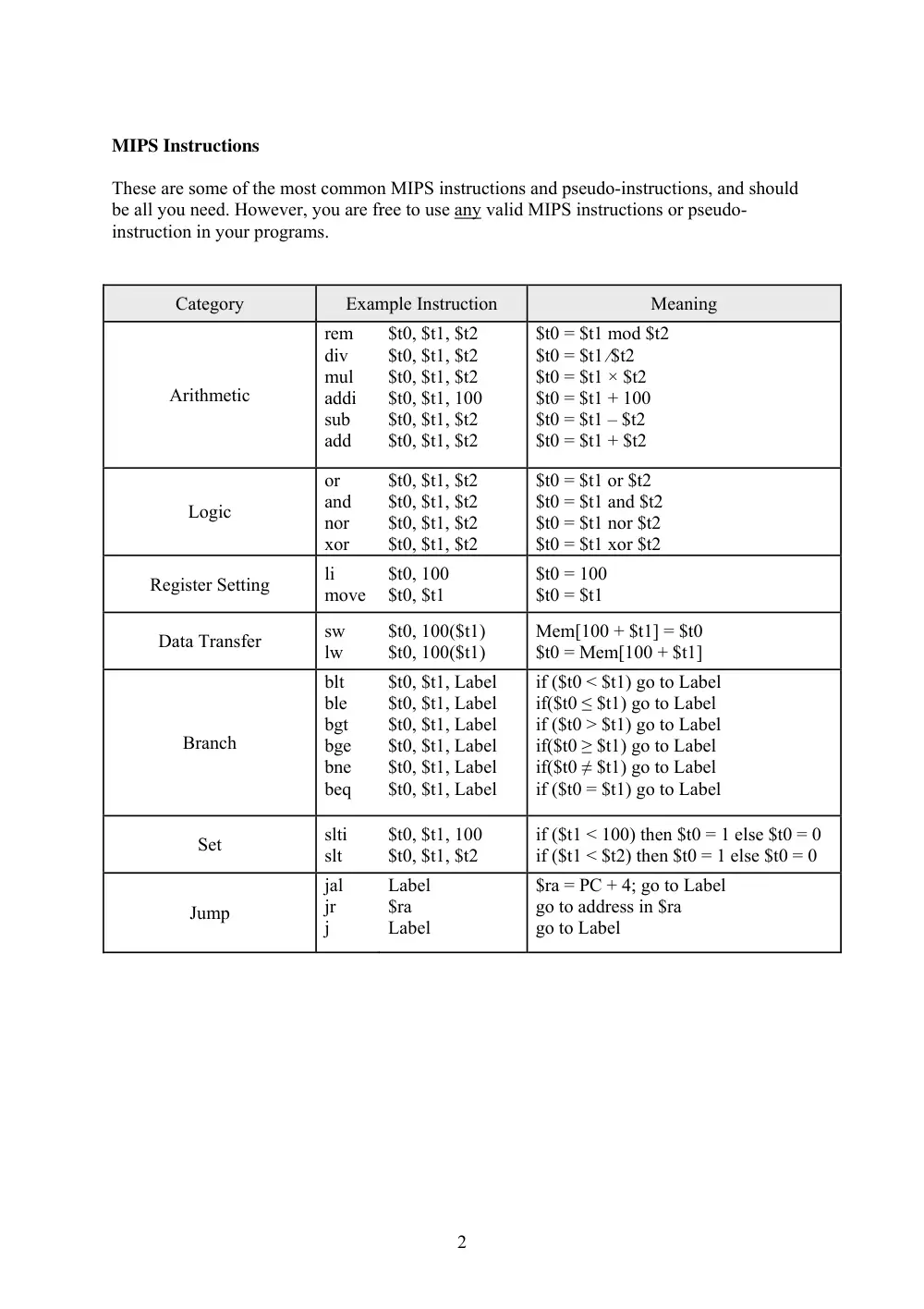
MIPS Instructions
These are some of the most common MIPS instructions and pseudo-instructions, and should
be all you need. However, you are free to use any valid MIPS instructions or pseudo-
instruction in your programs.
Category
Example Instruction
Meaning
Arithmetic
rem
div
mul
addi
sub
add
$t0, $t1, $t2
$t0, $t1, $t2
$t0, $t1, $t2
$t0, $t1, 100
$t0, $t1, $t2
$t0, $t1, $t2
$t0 = $t1 mod $t2
$t0 = $t1 ⁄$t2
$t0 = $t1 × $t2
$t0 = $t1 + 100
$t0 = $t1 – $t2
$t0 = $t1 + $t2
Logic
or
and
nor
xor
$t0, $t1, $t2
$t0, $t1, $t2
$t0, $t1, $t2
$t0, $t1, $t2
$t0 = $t1 or $t2
$t0 = $t1 and $t2
$t0 = $t1 nor $t2
$t0 = $t1 xor $t2
Register Setting
li
move
$t0, 100
$t0, $t1
$t0 = 100
$t0 = $t1
Data Transfer
sw
lw
$t0, 100($t1)
$t0, 100($t1)
Mem[100 + $t1] = $t0
$t0 = Mem[100 + $t1]
Branch
blt
ble
bgt
bge
bne
beq
$t0, $t1, Label
$t0, $t1, Label
$t0, $t1, Label
$t0, $t1, Label
$t0, $t1, Label
$t0, $t1, Label
if ($t0 < $t1) go to Label
if($t0 ≤ $t1) go to Label
if ($t0 > $t1) go to Label
if($t0 ≥ $t1) go to Label
if($t0 ≠ $t1) go to Label
if ($t0 = $t1) go to Label
Set
slti
slt
$t0, $t1, 100
$t0, $t1, $t2
if ($t1 < 100) then $t0 = 1 else $t0 = 0
if ($t1 < $t2) then $t0 = 1 else $t0 = 0
Jump
jal
jr
j
Label
$ra
Label
$ra = PC + 4; go to Label
go to address in $ra
go to Label
2
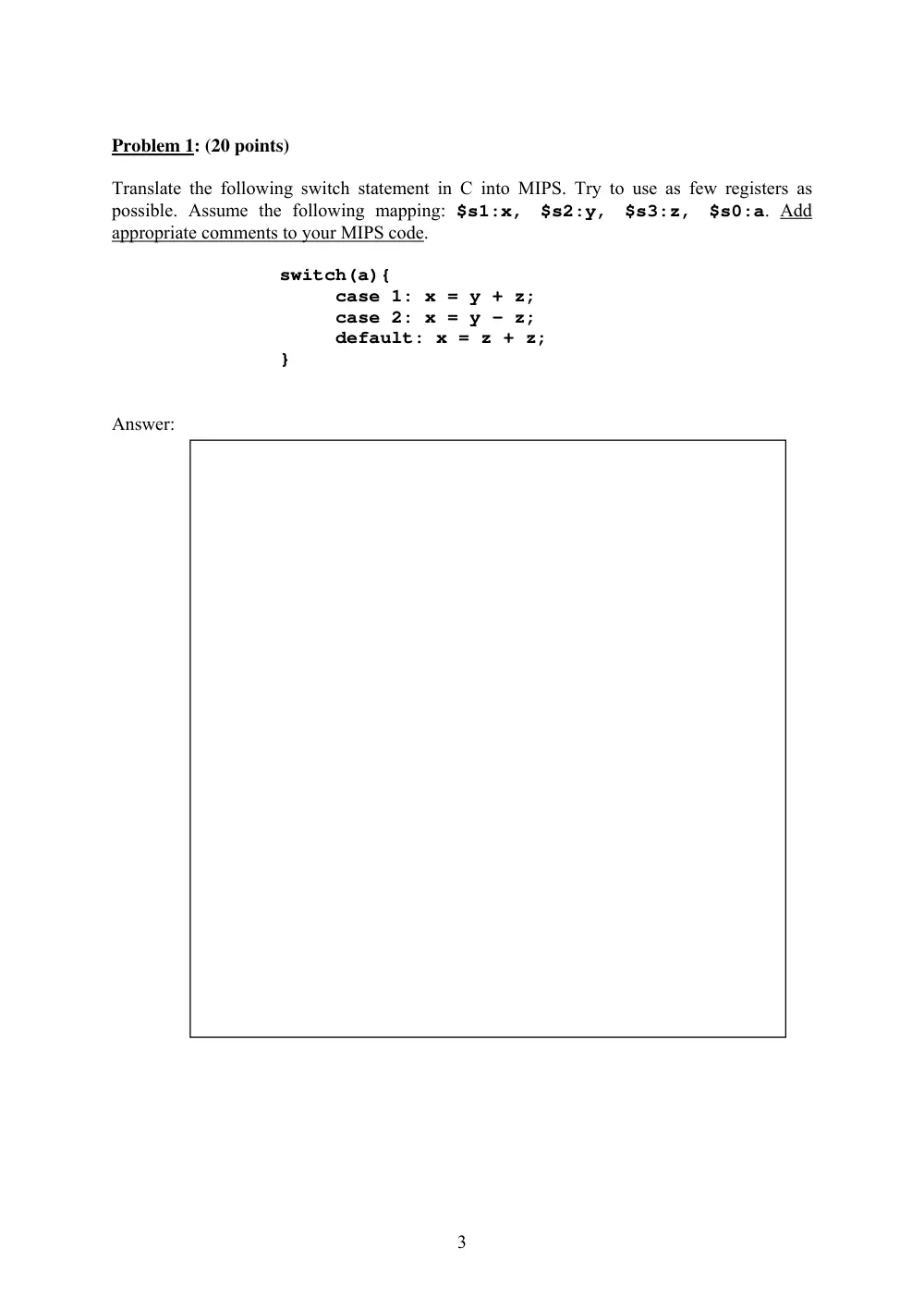
Problem 1: (20 points)
Translate the following switch statement in C into MIPS. Try to use as few registers as
possible. Assume the following mapping: $s1:x, $s2:y, $s3:z, $s0:a. Add
appropriate comments to your MIPS code.
switch(a){
case 1: x = y + z;
case 2: x = y - z;
default: x = z + z;
}
Answer:
3
Problem 2: (20 points)
func:
addi $t0,$a2,1
loop:
bge $t0,$a1,exit
mul $t1,$t0,4
add $t1,$t1,$a0
lw
$t2,0($t1)
sub $t1,$t1,4
sw
$t2,0($t1)
addi $t0,$t0,1
j
loop
exit:
jr
$ra
a) Translate the above MIPS assembly code into C. Your code should be as concise as
possible, without any gotos or explicit pointers. Specify how the variables you use in
your C code correspond to the above registers. (15 points)
Answer:
b) Describe briefly, in English, what this function does. (5 points)
4
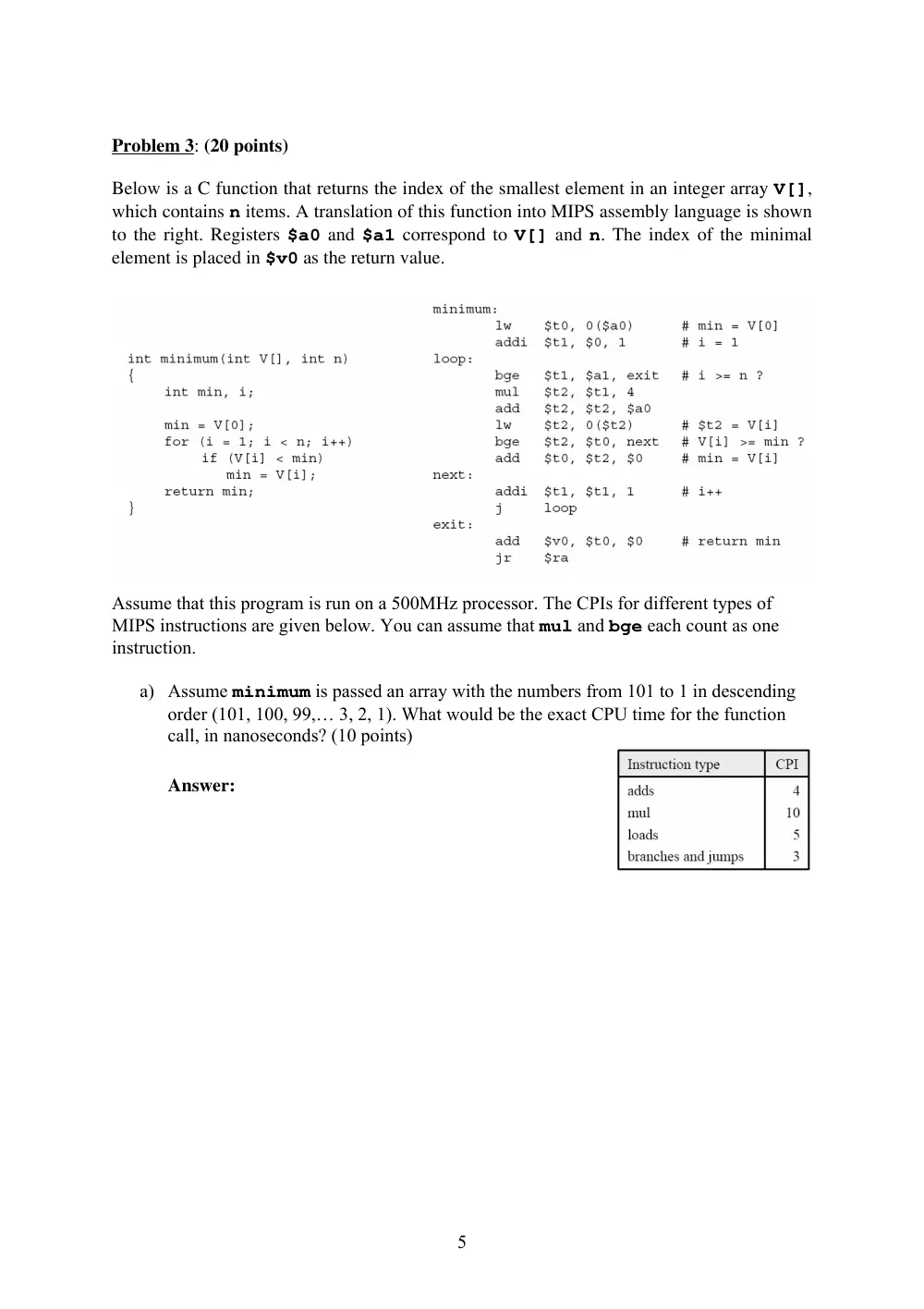
Problem 3: (20 points)
Below is a C function that returns the index of the smallest element in an integer array V[],
which contains n items. A translation of this function into MIPS assembly language is shown
to the right. Registers $a0 and $a1 correspond to V[] and n. The index of the minimal
element is placed in $v0 as the return value.
Assume that this program is run on a 500MHz processor. The CPIs for different types of
MIPS instructions are given below. You can assume that mul and bge each count as one
instruction.
a) Assume minimum is passed an array with the numbers from 101 to 1 in descending
order (101, 100, 99,… 3, 2, 1). What would be the exact CPU time for the function
call, in nanoseconds? (10 points)
Answer:
5
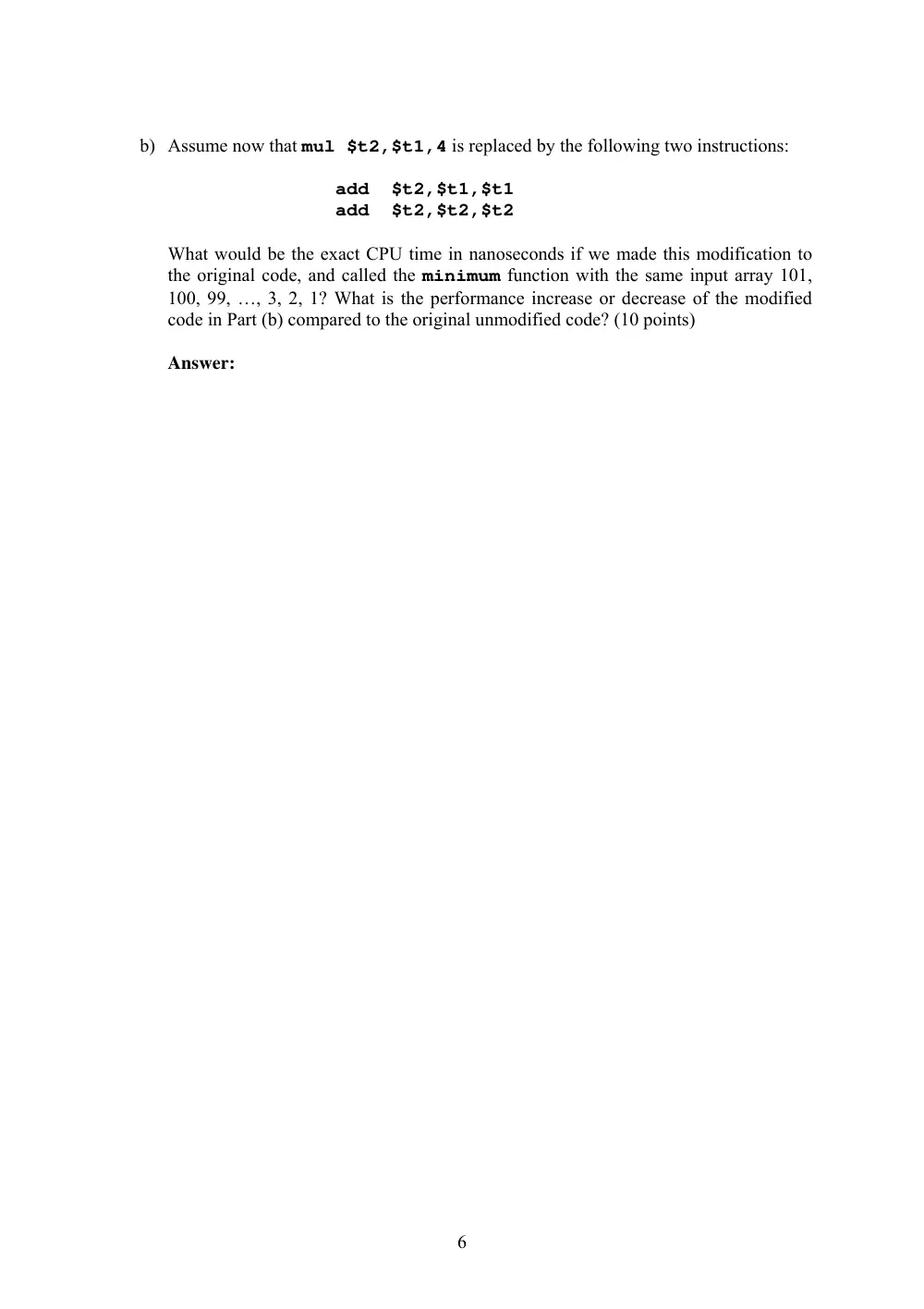
b) Assume now that mul $t2,$t1,4 is replaced by the following two instructions:
add $t2,$t1,$t1
add $t2,$t2,$t2
What would be the exact CPU time in nanoseconds if we made this modification to
the original code, and called the minimum function with the same input array 101,
100, 99, …, 3, 2, 1? What is the performance increase or decrease of the modified
code in Part (b) compared to the original unmodified code? (10 points)
Answer:
6
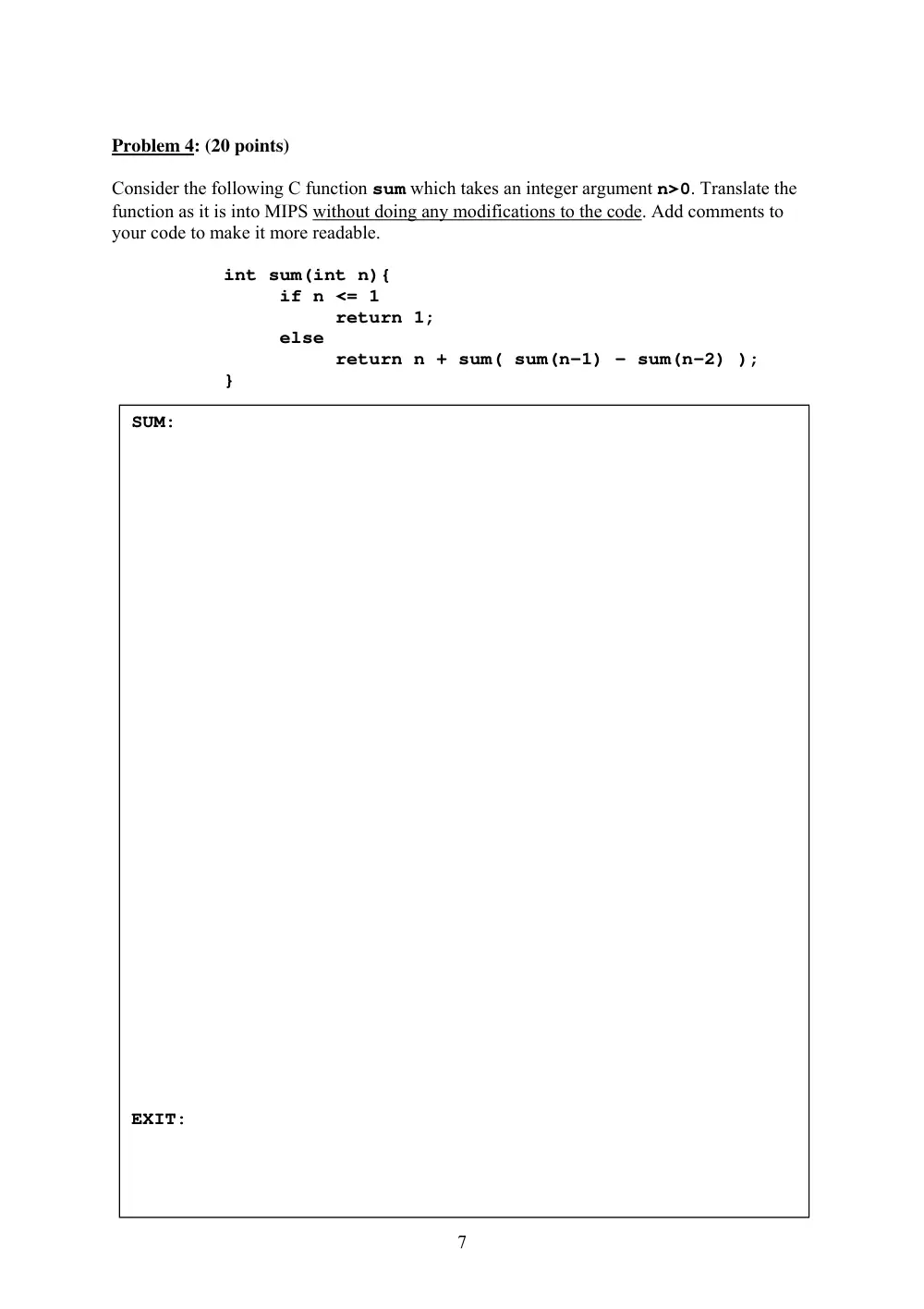
Problem 4: (20 points)
Consider the following C function sum which takes an integer argument n>0. Translate the
function as it is into MIPS without doing any modifications to the code. Add comments to
your code to make it more readable.
int sum(int n){
if n <= 1
return 1;
else
return n + sum( sum(n-1) – sum(n-2) );
}
SUM:
EXIT:
7
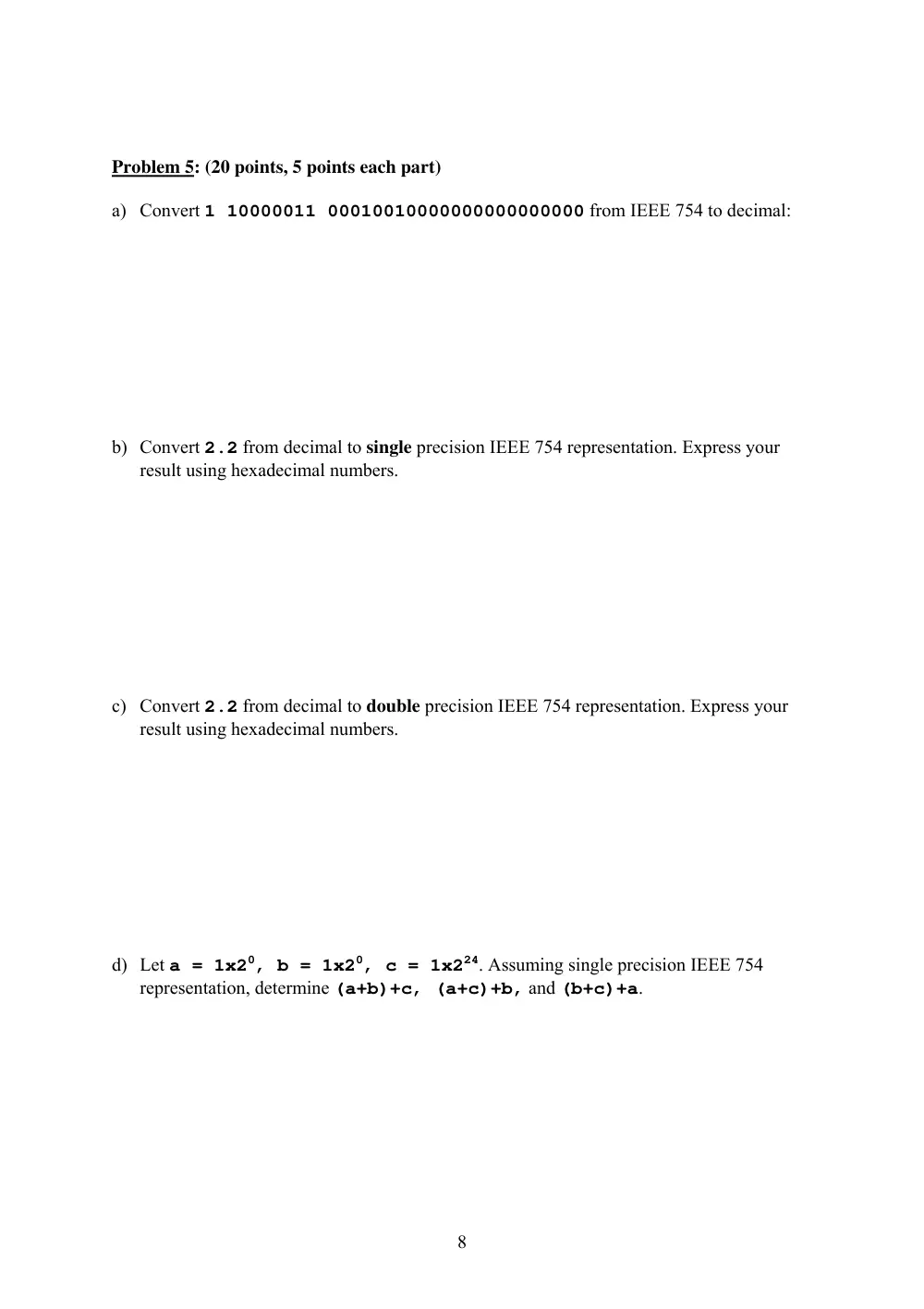
Problem 5: (20 points, 5 points each part)
a) Convert 1 10000011 00010010000000000000000 from IEEE 754 to decimal:
b) Convert 2.2 from decimal to single precision IEEE 754 representation. Express your
result using hexadecimal numbers.
c) Convert 2.2 from decimal to double precision IEEE 754 representation. Express your
result using hexadecimal numbers.
d) Let a = 1x20, b = 1x20, c = 1x224. Assuming single precision IEEE 754
representation, determine (a+b)+c, (a+c)+b, and (b+c)+a.
8
Problem 6: (20 points)
a) Write a minimum-length MIPS instruction sequence that writes an integer value stored in
$t0 repeatedly $t2 times in memory starting from the word address pointed to by $t1.
(10 points)
b) Can you write a sequence of MIPS instructions that exchanges the contents of $t0 and
$t1 without using any other registers? If so, write a minimal instruction sequence that
uses only $t0 and $t1. If no, justify your answer. (10 points)
9
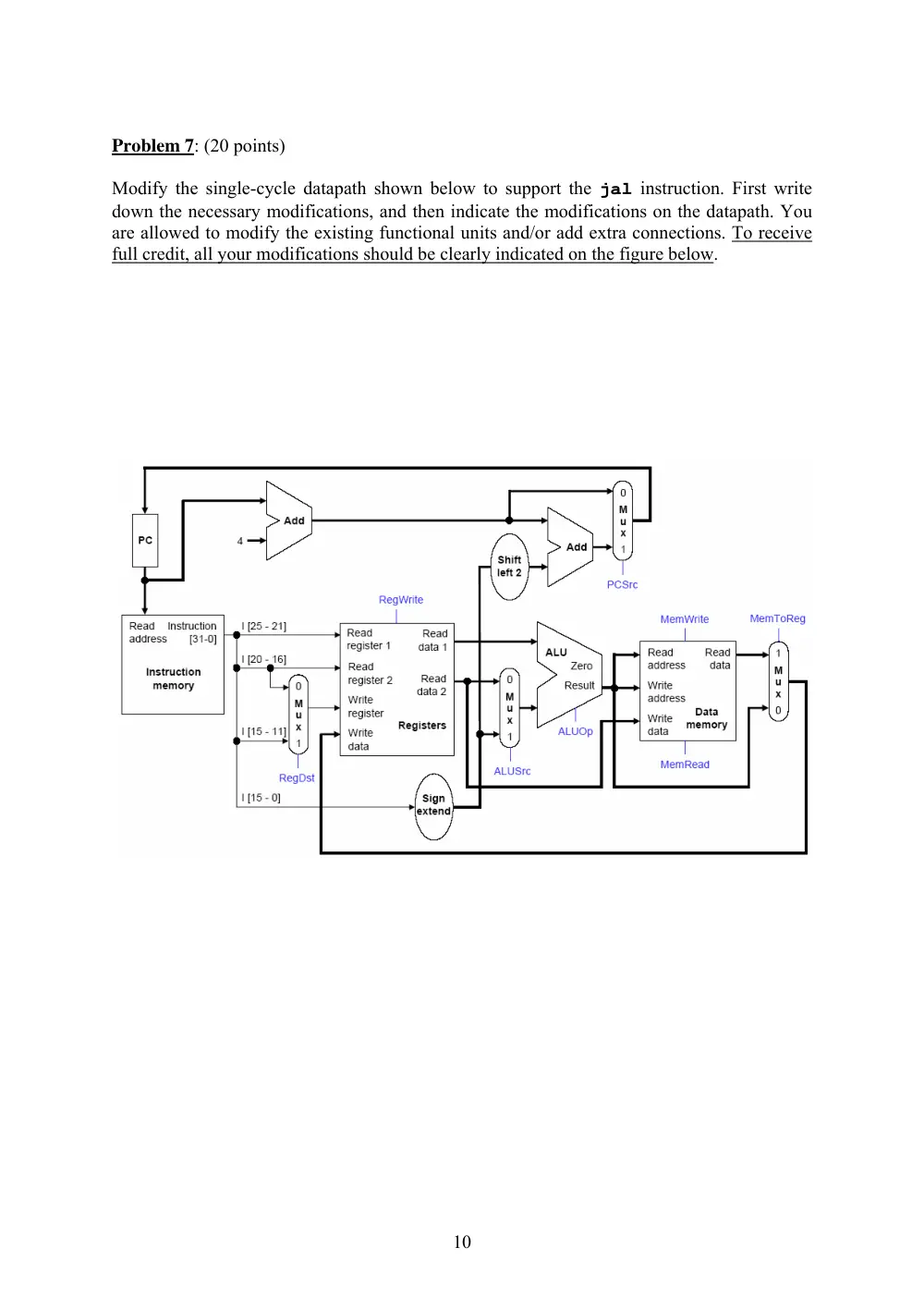
Problem 7: (20 points)
Modify the single-cycle datapath shown below to support the jal instruction. First write
down the necessary modifications, and then indicate the modifications on the datapath. You
are allowed to modify the existing functional units and/or add extra connections. To receive
full credit, all your modifications should be clearly indicated on the figure below.
10
Problem 8: (20 points)
Modify the single-cycle datapath shown below to support the following instruction:
exchange $s0, $s1
which exchanges the contents of $s0,$s1.First write down the necessary modifications,
and then indicate the modifications on the datapath. You are allowed to modify the existing
functional units and/or add extra connections. To receive full credit, all your modifications
should be clearly indicated on the figure below.
11