
EECE 321 Midterm, Spring 2005
American University of Beirut · Computer Organization · 11 pages




Showing the first 10 of 11 pages. Download the PDF to see all of it.
More EECE 321 files
Show the text of this exam
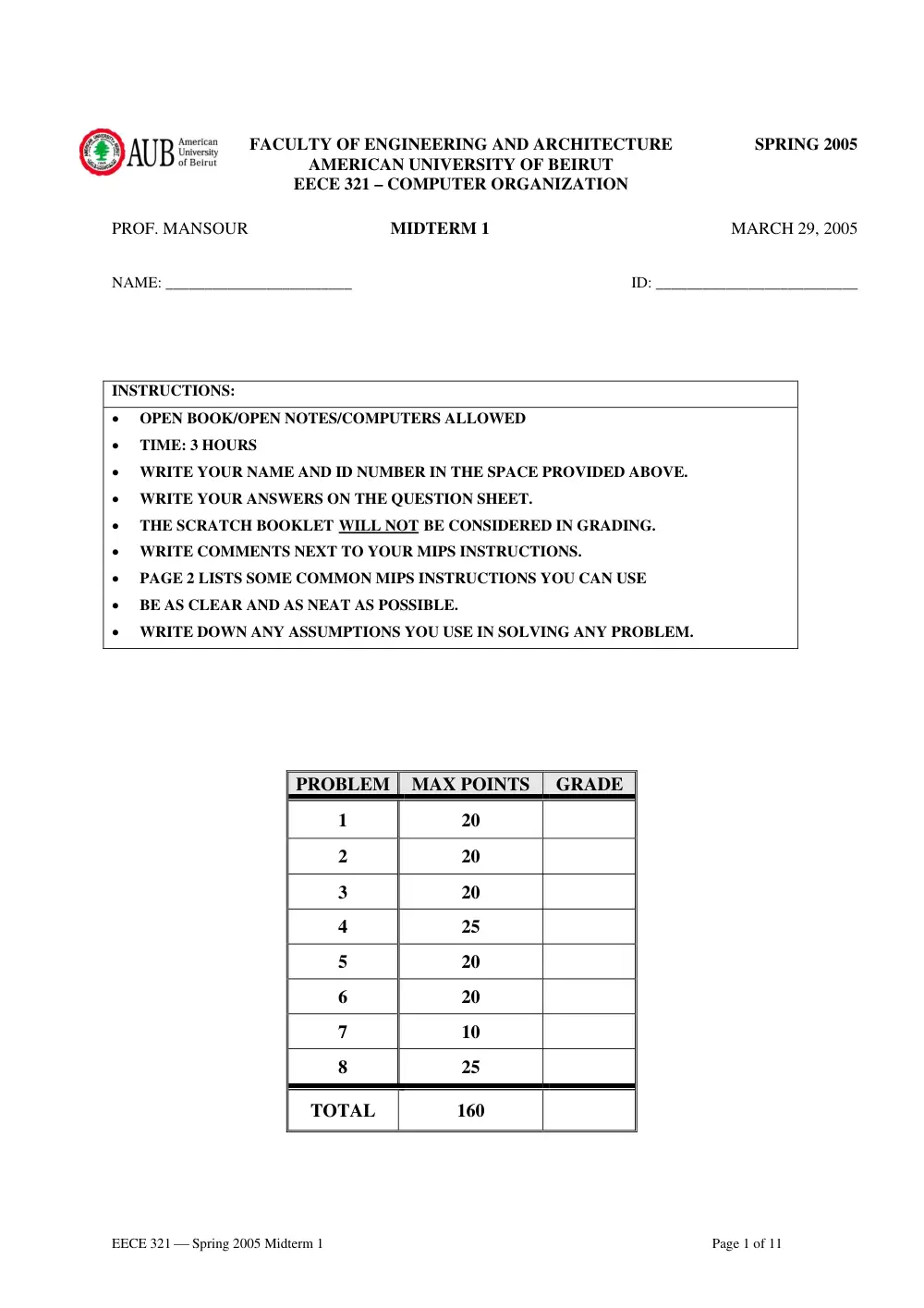
FACULTY OF ENGINEERING AND ARCHITECTURE
AMERICAN UNIVERSITY OF BEIRUT
EECE 321 – COMPUTER ORGANIZATION
SPRING 2005
PROF. MANSOUR
MIDTERM 1
MARCH 29, 2005
NAME: ________________________
ID: __________________________
INSTRUCTIONS:
•
OPEN BOOK/OPEN NOTES/COMPUTERS ALLOWED
•
TIME: 3 HOURS
•
WRITE YOUR NAME AND ID NUMBER IN THE SPACE PROVIDED ABOVE.
•
WRITE YOUR ANSWERS ON THE QUESTION SHEET.
•
THE SCRATCH BOOKLET UWILL NOTU BE CONSIDERED IN GRADING.
•
WRITE COMMENTS NEXT TO YOUR MIPS INSTRUCTIONS.
•
PAGE 2 LISTS SOME COMMON MIPS INSTRUCTIONS YOU CAN USE
•
BE AS CLEAR AND AS NEAT AS POSSIBLE.
•
WRITE DOWN ANY ASSUMPTIONS YOU USE IN SOLVING ANY PROBLEM.
PROBLEM
MAX POINTS
GRADE
1
20
2
20
3
20
4
25
5
20
6
20
7
10
8
25
TOTAL
160
EECE 321 ⎯ Spring 2005 Midterm 1
Page 1 of 11
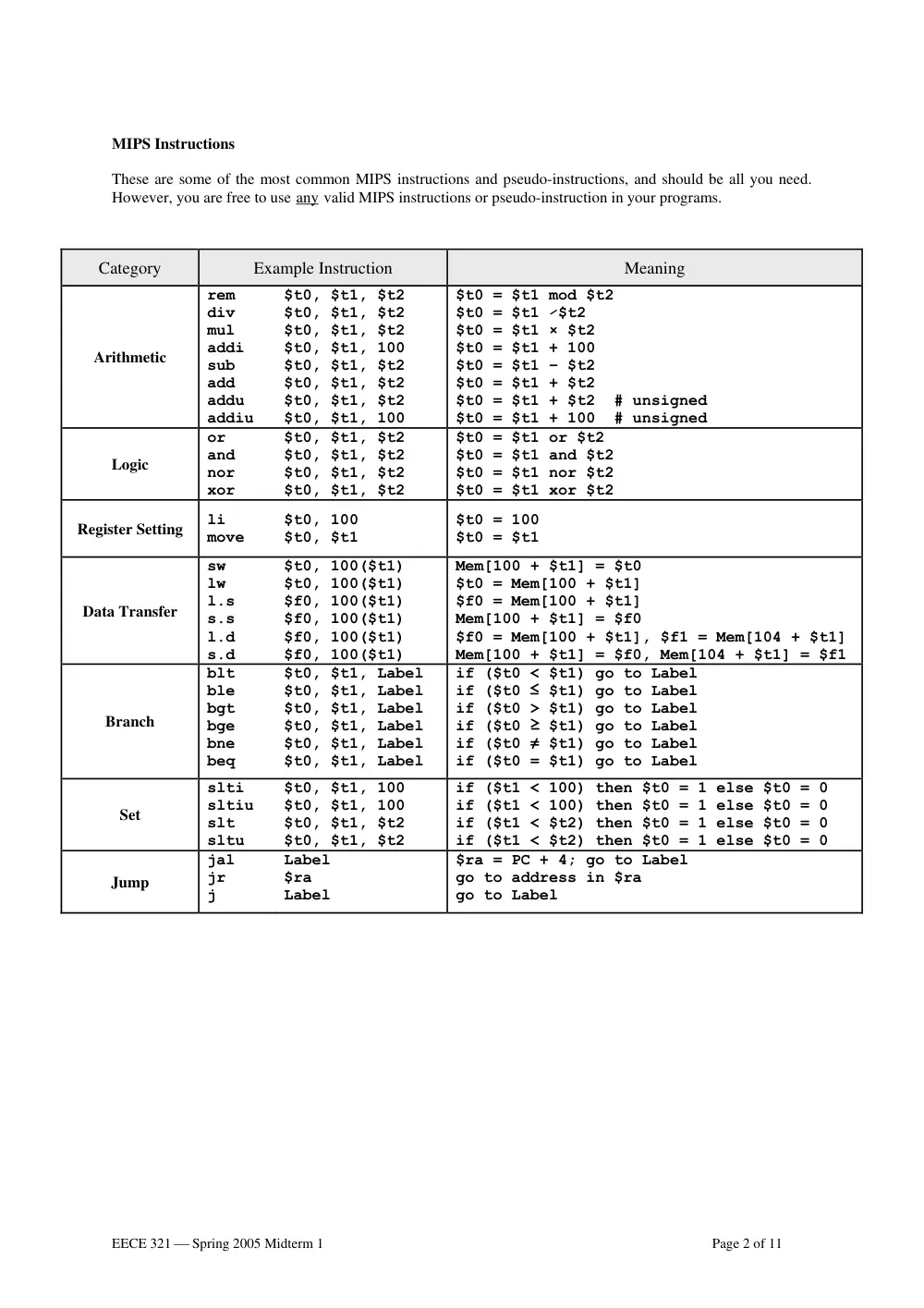
MIPS Instructions
These are some of the most common MIPS instructions and pseudo-instructions, and should be all you need.
However, you are free to use UanyU valid MIPS instructions or pseudo-instruction in your programs.
Category
Example Instruction
Meaning
Arithmetic
rem
div
mul
addi
sub
add
addu
addiu
$t0, $t1, $t2
$t0, $t1, $t2
$t0, $t1, $t2
$t0, $t1, 100
$t0, $t1, $t2
$t0, $t1, $t2
$t0, $t1, $t2
$t0, $t1, 100
$t0 = $t1 mod $t2
$t0 = $t1 ⁄$t2
$t0 = $t1 × $t2
$t0 = $t1 + 100
$t0 = $t1 – $t2
$t0 = $t1 + $t2
$t0 = $t1 + $t2 # unsigned
$t0 = $t1 + 100 # unsigned
Logic
or
and
nor
xor
$t0, $t1, $t2
$t0, $t1, $t2
$t0, $t1, $t2
$t0, $t1, $t2
$t0 = $t1 or $t2
$t0 = $t1 and $t2
$t0 = $t1 nor $t2
$t0 = $t1 xor $t2
Register Setting
li
move
$t0, 100
$t0, $t1
$t0 = 100
$t0 = $t1
Data Transfer
sw
lw
l.s
s.s
l.d
s.d
$t0, 100($t1)
$t0, 100($t1)
$f0, 100($t1)
$f0, 100($t1)
$f0, 100($t1)
$f0, 100($t1)
Mem[100 + $t1] = $t0
$t0 = Mem[100 + $t1]
$f0 = Mem[100 + $t1]
Mem[100 + $t1] = $f0
$f0 = Mem[100 + $t1], $f1 = Mem[104 + $t1]
Mem[100 + $t1] = $f0, Mem[104 + $t1] = $f1
Branch
blt
ble
bgt
bge
bne
beq
$t0, $t1, Label
$t0, $t1, Label
$t0, $t1, Label
$t0, $t1, Label
$t0, $t1, Label
$t0, $t1, Label
if ($t0 < $t1) go to Label
if ($t0 ≤ $t1) go to Label
if ($t0 > $t1) go to Label
if ($t0 ≥ $t1) go to Label
if ($t0 ≠ $t1) go to Label
if ($t0 = $t1) go to Label
Set
slti
sltiu
slt
sltu
$t0, $t1, 100
$t0, $t1, 100
$t0, $t1, $t2
$t0, $t1, $t2
if ($t1 < 100) then $t0 = 1 else $t0 = 0
if ($t1 < 100) then $t0 = 1 else $t0 = 0
if ($t1 < $t2) then $t0 = 1 else $t0 = 0
if ($t1 < $t2) then $t0 = 1 else $t0 = 0
Jump
jal
jr
j
Label
$ra
Label
$ra = PC + 4; go to Label
go to address in $ra
go to Label
EECE 321 ⎯ Spring 2005 Midterm 1
Page 2 of 11
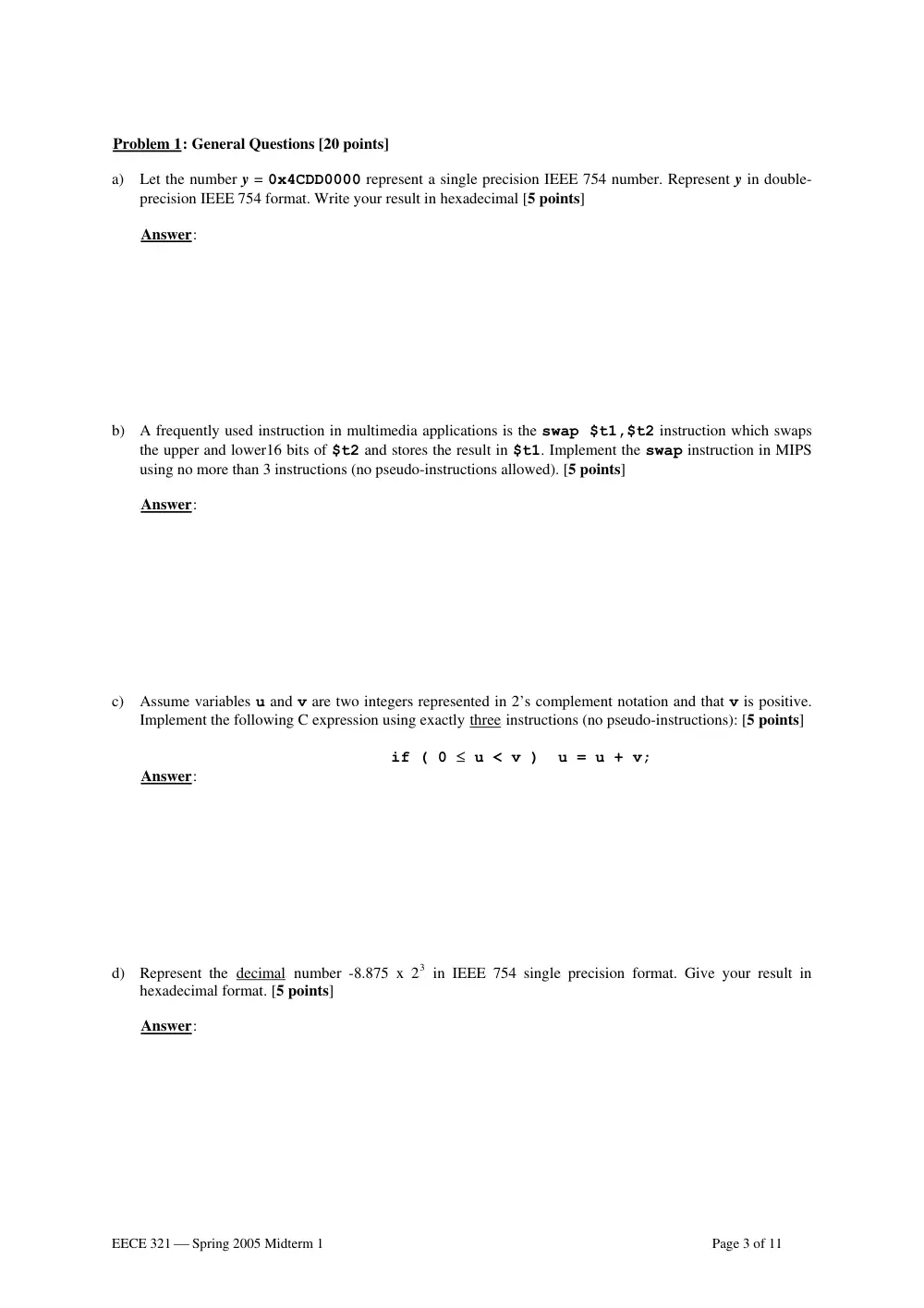
UProblem 1U: General Questions [20 points]
a) Let the number y = 0x4CDD0000 represent a single precision IEEE 754 number. Represent y in double-
precision IEEE 754 format. Write your result in hexadecimal [5 points]
UAnswerU:
b) A frequently used instruction in multimedia applications is the swap $t1,$t2 instruction which swaps
the upper and lower16 bits of $t2 and stores the result in $t1. Implement the swap instruction in MIPS
using no more than 3 instructions (no pseudo-instructions allowed). [5 points]
UAnswerU:
c) Assume variables u and v are two integers represented in 2’s complement notation and that v is positive.
Implement the following C expression using exactly UthreeU instructions (no pseudo-instructions): [5 points]
if ( 0 ≤ u < v ) u = u + v;
UAnswerU:
d) Represent the
UdecimalU number -8.875 x 2P3
P in IEEE 754 single precision format. Give your result in
hexadecimal format. [5 points]
UAnswerU:
EECE 321 ⎯ Spring 2005 Midterm 1
Page 3 of 11
UProblem 2U: Set-Less-Than [20 points]
Suppose the instructions slt, sltu, slti, sltiu were removed from the MIPS instruction set. Show
how to perform slt $s0,$s1,$s2 using the modified instruction set in which slt is not available (no
pseudo-instructions allowed). Beware to account for overflow.
USolutionU:
EECE 321 ⎯ Spring 2005 Midterm 1
Page 4 of 11
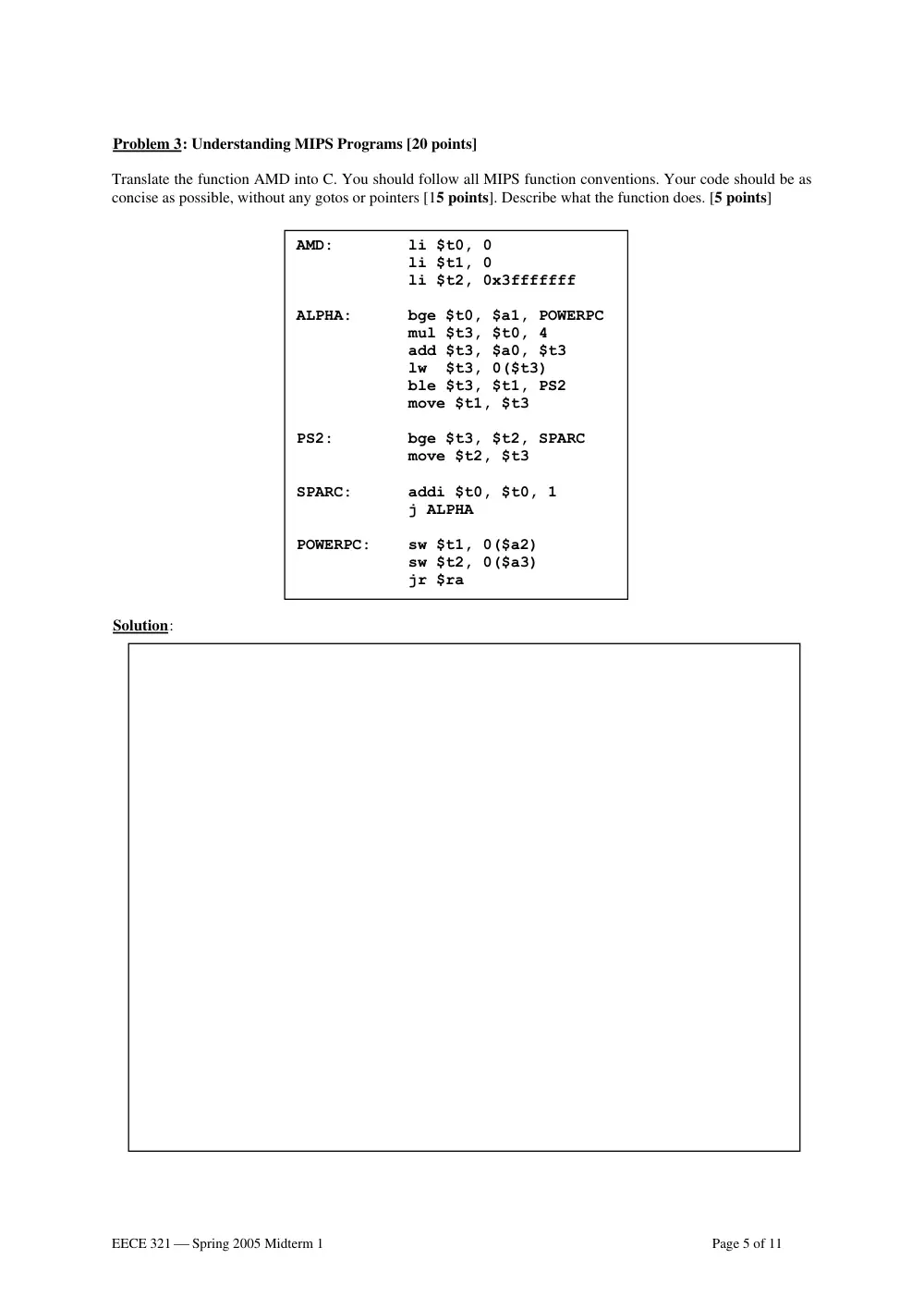
UProblem 3U: Understanding MIPS Programs [20 points]
Translate the function AMD into C. You should follow all MIPS function conventions. Your code should be as
concise as possible, without any gotos or pointers [15 points]. Describe what the function does. [5 points]
USolutionU:
AMD:
li $t0, 0
li $t1, 0
li $t2, 0x3fffffff
ALPHA:
bge $t0, $a1, POWERPC
mul $t3, $t0, 4
add $t3, $a0, $t3
lw $t3, 0($t3)
ble $t3, $t1, PS2
move $t1, $t3
PS2:
bge $t3, $t2, SPARC
move $t2, $t3
SPARC:
addi $t0, $t0, 1
j ALPHA
POWERPC:
sw $t1, 0($a2)
sw $t2, 0($a3)
jr $ra
EECE 321 ⎯ Spring 2005 Midterm 1
Page 5 of 11
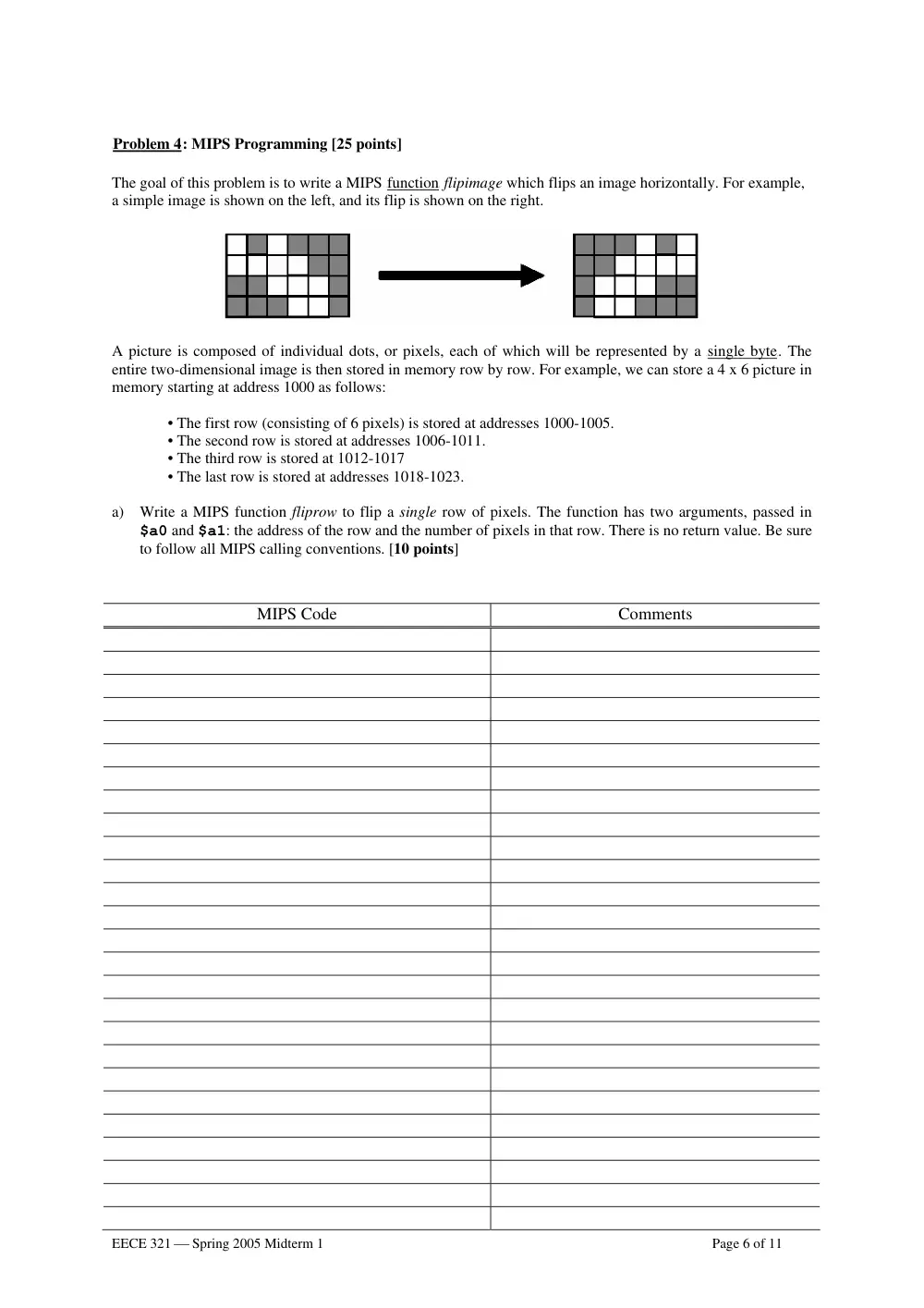
UProblem 4U: MIPS Programming [25 points]
The goal of this problem is to write a MIPS UfunctionU flipimage which flips an image horizontally. For example,
a simple image is shown on the left, and its flip is shown on the right.
A picture is composed of individual dots, or pixels, each of which will be represented by a
Usingle byteU. The
entire two-dimensional image is then stored in memory row by row. For example, we can store a 4 x 6 picture in
memory starting at address 1000 as follows:
• The first row (consisting of 6 pixels) is stored at addresses 1000-1005.
• The second row is stored at addresses 1006-1011.
• The third row is stored at 1012-1017
• The last row is stored at addresses 1018-1023.
a) Write a MIPS function fliprow to flip a single row of pixels. The function has two arguments, passed in
$a0 and $a1: the address of the row and the number of pixels in that row. There is no return value. Be sure
to follow all MIPS calling conventions. [10 points]
MIPS Code
Comments
EECE 321 ⎯ Spring 2005 Midterm 1
Page 6 of 11
b) Using the fliprow function, you should now be able to write flipimage. The arguments will be:
• The memory address where the image is stored
• The number of rows in the image
• The number of columns in the image
Again, there is no return value, and you should follow normal MIPS calling conventions. [15 points]
MIPS Code
Comments
EECE 321 ⎯ Spring 2005 Midterm 1
Page 7 of 11
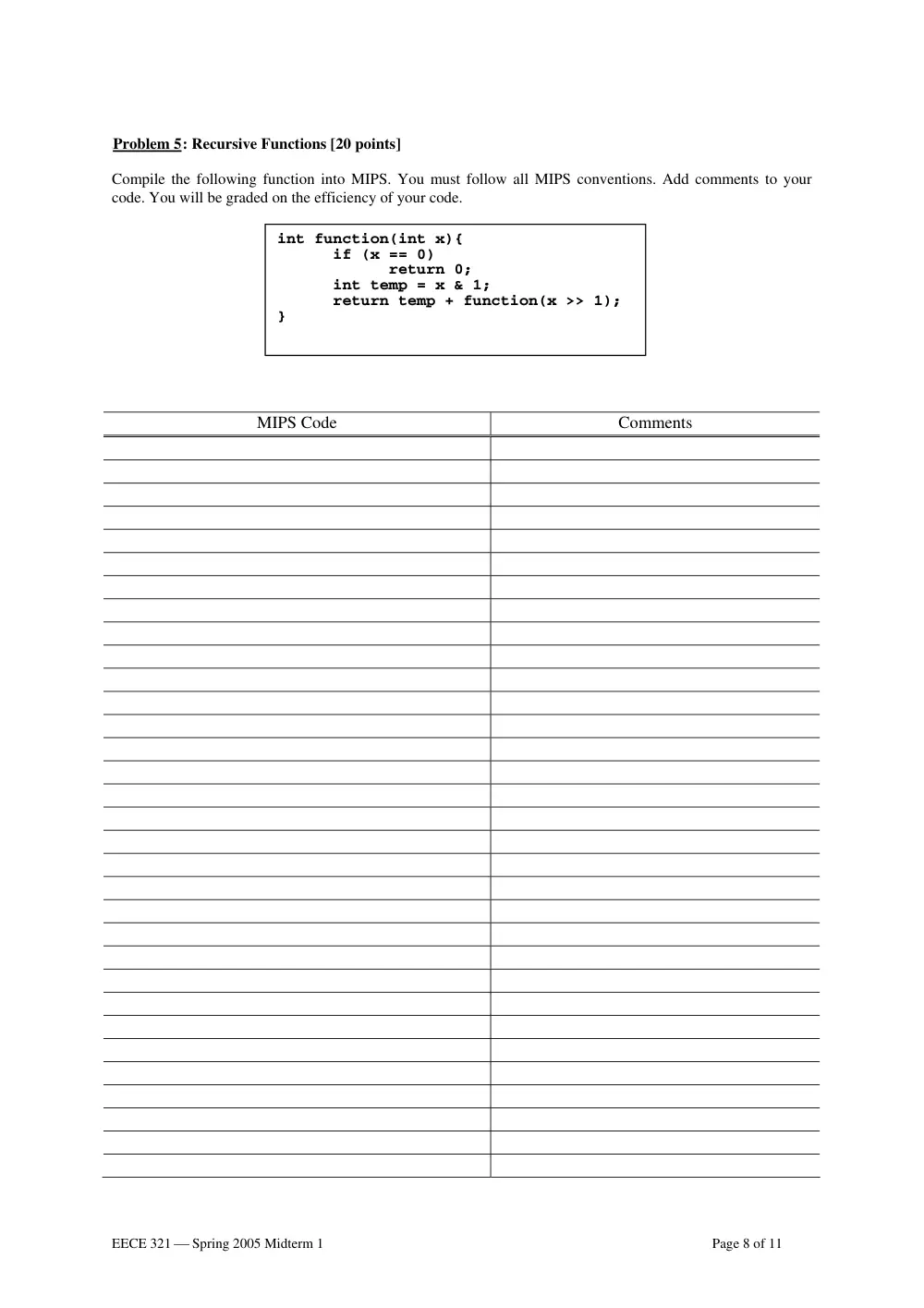
UProblem 5U: Recursive Functions [20 points]
Compile the following function into MIPS. You must follow all MIPS conventions. Add comments to your
code. You will be graded on the efficiency of your code.
MIPS Code
Comments
int function(int x){
if (x == 0)
return 0;
int temp = x & 1;
return temp + function(x >> 1);
}
EECE 321 ⎯ Spring 2005 Midterm 1
Page 8 of 11
UProblem 6U: Maximum [20 points]
Implement the instruction max $t1,$t2,$t3 in MIPS, which returns the maximum of $t2 and $t3 in
$t1, Uwithout using any conditional branch instructions (beq, bne)U. Also, you are not allowed to use pseudo-
instructions.
USolutionU:
EECE 321 ⎯ Spring 2005 Midterm 1
Page 9 of 11
UProblem 7U: Speedup [10 points]
We are interested in determining the speedup (S) gained from a certain improvement made to enhance a
computer. The improvement targets two classes of instructions which roughly constitute a fraction pB1
B and pB2
B,
respectively, of the overall instructions used. The first class of instructions runs xB1
B times faster with the
improvement, while the second runs xB2
B times faster. Determine S in terms of pB1
B, pB2
B. xB1
B, xB2
B.
USolutionU:
EECE 321 ⎯ Spring 2005 Midterm 1
Page 10 of 11
UProblem 8U: Square Function [20 points]
Let A be a 30x20 array of single-precision floating point numbers whose base address in memory is stored in
register $a0. The elements of A are stored in
Ucolumn-majorU form in memory. Write a function in MIPS that
squares the elements of A and stores the resulting array at memory address $a1 in Ucolumn-majorU form. Be sure
to follow all MIPS calling conventions. Comment your code.
MIPS Code
Comments
EECE 321 ⎯ Spring 2005 Midterm 1
Page 11 of 11