
EECE 321 Midterm, Spring 2005
American University of Beirut · Computer Organization · 12 pages




Showing the first 10 of 12 pages. Download the PDF to see all of it.
More EECE 321 files
Show the text of this exam
FACULTY OF ENGINEERING AND ARCHITECTURE
AMERICAN UNIVERSITY OF BEIRUT
EECE 321 – COMPUTER ORGANIZATION
SPRING 2005
PROF. MANSOUR
MIDTERM 2
MAY 10, 2005
NAME: ________________________
ID: __________________________
TIME: 6:00 – 8:00 p.m.
INSTRUCTIONS:
•
CLOSED BOOK/CLOSED NOTES
•
TIME: 2 HOURS
•
WRITE YOUR NAME AND ID NUMBER IN THE SPACE PROVIDED ABOVE.
•
WRITE YOUR ANSWERS ON THE QUESTION SHEET.
•
THE SCRATCH BOOKLET UWILL NOTU BE CONSIDERED IN GRADING.
•
BE AS CLEAR AND AS NEAT AS POSSIBLE WHEN MODIFYING DATAPATHS.
•
WRITE DOWN ANY ASSUMPTIONS YOU USE IN SOLVING ANY PROBLEM.
PROBLEM
MAX POINTS
GRADE
1
12
2
16
3
20
4
14
5
22
6
42
7
16
8
18
TOTAL
160
EECE 321 ⎯ Spring 2005 Midterm 2
Page 1 of 12
UProblem 1U: Single-Cycle Datapath [12 Points]
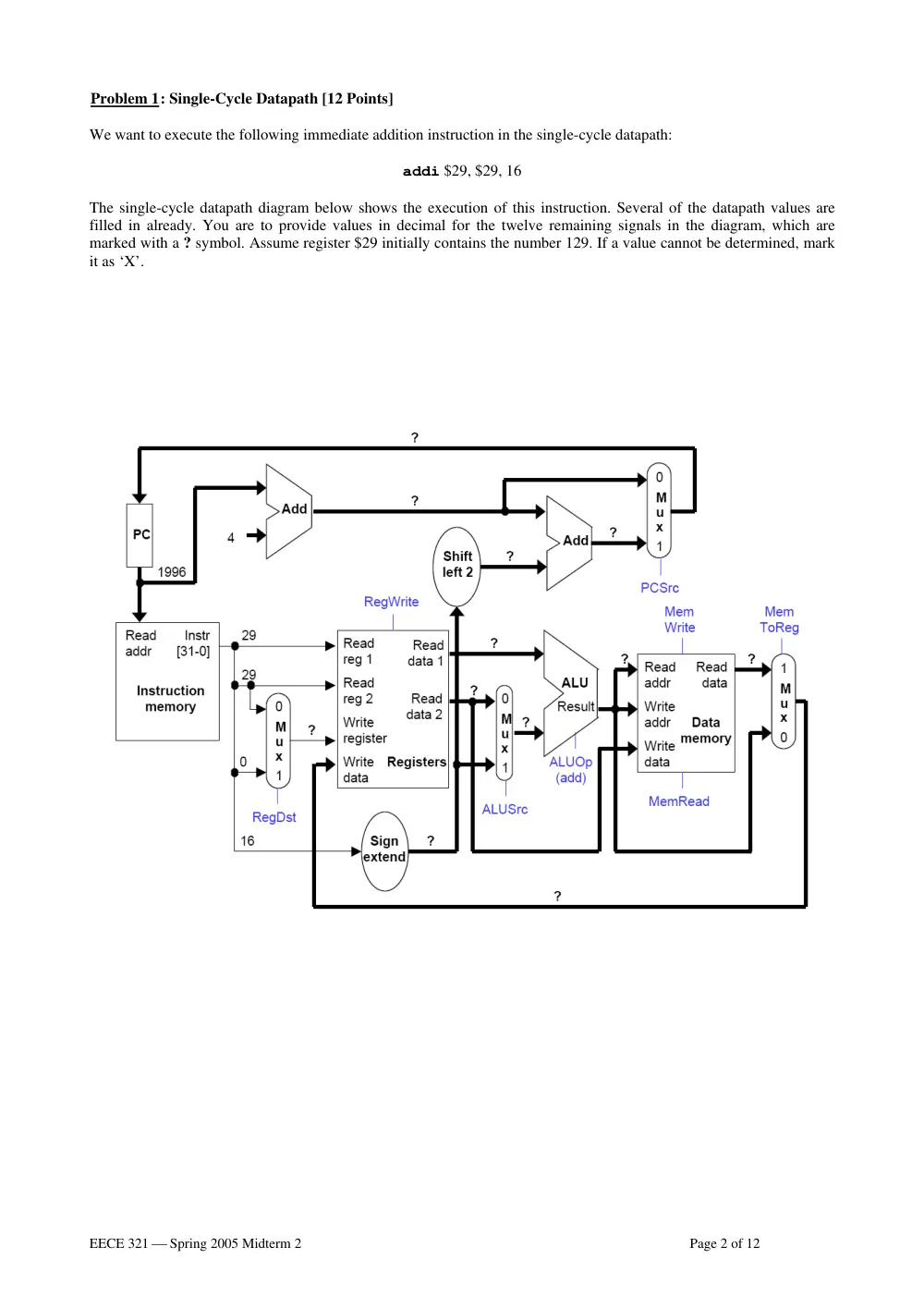
We want to execute the following immediate addition instruction in the single-cycle datapath:
addi $29, $29, 16
The single-cycle datapath diagram below shows the execution of this instruction. Several of the datapath values are
filled in already. You are to provide values in decimal for the twelve remaining signals in the diagram, which are
marked with a ? symbol. Assume register $29 initially contains the number 129. If a value cannot be determined, mark
it as ‘X’.
EECE 321 ⎯ Spring 2005 Midterm 2
Page 2 of 12
UProblem 2U: Multi-Cycle MIPS [16 Points]
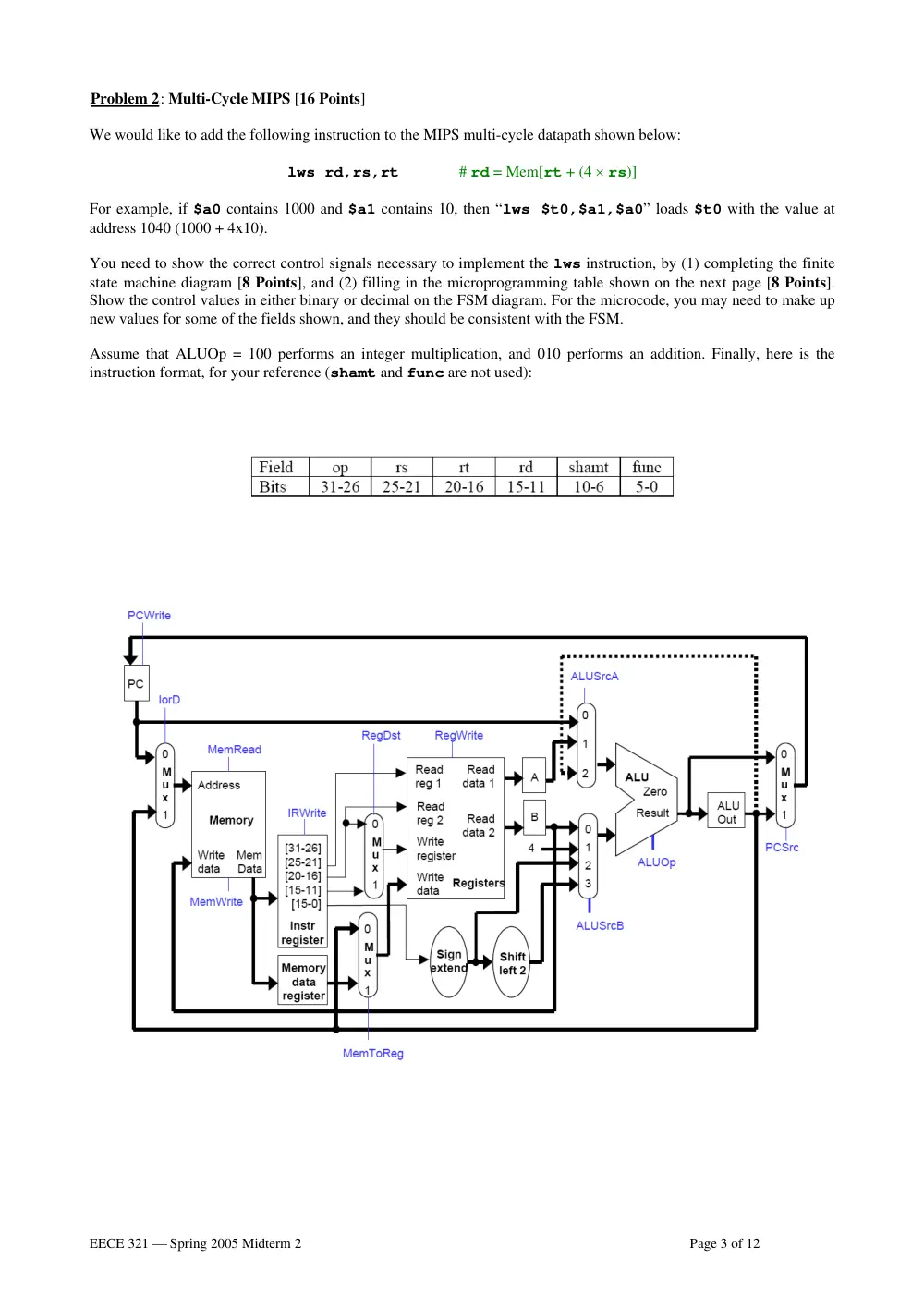
We would like to add the following instruction to the MIPS multi-cycle datapath shown below:
lws rd,rs,rt
# rd = Mem[rt + (4 × rs)]
For example, if $a0 contains 1000 and $a1 contains 10, then “lws $t0,$a1,$a0” loads $t0 with the value at
address 1040 (1000 + 4x10).
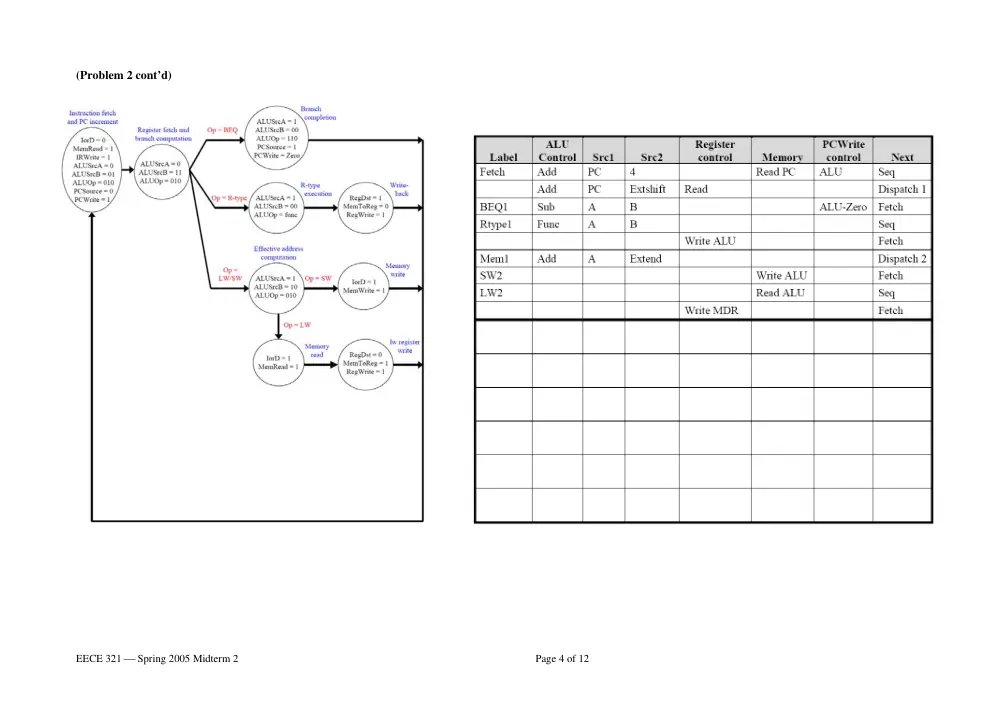
You need to show the correct control signals necessary to implement the lws instruction, by (1) completing the finite
state machine diagram [8 Points], and (2) filling in the microprogramming table shown on the next page [8 Points].
Show the control values in either binary or decimal on the FSM diagram. For the microcode, you may need to make up
new values for some of the fields shown, and they should be consistent with the FSM.
Assume that ALUOp = 100 performs an integer multiplication, and 010 performs an addition. Finally, here is the
instruction format, for your reference (shamt and func are not used):
EECE 321 ⎯ Spring 2005 Midterm 2
Page 3 of 12
(Problem 2 cont’d)
EECE 321 ⎯ Spring 2005 Midterm 2
Page 4 of 12
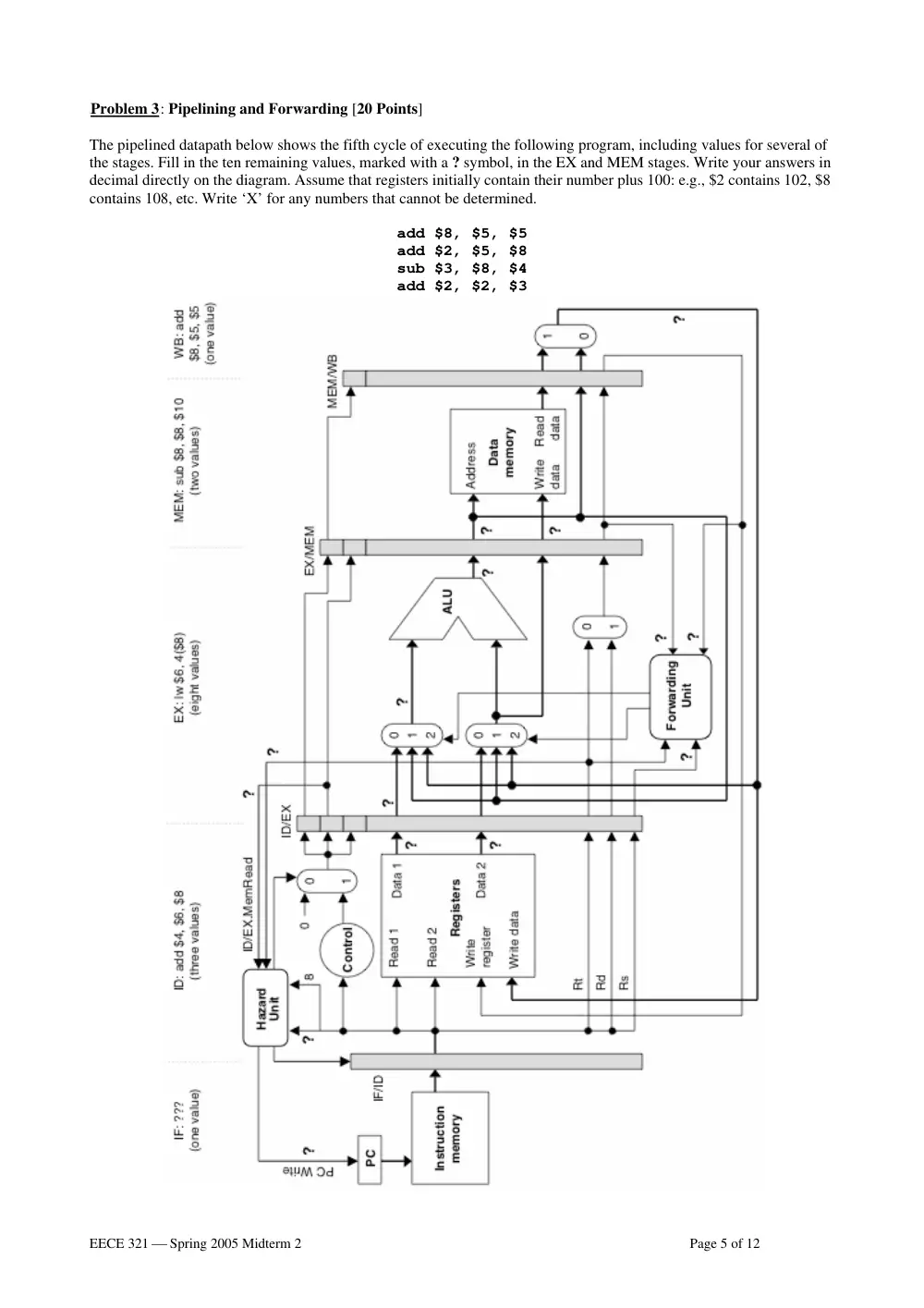
UProblem 3U: Pipelining and Forwarding [20 Points]
The pipelined datapath below shows the fifth cycle of executing the following program, including values for several of
the stages. Fill in the ten remaining values, marked with a ? symbol, in the EX and MEM stages. Write your answers in
decimal directly on the diagram. Assume that registers initially contain their number plus 100: e.g., $2 contains 102, $8
contains 108, etc. Write ‘X’ for any numbers that cannot be determined.
add $8, $5, $5
add $2, $5, $8
sub $3, $8, $4
add $2, $2, $3
EECE 321 ⎯ Spring 2005 Midterm 2
Page 5 of 12
UProblem 4U: Pipelining Performance [14 Points]
A designer has proposed modifying the pipelined MIPS datapath to the 10-stage pipeline above so that the resulting
processor can run at 500MHz (2ns clock cycle). The correspondences between this and the standard MIPS pipeline are:
• Instructions are fetched in the FET stage.
• Register reading is performed in the REG stage.
• ALU operations and memory accesses are both done in the EXE stage.
• Branches are resolved in the DET stage.
• WRB is the writeback stage.
a) How much time is required to execute one million instructions on this processor, assuming there are no
dependencies or branches in the code? [2 Points]
USolutionU:
b) Without forwarding, how many stall cycles are needed for the following code fragment? [3 Points]
lw $t0,0($a0)
add $v1,$t0,$t0
USolutionU:
c) If a branch is mis-predicted, how many instructions would have to be flushed from the pipeline? [4 Points]
USolutionU:
d) Assume that a program executes one million instructions. Of these, 15% are load instructions which stall, and 10%
of the instructions are branches. The CPU predicts branches correctly 75% of the time. How much time will it take
to execute this program? [5 Points]
USolutionU:
EECE 321 ⎯ Spring 2005 Midterm 2
Page 6 of 12
UProblem 5U: Cache Computations [22 Points]
The Trashium processor has a 16KB, 4-way set-associative data cache with 32-byte blocks.
a) How many total blocks are in the Level 1 cache? How many sets are there? [3 Points]
USolutionU:
b) Assuming that memory is byte addressable and addresses are 35-bits long, give the number of bits required for
each of the following fields: [6 Points]
TAG:
SET INDEX:
BLOCK OFFSET:
c) What is the total size of the cache in bits, including the valid, tag and data fields? [3 Points]
USolutionU:
d) Assume that the Trashium cache communicates with main memory via a 64-bit bus that can perform one transfer
every 10 cycles. Main memory itself is 64-bits wide and has a 10-cycle access time. Memory accesses and bus
transfers may be overlapped. What is the miss penalty for the cache? In other words, how long does it take to send
a request to main memory and to receive an entire cache block? Explain. [4 Points]
USolutionU:
e) Assume the memory system described above, if the cache has a 95% hit rate and a one-cycle hit time, what is the
average memory access time? [3 Points]
USolutionU:
f)
If we run a program which consists of 30% load/store instructions, what is the average number of memory stall
cycles per instruction assuming again the memory system above? [3 Points]
USolutionU:
EECE 321 ⎯ Spring 2005 Midterm 2
Page 7 of 12
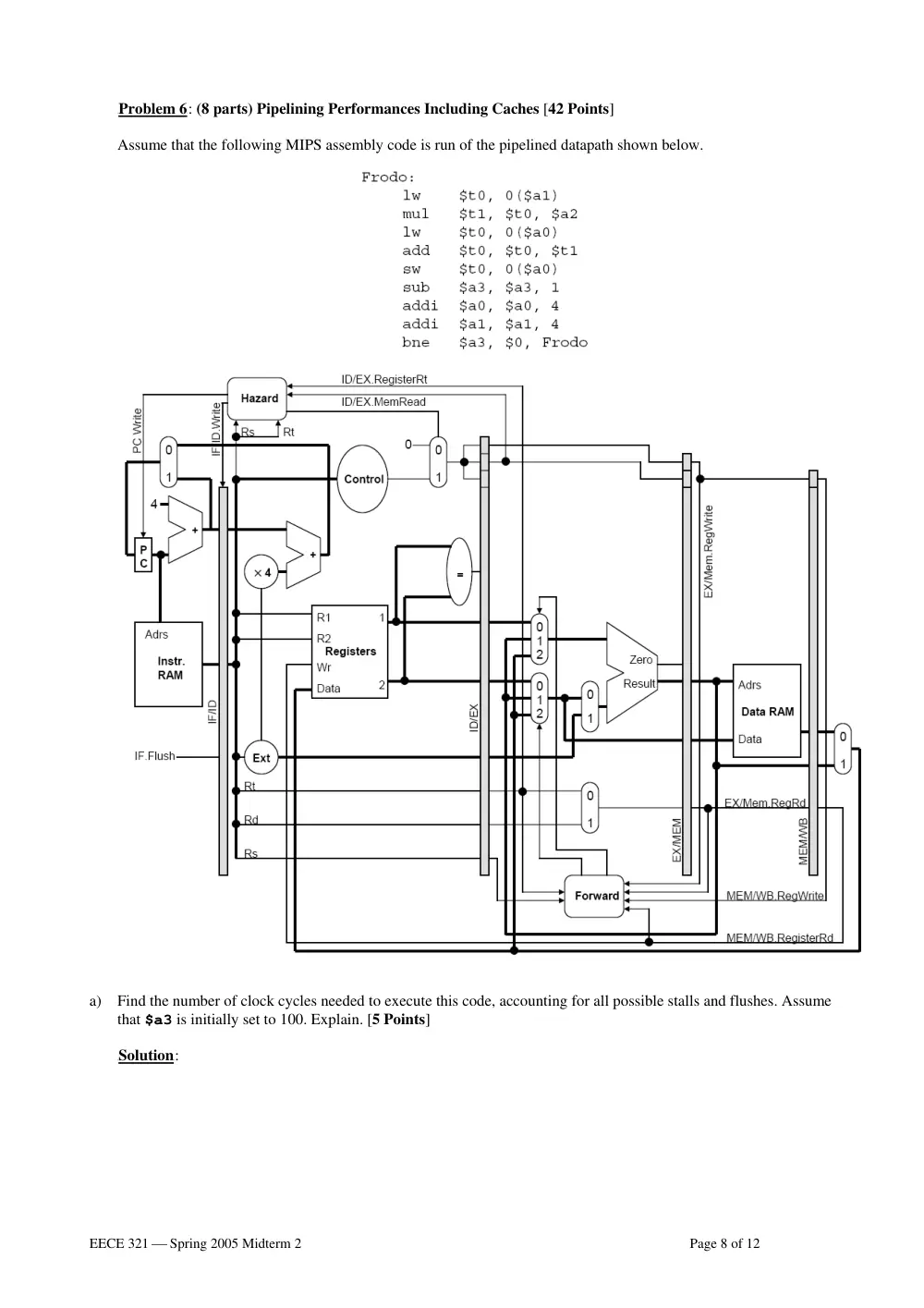
UProblem 6U: (8 parts) Pipelining Performances Including Caches [42 Points]
Assume that the following MIPS assembly code is run of the pipelined datapath shown below.
a) Find the number of clock cycles needed to execute this code, accounting for all possible stalls and flushes. Assume
that $a3 is initially set to 100. Explain. [5 Points]
USolutionU:
EECE 321 ⎯ Spring 2005 Midterm 2
Page 8 of 12
(Problem 6 cont’d)
b) Rewrite the code to eliminate as many stalls as possible. Show your modified assembly language program below.
[5 Points]
USolutionU:
c) What is the performance improvement of your new function as compared to the original one? Again, assume that
$a3 is initially set to 100. [5 Points]
USolutionU:
d) Suggest a way to rewrite this code to reduce the number of cycles lost to flushes. You do not have to show any
actual code. [5 Points]
USolutionU:
EECE 321 ⎯ Spring 2005 Midterm 2
Page 9 of 12
(Problem 6 cont’d)
Assume you run the Frodo code on a Corleone2000 processor that has two levels of data caches, with the
characteristics shown below. Assume that it takes 50 clock cycles to request and complete a 32-byte transfer between
main memory and the L2 cache.
e) How many bits of a 32-bit main memory address would be used as the tag, index and block offset fields, for each
of the two caches above? [6 Points]
f)
Find the average memory access time for both the L2 and L1 caches. Explain. [5 Points]
USolutionU:
g) Looking back at the Frodo code, assume that $a0 and $a1 are initially 3000 and 4000, and the loop iterates 100
times. Both level 1 and level 2 data caches are empty at first. How many memory stall cycles would be required for
the execution of this code? [6 Points]
USolutionU:
h) Briefly discuss how each of the different write policies (write-back or write-through for hits, and allocate-on-write
or write-around for misses) might affect the performance of the Frodo function. [5 Points]
USolutionU:
EECE 321 ⎯ Spring 2005 Midterm 2
Page 10 of 12
UProblem 7U: More on Pipelining [16 Points]
Below is a MIPS pipelined datapath, annotated with some signal values. Select the instructions in each pipe stage that
are consistent with the annotated signal values. Be careful, these are tricky because the datapath includes some values
that are correct, but will be ignored.
EECE 321 ⎯ Spring 2005 Midterm 2
Page 11 of 12
UProblem 8U: Pipelining and Data Hazards [18 Points]
Consider again the pipelined MIPS datapath shown below where branches are resolved in the ID stage. Assume we
want to change the format of the branch instruction to
beq $t1,$t2,$t3,
# PC� $t3 if $t1=$t2
where $t3 now contains the branch target address. Modify the datapath so that it supports the new branch format [4
Points], and then add forwarding data paths to correctly support
Uall data hazardsU for the new beq instruction [8
Points]. Write the control logic for the forwarding muxes you use. [6 Points]
UControl equationsU:
EECE 321 ⎯ Spring 2005 Midterm 2
Page 12 of 12