
EECE 321 Midterm, Spring 2006
American University of Beirut · Computer Organization · 9 pages



More EECE 321 files
Show the text of this exam
FACULTY OF ENGINEERING AND ARCHITECTURE
AMERICAN UNIVERSITY OF BEIRUT
EECE 321 – COMPUTER ORGANIZATION
SPRING 2006
PROF. MANSOUR
MIDTERM I (HW 8)
MARCH 27, 2006
NAME: ________________________
ID: __________________________
INSTRUCTIONS:
•
CLOSED BOOK/CLOSED NOTES
•
EXAM DURATION: 2 HOURS
•
WRITE YOUR NAME AND ID NUMBER IN THE SPACE PROVIDED ABOVE.
•
WRITE YOUR ANSWERS ON THE QUESTION SHEET.
•
THE SCRATCH BOOKLET UWILL NOTU BE CONSIDERED IN GRADING.
•
WRITE COMMENTS NEXT TO YOUR MIPS INSTRUCTIONS.
•
BE AS CLEAR AND AS NEAT AS POSSIBLE.
•
WRITE DOWN ANY ASSUMPTIONS YOU USE IN SOLVING ANY PROBLEM.
PROBLEM
MAX POINTS
GRADE
1
12
2
24
3
12
4
22
5
12
6
22
7
16
8
20
TOTAL
140
EECE 321 ⎯ Spring 2006 Midterm 1
Page 1 of 9
UProblem 1U: Single Cycle MIPS Datapath [12 points]
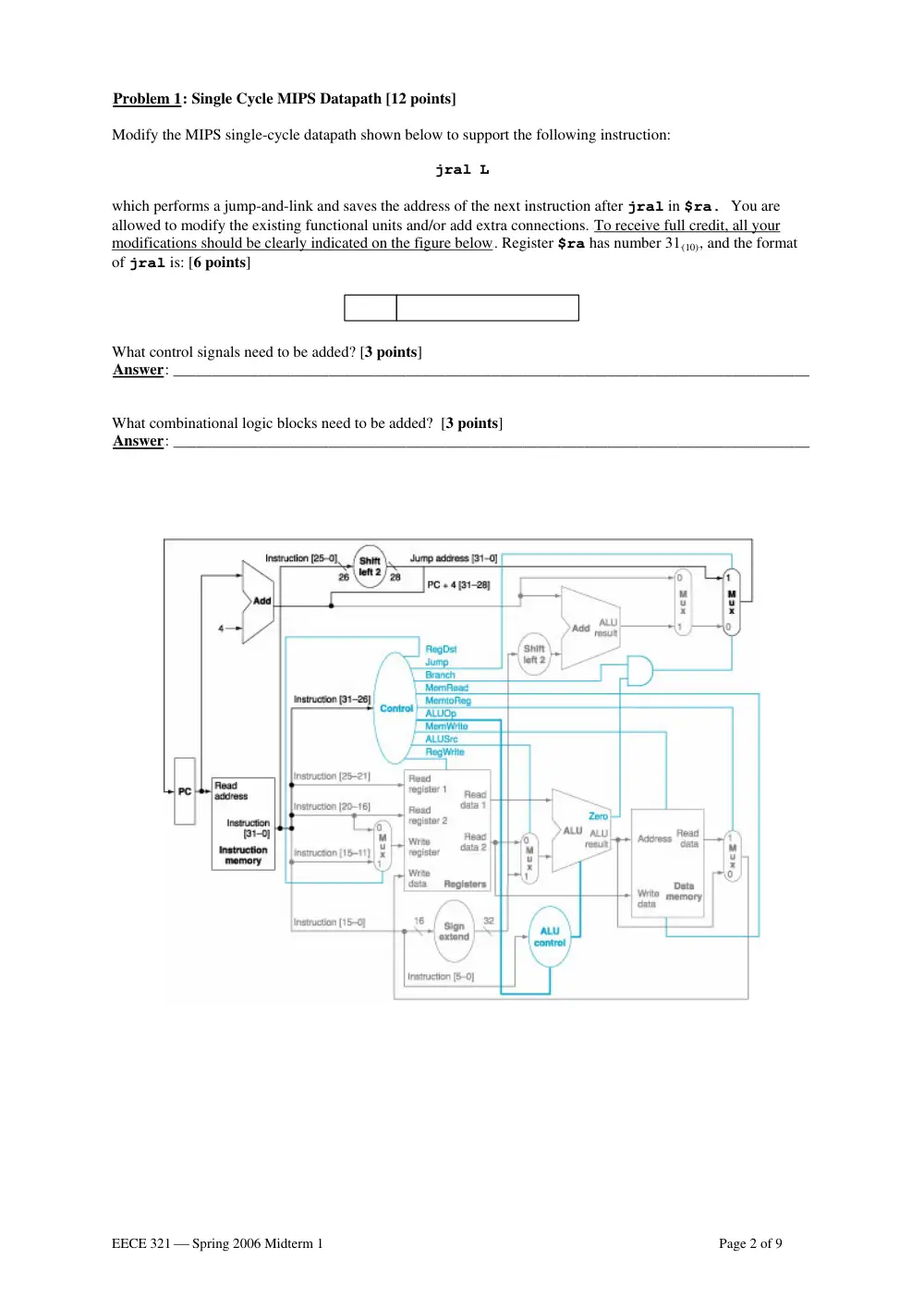
Modify the MIPS single-cycle datapath shown below to support the following instruction:
jral L
which performs a jump-and-link and saves the address of the next instruction after jral in $ra. You are
allowed to modify the existing functional units and/or add extra connections. UTo receive full credit, all your
modifications should be clearly indicated on the figure belowU. Register $ra has number 31B(10)
B, and the format
of jral is: [6 points]
What control signals need to be added? [3 points]
UAnswerU: __________________________________________________________________________________
What combinational logic blocks need to be added? [3 points]
UAnswerU: __________________________________________________________________________________
EECE 321 ⎯ Spring 2006 Midterm 1
Page 2 of 9
UProblem 2U: MIPS Compilation [24 points]
Compile the following C++ statements shown on the left column. Assume the following register-to-variable
mappings: i:$s0, j:$s1, A:$s2. You can only use the following MIPS instructions: sll, srl,
add,addi,sub,lw,sw,slt,beq,bne,j.
UNO OTHER INSTRUCTIONS ARE ALLOWEDU. The
variables i, j, and the array A are all integers.
C++ statement
MIPS assembly code
A[i*64+j] = A[i+j*64];
[5 points]
*i = *j;
[2 points]
if(i>j) i = i + 1;
[3 points]
while(i<=j) i++;
[4 points]
for(i=0;i<10 && j>0;i++)
A[j--] = i;
[5 points]
j = (2P16
P+2P-16
P)*i;
[5 points]
EECE 321 ⎯ Spring 2006 Midterm 1
Page 3 of 9
UProblem 3U: MIPS Assembly [12 points]
Consider the following MIPS assembly code.
main: addi $t0, $zero, 5
add $t1, $zero, $t0
addi $t2, $zero, 1
add $t3, $zero, $t0
loop: sub $t1, $t1, $t2
beq $t1, $zero, finish
add $t3, $t3, $t1
j loop
finish:
a) What is the value of $t1 when the program reaches “finish” (in decimal)? [3 points]
Answer: $t1 =
b) What is the value of $t3 when the program reaches “finish” (in decimal)? [3 points]
Answer: $t3 =
c) Assume that add and sub require 1 instruction cycle, and j and bne require 2 instruction cycles, how many
cycles does this code run when reaching “finish” (do not count “finish”)? [6 points]
Answer: Cycles =
EECE 321 ⎯ Spring 2006 Midterm 1
Page 4 of 9
UProblem 4U: Floating Point [22 points]
a) You are writing a program that requires several floating point multiplications by -2.5B(10)
B. You decide to load
this constant into the floating point register $f2 using the following instruction:
mtc1 $t0, $f2
# $f2 � $t0
However, before you can transfer the constant to $f2 you have to load it into $t0. Write the shortest
sequence of instructions that will load the constant -2.5B(10)
B represented in the IEEE 754 single floating point
standard into $t0. [6 points]
UAnswerU:
b) Find a number x so that x + 1.0 = x, according to single precision floating-point arithmetic. [4 points]
UAnswerU: x =
c) Determine what 0x3e000000 is in decimal, if we assume it represents an IEEE Usingle precisionU number.
[6 points]
UAnswerU:
d) Assume you have a 64x32 matrix A of double precision complex numbers. Each element of the matrix is a
complex number, with the real and imaginary parts are represented as double precision numbers. The
matrix is stored in column major format, i.e., all entries in a column are stored sequentially in memory
before storing the entries of the next column. The real part of each entry is stored first as a double number,
followed immediately by the imaginary part, again stored as a double number. If the array is stored starting
at byte address 0x00400008, at what byte address is the array element A[3][6] stored? Write your
answer in hexadecimal. [6 points]
UAnswerU:
EECE 321 ⎯ Spring 2006 Midterm 1
Page 5 of 9
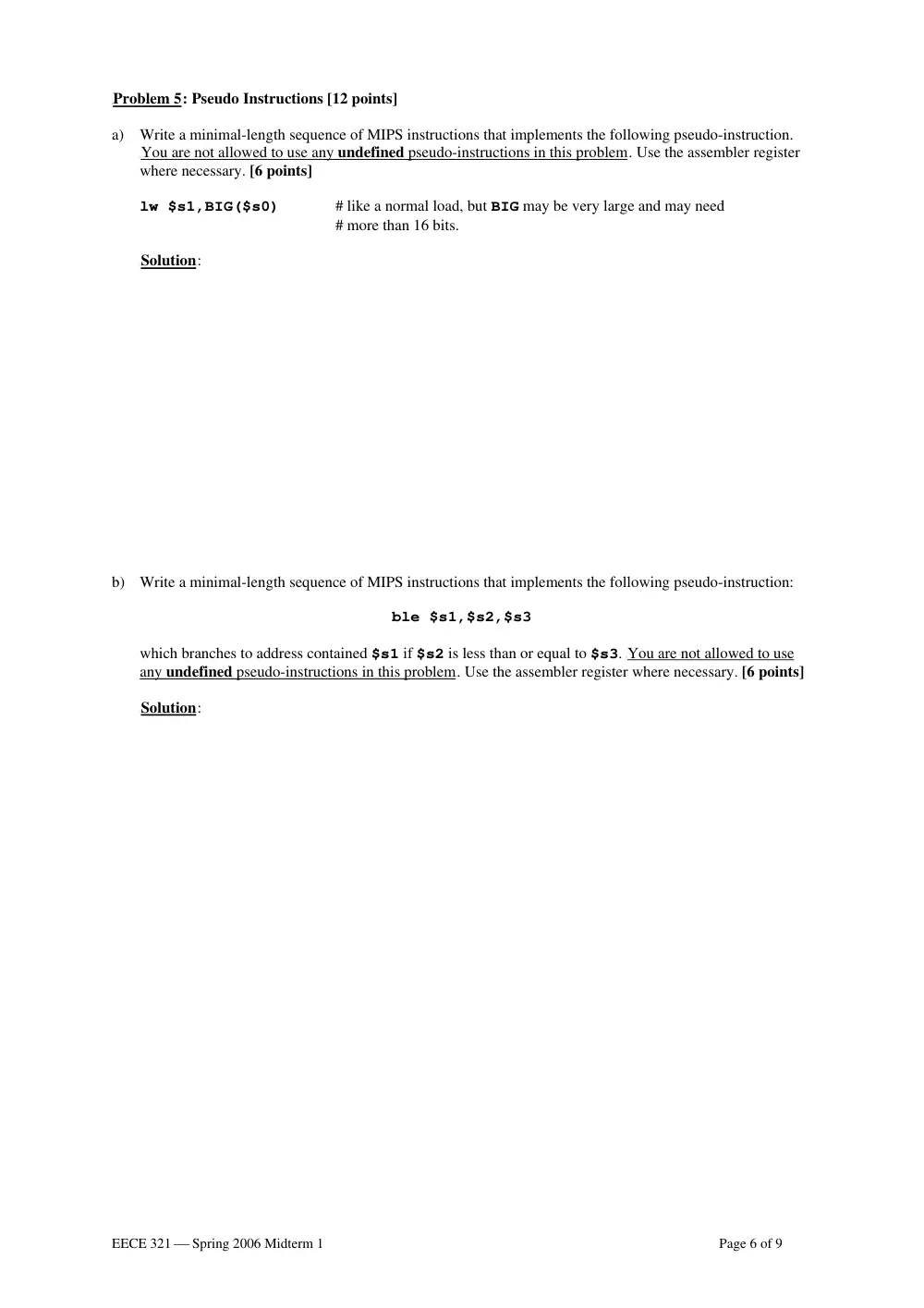
UProblem 5U: Pseudo Instructions [12 points]
a) Write a minimal-length sequence of MIPS instructions that implements the following pseudo-instruction.
UYou are not allowed to use any undefined pseudo-instructions in this problemU. Use the assembler register
where necessary. [6 points]
lw $s1,BIG($s0)
# like a normal load, but BIG may be very large and may need
# more than 16 bits.
USolutionU:
b) Write a minimal-length sequence of MIPS instructions that implements the following pseudo-instruction:
ble $s1,$s2,$s3
which branches to address contained $s1 if $s2 is less than or equal to $s3. UYou are not allowed to use
any undefined pseudo-instructions in this problemU. Use the assembler register where necessary. [6 points]
USolutionU:
EECE 321 ⎯ Spring 2006 Midterm 1
Page 6 of 9
UProblem 6U: CPU Performance [22 points]
Consider the following C++ code. Assume you generated MIPS assembly code for the C++ code shown using
two different compilers. Compiler 1 generated the code in Figure P6(a) while compiler 2 generated the code in
Figure P6(b). For the scope of this question only, you should assume that all the instructions used by the
compilers are real instructions (as opposed to pseudo-instructions) in the MIPS architecture. Assume
arithmetic/logic instructions require 2 cycles to execute, loads 5 cycles, branches 3 cycles, and jumps 1 cycle.
int foo(int v[ ], int k, int n, int m){
sum = 0;
for(i=k ; i<n ; i=i+m)
sum = sum + v[i];
return sum;
}
add $t0, $zero, $zero
add $t1, $a1, $zero
loop: bge $t1, $a2, return
sll $t2, $t1, 2
add $t2, $t2, $a0
lw $t3, 0($t2)
add $t0, $t0, $t3
add $t1, $t1, $a3
j loop
return: add $v0, $t0, $zero
jal $ra
add $v0, $zero, $zero
sll $a1, $a1, 2
sll $a2, $a2, 2
sll $a3, $a3, 2
add $t1, $a1, $zero
bge $t1, $a2, return
loop: add $t2, $t1, $a0
lw $t3, 0($t2)
add $v0, $v0, $t3
add $t1, $t1, $a3
blt $t1, $a2 loop
return: jal $ra
Figure P6(a): Code generated by Compiler 1
Figure P6(b) : Code generated by Compiler 2
a) Fill the table below with the number of instructions of each type that will be executed by the code generated
by compiler 1 and by compiler 2 when the function foo(v,0,100,1) is invoked. [8 points]
Instruction Type
Compiler 1 Code
Compiler 2 Code
Arithmetic/logic
Loads
Branches
Jumps
b) Compute the average number of clocks per instruction (CPI) for each version of the program. [8 points]
USolutionU:
CPI(P1) =
CPI(P2) =
c) Which version of foo(), P1 or P2, is faster if you run it on a 1 GHz processor? By how much? [6 points]
USolutionU:
EECE 321 ⎯ Spring 2006 Midterm 1
Page 7 of 9
UProblem 7U: Function Calls [16 points]
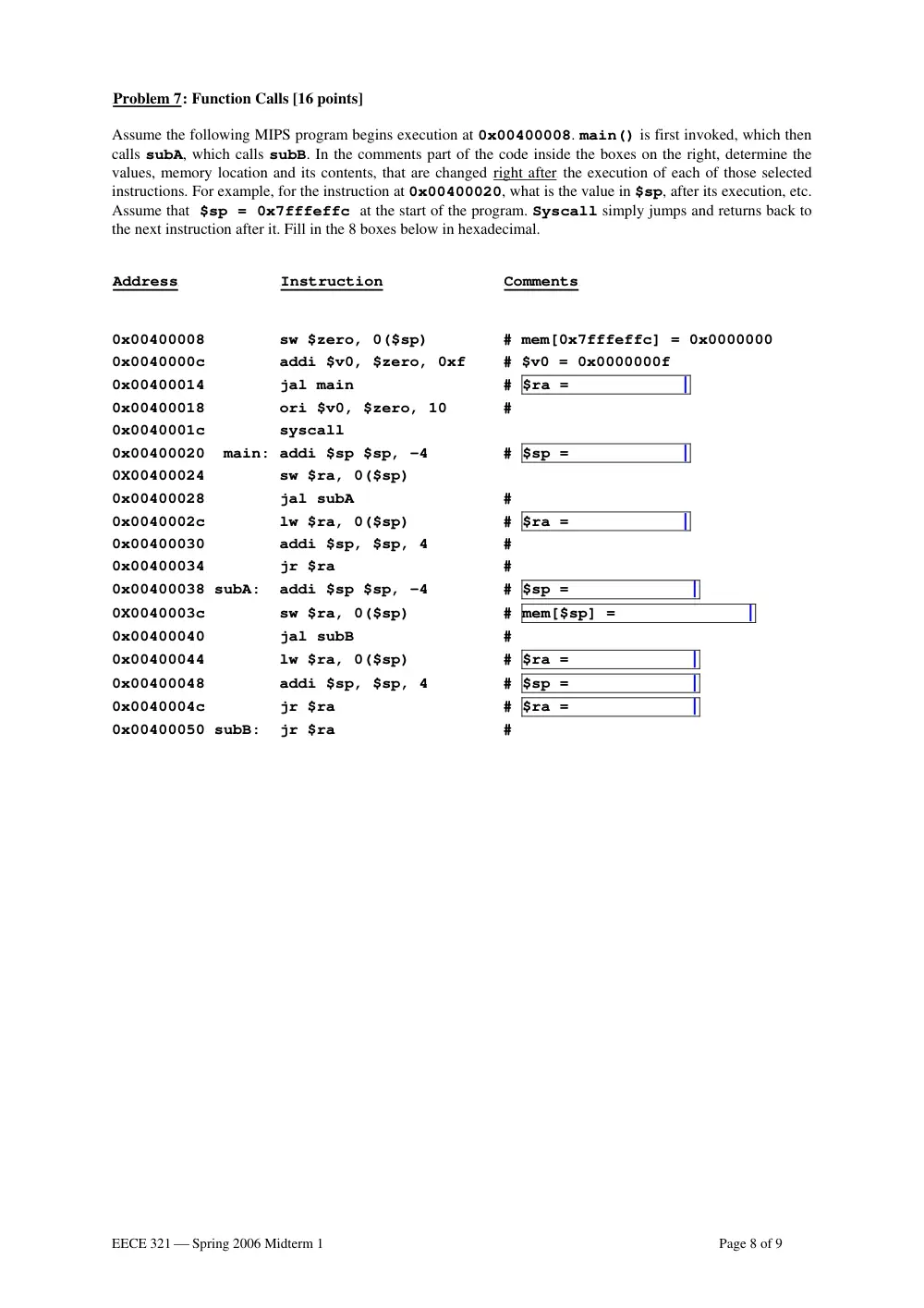
Assume the following MIPS program begins execution at 0x00400008. main() is first invoked, which then
calls subA, which calls subB. In the comments part of the code inside the boxes on the right, determine the
values, memory location and its contents, that are changed
Uright afterU the execution of each of those selected
instructions. For example, for the instruction at 0x00400020, what is the value in $sp, after its execution, etc.
Assume that $sp = 0x7fffeffc at the start of the program. Syscall simply jumps and returns back to
the next instruction after it. Fill in the 8 boxes below in hexadecimal.
UAddressU
UInstructionU
UCommentsU
0x00400008
sw $zero, 0($sp)
# mem[0x7fffeffc] = 0x0000000
0x0040000c
addi $v0, $zero, 0xf
# $v0 = 0x0000000f
0x00400014
jal main
# $ra = |
0x00400018
ori $v0, $zero, 10
#
0x0040001c
syscall
0x00400020 main: addi $sp $sp, -4
# $sp = |
0X00400024
sw $ra, 0($sp)
0x00400028
jal subA
#
0x0040002c
lw $ra, 0($sp)
# $ra = |
0x00400030
addi $sp, $sp, 4
#
0x00400034
jr $ra
#
0x00400038 subA: addi $sp $sp, -4
# $sp = |
0X0040003c
sw $ra, 0($sp)
# mem[$sp] = |
0x00400040
jal subB
#
0x00400044
lw $ra, 0($sp)
# $ra = |
0x00400048
addi $sp, $sp, 4
# $sp = |
0x0040004c
jr $ra
# $ra = |
0x00400050 subB: jr $ra
#
EECE 321 ⎯ Spring 2006 Midterm 1
Page 8 of 9
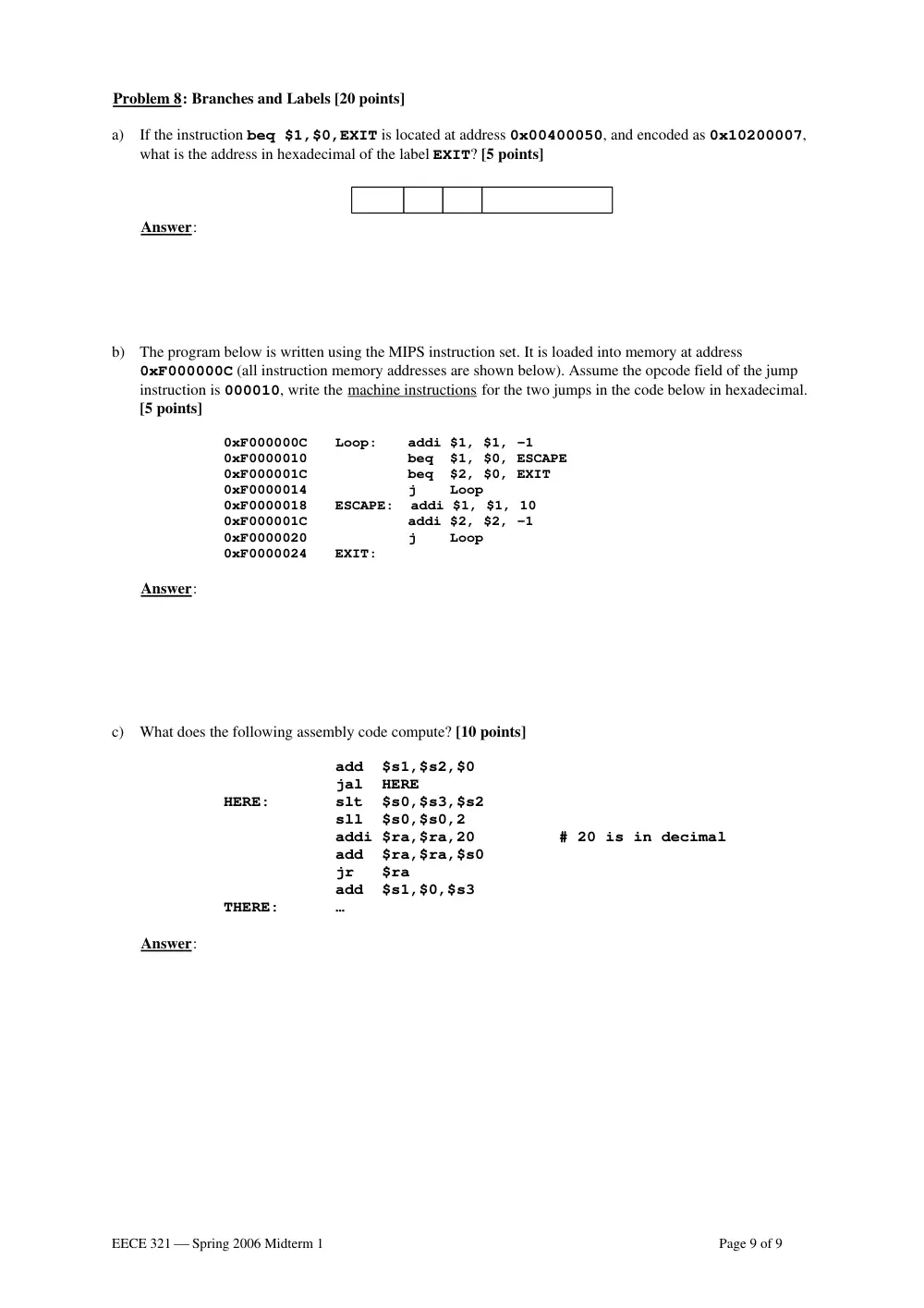
UProblem 8U: Branches and Labels [20 points]
a) If the instruction beq $1,$0,EXIT is located at address 0x00400050, and encoded as 0x10200007,
what is the address in hexadecimal of the label EXIT? [5 points]
UAnswerU:
b) The program below is written using the MIPS instruction set. It is loaded into memory at address
0xF000000C (all instruction memory addresses are shown below). Assume the opcode field of the jump
instruction is 000010, write the Umachine instructionsU for the two jumps in the code below in hexadecimal.
[5 points]
0xF000000C Loop: addi $1, $1, -1
0xF0000010
beq $1, $0, ESCAPE
0xF000001C
beq $2, $0, EXIT
0xF0000014
j Loop
0xF0000018 ESCAPE: addi $1, $1, 10
0xF000001C
addi $2, $2, -1
0xF0000020
j Loop
0xF0000024
EXIT:
UAnswerU:
c) What does the following assembly code compute? [10 points]
add $s1,$s2,$0
jal HERE
HERE:
slt $s0,$s3,$s2
sll $s0,$s0,2
addi $ra,$ra,20
# 20 is in decimal
add $ra,$ra,$s0
jr $ra
add $s1,$0,$s3
THERE:
…
UAnswerU:
EECE 321 ⎯ Spring 2006 Midterm 1
Page 9 of 9