
EECE 321 Problems Practice Problems, Spring 2014
American University of Beirut · Computer Organization · 20 pages · Prof. Mohammad Mansour

Showing the first 10 of 20 pages. Download the PDF to see all of it.
More EECE 321 files
Show the text of this problems
EECE 321: Computer Organization
Mohammad M. Mansour
Dept. of Electrical and Compute Engineering
American University of Beirut
Prof. M. Mansour
Practice Problems
EECE 321: Computer Organization
1
Prof. M. Mansour
Arrays
EECE 321: Computer Organization
2
Prof. M. Mansour
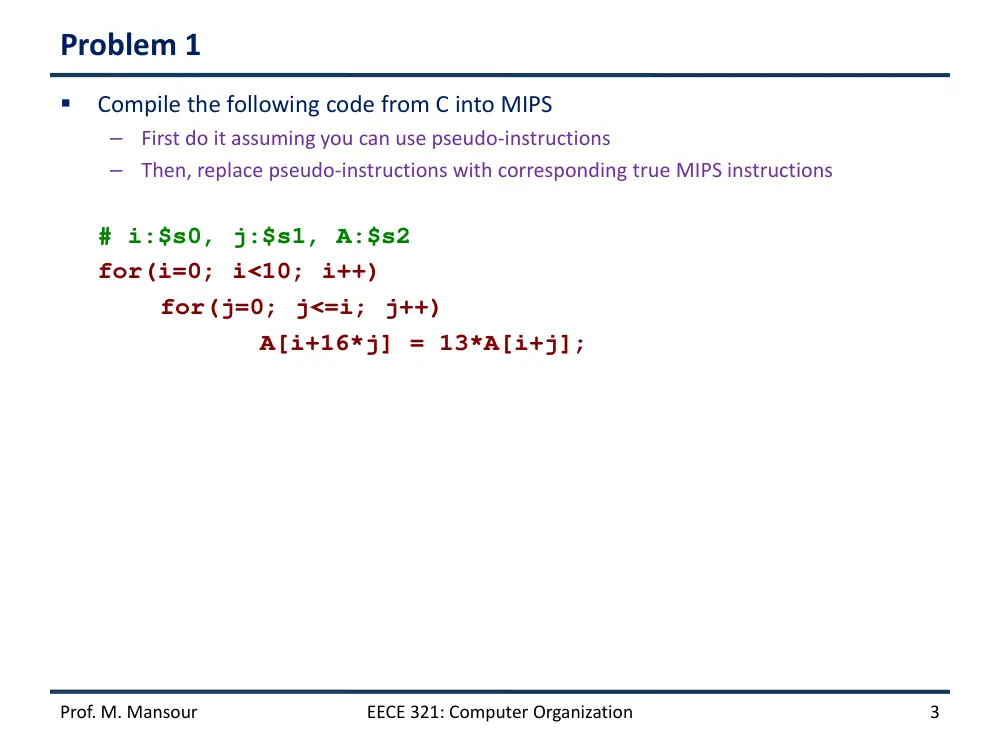
Problem 1
Compile the following code from C into MIPS
–
First do it assuming you can use pseudo-instructions
–
Then, replace pseudo-instructions with corresponding true MIPS instructions
# i:$s0, j:$s1, A:$s2
for(i=0; i<10; i++)
for(j=0; j<=i; j++)
A[i+16*j] = 13*A[i+j];
EECE 321: Computer Organization
3
Prof. M. Mansour
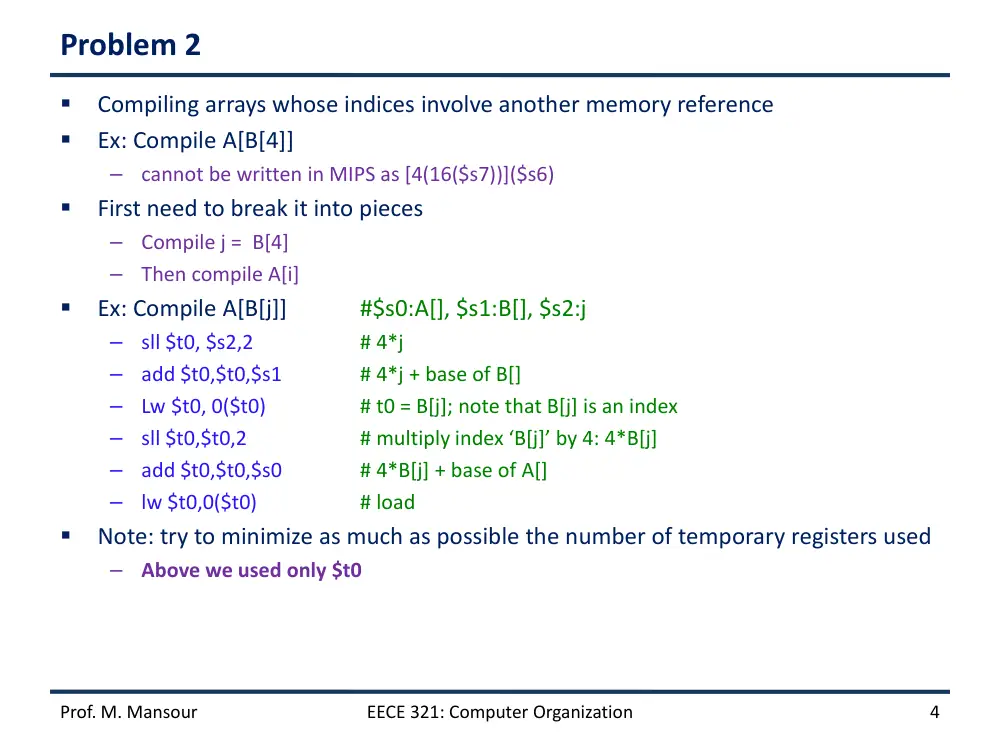
Problem 2
Compiling arrays whose indices involve another memory reference
Ex: Compile A[B[4]]
–
cannot be written in MIPS as [4(16($s7))]($s6)
First need to break it into pieces
–
Compile j = B[4]
–
Then compile A[i]
Ex: Compile A[B[j]]
#$s0:A[], $s1:B[], $s2:j
–
sll $t0, $s2,2
# 4*j
–
add $t0,$t0,$s1
# 4*j + base of B[]
–
Lw $t0, 0($t0)
# t0 = B[j]; note that B[j] is an index
–
sll $t0,$t0,2
# multiply index ‘B[j]’ by 4: 4*B[j]
–
add $t0,$t0,$s0
# 4*B[j] + base of A[]
–
lw $t0,0($t0)
# load
Note: try to minimize as much as possible the number of temporary registers used
–
Above we used only $t0
EECE 321: Computer Organization
4
Prof. M. Mansour
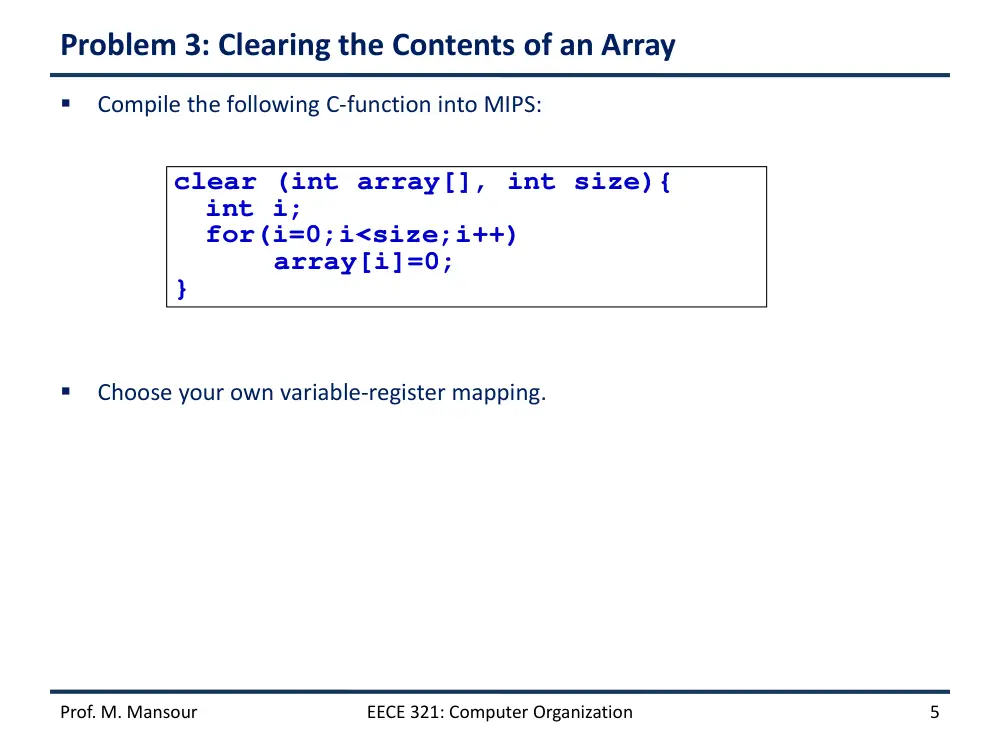
Problem 3: Clearing the Contents of an Array
Compile the following C-function into MIPS:
Choose your own variable-register mapping.
clear (int array[], int size){
int i;
for(i=0;i<size;i++)
array[i]=0;
}
EECE 321: Computer Organization
5
Prof. M. Mansour
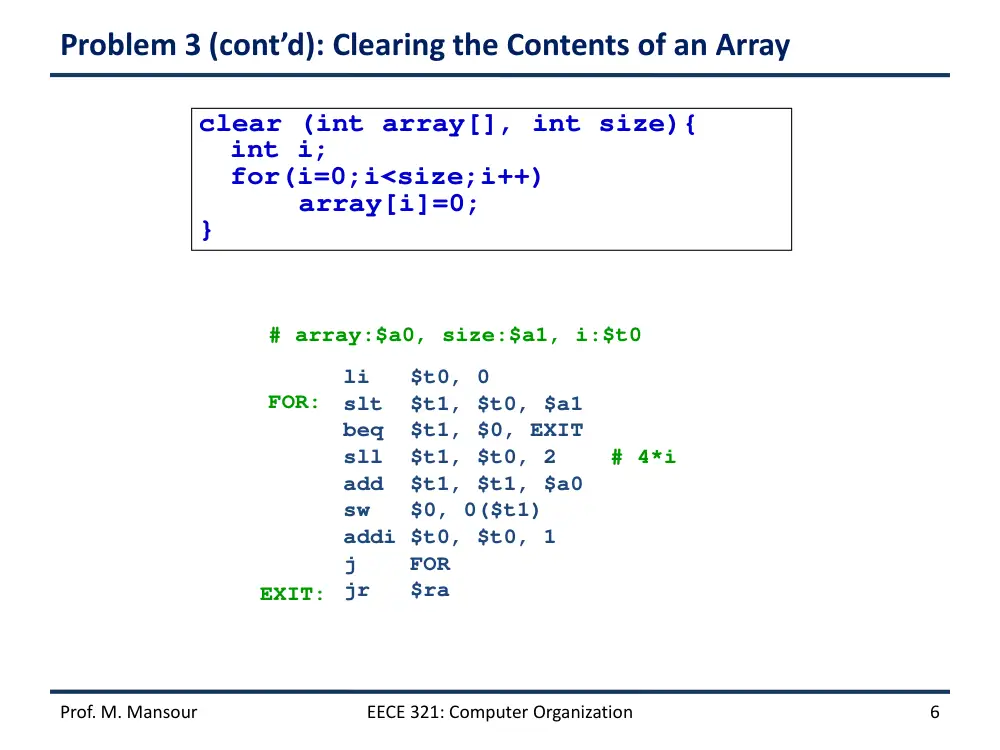
Problem 3 (cont’d): Clearing the Contents of an Array
li $t0, 0
slt $t1, $t0, $a1
beq $t1, $0, EXIT
sll $t1, $t0, 2 # 4*i
add $t1, $t1, $a0
sw $0, 0($t1)
addi $t0, $t0, 1
j FOR
jr $ra
clear (int array[], int size){
int i;
for(i=0;i<size;i++)
array[i]=0;
}
# array:$a0, size:$a1, i:$t0
FOR:
EXIT:
EECE 321: Computer Organization
6
Prof. M. Mansour
Arithmetic/Overflow
EECE 321: Computer Organization
7
Prof. M. Mansour
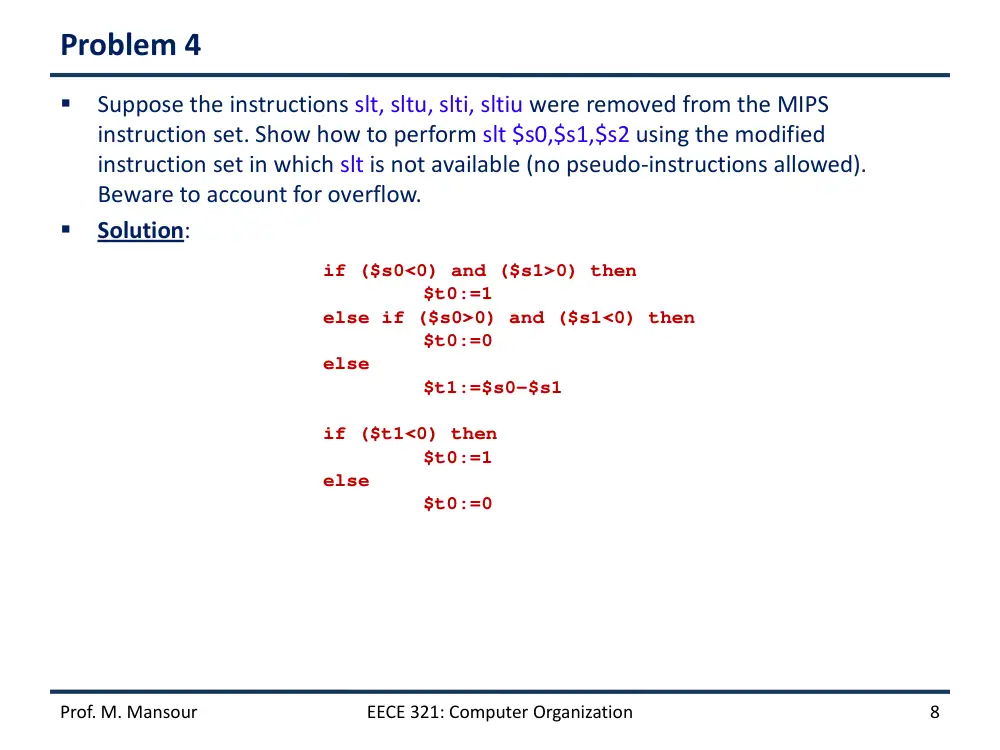
Problem 4
Suppose the instructions slt, sltu, slti, sltiu were removed from the MIPS
instruction set. Show how to perform slt $s0,$s1,$s2 using the modified
instruction set in which slt is not available (no pseudo-instructions allowed).
Beware to account for overflow.
Solution:
if ($s0<0) and ($s1>0) then
$t0:=1
else if ($s0>0) and ($s1<0) then
$t0:=0
else
$t1:=$s0–$s1
if ($t1<0) then
$t0:=1
else
$t0:=0
EECE 321: Computer Organization
8
Prof. M. Mansour
Dissassembly
EECE 321: Computer Organization
9
Prof. M. Mansour
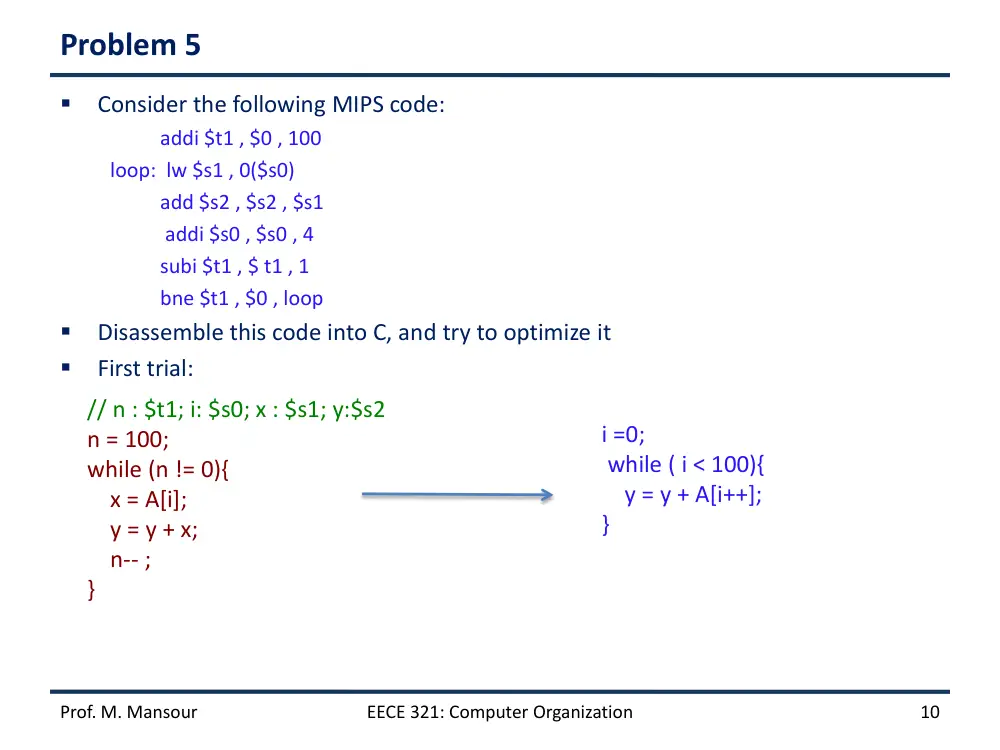
Problem 5
Consider the following MIPS code:
addi $t1 , $0 , 100
loop: lw $s1 , 0($s0)
add $s2 , $s2 , $s1
addi $s0 , $s0 , 4
subi $t1 , $ t1 , 1
bne $t1 , $0 , loop
Disassemble this code into C, and try to optimize it
First trial:
EECE 321: Computer Organization
10
// n : $t1; i: $s0; x : $s1; y:$s2
n = 100;
while (n != 0){
x = A[i];
y = y + x;
n-- ;
}
i =0;
while ( i < 100){
y = y + A[i++];
}
Prof. M. Mansour
Branches
EECE 321: Computer Organization
11
Prof. M. Mansour
Problem 6
How to branch to a location that is further than what can be represented in the
immediate field in a branch instruction?
–
Solution: Branch to a “jr” instruction
Ex: if $s1=$s2 jump to L, but L is very far away
beq $s1 , $s2 , L1
j L2
L1: li $t0 , L
# here L is a 32-bit value that represents the ‘far’ address
jr $t0
L2:
What is the disadvantage of this approach? What needs to be changed if this code
is moved in memory?
EECE 321: Computer Organization
12
Prof. M. Mansour
Problem 7
Suppose that MIPS does not have conditional branch instructions (beq, bne, …).
Can you write a sequence of MIPS instructions to implement a conditional branch
instruction?
EECE 321: Computer Organization
13
Prof. M. Mansour
Problem 8
Translate the following switch statement in C into MIPS. Try to use as few registers
as possible. Assume the following mapping: $s1:x, $s2:y, $s3:z, $s0:a. Add
appropriate comments to your MIPS code.
switch(a){
case 1: x = y + z;
case 2: x = y - z;
case -1: x = x - z;
default: x = z + z;
}
Solution:
addi $t0, $0, 1
# case a=1
addi $t1, $0, 2
# case a=2
addi $t2, $0, -1
# case a=-1
bne $s0, $t0, L2
# handle case 1
add $s1, $s2, $s3
#
j EXIT
L2:
bne $s0, $t1, L3
# handle case 2
sub $s1, $s2, $s3
j EXIT
L3:
bne $s0, $t2, D
# handle case -1
sub $s1, $s1, $s3
j EXIT
D:
add $s1, $s3, $s3
EXIT:
EECE 321: Computer Organization
14
Prof. M. Mansour
Problem 9
Implement the instruction max $t1,$t2,$t3 in MIPS, which returns the maximum of
$t2 and $t3 in $t1, without using any conditional branch instructions (beq, bne).
Also, you are not allowed to use pseudo-instructions.
Solution:
add $t1,$t2,$0
# MAX is t2
jal MAX
# $ra = address MAX
MAX:
slt $t0,$t3,$t2
# t0=1 if t2 is MAX, exit
sll $t0,$t0,2
# t0 is 4
addi $ra,$ra,20
# adjust jump offset
add $ra,$ra,$t0
jr $ra
T3MAX: add $t1,$0,$t3
# t3 is MAX
T2MAX: ……
EECE 321: Computer Organization
15
Prof. M. Mansour
Functions
EECE 321: Computer Organization
16
Prof. M. Mansour
Problem 10: Sorting Function
Compile the following C-function into MIPS:
Steps:
–
Allocate registers to program variables.
–
Produce code for the body of the function.
–
Preserve registers across the procedure invocation.
Compiling swap: #v:$a0, k:$a1
sort (int v[], int n){
int i,j;
for(i=0;i<n;i++){
for(j=i-1;j>=0 && v[j]>v[j+1]; j--){
swap(v,j);
}
}
}
swap (int v[], int k){
int temp;
temp=v[k];
v[k]=v[k+1];
v[k+1]=temp;
}
swap:
sll $t1,$a1,2
# $t1=k*4
add $t1,$a0,$t1
# $t1=v+4*k, $t1 has address of v[k]
lw $t0,0($t1)
# temp = v[k]
lw $t2,4($t1)
# $t2 = v[k+1]
sw $t2,0($t1)
# v[k] = $t2
sw $t0,4($t1)
# v[k+1] = temp
jr $ra
# return to caller
EECE 321: Computer Organization
17
Prof. M. Mansour
Problem 10 (cont’d): Compiling sort()
First for loop:
#i:s0, j:$s1, n:$a1
sort (int v[], int n){
int i,j;
for(i=0;i<n;i++){
for(j=i-1;j>=0 && v[j]>v[j+1]; j--){
swap(v,j);
}
}
}
add $s0,$zero,$zero
# i=0
FOR1:
slt $t0,$s0,$a1
# if i>=n
beq $t0,$zero,EXIT1
# exit loop
. . .
(body of first loop)
. . .
addi $s0,$s0,1
# i++
j FOR1
EXIT1:
EECE 321: Computer Organization
18
Prof. M. Mansour
Problem 10 (cont’d): Compiling sort()
Second for loop: #i:s0, j:$s1
sort (int v[], int n){
int i,j;
for(i=0;i<n;i++){
for(j=i-1;j>=0 && v[j]>v[j+1]; j--){
swap(v,j);
}
}
}
addi $s1,$s0,-1
# j=i-1
FOR2:
slti $t0,$s1,0
# $t0=1 if j<0
bne $t0,$zero,EXIT2
# exit loop if j<0
sll $t1,$t1,2
# $t1 = 4*j
add $t2,$a0,$t1
# $t2 = v + 4*j
lw $t3,0($t2)
# $t3 = v[j]
lw $t4,4($t2)
# $t4 = v[j+1]
slt $t0,$t4,$t3
# $t0=0 if $t4 >= $t3
beq $t0,$zero,EXIT2
# goto EXIT2 if $t4 >= $t3
. . .
(body of second loop)
. . .
addi $s1,$s1,1
# j--
j FOR2
EXIT2:
EECE 321: Computer Organization
19
Prof. M. Mansour
Problem 10 (cont’d): Compiling sort()
Preserving registers:
–
Need to save $a0, $a1. Can do so on stack, but better copy them to unused registers
$s2,$s3.
add $s2,$a0,$zero
# move $a0 into $s2
add $s3,$a1,$zero
# move $a1 into $s3
Pass parameters to swap as:
add $a0,$s2,$zero
# first swap parameter is v
add $a1,$s1,$zero
# second swap parameter is j
Since sort uses saved registers, it must save them on stack in addition to $ra:
addi $sp,$sp,-20
# make room for 5 registers
sw $ra,16($sp)
# save $ra
sw $s3,12($sp)
# save $s3
sw $s2, 8($sp)
# save $s2
sw $s1, 4($sp)
# save $s1
sw $s0, 0($sp)
# save $s0
Epilogue simply pops the stack.
See the overall code in your textbook.
EECE 321: Computer Organization
20