
EECE 330 Problems For Exam, Fall 2011
American University of Beirut · Data Structures and Algorithms · 36 pages · Prof. Hassan Artail

Showing the first 10 of 36 pages. Download the PDF to see all of it.
More EECE 330 files
- Exam 1 Artail Sample Questions (solution) · Summer 2014Problems · with solutionView
- Problems Huffman Coding · Summer 2014ProblemsView
- Problems Binary Trees · Summer 2014ProblemsView
- Problems Solution Manual · Spring 2012Problems · with solutionView
- Problems For Quiz 1 · Fall 2009ProblemsView
- Problems (Samples) · Spring 2008ProblemsView
- Questions · Spring 2008ProblemsView
- Other Extra Lecture About Dynamic Programming · Spring 2017LabView
Show the text of this problems
1. If a node is at position r in the array implementation for a complete binary tree, then its
parent is at:
a) (r - 1)/2 if r > 0
b) 2r + 1 if (2r + 1) < n
c) 2r + 2 if (2r + 2) < n
d) r - 1 if r is even
e) r + 1 if r is odd.
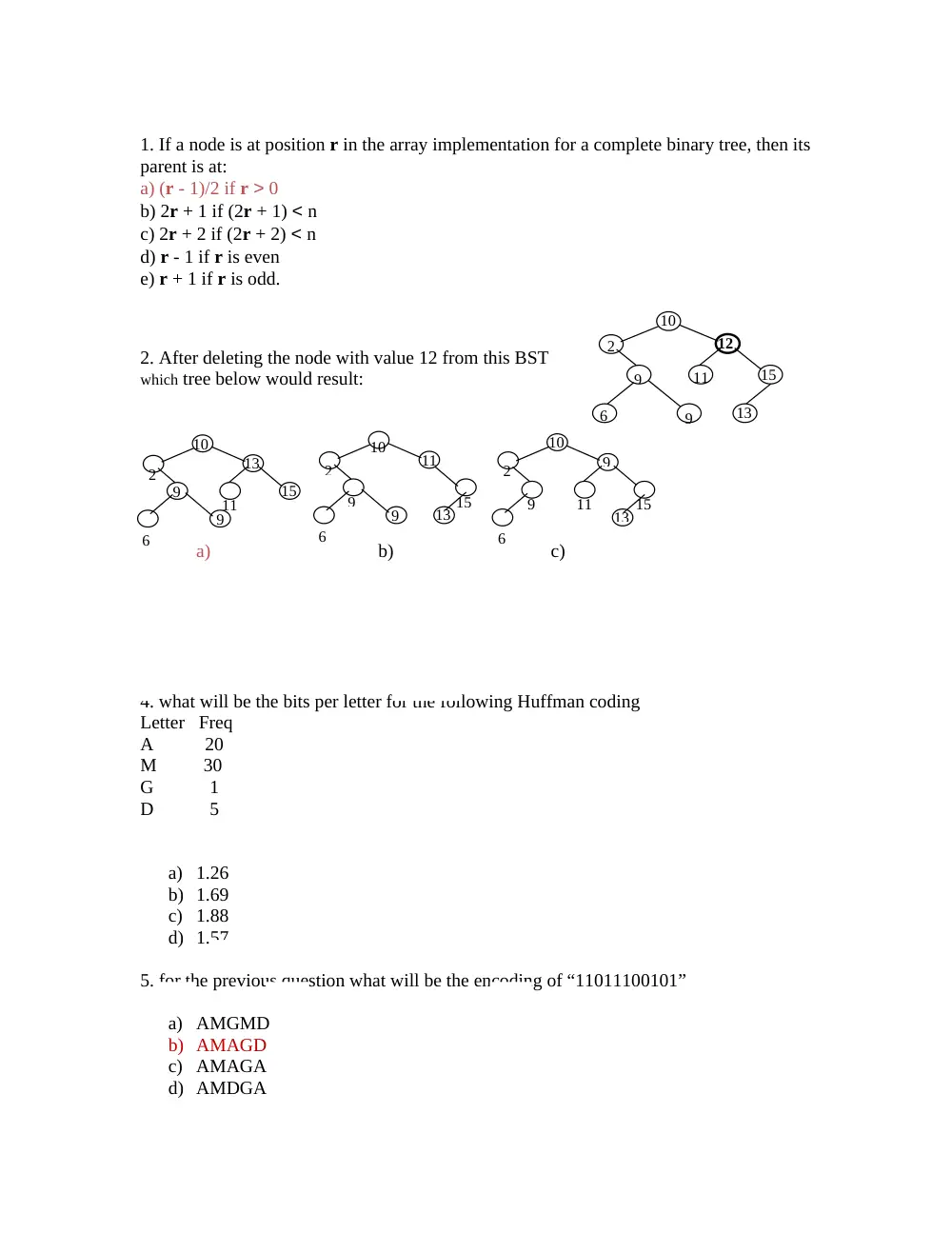
2. After deleting the node with value 12 from this BST
which tree below would result:
a)
b)
c)
4. what will be the bits per letter for the following Huffman coding
Letter Freq
A 20
M 30
G 1
D 5
a) 1.26
b) 1.69
c) 1.88
d) 1.57
5. for the previous question what will be the encoding of “11011100101”
a) AMGMD
b) AMAGD
c) AMAGA
d) AMDGA
2
12
9
6
9
11
15
13
10
2
13
9
6
9
11
15
10
2
11
9
6
9
15
13
10
2
9
9
6
11
15
13
10
Question 1
Suppose that we have numbers between 1 and 1000 in a binary search tree and want to
search for the number 363. Which of the following sequences could not be the sequence
of nodes examined?
a.
2, 252, 401, 398, 330, 344, 397, 363.
b. 924, 220, 911, 244, 898, 258, 362, 363.
c.
925, 202, 911, 240, 912, 245, 363.
d. 2, 399, 387, 219, 266, 382, 381, 278, 363.
e.
935, 278, 347, 621, 299, 392, 358, 363.
Question 3
What is the maximum number of edges for a graph with n vertices?
a.
n-1
b. (n-1)/2
c.
n(n-1)
d. n(n-1)/2
e.
n/2
Question 4
In a non-empty full k-ary tree, what is the number of leaves if n is the number of internal
nodes?
a.
kn+1
b. n(k-1) + 1
c.
n(k-1)
d. n+1
e.
nk
Question 5
If the costs for the edges of Graph G are distinct, then only ____ MST exist(s) for G.
a.
one
b. no
c.
two
d. three
e.
none of the above
Question 1:
What does the following function does?
template <class Key, class Elem, class KEComp, class EEComp>
BinNode<Elem>* BST<Key, Elem, KEComp, EEComp>::
inserthelp(BinNode<Elem>* subroot, const Elem& val) {
BinNode<Elem>* A,*B;
A=B=subroot;
if (subroot ==NULL) return new BinNodePtr <Elem> (val, NULL, NULL);
while(B!=NULL)
{
A=B;
if(EEComp:: lt(val, A->val())) B=A->left();
else
B=A->right();
}
if
(EEComp:: gt(val, A->val())
)
A->setRight(new BinNodePtr<Elem>(val));
else
A->setLeft(new BinNodePtr<Elem>(val));
return subroot;
}
a) It is the nonrecursive version of the insert function
b) It is the insert function but it sets the smaller elements to the right part and the larger
elements to the left part of the tree
c) It is the nonrecursive version of the insert function with duplicates inserted
d) It is the insert function but it sets the smaller elements to the right part and the larger
elements and the duplicates to the left part of the tree
Question 2:
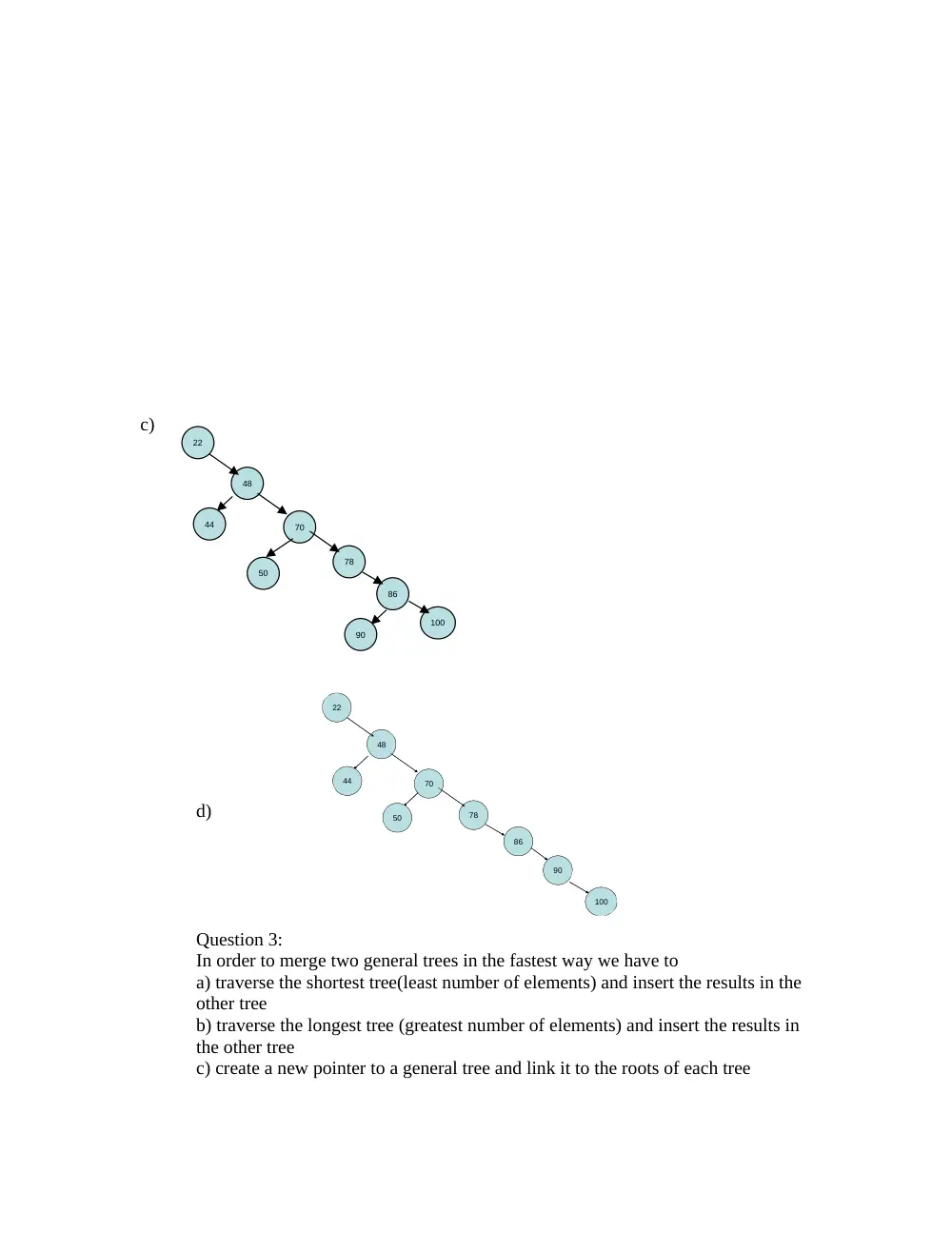
48
70
44
50
22
78
90
100
86
48
70
44
50
22
78
90
100
86
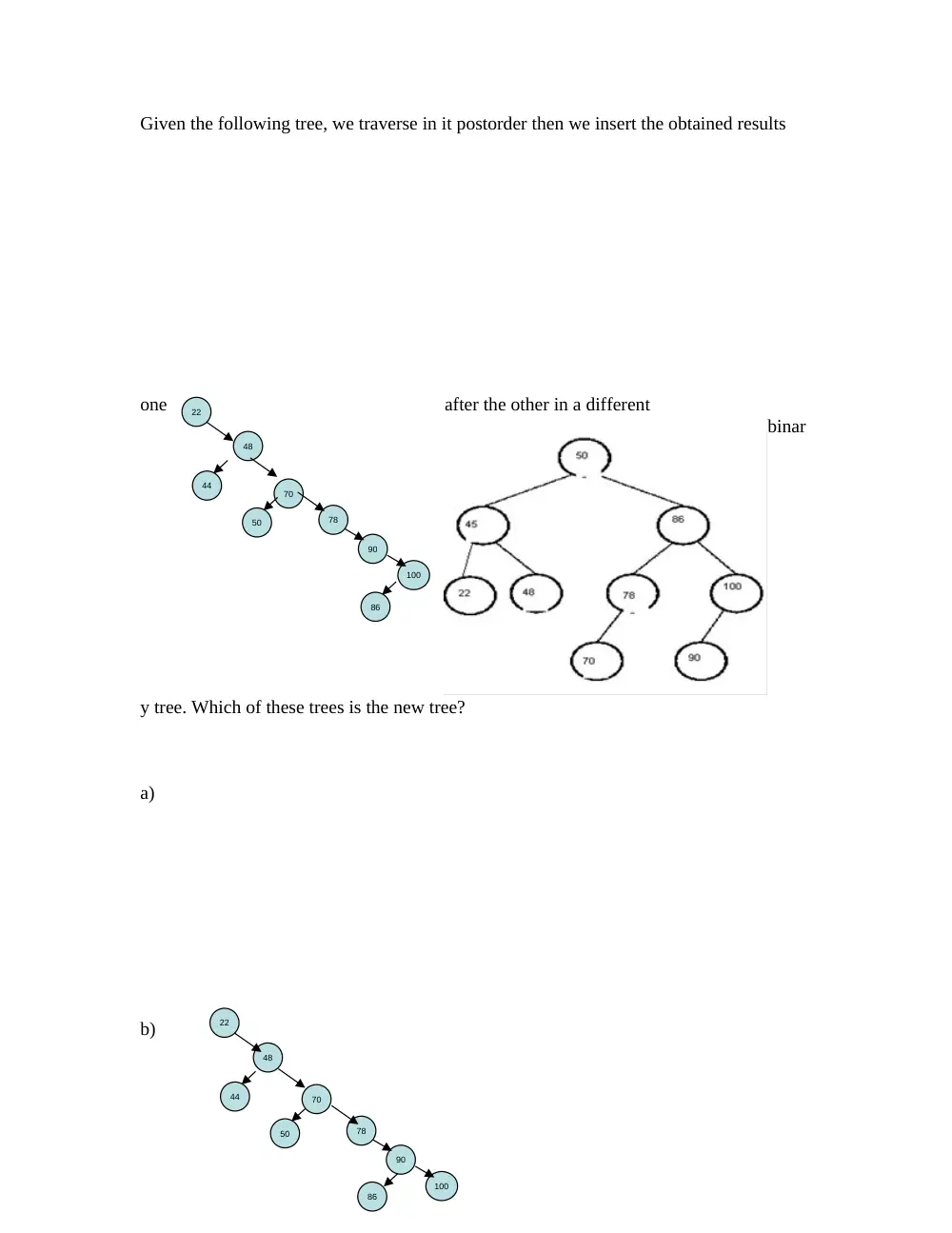
Given the following tree, we traverse in it postorder then we insert the obtained results
one
after the other in a different
binar
y tree. Which of these trees is the new tree?
a)
b)
48
70
44
50
22
78
86
100
90
48
70
44
50
22
78
90
100
86
48
70
44
50
22
78
90
100
86
c)
d)
Question 3:
In order to merge two general trees in the fastest way we have to
a) traverse the shortest tree(least number of elements) and insert the results in the
other tree
b) traverse the longest tree (greatest number of elements) and insert the results in
the other tree
c) create a new pointer to a general tree and link it to the roots of each tree
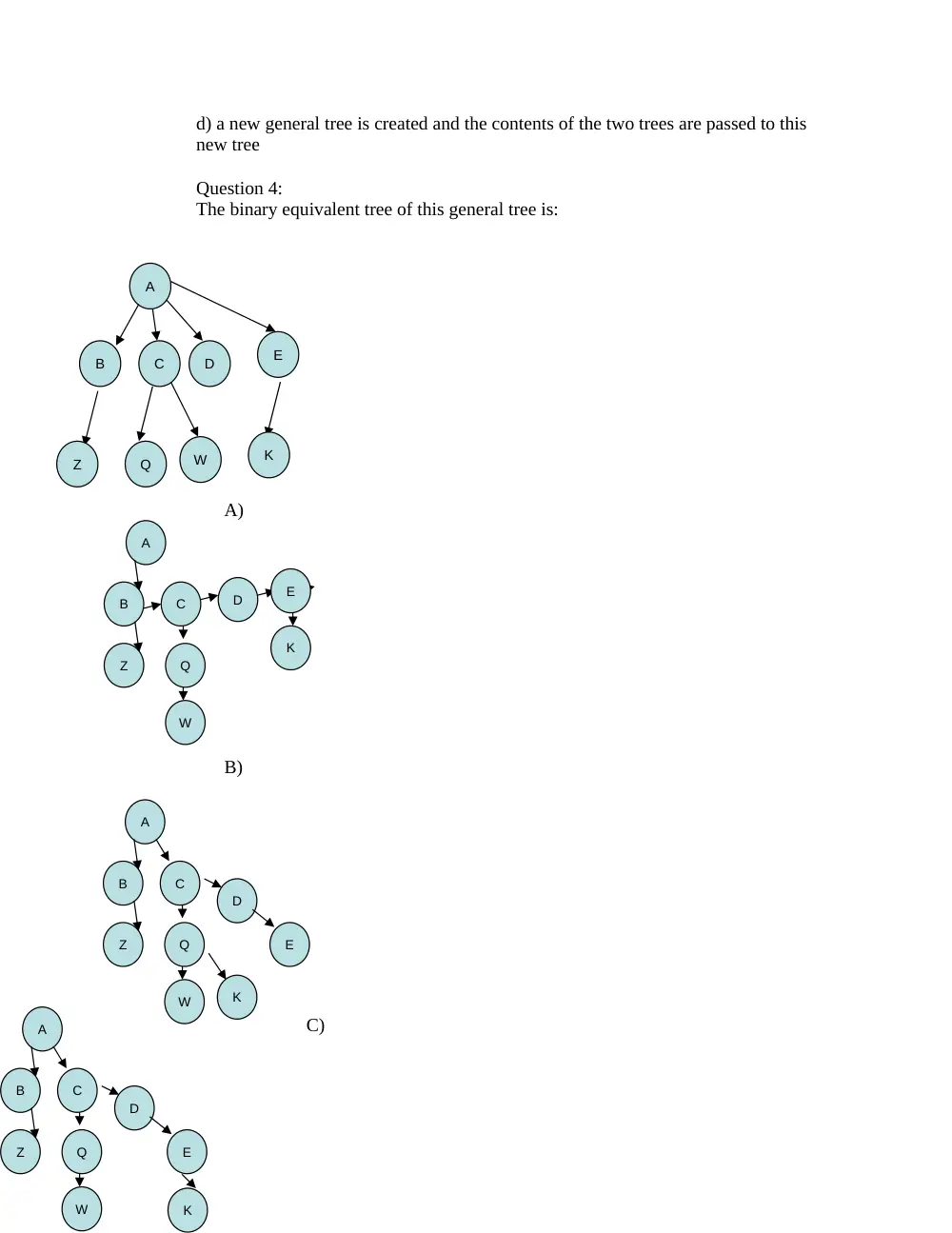
A
B
C
D
E
K
Q
Z
W
A
B
C
Z
Q
D
E
W
K
D
A
B
C
Z
Q
E
W
K
D
A
B
C
Z
Q
E
W
K
d) a new general tree is created and the contents of the two trees are passed to this
new tree
Question 4:
The binary equivalent tree of this general tree is:
A)
B)
C)
d)There is no binary equivalent tree for this general tree
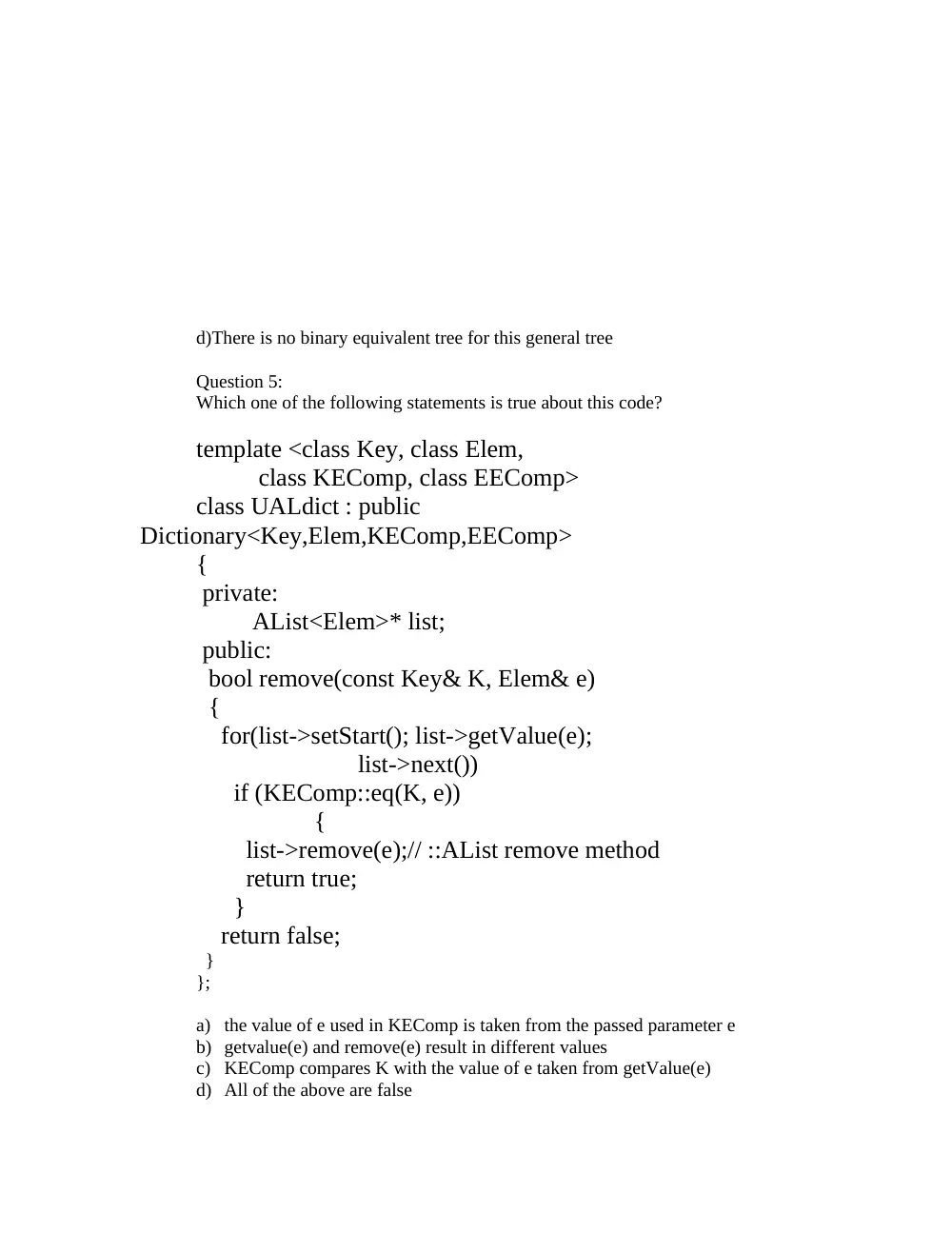
Question 5:
Which one of the following statements is true about this code?
template <class Key, class Elem,
class KEComp, class EEComp>
class UALdict : public
Dictionary<Key,Elem,KEComp,EEComp>
{
private:
AList<Elem>* list;
public:
bool remove(const Key& K, Elem& e)
{
for(list->setStart(); list->getValue(e);
list->next())
if (KEComp::eq(K, e))
{
list->remove(e);// ::AList remove method
return true;
}
return false;
}
};
a) the value of e used in KEComp is taken from the passed parameter e
b) getvalue(e) and remove(e) result in different values
c) KEComp compares K with the value of e taken from getValue(e)
d) All of the above are false
e) All of the above are true
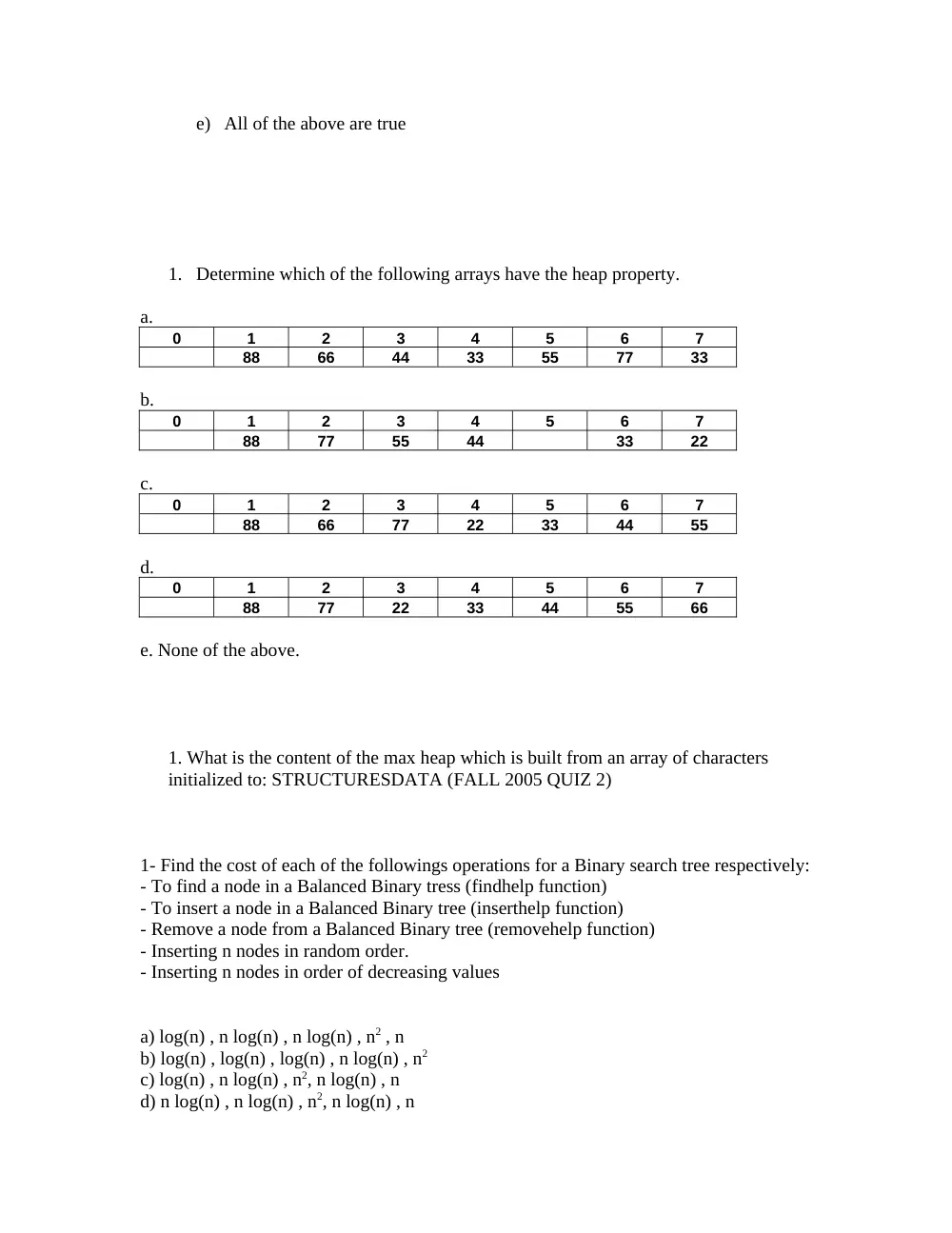
1. Determine which of the following arrays have the heap property.
a.
0
1
2
3
4
5
6
7
88
66
44
33
55
77
33
b.
0
1
2
3
4
5
6
7
88
77
55
44
33
22
c.
0
1
2
3
4
5
6
7
88
66
77
22
33
44
55
d.
0
1
2
3
4
5
6
7
88
77
22
33
44
55
66
e. None of the above.
1. What is the content of the max heap which is built from an array of characters
initialized to: STRUCTURESDATA (FALL 2005 QUIZ 2)
1- Find the cost of each of the followings operations for a Binary search tree respectively:
- To find a node in a Balanced Binary tress (findhelp function)
- To insert a node in a Balanced Binary tree (inserthelp function)
- Remove a node from a Balanced Binary tree (removehelp function)
- Inserting n nodes in random order.
- Inserting n nodes in order of decreasing values
a) log(n) , n log(n) , n log(n) , n2 , n
b) log(n) , log(n) , log(n) , n log(n) , n2
c) log(n) , n log(n) , n2, n log(n) , n
d) n log(n) , n log(n) , n2, n log(n) , n
e) log(n) , log(n) , log(n2) , n log(n) , n2
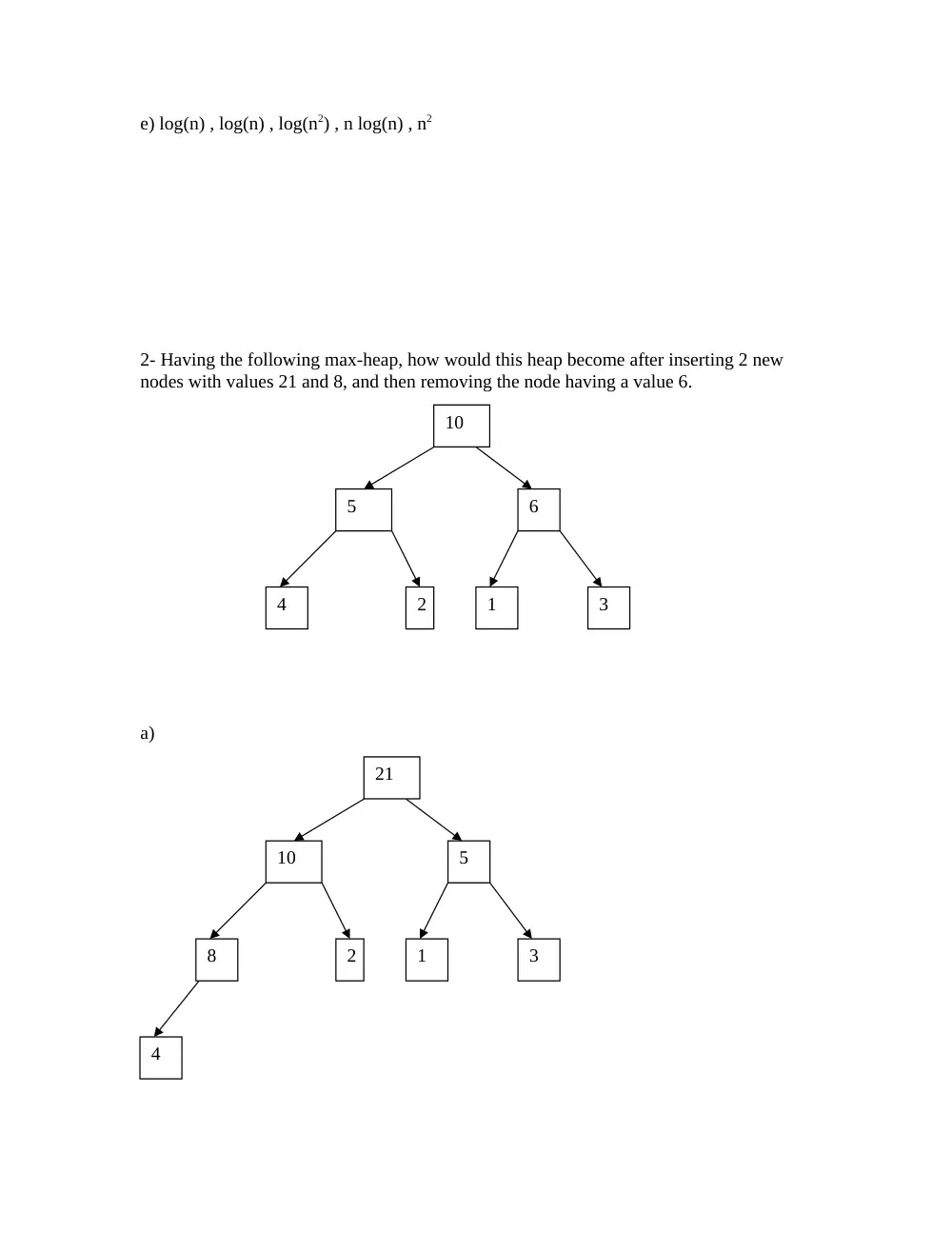
2- Having the following max-heap, how would this heap become after inserting 2 new
nodes with values 21 and 8, and then removing the node having a value 6.
a)
10
5
6
4
2
1
3
21
10
5
8
2
1
3
4
b)
c)
21
10
3
8
2
1
4
5
d)
e) None of the above.
3- Having the following General tree, what is its sequential representation?
21
10
5
8
2
4
3
1
21
10
8
5
2
1
3
4
a) AC/BD//F/IH/EG//
b) AC/BI//DH/E//FG///
c) AC)BI)DH))E))FG)))
d) AC)BI))DH)E))FG)))
e) None of the above.
4- Having the following Graph, find the adjacency 4 matrix including cycles.
012345
A
B
C
D
F
I
H
G
E
0
3
4
1
5
2
a) 0 010110
1 001000
2 000010
3 000011
4 010000
5 000010
012345
b) 0 011011
1 000010
2 010000
3 010010
4 001000
5 010000
012345
c) 0 011010
1 010000
2 001000
3 011000
4 000010
5 001000
012345
d) 0 011010
1 001000
2 000010
3 001010
4 010000
5 000010
e) None of the above
1- In what order does the following traverse a binary tree?
template<Elem>
void order (BinNode<Elem>* root)
{
if (subroot==NULL)
return;
order(root->right);
order(root->left);
cout<<root->val<<endl;
}
a- left-right-root
b- right-left-root
c- root-right-left
d- right-root-left
e- None of the above
2- Given the above traversal, traverse the below tree.
a- FIGCBMLNKA
b- NMLKIGFCBA
c- AKNLMBCGIF
d- NKMLAIGCFB
e- None of the above
3- If we remove the 1 from the below code, what would we be counting?
template<Elem>
int count (BinNode<Elem>* root)
{
if (subroot==NULL)
return 0;
return 1 + count(subroot->left())
+ count(subroot->right());
}
a- The number of children on the right and left.
b- The number of children on the right.
c- The number of children on the left.
d- Nothing.
e- None of the above.
4- What does the following code do?
template<class Key, class Elem, class KEComp, class EEComp>
BinNode<Elem>* BST<Key, Elem, KEComp, EEComp>::
do(BinNode<Elem>*root, BinNode<Elem>*& bn)
{
if(root->right() == NULL)
{
bn = root;
return root->left();
}
else
{
root->setright()(do(root->right(), bn));
return root;
}
}
a- Delete the node with maximum value.
b- The code does not represent a set operation.
c- Delete the node with average value.
d- Insert a node “bn” at a certain location in the binary tree.
e- Node of the above.
5- How does the last else-statement of the function “removehelp” below differ
from that of the original one (given in class)? Would it be valid?
template <class Key, class Elem, class KEComp, class EEComp>
BinNode<Elem>* BST<Key, Elem, KEComp, EEComp>::
removehelp(BinNode<Elem>* subroot, const Key& K, BinNode<Elem>*& t)
{
if (subroot == NULL)
return NULL;
else if (KEComp::lt(K, subroot->val()))
subroot->setLeft(removehelp(subroot->left(), K, t));
else if (KEComp::gt(K, subroot->val()))
subroot->setRight(removehelp(subroot->right(), K, t));
else
{
BinNode<Elem>* temp;
t = subroot;
if (subroot->left() == NULL)
subroot = subroot->right();
else if (subroot->right() == NULL)
subroot = subroot->left();
else
{
subroot->setLeft(deletemin(subroot->left(), temp));
Elem te = subroot->val();
subroot->setVal(temp->val());
temp->setVal(te);
t = temp;
}
}
}
a- The “removehelp” function replaces the removed node with the minimum value
from the left of subroot. It won’t be valid.
b- The “removehelp” function replaces the removed node with a value from the left
of subroot. It will be valid.
c- The “removehelp” function only removes a given node.
d- Not different.
e- None of the above.
6- If a child of a heap is at position “pos”, what is the position of its parent?
a- 2*pos + 2
b- Answer requires heap
c- 2*pos + 1
d- (pos-1)/2
e- None of the above.
7- What function is used to avoid rewriting terms in a code (for example when
changing from using a linked list based graph implementation to an array-
based graph implementation)?
a- #include
b- #define.
c- Inline.
d- Typedef.
f-
None of the above.
8- What is incorrect in the below code for getting v1’s neighbor after v2 for an
array-based graph implementation?
int next(int v1, int v2)
{
int i;
for(i=v2; i<=numVertex; i++)
if (matrix[v1][i] != 0)
return i;
return i;
}
a- i = v2 + 1.
b- i<numVertex.
c- i<numVertex – 1.
d- a and b.
e- a and c.
9- In what of the below conditions would a siftdown probably be required in a
max-heap implementation?
I.
Removing a node.
II.
Inserting a node.
III.
Building a Heap.
IV.
Removing the maximum.
V.
Removing the minimum.
a- I and IV.
b- All except II.
c- I, III, and IV.
d- All except V.
e- III and IV.
For questions 1 –3 please refer to the following tree:
1)
What would the result of a pre-order traversal of the above tree?
a. 60 20 10 40 30 50 70 (The nodes on the left are printed before the nodes in the right
subtree)
b. 10 20 30 40 50 60 70
c. 10 30 50 40 20 70 60
d. 70 60 50 40 30 20 10
e. None of the above
2)
What would the result of an in-order traversal of the above tree?
a. 60 20 10 40 30 50 70
b. 10 20 30 40 50 60 70
c. 10 30 50 40 20 70 60
d. 70 60 50 40 30 20 10
e. None of the above
3)
What would the result of a post-order traversal of the above tree?
a. 60 20 10 40 30 50 70
b. 10 20 30 40 50 60 70
c. 10 30 50 40 20 70 60
d. 70 60 50 40 30 20 10
e. None of the above
4)
Consider this binary search tree:
14
/ \
2 16
/ \
1 5
/
4
Suppose we remove the root, replacing it with something from the left subtree. What will
be the new root?
A. 1
B. 2
C. 4
D. 5
E. 16
1) Consider this binary search tree:
14
/ \
2 16
/ \
1 5
/
4
Suppose we remove the root, replacing it with something from the left subtree. What will
be the new root?
5??
2)
What graph traversal algorithm uses a queue to keep track of vertices which need to be
processed?
3)
A complete binary tree of size 16 has a height of
4)
Which of the following statements are true of the tree shown below?
It is a binary search tree.
Yes??
1. The tree shown below is a Huffman code tree for the letters F, G, H, I, and
J. What is the last character in the string encoded by “011101011101"?
A. F B. G C. H D. I E. J
2.Creat a Binary search tree that contains {M,T,J,R,G,D} What will be the tree if we
delete M
0
0
0
0
1
1
1
1
F
G
H
I
J
3.How many nodes in the following tree at most have one sibling?
a) 5
b) 6
c) 7
d) 8
e) 3
4. if we remove the root what will replace the new root from the lower left sub tree?
D
T
R
G
J J
G
J
T
R
D
T
D
G
J
R
a)
b)
c)
2
7
13
6
1
3
7
10
12
Letter
Freq
Code
Bits
C
32
1110
4
D
42
101
3
E
120
0
1
K
7
111101
6
L
42
110
3
M
24
11111
5
U
37
100
3
Z
2
111100
6
1
4
2
1
6
5
1
4
a) 4
b) 1
c) 5
d) 2
e) non of the above
1) What will become the code of M if the frequency of L is changed to 12?
a) 1111
b) 111
c) 11101
d) 11011
e) 11111
2) What is the equivalent adjacency matrix of the following adjacency list?
a)
b)
c)
d)
e) none of the above
3) What will become the following array of integers after using build heap for a
max-heap? A ={ 2,0,7,9,6,8,1,5,3,4 }
a) A = { 9,8,7,6,5,4,3,2,1,0 }
b) A = { 4,2,0,1,7,6,3,8,5,9 }
c) A = { 9,5,8,3,6,7,1,0,2,4 }
d) A = { 9,6,8,5,4,7,1,0,3,2 }
e) None of the above
4) What are respectively the inorder; postorder; preorder traversals of the following
tree?
a) ABCDEFGHILP; PLIHGFEDCBA; ABDGEHLCFIP
b) GDBHELACIFP; ABDGEHLCFIP; GDHLEBIPFCA
c) GDBHELACIFP; GDHLEBIPFCA; ABDGEHLCFIP
d) GDHLEBIPFCA; ABDGEHLCFIP; GDBHELACIFP
e) ABDGEHLCFIP; GDHLEBIPFCA; GDBHELACIFP
5) What is the parent pointer implementation of the following tree?
a)
KEY
A
B
C
D
E
F
G
H
I
parent
1
/
1
2
1
2
0
8
/
node
0
1
2
3
4
5
6
7
8
b)
KEY
A
B
C
D
E
F
G
H
I
parent
1
/
1
2
1
2
2
8
/
node
0
1
2
3
4
5
6
7
8
c)
KEY
A
B
C
D
E
F
G
H
I
parent
1
1
1
2
0
2
2
8
8
node
0
1
2
3
4
5
6
7
8
d)
KEY
A
B
C
D
E
F
G
H
I
parent
1
/
1
2
0
2
2
/
7
node
0
1
2
3
4
5
6
7
8
e)
KEY
A
B
C
D
E
F
G
H
I
parent
7
/
7
6
8
6
6
0
/
node
8
7
6
5
4
3
2
1
0
1)
Which of the following rankings orders the algorithms from fastest to slowest?
a. O(N), O(log2N), O(NM), O(2N), O(N!)
b. O(log2N), O(N), O(NM), O(2N), O(N!)
c. O(log2N), O(N), O(2N), O(NM), O(N!)
d. O(log2N), O(N), O(N!), O(NM), O(2N),
e. O(log2N), O(N), O(NM), O(N!), O(2N)
For Questions 2 & 3 please refer to the graph shown below.
2)
What would be the result of a breadth first traversal starting with node V1?
Whenever there is a choice of path traversals, the node with the lowest number will
be traversed first.
a. V1 V2 V3 V4 V5 V6 V7 V8 V9
b. V1 V2 V3 V4 V5 V9 V8 V7 V6
c. V1 V2 V6 V3 V7 V4 V8 V5 V9
d. V1 V5 V2 V3 V4 V9 V6 V7 V8
e. V1 V2 V3 V1 V2 V3…
3)
What would be the result of a depth first traversal (ignoring backtracking) starting
with node V1? Whenever there is a choice of path traversals, the node with the
lowest number will be traversed first.
a. V1 V2 V3 V4 V5 V6 V7 V8 V9
b. V1 V2 V3 V4 V5 V9 V8 V7 V6
c. V1 V2 V6 V3 V7 V4 V8 V5 V9
d. V1 V5 V2 V3 V4 V9 V6 V7 V8
e. V1 V2 V3 V1 V2 V3…
4)
Which of the following statements are true of the tree shown below?
a. It is a binary search tree.
b. It is a complete tree.
c. It is a full tree.
d. It is a max heap.
e. (a) & (b)
1) Answer by true or false
i-
In a binary tree the preorder successor of a node is its left son (if the
left son exists)
ii-
In a binary tree the postorder successor of a left son is its brother
(A) T F
(B) F T
(C) F F
(D) T T
(E) None of the above
2) A complete binary tree contains n nodes. What is the possible value of n?
(A) 1023
(B) 1024
(C) 1025
(D) 1026
(E) None of the above
3) Given the following table:
Symbol
Frequency
A
8
B
6
C
12
D
5
E
10
F
3
G
1
What is the code of F?
(A) 1000
(B) 0001
(C) 001
(D) 1001
(E) None of the above
4) Suppose that the following letters are entered inorder into an empty binary search
tree.
JRDGTEMHPAFQ
Indicate the address of Q
(A) 12
(B) 15
(C) 26
(D) 35
(E) None of the above
A
B
Z
F
50
6
4
Find the missing frequency (or weight) knowing that “F” has a 75% reduction in the
number of bits of an ASCII letter representation, and that its probability of occurrence in
the given set is 25%. Also, for this Huffman coding, the number of bits/letter is 1.5
Samer AZAR
Ward
Questions and answers :
1-In what order does the following function prints the binary tree?
void BST<Key, Elem, KEComp, EEComp>::
printhelp(BinNode<Elem>* subroot, int level) const {
if (subroot == NULL) return;
for (int i=0; i<level; i++)
cout << " ";
printhelp(subroot->right(), level+1);
cout << subroot->val() << "\n";
printhelp(subroot->left(), level+1); }
a) inorder traversal
b) preorder traversal
c) postorder traversal
d) descending order (answer)
e) none of the above
2-Given the following information about traversing a general tree propose a correct
structure of the tree.
Preorder traversal: R A C D E B F
Postorder traversal: C D E A F B R
(1)
(2)
(3)
(4)
a) all of the above
b) none of the above
c) only (1) (answer)
d) (1) and (3)
e) (1) and (4)
3-What does the function “unknown” do?
void GenTree<Elem>::unknown(GTNode<Elem>* subroot) {
if (subroot->isleaf()) cout<<”leaf”;
else cout<<”internal:”;
cout << subroot->value() << "\n";
for (GTNode<Elem>* temp =
subroot->leftmost_child();
temp != NULL;
temp = temp->right_sibling())
unknown(subroot);
}
a) prints all nodes of the tree
b) distinguishes between a leaf and internal node
c) merges two trees
d) none of the above(answer)
4- What is the sequential representation of the below tree?
a) RAC)D)E))BF)))
b) AB/D//CEG///FH//I//
c) A’B’/DC’E’G/F’HI
d) All of the above(answer)
e) None of the above
Quiz 2 questions:
Consider the following piece of code:
template <class Key, class Elem, class KEComp, class
EEComp>
void BST<Key, Elem, KEComp, EEComp>::myfunction()
{
bool popped=false;;
int n = nodecount;
AStack<BinNode<Elem>*> s(n);
BinNode<Elem>* temp = root;
for(int i=0; i!= nodecount; )
{
if (temp->left() == NULL || popped)
{
popped = false;
cout << temp-> val() << endl ;
i++;
if (temp-> right() != NULL )
temp = temp -> right() ;
else { s.pop(temp) ; popped = true; }
}
else
{
s.push (temp);
temp = temp -> left();
}
}
}
Question 1:
Choose the role of the function:
a- Preorder Traversal
b- Postorder Traversal
c- Inorder Traversal
d- Insert
e- None of the above
Question 2:
If we move the statement cout << temp-> val() << endl ; to before
s.push (temp); what function do we get?
a- Preorder Traversal
b- Postorder Traversal
c- Inorder Traversal
d- Insert
e- None of the above
Question 3:
Given a plain binary tree, examine the tree to determine if it meets the requirement
to be a binary search tree. Which trees are BSTs?
a. 5
/ \
2 7
b. 5
/ \
6 7
c. 5
/ \
2 7
/
1
d. 5
/ \
2 7
/ \
1 6
a - Tree a , b and d
b - Tree b
c- Trees b and c
d- Trees a and d
e- None of the above
Question 4:
Given the following code:
void myfunction(BinNodePtr* node) {
if (node==NULL) {
return;
}
else {
BinNodePtr* temp;
// do the subtrees
myfunction(node->left);
myfunction (node->right);
// swap the pointers in this node
temp = node->left;
node->left = node->right;
node->right = temp;
}
}
What will be its role?
a- Inorder traversal
b- Mirror tree
c- Search node
d- Find node
e- None of the above
Question 5:
Given the previous code and the following tree:
4
/ \
2 5
/ \
1 3
What can be the output of the function:
a- Function has no role
b- The same Tree
c- Tree
4
/ \
5 2
/ \
3 1
d- Tree 4
/ \
2 5
/ \
1 3
e- None of the above