
EECE 330 Problems Huffman Coding, Summer 2014
American University of Beirut · Data Structures and Algorithms · 7 pages · Prof. Hassan Artail


More EECE 330 files
- Exam 1 Artail Sample Questions (solution) · Summer 2014Problems · with solutionView
- Problems Binary Trees · Summer 2014ProblemsView
- Problems Solution Manual · Spring 2012Problems · with solutionView
- Problems For Exam · Fall 2011ProblemsView
- Problems For Quiz 1 · Fall 2009ProblemsView
- Problems (Samples) · Spring 2008ProblemsView
- Questions · Spring 2008ProblemsView
- Other Extra Lecture About Dynamic Programming · Spring 2017LabView
Show the text of this problems
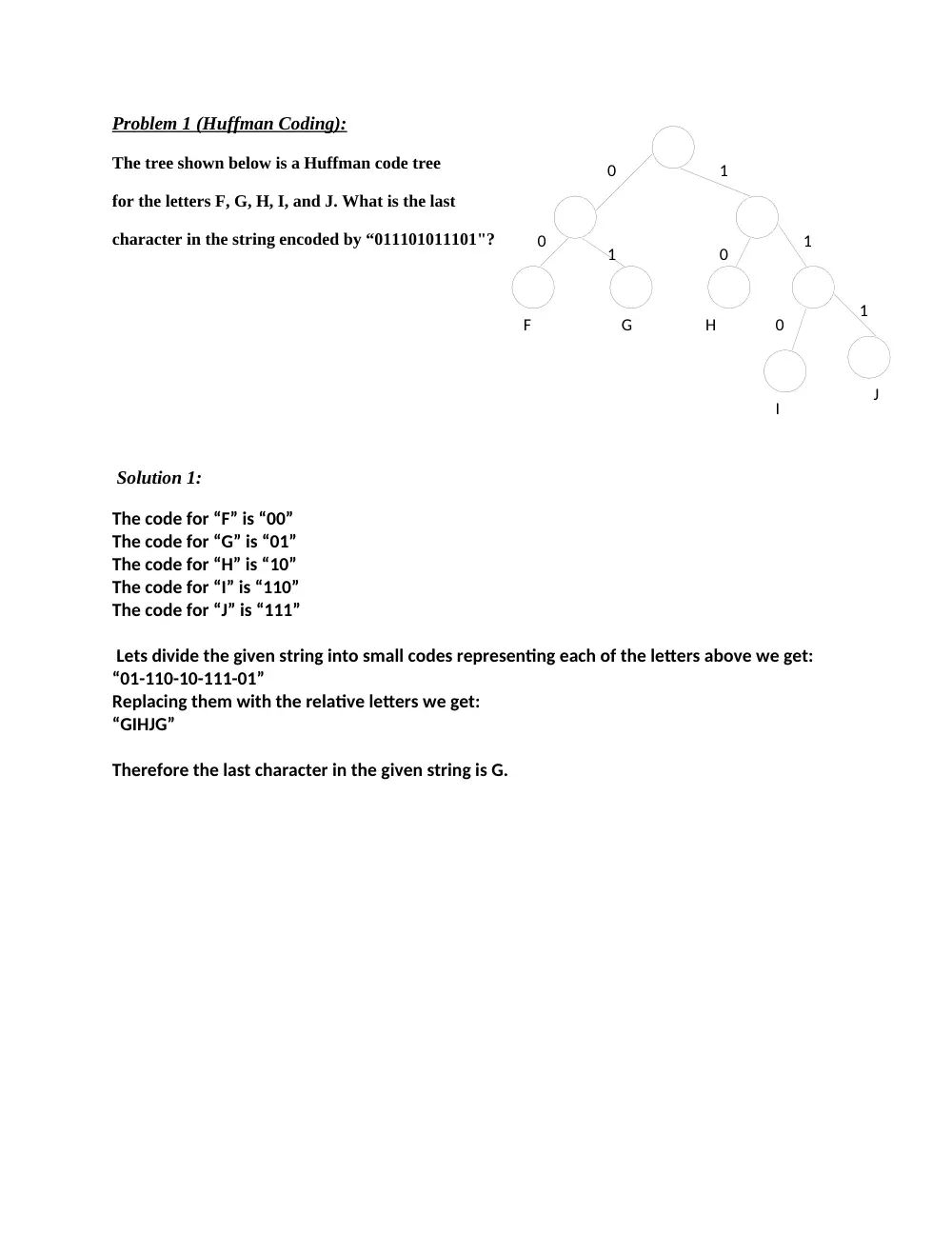
0
0
0
0
1
1
1
1
F
G
H
I
J
Problem 1 (Huffman Coding):
The tree shown below is a Huffman code tree
for the letters F, G, H, I, and J. What is the last
character in the string encoded by “011101011101"?
Solution 1:
The code for “F” is “00”
The code for “G” is “01”
The code for “H” is “10”
The code for “I” is “110”
The code for “J” is “111”
Lets divide the given string into small codes representing each of the letters above we get:
“01-110-10-111-01”
Replacing them with the relative letters we get:
“GIHJG”
Therefore the last character in the given string is G.
Problem 2 (Huffman Coding):
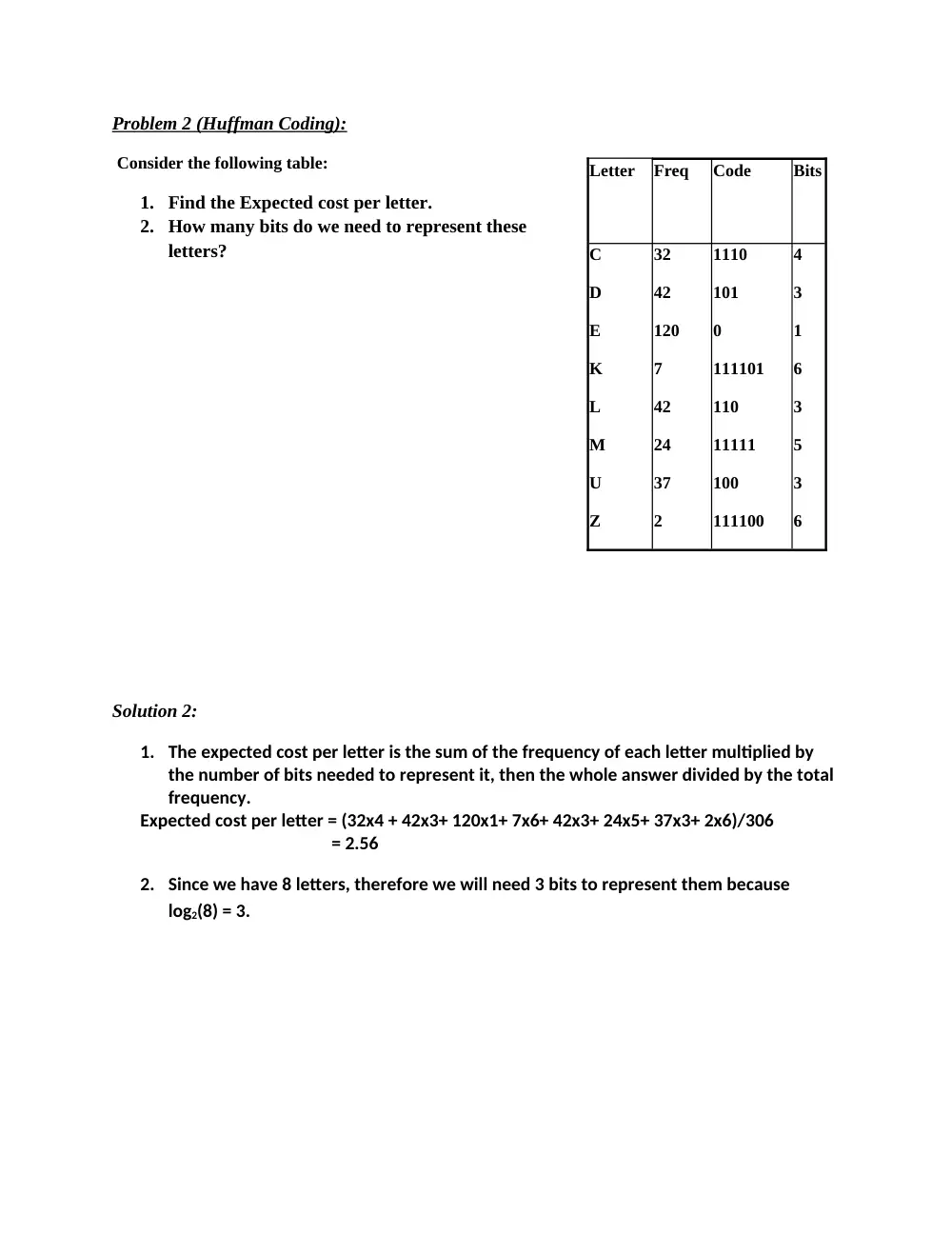
Consider the following table:
1. Find the Expected cost per letter.
2. How many bits do we need to represent these
letters?
Solution 2:
1. The expected cost per letter is the sum of the frequency of each letter multiplied by
the number of bits needed to represent it, then the whole answer divided by the total
frequency.
Expected cost per letter = (32x4 + 42x3+ 120x1+ 7x6+ 42x3+ 24x5+ 37x3+ 2x6)/306
= 2.56
2. Since we have 8 letters, therefore we will need 3 bits to represent them because
log2(8) = 3.
Letter
Freq
Code
Bits
C
32
1110
4
D
42
101
3
E
120
0
1
K
7
111101
6
L
42
110
3
M
24
11111
5
U
37
100
3
Z
2
111100
6
Problem 3 (Huffman Coding):
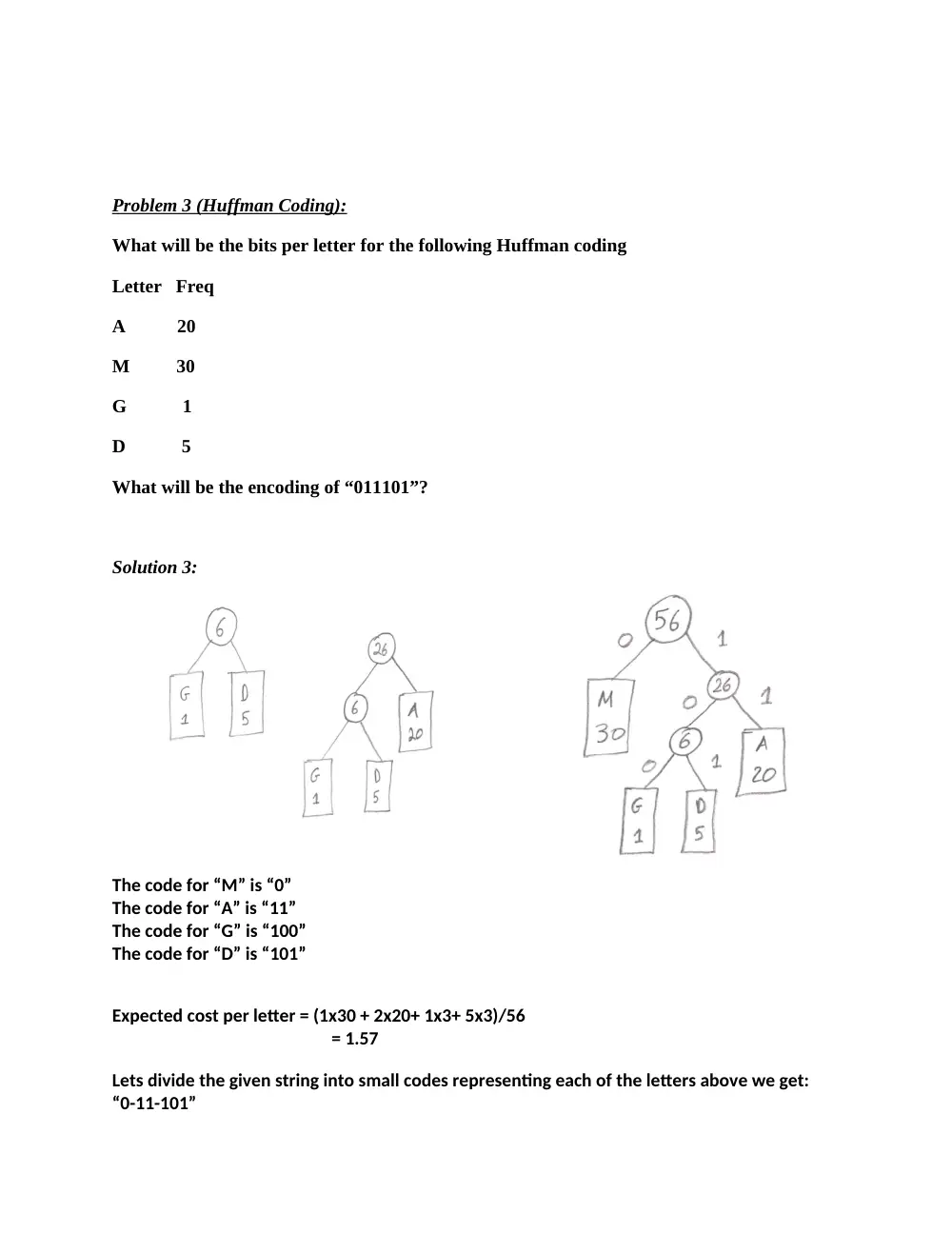
What will be the bits per letter for the following Huffman coding
Letter Freq
A 20
M 30
G 1
D 5
What will be the encoding of “011101”?
Solution 3:
The code for “M” is “0”
The code for “A” is “11”
The code for “G” is “100”
The code for “D” is “101”
Expected cost per letter = (1x30 + 2x20+ 1x3+ 5x3)/56
= 1.57
Lets divide the given string into small codes representing each of the letters above we get:
“0-11-101”
Replacing them with the relative letters we get:
“MAD”
Problem 4 (Huffman Coding):
The variable length coding is:
Z
K
F
C
U
D
L
E
2
7
24
32
37
42
42
120
Find the code for the word DEED.
Solution 4:
The
Huffman tree is:
Code for DEED is: “101 0 0 101”
Letter
Freq
Code
Bits
C
32
1110
4
D
42
101
3
E
120
0
1
K
7
111101
6
L
42
110
3
M
20
11111
5
U
37
100
3
Z
2
111100
6
Problem 5 (Huffman Coding):
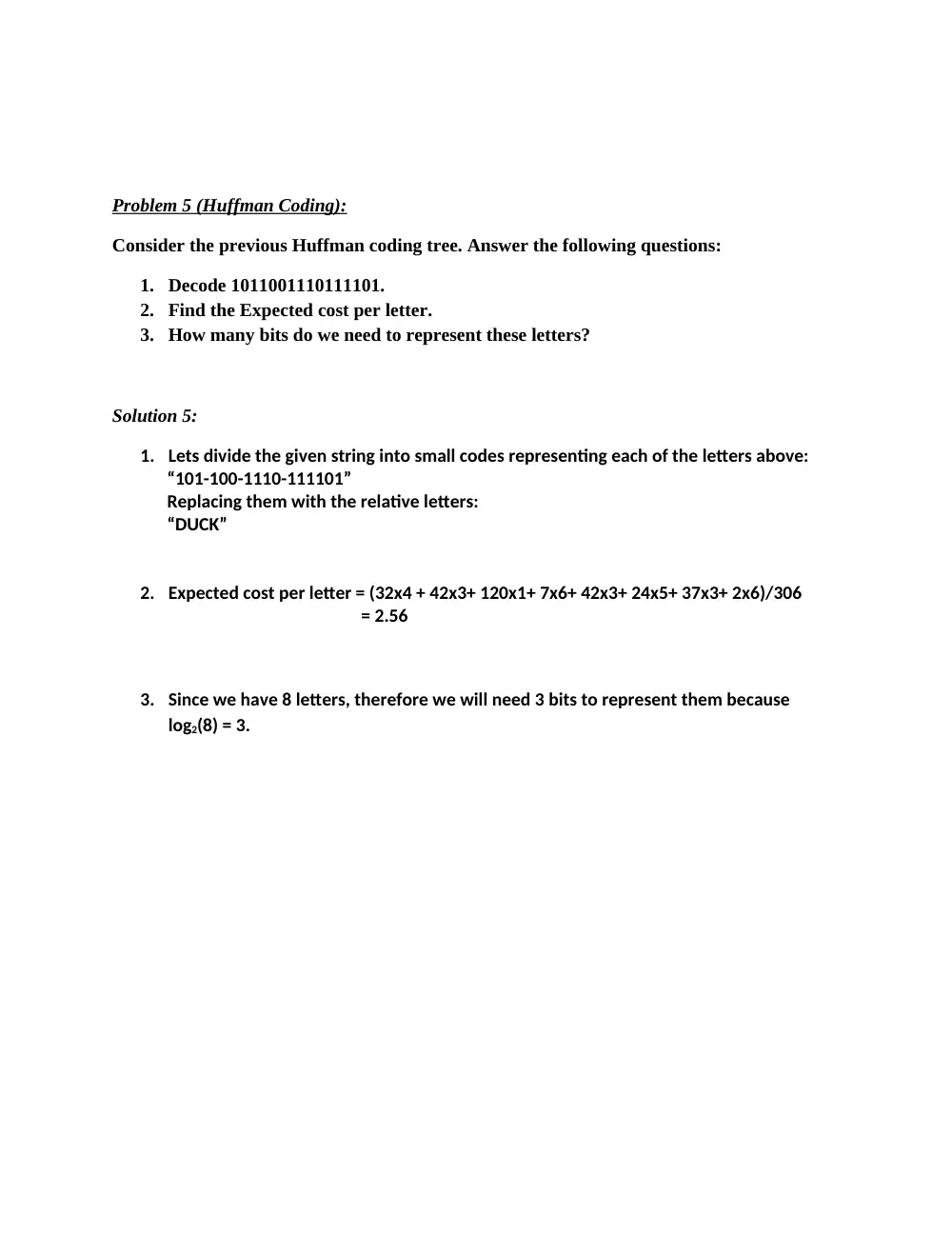
Consider the previous Huffman coding tree. Answer the following questions:
1. Decode 1011001110111101.
2. Find the Expected cost per letter.
3. How many bits do we need to represent these letters?
Solution 5:
1. Lets divide the given string into small codes representing each of the letters above:
“101-100-1110-111101”
Replacing them with the relative letters:
“DUCK”
2. Expected cost per letter = (32x4 + 42x3+ 120x1+ 7x6+ 42x3+ 24x5+ 37x3+ 2x6)/306
= 2.56
3. Since we have 8 letters, therefore we will need 3 bits to represent them because
log2(8) = 3.
Problem 6 (Huffman Coding):
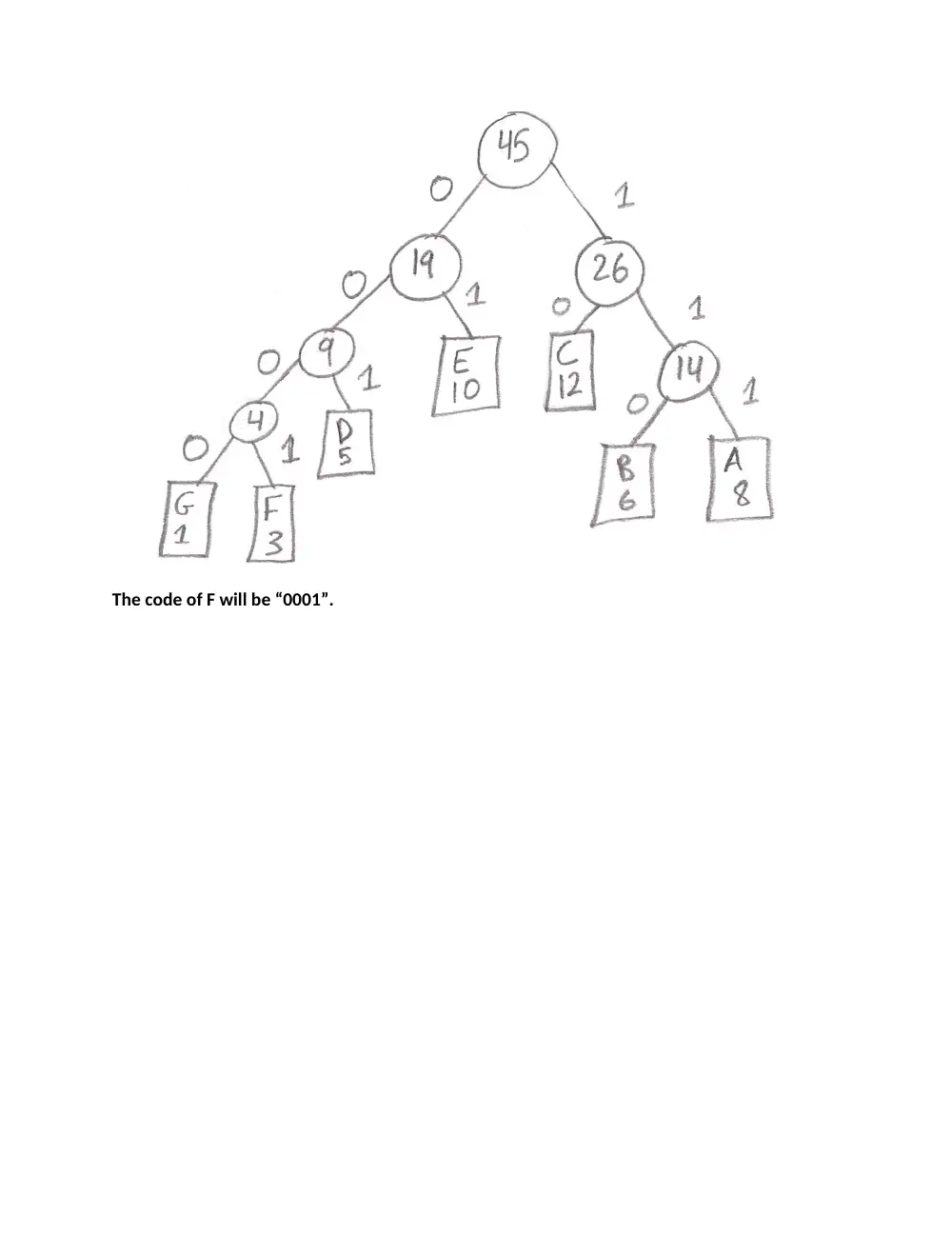
Given the following table:
Symbol
Frequency
A
8
B
6
C
12
D
5
E
10
F
3
G
1
What is the code of F?
Solution 6:
The Huffman Graph will be:
The code of F will be “0001”.