
EECE 330 Problems Solution Manual, Spring 2012
American University of Beirut · Data Structures and Algorithms · 101 pages · Prof. Hassan Artail · with solution


Showing the first 10 of 101 pages. Download the PDF to see all of it.
More EECE 330 files
- Exam 1 Artail Sample Questions (solution) · Summer 2014Problems · with solutionView
- Problems Binary Trees · Summer 2014ProblemsView
- Problems Huffman Coding · Summer 2014ProblemsView
- Problems For Exam · Fall 2011ProblemsView
- Problems For Quiz 1 · Fall 2009ProblemsView
- Problems (Samples) · Spring 2008ProblemsView
- Questions · Spring 2008ProblemsView
- Other Extra Lecture About Dynamic Programming · Spring 2017LabView
Show the text of this problems
Solutions Manual for
A Practical Introduction to
Data Structures and Algorithm
Analysis
Second Edition
Clifford A. Shaffer
Department of Computer Science
Virginia Tech
Blacksburg, VA 24061
November 30, 2000
Copyright c⃝2000 by Clifford A. Shaffer.
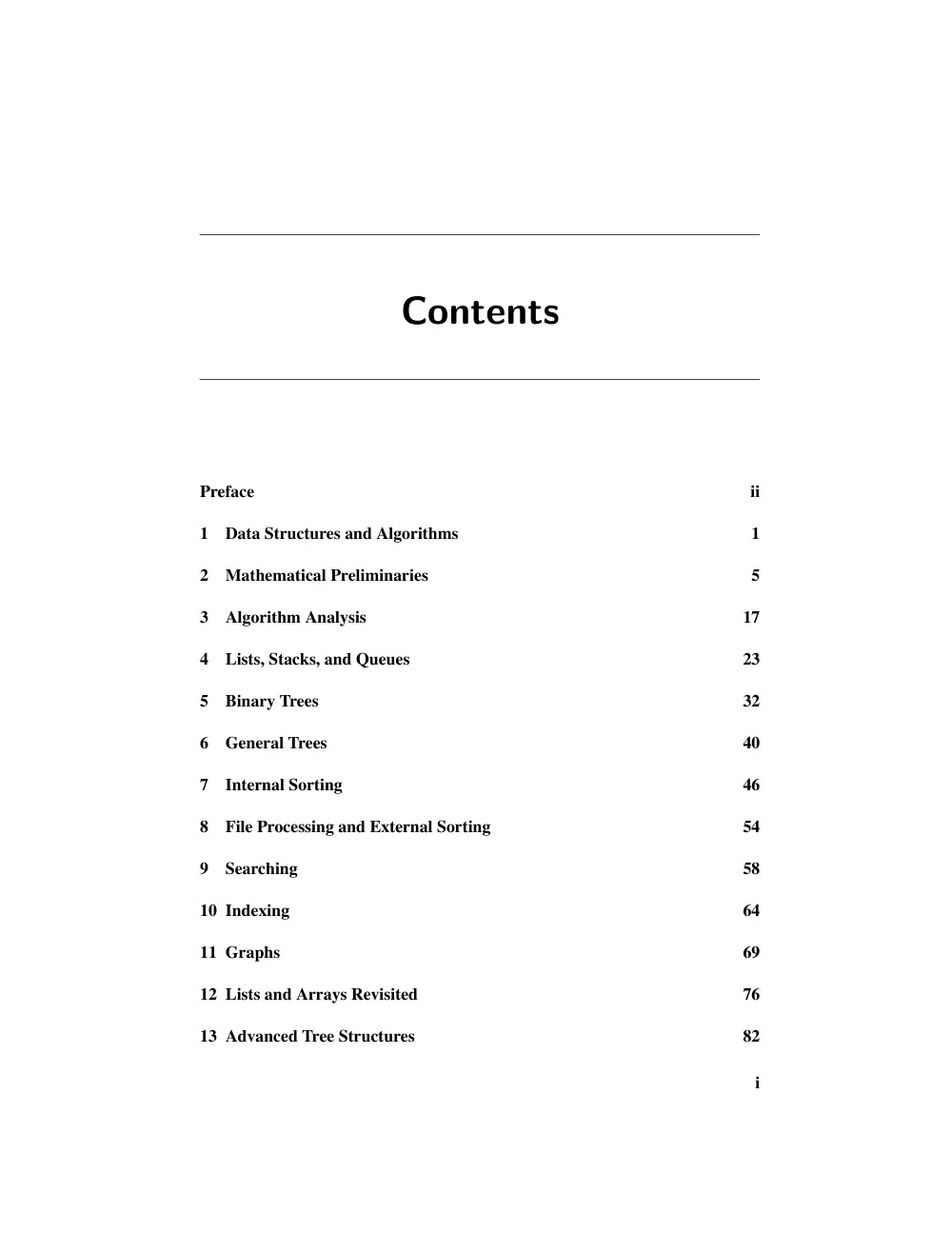
Contents
Preface
ii
1
Data Structures and Algorithms
1
2
Mathematical Preliminaries
5
3
Algorithm Analysis
17
4
Lists, Stacks, and Queues
23
5
Binary Trees
32
6
General Trees
40
7
Internal Sorting
46
8
File Processing and External Sorting
54
9
Searching
58
10 Indexing
64
11 Graphs
69
12 Lists and Arrays Revisited
76
13 Advanced Tree Structures
82
i
ii
Contents
14 Analysis Techniques
88
15 Limits to Computation
94
Preface
Contained herein are the solutions to all exercises from the textbook A Practical
Introduction to Data Structures and Algorithm Analysis, 2nd edition.
For most of the problems requiring an algorithm I have given actual code. In
a few cases I have presented pseudocode. Please be aware that the code presented
in this manual has not actually been compiled and tested. While I believe the algo-
rithms to be essentially correct, there may be errors in syntax as well as semantics.
Most importantly, these solutions provide a guide to the instructor as to the intended
answer, rather than usable programs.
iii
1
Data Structures and Algorithms
Instructor’s note: Unlike the other chapters, many of the questions in this chapter
are not really suitable for graded work. The questions are mainly intended to get
students thinking about data structures issues.
1.1 This question does not have a specific right answer, provided the student
keeps to the spirit of the question. Students may have trouble with the con-
cept of “operations.”
1.2 This exercise asks the student to expand on their concept of an integer repre-
sentation. A good answer is described by Project 4.5, where a singly-linked
list is suggested. The most straightforward implementation stores each digit
in its own list node, with digits stored in reverse order. Addition and multi-
plication are implemented by what amounts to grade-school arithmetic. For
addition, simply march down in parallel through the two lists representing
the operands, at each digit appending to a new list the appropriate partial
sum and bringing forward a carry bit as necessary. For multiplication, com-
bine the addition function with a new function that multiplies a single digit
by an integer. Exponentiation can be done either by repeated multiplication
(not really practical) or by the traditional Θ(log n)-time algorithm based on
the binary representation of the exponent. Discovering this faster algorithm
will be beyond the reach of most students, so should not be required.
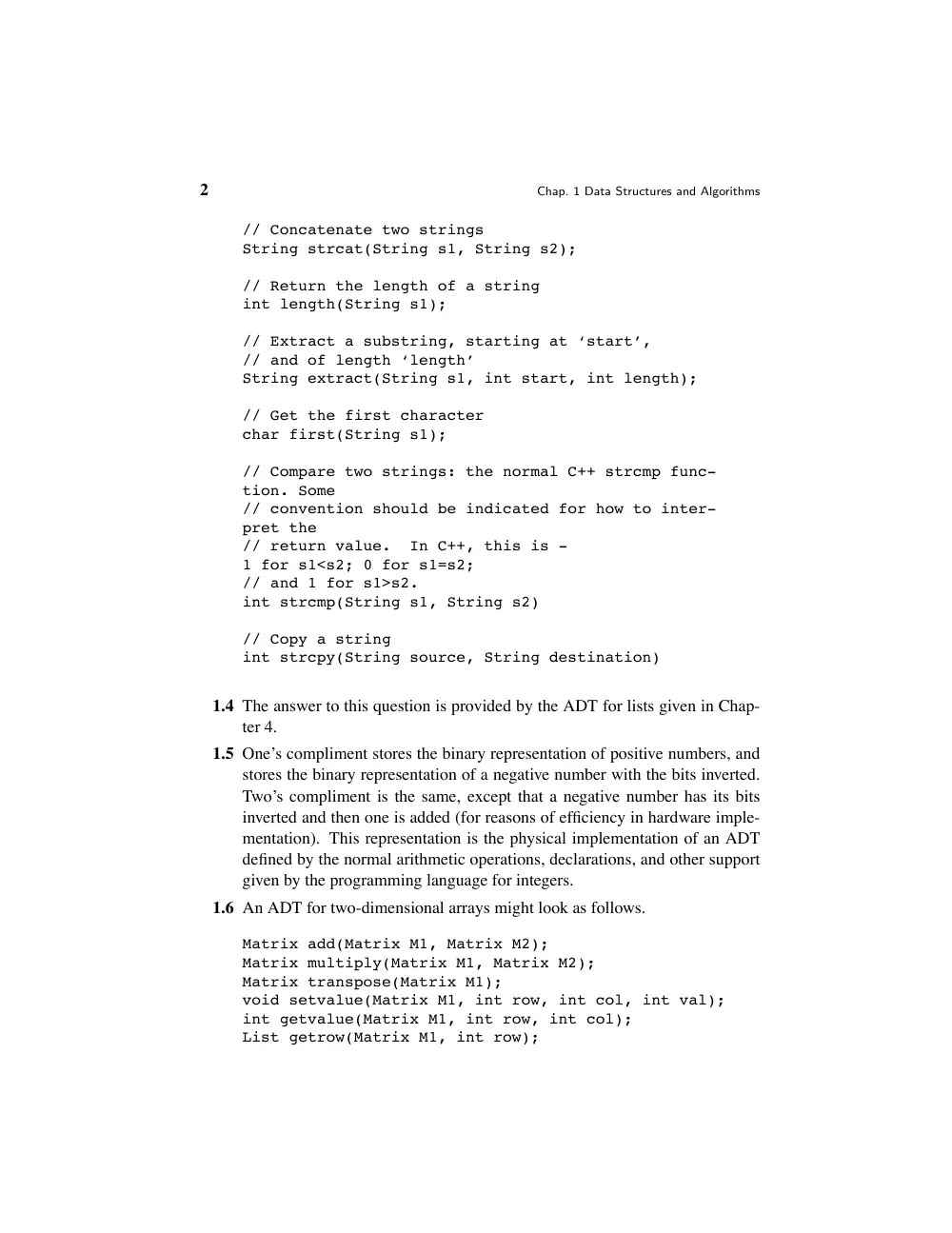
1.3 A sample ADT for character strings might look as follows (with the normal
interpretation of the function names assumed).
1
2
Chap. 1 Data Structures and Algorithms
// Concatenate two strings
String strcat(String s1, String s2);
// Return the length of a string
int length(String s1);
// Extract a substring, starting at ‘start’,
// and of length ‘length’
String extract(String s1, int start, int length);
// Get the first character
char first(String s1);
// Compare two strings: the normal C++ strcmp func-
tion. Some
// convention should be indicated for how to inter-
pret the
// return value.
In C++, this is -
1 for s1<s2; 0 for s1=s2;
// and 1 for s1>s2.
int strcmp(String s1, String s2)
// Copy a string
int strcpy(String source, String destination)
1.4 The answer to this question is provided by the ADT for lists given in Chap-
ter 4.
1.5 One’s compliment stores the binary representation of positive numbers, and
stores the binary representation of a negative number with the bits inverted.
Two’s compliment is the same, except that a negative number has its bits
inverted and then one is added (for reasons of efficiency in hardware imple-
mentation). This representation is the physical implementation of an ADT
defined by the normal arithmetic operations, declarations, and other support
given by the programming language for integers.
1.6 An ADT for two-dimensional arrays might look as follows.
Matrix add(Matrix M1, Matrix M2);
Matrix multiply(Matrix M1, Matrix M2);
Matrix transpose(Matrix M1);
void setvalue(Matrix M1, int row, int col, int val);
int getvalue(Matrix M1, int row, int col);
List getrow(Matrix M1, int row);
3
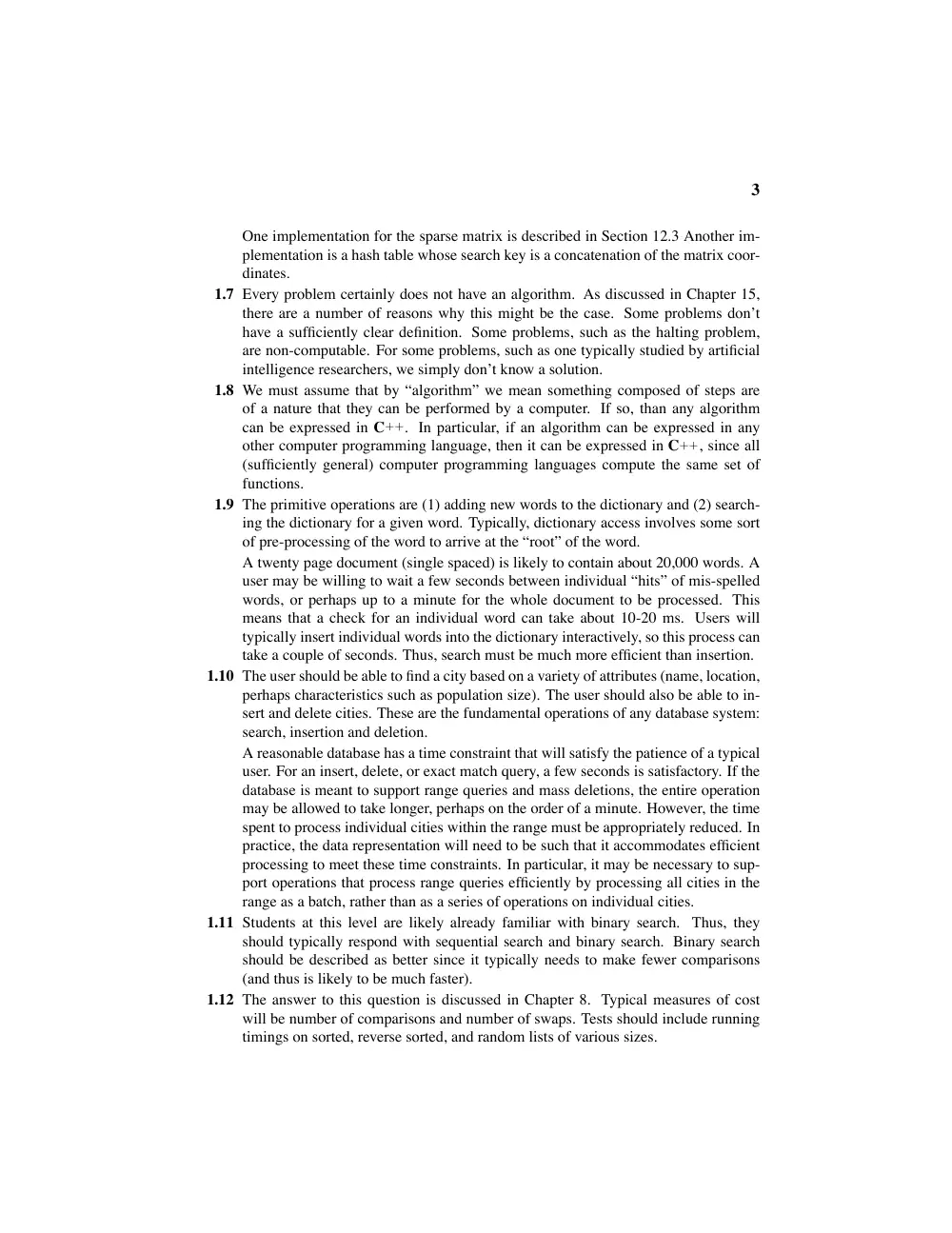
One implementation for the sparse matrix is described in Section 12.3 Another im-
plementation is a hash table whose search key is a concatenation of the matrix coor-
dinates.
1.7 Every problem certainly does not have an algorithm. As discussed in Chapter 15,
there are a number of reasons why this might be the case. Some problems don’t
have a sufficiently clear definition. Some problems, such as the halting problem,
are non-computable. For some problems, such as one typically studied by artificial
intelligence researchers, we simply don’t know a solution.
1.8 We must assume that by “algorithm” we mean something composed of steps are
of a nature that they can be performed by a computer. If so, than any algorithm
can be expressed in C++. In particular, if an algorithm can be expressed in any
other computer programming language, then it can be expressed in C++, since all
(sufficiently general) computer programming languages compute the same set of
functions.
1.9 The primitive operations are (1) adding new words to the dictionary and (2) search-
ing the dictionary for a given word. Typically, dictionary access involves some sort
of pre-processing of the word to arrive at the “root” of the word.
A twenty page document (single spaced) is likely to contain about 20,000 words. A
user may be willing to wait a few seconds between individual “hits” of mis-spelled
words, or perhaps up to a minute for the whole document to be processed. This
means that a check for an individual word can take about 10-20 ms. Users will
typically insert individual words into the dictionary interactively, so this process can
take a couple of seconds. Thus, search must be much more efficient than insertion.
1.10 The user should be able to find a city based on a variety of attributes (name, location,
perhaps characteristics such as population size). The user should also be able to in-
sert and delete cities. These are the fundamental operations of any database system:
search, insertion and deletion.
A reasonable database has a time constraint that will satisfy the patience of a typical
user. For an insert, delete, or exact match query, a few seconds is satisfactory. If the
database is meant to support range queries and mass deletions, the entire operation
may be allowed to take longer, perhaps on the order of a minute. However, the time
spent to process individual cities within the range must be appropriately reduced. In
practice, the data representation will need to be such that it accommodates efficient
processing to meet these time constraints. In particular, it may be necessary to sup-
port operations that process range queries efficiently by processing all cities in the
range as a batch, rather than as a series of operations on individual cities.
1.11 Students at this level are likely already familiar with binary search. Thus, they
should typically respond with sequential search and binary search. Binary search
should be described as better since it typically needs to make fewer comparisons
(and thus is likely to be much faster).
1.12 The answer to this question is discussed in Chapter 8. Typical measures of cost
will be number of comparisons and number of swaps. Tests should include running
timings on sorted, reverse sorted, and random lists of various sizes.
4
Chap. 1 Data Structures and Algorithms
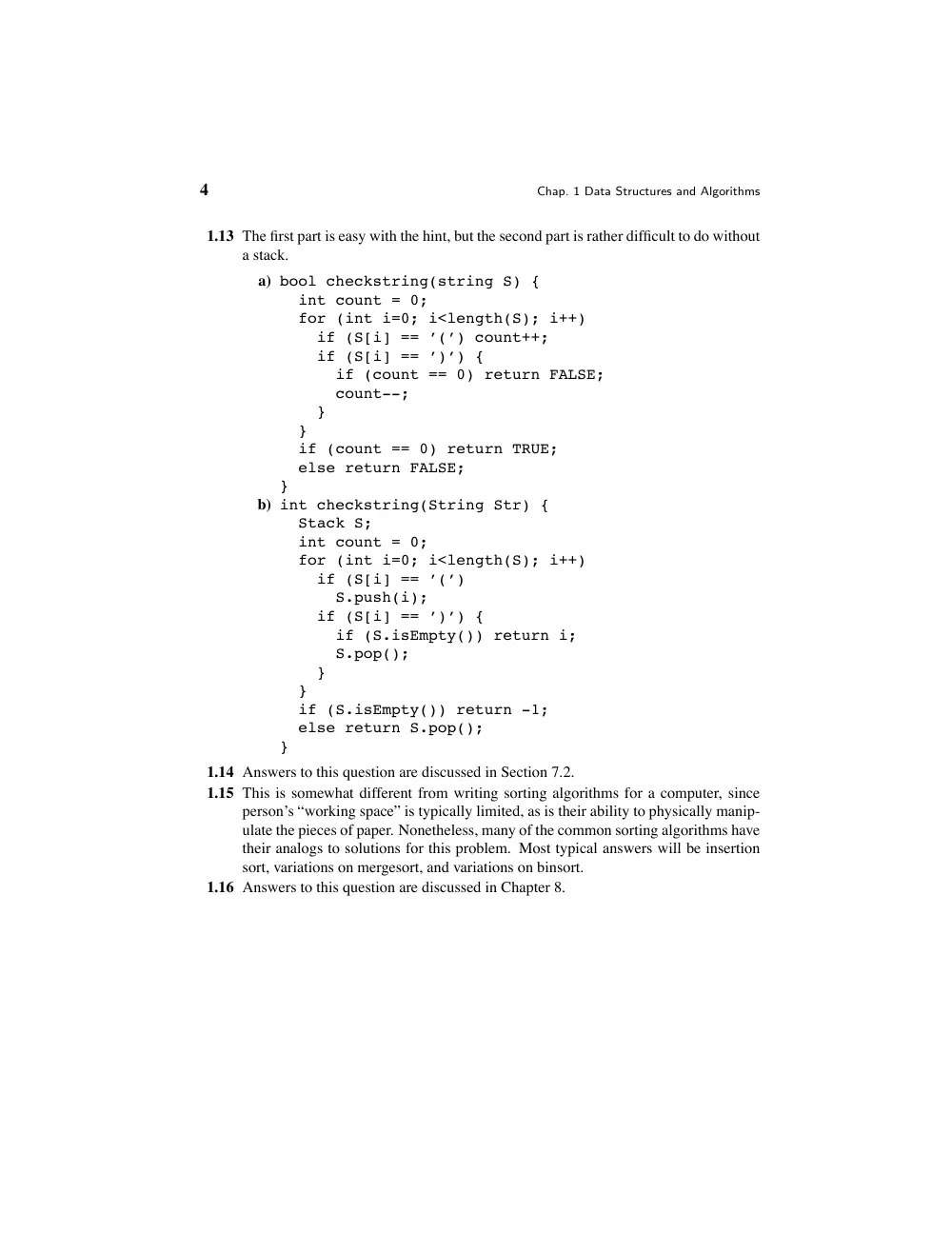
1.13 The first part is easy with the hint, but the second part is rather difficult to do without
a stack.
a) bool checkstring(string S) {
int count = 0;
for (int i=0; i<length(S); i++)
if (S[i] == ’(’) count++;
if (S[i] == ’)’) {
if (count == 0) return FALSE;
count--;
}
}
if (count == 0) return TRUE;
else return FALSE;
}
b) int checkstring(String Str) {
Stack S;
int count = 0;
for (int i=0; i<length(S); i++)
if (S[i] == ’(’)
S.push(i);
if (S[i] == ’)’) {
if (S.isEmpty()) return i;
S.pop();
}
}
if (S.isEmpty()) return -1;
else return S.pop();
}
1.14 Answers to this question are discussed in Section 7.2.
1.15 This is somewhat different from writing sorting algorithms for a computer, since
person’s “working space” is typically limited, as is their ability to physically manip-
ulate the pieces of paper. Nonetheless, many of the common sorting algorithms have
their analogs to solutions for this problem. Most typical answers will be insertion
sort, variations on mergesort, and variations on binsort.
1.16 Answers to this question are discussed in Chapter 8.
2
Mathematical Preliminaries
2.1
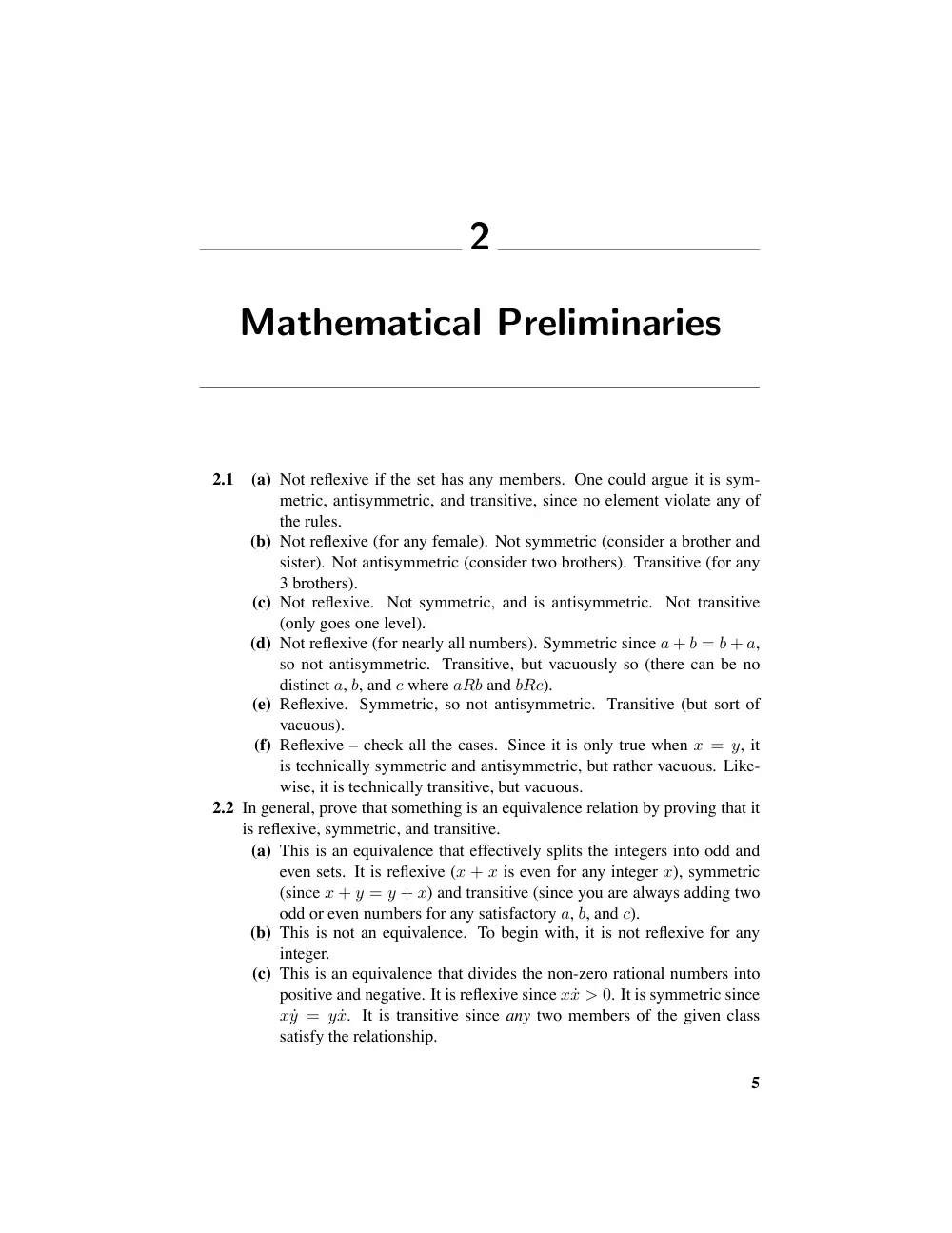
(a) Not reflexive if the set has any members. One could argue it is sym-
metric, antisymmetric, and transitive, since no element violate any of
the rules.
(b) Not reflexive (for any female). Not symmetric (consider a brother and
sister). Not antisymmetric (consider two brothers). Transitive (for any
3 brothers).
(c) Not reflexive. Not symmetric, and is antisymmetric. Not transitive
(only goes one level).
(d) Not reflexive (for nearly all numbers). Symmetric since a + b = b + a,
so not antisymmetric. Transitive, but vacuously so (there can be no
distinct a, b, and c where aRb and bRc).
(e) Reflexive. Symmetric, so not antisymmetric. Transitive (but sort of
vacuous).
(f) Reflexive – check all the cases. Since it is only true when x = y, it
is technically symmetric and antisymmetric, but rather vacuous. Like-
wise, it is technically transitive, but vacuous.
2.2 In general, prove that something is an equivalence relation by proving that it
is reflexive, symmetric, and transitive.
(a) This is an equivalence that effectively splits the integers into odd and
even sets. It is reflexive (x + x is even for any integer x), symmetric
(since x + y = y + x) and transitive (since you are always adding two
odd or even numbers for any satisfactory a, b, and c).
(b) This is not an equivalence. To begin with, it is not reflexive for any
integer.
(c) This is an equivalence that divides the non-zero rational numbers into
positive and negative. It is reflexive since x ˙x > 0. It is symmetric since
x ˙y = y ˙x. It is transitive since any two members of the given class
satisfy the relationship.
5
6
Chap. 2 Mathematical Preliminaries
(d) This is not an equivalance relation since it is not symmetric. For exam-
ple, a = 1 and b = 2.
(e) This is an eqivalance relation that divides the rationals based on their
fractional values. It is reflexive since for all a, a−a = 0. It is symmetric
since if a−b = x then b−a = −x. It is transitive since any two rationals
with the same fractional value will yeild an integer.
(f) This is not an equivalance relation since it is not transitive. For exam-
ple, 4 − 2 = 2 and 2 − 0 = 2, but 4 − 0 = 4.
2.3 A relation is a partial ordering if it is antisymmetric and transitive.
(a) Not a partial ordering because it is not transitive.
(b) Is a partial ordering bacause it is antisymmetric (if a is an ancestor of
b, then b cannot be an ancestor of a) and transitive (since the ancestor
of an ancestor is an ancestor).
(c) Is a partial ordering bacause it is antisymmetric (if a is older than b,
then b cannot be older than a) and transitive (since if a is older than b
and b is older than c, a is older than c).
(d) Not a partial ordering, since it is not antisymmetric for any pair of sis-
ters.
(e) Not a partial ordering because it is not antisymmetric.
(f) This is a partial ordering. It is antisymmetric (no violations exist) and
transitive (no violations exist).
2.4 A total ordering can be viewed as a permuation of the elements. Since there
are n! permuations of n elements, there must be n! total orderings.
2.5 This proposed ADT is inspired by the list ADT of Chapter 4.
void clear();
void insert(int);
void remove(int);
void sizeof();
bool isEmpty();
bool isInSet(int);
2.6 This proposed ADT is inspired by the list ADT of Chapter 4. Note that while
it is similiar to the operations proposed for Question 2.5, the behaviour is
somewhat different.
void clear();
void insert(int);
void remove(int);
void sizeof();
7
bool isEmpty();
// Return the number of elements with a given valueint
countInBag(int);
2.7 The list class ADT from Chapter 4 is a sequence.
2.8 long ifact(int n) { // make n <= 12 so n! for long int
long fact = 1;
Assert((n >= 0) && (n <= 12), "Input out of range");
for (int i=1; i<= n; i++)
fact = fact * i;
return fact;
}
2.9 void rpermute(int *array, int n) {
swap(array, n-1, Random(n));
rpermute(array, n-1);
}
2.10
(a) Most people will find the recursive form natural and easy to understand.
The iterative version requires careful examination to understand what
it does, or to have confidence that it works as claimed.
(b) Fibr is so much slower than Fibi because Fibr re-computes the
bulk of the series twice to get the two values to add. What is much
worse, the recursive calls to compute the subexpressions also re-com-
pute the bulk of the series, and do so recursively. The result is an expo-
nential explosion. In contrast, Fibi computes each value in the series
exactly once, and so its running time is proportional to n.
2.11 // Array curr[i] indicates current position of ring i.
void GenTOH(int n, POLE goal, POLE t1, POLE t2,
POLE* curr) {
if (curr[n] == goal) // Get top n-1 rings set up
GenTOH(n-1, goal, t1, t2, curr);
else {
if (curr[n] == t1) swap(t1, t2); // Get names right
// Now, ring n is on pole t2.
Put others on t1.
GenTOH(n-1, t1, goal, t2, curr);
move(t2, goal);
GenTOH(n-1, goal, t1, t2, curr); // Move n-1 back
}
}
2.12 At each step of the way, the reduction toward the base case is only half as
far as the previous time. In theory, this series approaches, but never reaches,
0, so it will go on forever. In practice, the value should become computa-
tionally indistinguishable from zero, and terminate. However, this is terrible
programming practice.
8
Chap. 2 Mathematical Preliminaries
2.13 void allpermute(int array[], int n, int currpos) {
if (currpos == (n-1)} {
printout(array);
return;
}
for (int i=currpos; i<n; i++) {
swap(array, currpos, i);
allpermute(array, n, currpos+1);
swap(array, currpos, i);
// Put back for next pass
}
}
2.14 In the following, function bitposition(n, i) returns the value (0 or
1) at the ith bit position of integer value n. The idea is the print out the
elements at the indicated bit positions within the set. If we do this for values
in the range 0 to 2n − 1, we will get the entire powerset.
void powerset(int n) {
for (int i=0; i<ipow(2, n); i++) {
for (int j=0; j<n; j++)
if (bitposition(n, j) == 1) cout << j << " ";
cout << endl;
}
2.15 Proof: Assume that there is a largest prime number. Call it Pn, the nth
largest prime number, and label all of the primes in order P1 = 2, P2 = 3,
and so on. Now, consider the number C formed by multiplying all of the n
prime numbers together. The value C + 1 is not divisible by any of the n
prime numbers. C + 1 is a prime number larger than Pn, a contradiction.
Thus, we conclude that there is no largest prime number.
✷
2.16 Note: This problem is harder than most sophomore level students can handle.
Proof: The proof is by contradiction. Assume that
√
2 is rational. By defini-
tion, there exist integers p and q such that
√
2 = p
q ,
where p and q have no common factors (that is, the fraction p/q is in lowest
terms). By squaring both sides and doing some simple algebraic manipula-
tion, we get
2
=
p2
q2
2q2
=
p2
Since p2 must be even, p must be even. Thus,
9
2q2
=
4(p
2)2
q2
=
2(p
2)2
This implies that q2 is also even. Thus, p and q are both even, which contra-
dicts the requirement that p and q have no common factors. Thus,
√
2 must
be irrational.
✷
2.17 The leftmost summation sums the integers from 1 to n. The second summa-
tion merely reverses this order, summing the numbers from n − 1 + 1 = n
down to n − n + 1 = 1. The third summation has a variable substitution of
i−1 for i, with a corresponding substitution in the summation bounds. Thus,
it is also the summation of n − 0 = n to n − (n − 1) = 1.
2.18 Proof:
(a) Base case. For n = 1, 12 = [2(1)3 + 3(1)2 + 1]/6 = 1. Thus, the
formula is correct for the base case.
(b) Induction Hypothesis.
n−1
�
i=1
i2 = 2(n − 1)3 + 3(n − 1)2 + (n − 1)
6
.
(c) Induction Step.
n
�
i=1
i2
=
n−1
�
i=1
i2 + n2
=
2(n − 1)3 + 3(n − 1)2 + (n − 1)
6
+ n2
=
2n3 − 6n2 + 6n − 2 + 3n2 − 6n + 3 + n − 1
6
+ n2
=
2n3 + 3n2 + n
6
.
Thus, the theorem is proved by mathematical induction.
✷
2.19 Proof:
(a) Base case. For n = 1, 1/2 = 1 − 1/2 = 1/2. Thus, the formula is
correct for the base case.
(b) Induction Hypothesis.
n−1
�
i=1
1
2i = 1 −
1
2n−1 .
10
Chap. 2 Mathematical Preliminaries
(c) Induction Step.
n
�
i=1
1
2i
=
n−1
�
i=1
1
2i + 1
2n
=
1 −
1
2n−1 + 1
2n
=
1 − 1
2n .
Thus, the theorem is proved by mathematical induction.
✷
2.20 Proof:
(a) Base case. For n = 0, 20 = 21 − 1 = 1. Thus, the formula is correct
for the base case.
(b) Induction Hypothesis.
n−1
�
i=0
2i = 2n − 1.
(c) Induction Step.
n
�
i=0
2i
=
n−1
�
i=0
2i + 2n
=
2n − 1 + 2n
=
2n+1 − 1.
Thus, the theorem is proved by mathematical induction.
✷
2.21 The closed form solution is 3n+1−3
2
, which I deduced by noting that 3F(n)−
F(n) = 2F(n) = 3n+1 − 3. Now, to verify that this is correct, use mathe-
matical induction as follows.
For the base case, F(1) = 3 = 32−3
2 .
The induction hypothesis is that �n−1
i=1 = (3n − 3)/2.
So,
n
�
i=1
3i
=
n−1
�
i=1
3i + 3n
=
3n − 3
2
+ 3n
=
3n+1 − 3
2
.
Thus, the theorem is proved by mathematical induction.
11
2.22 Theorem 2.1 �n
i=1(2i) = n2 + n.
(a) Proof: We know from Example 2.3 that the sum of the first n odd
numbers is n2. The ith even number is simply one greater than the ith
odd number. Since we are adding n such numbers, the sum must be n
greater, or n2 + n.
✷
(b) Proof: Base case: n = 1 yields 2 = 12 + 1, which is true.
Induction Hypothesis:
n−1
�
i=1
2i = (n − 1)2 + (n − 1).
Induction Step: The sum of the first n even numbers is simply the sum
of the first n − 1 even numbers plus the nth even number.
n
�
i=1
2i
=
(
n−1
�
i=1
2i) + 2n
=
(n − 1)2 + (n − 1) + 2n
=
(n2 − 2n + 1) + (n − 1) + 2n
=
n2 − n + 2n
=
n2 + n.
Thus, by mathematical induction, �n
i=1 2i = n2 + n.
✷
2.23 Proof:
Base case. For n = 1, Fib(1) = 1 < 5
3. For n = 2, Fib(2) = 1 < (5
3)2.
Thus, the formula is correct for the base case.
Induction Hypothesis. For all positive integers i < n,
Fib(i) < (5
3)i.
Induction Step. Fib(n) = Fib(n − 1) + Fib(n − 2) and, by the Induction
Hypothesis, Fib(n − 1) < (5
3)n−1 and Fib(n − 2) < (5
3)n−2. So,
Fib(n)
<
(5
3)n−1 + (5
3)n−2
<
5
3(5
3)n−2 + (5
3)n−2
12
Chap. 2 Mathematical Preliminaries
=
8
3(5
3)n−2
<
(5
3)2(5
3)n−2
=
5
3
n
.
Thus, the theorem is proved by mathematical induction.
✷
2.24 Proof:
(a) Base case. For n = 1, 13 = 12(1+1)2
4
= 1. Thus, the formula is correct
for the base case.
(b) Induction Hypothesis.
n−1
�
i=0
i3 = (n − 1)2n2
4
.
(c) Induction Step.
n
�
i=0
i3
=
(n − 1)2n2
4
+ n3
=
n4 − 2n3 + n2
4
+ n3
=
n4 + 2n3 + n2
4
=
n2(n2 + 2n + 2)
4
=
n2(n + 1)2
4
Thus, the theorem is proved by mathematical induction.
✷
2.25
(a) Proof: By contradiction. Assume that the theorem is false. Then, each
pigeonhole contains at most 1 pigeon. Since there are n holes, there is
room for only n pigeons. This contradicts the fact that a total of n + 1
pigeons are within the n holes. Thus, the theorem must be correct.
✷
(b) Proof:
i. Base case. For one pigeon hole and two pigeons, there must be
two pigeons in the hole.
ii. Induction Hypothesis. For n pigeons in n − 1 holes, some hole
must contain at least two pigeons.
13
iii. Induction Step. Consider the case where n + 1 pigeons are in n
holes. Eliminate one hole at random. If it contains one pigeon,
eliminate it as well, and by the induction hypothesis some other
hole must contain at least two pigeons. If it contains no pigeons,
then again by the induction hypothesis some other hole must con-
tain at least two pigeons (with an extra pigeon yet to be placed). If
it contains more than one pigeon, then it fits the requirements of
the theorem directly.
✷
2.26
(a) When we add the nth line, we create n new regions. But, we start
with one region even when there are no lines. Thus, the recurrence is
F(n) = F(n − 1) + n + 1.
(b) This is equivalent to the summation F(n) = 1 + �
i=1 ni.
(c) This is close to a summation we already know (equation 2.1).
2.27 Base case: T(n − 1) = 1 = 1(1 + 1)/2.
Induction hypothesis: T(n − 1) = (n − 1)(n)/2.
Induction step:
T(n)
=
T(n − 1) + n
=
(n − 1)(n)/2 + n
=
n(n + 1)/2.
Thus, the theorem is proved by mathematical induction.
2.28 If we expand the recurrence, we get
T(n) = 2T(n − 1) + 1 = 2(2T(n − 2) + 1) + 1) = 4T(n − 2 + 2 + 1.
Expanding again yields
T(n) = 8T(n − 3) + 4 + 2 + 1.
From this, we can deduce a pattern and hypothesize that the recurrence is
equivalent to
T(n) =
n
�
i=0
−12i = 2n − 1.
To prove this formula is in fact the proper closed form solution, we use math-
ematical induction.
Base case: T(1) = 21 − 1 = 1.
14
Chap. 2 Mathematical Preliminaries
Induction hypothesis: T(n − 1) = 2n−1 − 1.
Induction step:
T(n)
=
2T(n − 1) + 1
=
2(2n−1 − 1) + 1
=
2n − 1.
Thus, as proved by mathematical induction, this formula is indeed the correct
closed form solution for the recurrence.
2.29
(a) The probability is 0.5 for each choice.
(b) The average number of “1” bits is n/2, since each position has 0.5
probability of being “1.”
(c) The leftmost “1” will be the leftmost bit (call it position 0) with prob-
ability 0.5; in position 1 with probability 0.25, and so on. The number
of positions we must examine is 1 in the case where the leftmost “1” is
in position 0; 2 when it is in position 1, and so on. Thus, the expected
cost is the value of the summation
n
�
i=1
i
2i .
The closed form for this summation is 2 − n+2
2n , or just less than two.
Thus, we expect to visit on average just less than two positions. (Stu-
dents at this point will probably not be able to solve this summation,
and it is not given in the book.)
2.30 There are at least two ways to approach this problem. One is to estimate the
volume directly. The second is to generate volume as a function of weight.
This is especially easy if using the metric system, assuming that the human
body is roughly the density of water. So a 50 Kilo person has a volume
slightly less than 50 liters; a 160 pound person has a volume slightly less
than 20 gallons.
2.31
(a) Image representations vary considerably, so the answer will vary as a
result. One example answer is: Consider VGA standard size, full-color
(24 bit) images, which is 3 × 640 × 480, or just less than 1 Mbyte per
image. The full database requires some 30-35 CDs.
(b) Since we needed 30-35 CDs before, compressing by a factor of 10 is
not sufficient to get the database onto one CD.
[Note that if the student picked a smaller format, such as estimating the
size of a “typical” gif image, the result might well fit onto a single CD.]
15
2.32 (I saw this problem in John Bentley’s Programming Pearls.) Approach 1:
The model is Depth X Width X Flow where Depth and Width are in miles
and Flow is in miles/day. The Mississippi river at its mouth is about 1/4 mile
wide and 100 feet (1/50 mile) deep, with a flow of around 15 miles/hour =
360 miles/day. Thus, the flow is about 2 cubic miles/day.
Approach 2: What goes out must equal what goes in. The model is Area X
Rainfall where Area is in square miles and Rainfall is in (linear) miles/day.
The Mississipi watershed is about 1000 X 1000 miles, and the average rainfal
is about 40 inches/year ≈ .1 inches/day ≈ .000002 miles/day (2 X 10⁻⁶).
Thus, the flow is about 2 cubic miles/day.
2.33 Note that the student should NOT be providing answers that look like they
were done using a calculator. This is supposed to be an exercise in estima-
tion!
The amount of the mortgage is irrelevant, since this is a question about rates.
However, to give some numbers to help you visualize the problem, pick a
$100,000 mortgage. The up-front charge would be $1,000, and the savings
would be 1/4% each payment over the life of the mortgage. The monthly
charge will be on the remaining principle, being the highest at first and grad-
ually reducing over time. But, that has little effect for the first few years.
At the grossest approximation, you paid 1% to start and will save 1/4% each
year, requiring 4 years. To be more precise, 8% of $100,000 is $8,000, while
7 3/4% is $7,750 (for the first year), with a little less interest paid (and there-
fore saved) in following years. This will require a payback period of slightly
over 4 years to save $1000. If the money had been invested, then in 5 years
the investment would be worth about $1300 (at 5would be close to 5 1/2
years.
2.34 Disk drive seek time is somewhere around 10 milliseconds or a little less
in 2000. RAM memory requires around 50 nanoseconds – much less than
a microsecond. Given that there are about 30 million seconds in a year, a
machine capable of executing at 100 MIPS would execute about 3 billion
billion (3 ∗ 1018) instructions in a year.
2.35 Typical books have around 500 pages/inch of thickness, so one million pages
requires 2000 inches or 150-200 feet of bookshelf. This would be in excess of
50 typical shelves, or 10-20 bookshelves. It is within the realm of possibility
that an individual home has this many books, but it is rather unusual.
2.36 A typical page has around 400 words (best way to derive this is to estimate
the number of words/line and lines/page), and the book has around 500 pages,
so the total is around 200,000 words.
16
Chap. 2 Mathematical Preliminaries
2.37 An hour has 3600 seconds, so one million seconds is a bit less than 300 hours.
A good estimater will notice that 3600 is about 10% greater than 3333, so the
actual number of hours is about 10% less than 300, or close to 270. (The real
value is just under 278). Of course, this is just over 11 days.
2.38 Well over 100,000, depending on what you wish to classify as a city or town.
The real question is what technique the student uses.
2.39
(a) The time required is 1 minute for the first mile, then 60/59 minutes
for the second mile, and so on until the last mile requires 60/1 = 60
minutes. The result is the following summation.
60
�
i=1
60/i = 60
60
�
i=1
1/i = 60H60.
(b) This is actually quite easy. The man will never reach his destination,
since his speed approaches zero as he approaches the end of the journey.
3
Algorithm Analysis
3.1 Note that n is a positive integer.
5n log n is most efficient for n = 1.
2n is most efficient when 2 ≤ n ≤ 4.
10n is most efficient for all n > 5. 20n and 2n are never more
efficient than the other choices.
3.2
Both log3 n and log2 n will have value 0 when n = 1.
Otherwise, 2 is the most efficient expression for all n > 1.
3.3
2
log3n
log2 n
n2/3
20n
4n2
3n
n!.
3.4
(a) n + 6 inputs (an additive amount, independent of n).
(b) 8n inputs (a multiplicative factor).
(c) 64n inputs.
3.5
100n.
10n.
About 4.6n (actually,
3√
100n).
n + 6.
3.6
(a) These questions are quite hard. If f(n) = 2n = x, then f(2n) = 22n =
(2n)2 = x2.
(b) The answer is 2(nlog2 3). Extending from part (a), we need some way to
make the growth rate even higher. In particular, we seek some way to
make the exponent go up by a factor of 3. Note that, if f(n) = nlog2 3 =
y, then f(2n) = 2log2 3nlog2 3 = 3x. So, we combine this observation
with part (a) to get the desired answer.
3.7 First, we need to find constants c and no such that 1 ≤ c × 1 for n > n0.
This is true for any positive value c < 1 and any positive value of n0 (since
n plays no role in the equation).
Next, we need to find constants c and n0 such that 1 ≤ c × n for n > n0.
This is true for, say, c = 1 and n0 = 1.
17
18
Chap. 3 Algorithm Analysis
3.8 Other values for n0 and c are possible than what is given here.
(a) The upper bound is O(n) for n0 > 0 and c = c1. The lower bound is
Ω(n) for n0 > 0 and c = c1.
(b) The upper bound is O(n3) for n0 > c3 and c = c2 + 1. The lower
bound is Ω(n3) for n0 > c3 and c = c2.
(c) The upper bound is O(n log n) for n0 > c5 and c = c4 + 1. The lower
bound is Ω(n log n) for n0 > c5 and c = c4.
(d) The upper bound is O(2n) for n0 > c7100 and c = c6 + 1. The
lower bound is Ω(2n) for n0 > c7100 and c = c6. (100 is used for
convenience to insure that 2n > n6)
3.9
(a) f(n) = Θ(g(n)) since log n2 = 2 log n.
(b) f(n) is in Ω(g(n)) since nc grows faster than log nc for any c.
(c) f(n) is in Ω(g(n)). Dividing both sides by log n, we see that log n
grows faster than 1.
(d) f(n) is in Ω(g(n)). If we take both f(n) and g(n) as exponents for 2,
we get 2n on one side and 2log2 n = (2log n)2 = n2 on the other, and n2
grows slower than 2n.
(e) f(n) is in Ω(g(n)). Dividing both sides by log n and throwing away
the low order terms, we see that n grows faster than 1.
(f) f(n) = Θ(g(n)) since log 10 and 10 are both constants.
(g) f(n) is in Ω(g(n)) since 2n grows faster than 10n2.
(h) f(n) is in O(g(n)). 3n = 1.5n2n, and if we divide both sides by 2n,
we see that 1.5n grows faster than 1.
3.10
(a) This fragment is Θ(1).
(b) This fragment is Θ(n) since the outer loop is executed a constant num-
ber of times.
(c) This fragment is Θ(n2) since the loop is executed n2 times.
(d) This fragment is Θ(n2 log n) since the outer for loop costs n log n for
each execution, and is executed n times. The inner loop is dominated
by the call to sort.
(e) For each execution of the outer loop, the inner loop is generated a “ran-
dom” number of times. However, since the values in the array are a
permutation of the values from 0 to n − 1, we know that the inner loop
will be run i times for each value of i from 1 to n. Thus, the total cost
is �n
i=1 i = Θ(n2).
(f) One branch of the if statement requires Θ(n) time, while the other
requires constant time. By the rule for if statements, the bound is the
greater cost, yielding Θ(n) time.
19
3.11
(a)
n!
=
n × (n − 1) × · · · × n
2 × (n
2 − 1) × · · · × 2