
EECE 380 Notes, Spring 2008
American University of Beirut · Engineering Electromagnetics · 5 pages
More EECE 380 files
- Notes Chap 3.1 · Fall 2011NotesView
- Notes Chapter 3.2 · Fall 2011NotesView
- Homework 6 Solution · Fall 2016Homework · with solutionView
- Other Formula Sheet 2 · Fall 2014FileView
- Exam 1 with Solution · Spring 2014Exam · with solutionView
- Exam 2 with Solutions · Spring 2014Exam · with solutionView
- Exam 1 · Spring 2013ExamView
- Exam 1 With Answers · Fall 2013Exam · with solutionView
Show the text of this notes
Main concepts in Electrostatics
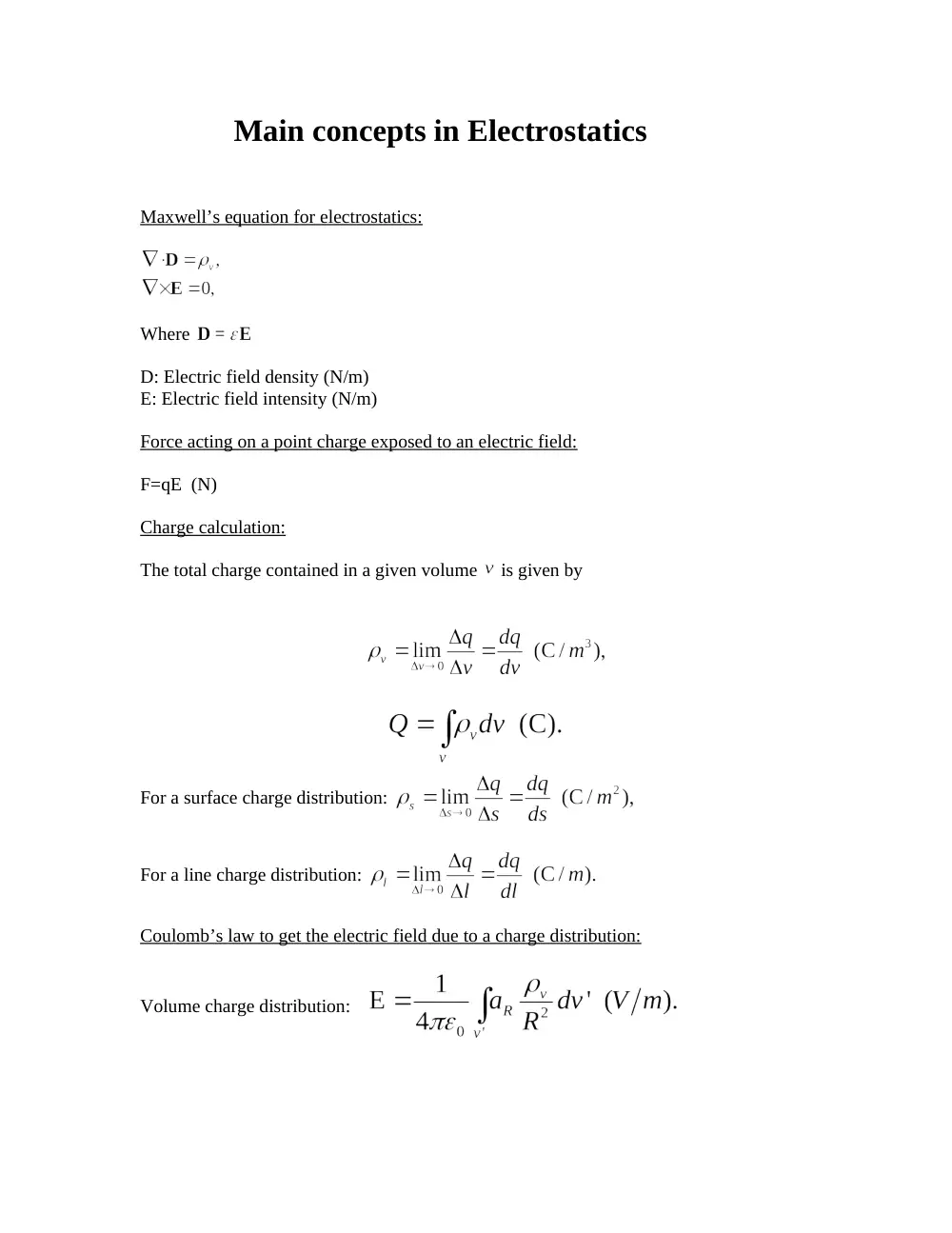
Maxwell’s equation for electrostatics:
Where
D: Electric field density (N/m)
E: Electric field intensity (N/m)
Force acting on a point charge exposed to an electric field:
F=qE (N)
Charge calculation:
The total charge contained in a given volume is given by
For a surface charge distribution:
For a line charge distribution:
Coulomb’s law to get the electric field due to a charge distribution:
Volume charge distribution:
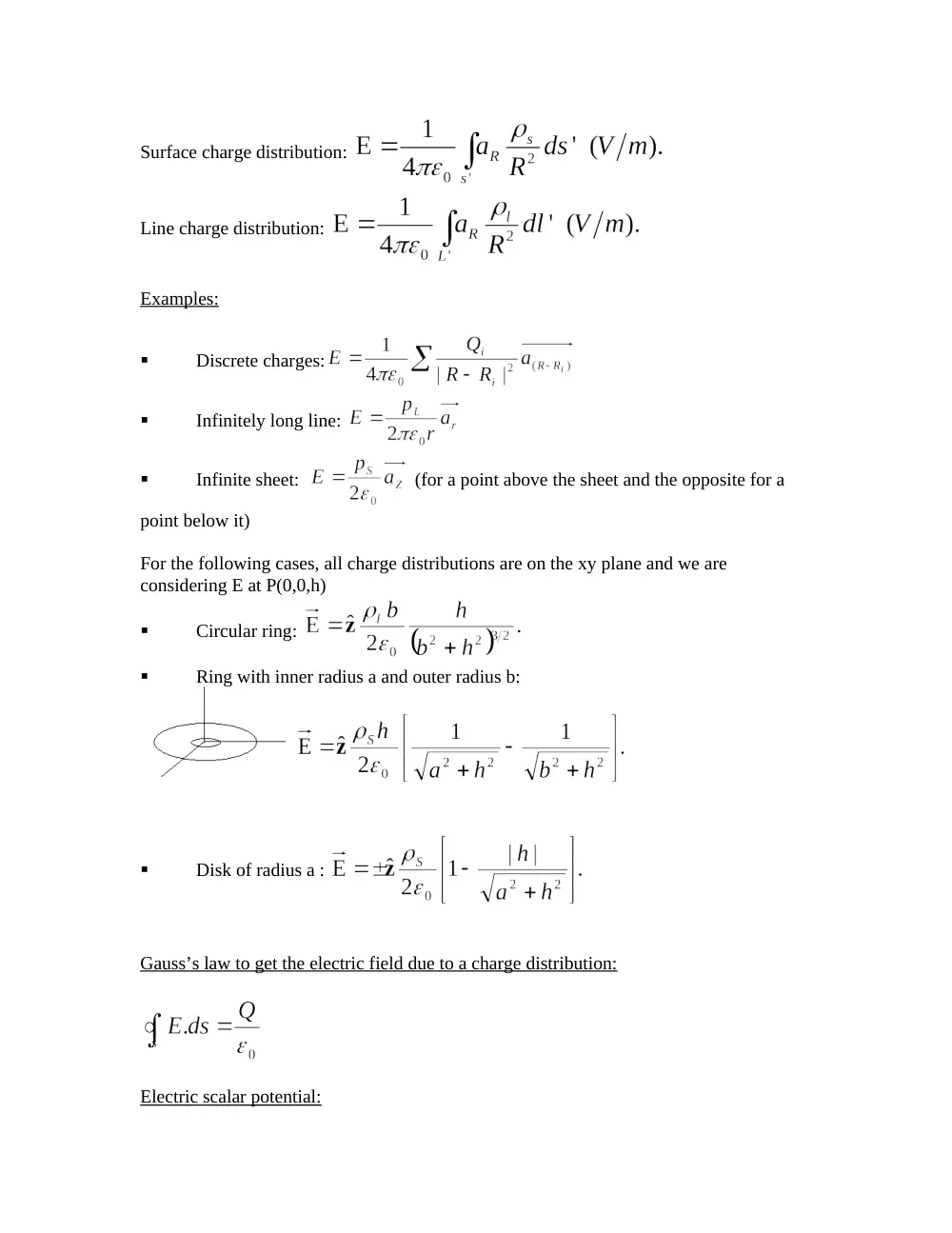
Surface charge distribution:
Line charge distribution:
Examples:
Discrete charges:
Infinitely long line:
Infinite sheet:
(for a point above the sheet and the opposite for a
point below it)
For the following cases, all charge distributions are on the xy plane and we are
considering E at P(0,0,h)
Circular ring:
Ring with inner radius a and outer radius b:
Disk of radius a :
Gauss’s law to get the electric field due to a charge distribution:
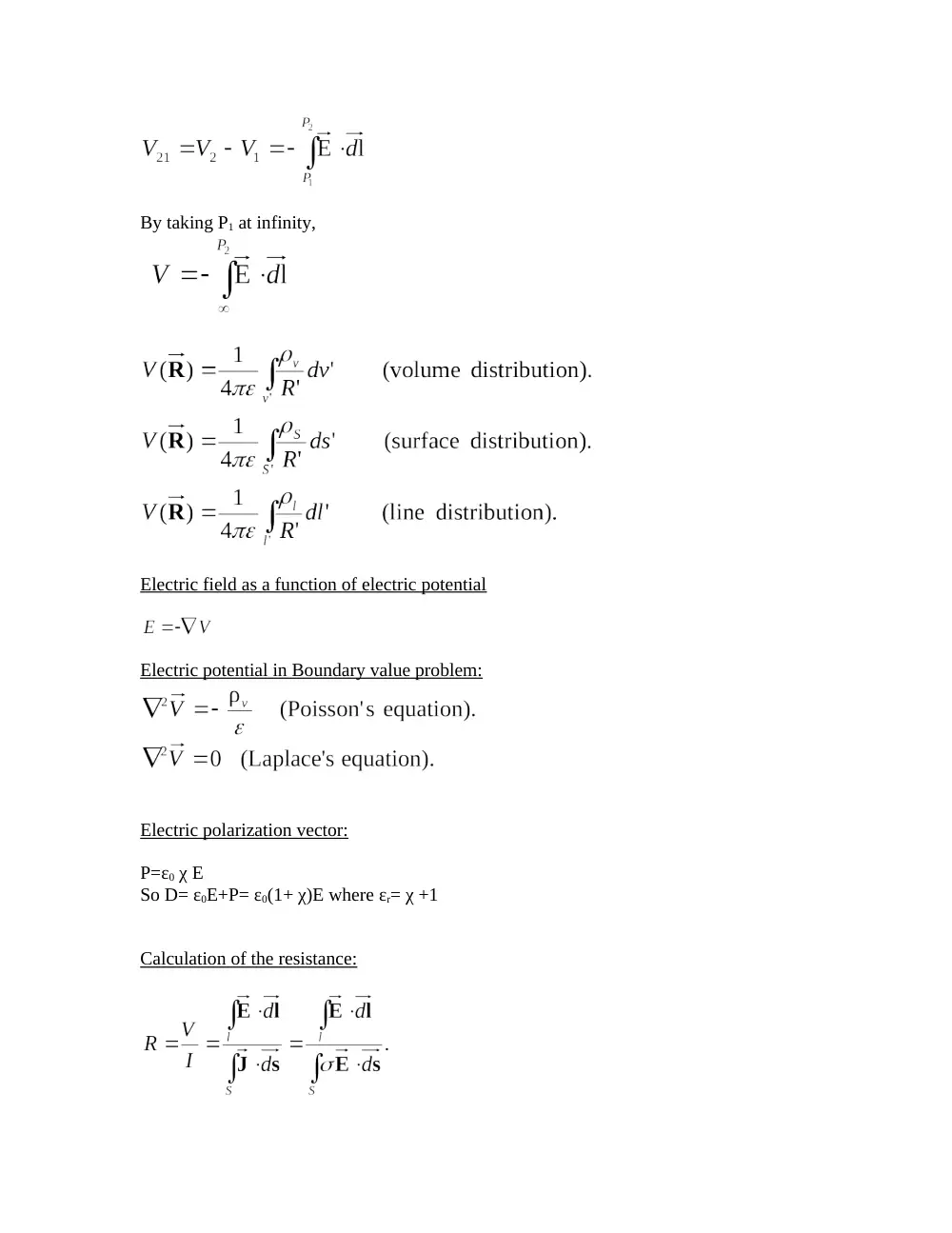
Electric scalar potential:
By taking P1 at infinity,
Electric field as a function of electric potential
Electric potential in Boundary value problem:
Electric polarization vector:
P=ε0 χ E
So D= ε0E+P= ε0(1+ χ)E where εr= χ +1
Calculation of the resistance:
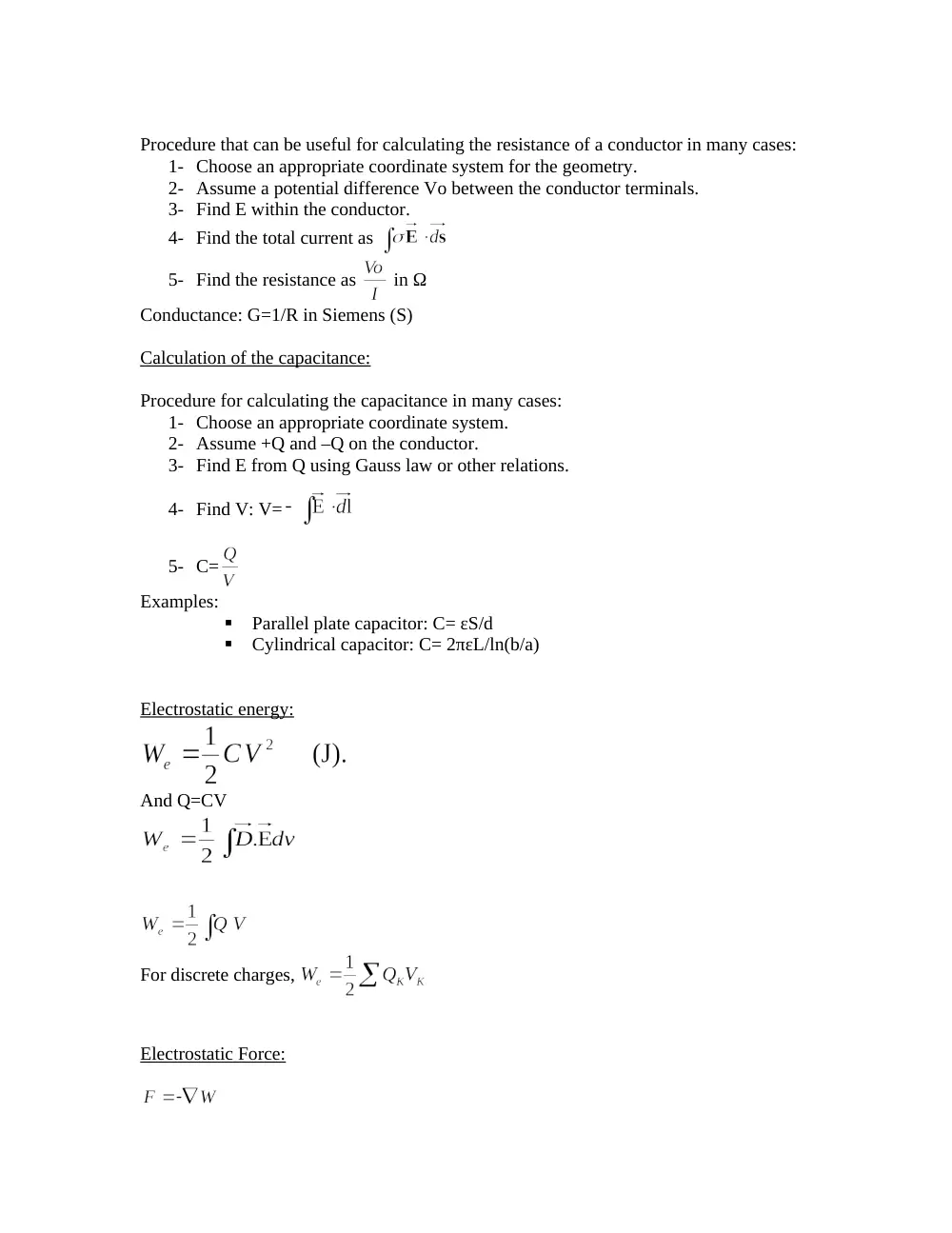
Procedure that can be useful for calculating the resistance of a conductor in many cases:
1- Choose an appropriate coordinate system for the geometry.
2- Assume a potential difference Vo between the conductor terminals.
3- Find E within the conductor.
4- Find the total current as
5- Find the resistance as
in Ω
Conductance: G=1/R in Siemens (S)
Calculation of the capacitance:
Procedure for calculating the capacitance in many cases:
1- Choose an appropriate coordinate system.
2- Assume +Q and –Q on the conductor.
3- Find E from Q using Gauss law or other relations.
4- Find V: V=
5- C=
Examples:
Parallel plate capacitor: C= εS/d
Cylindrical capacitor: C= 2πεL/ln(b/a)
Electrostatic energy:
And Q=CV
For discrete charges,
Electrostatic Force:
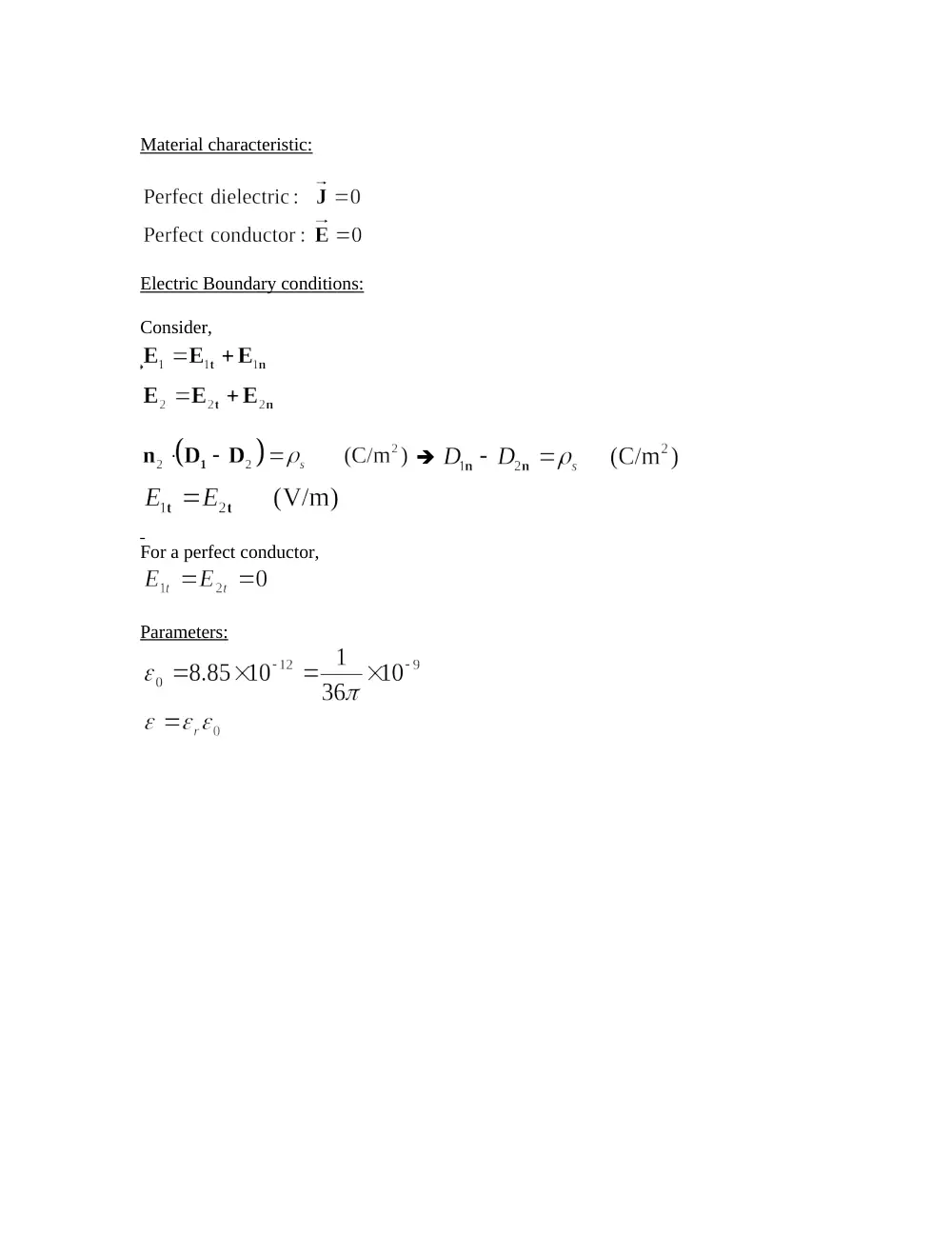
Material characteristic:
Electric Boundary conditions:
Consider,
For a perfect conductor,
Parameters: