
EECE 421 Exam 3, Fall 2012
American University of Beirut · Computer Architecture · 6 pages · Prof. Haitham Akkary


More EECE 421 files
Show the text of this exam
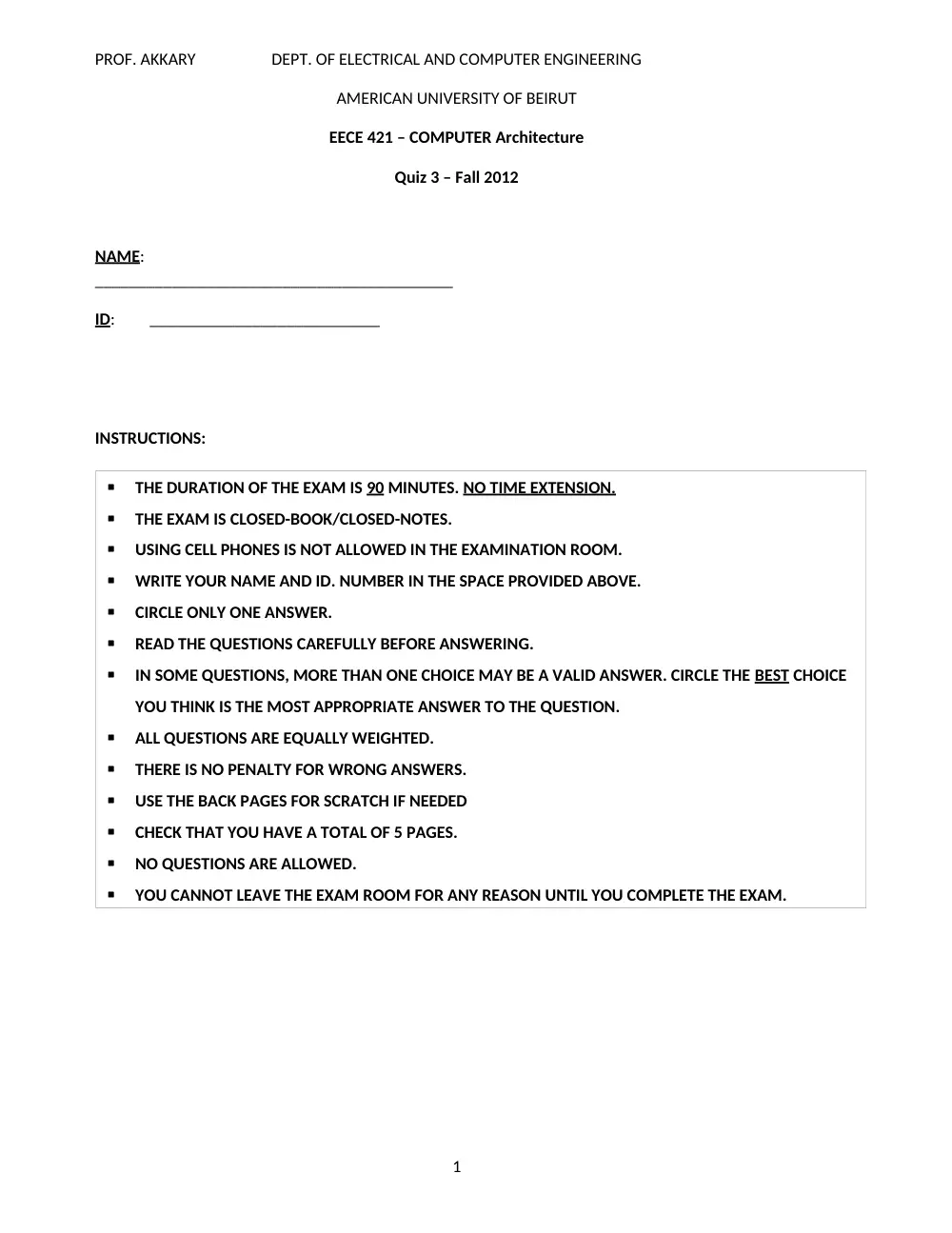
PROF. AKKARY
DEPT. OF ELECTRICAL AND COMPUTER ENGINEERING
AMERICAN UNIVERSITY OF BEIRUT
EECE 421 – COMPUTER Architecture
Quiz 3 – Fall 2012
NAME:
__________________________________________
ID: ___________________________
INSTRUCTIONS:
1
THE DURATION OF THE EXAM IS 90 MINUTES. NO TIME EXTENSION.
THE EXAM IS CLOSED-BOOK/CLOSED-NOTES.
USING CELL PHONES IS NOT ALLOWED IN THE EXAMINATION ROOM.
WRITE YOUR NAME AND ID. NUMBER IN THE SPACE PROVIDED ABOVE.
CIRCLE ONLY ONE ANSWER.
READ THE QUESTIONS CAREFULLY BEFORE ANSWERING.
IN SOME QUESTIONS, MORE THAN ONE CHOICE MAY BE A VALID ANSWER. CIRCLE THE BEST CHOICE
YOU THINK IS THE MOST APPROPRIATE ANSWER TO THE QUESTION.
ALL QUESTIONS ARE EQUALLY WEIGHTED.
THERE IS NO PENALTY FOR WRONG ANSWERS.
USE THE BACK PAGES FOR SCRATCH IF NEEDED
CHECK THAT YOU HAVE A TOTAL OF 5 PAGES.
NO QUESTIONS ARE ALLOWED.
YOU CANNOT LEAVE THE EXAM ROOM FOR ANY REASON UNTIL YOU COMPLETE THE EXAM.
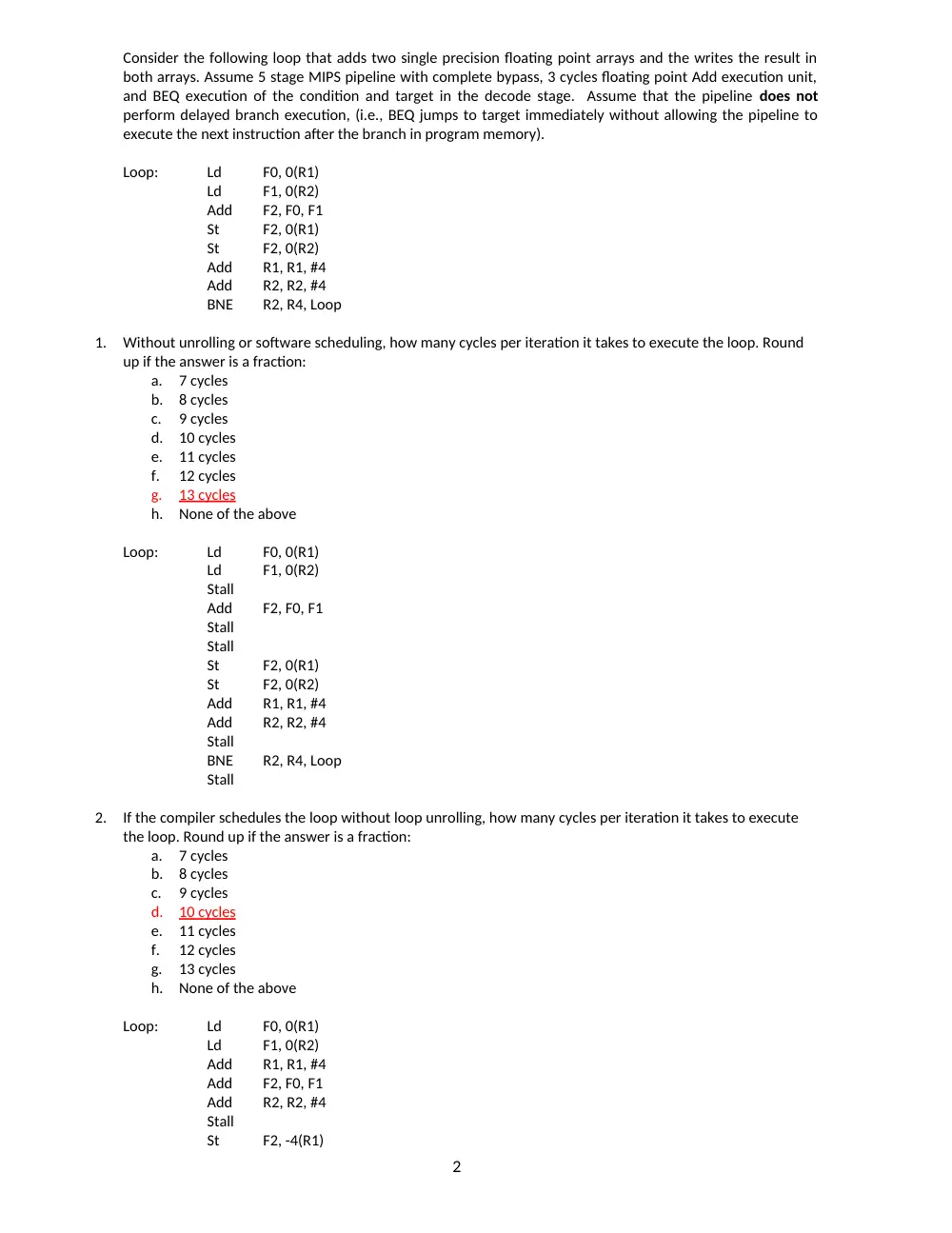
Consider the following loop that adds two single precision floating point arrays and the writes the result in
both arrays. Assume 5 stage MIPS pipeline with complete bypass, 3 cycles floating point Add execution unit,
and BEQ execution of the condition and target in the decode stage. Assume that the pipeline does not
perform delayed branch execution, (i.e., BEQ jumps to target immediately without allowing the pipeline to
execute the next instruction after the branch in program memory).
Loop:
Ld
F0, 0(R1)
Ld
F1, 0(R2)
Add
F2, F0, F1
St
F2, 0(R1)
St
F2, 0(R2)
Add
R1, R1, #4
Add
R2, R2, #4
BNE
R2, R4, Loop
1.
Without unrolling or software scheduling, how many cycles per iteration it takes to execute the loop. Round
up if the answer is a fraction:
a.
7 cycles
b.
8 cycles
c.
9 cycles
d.
10 cycles
e.
11 cycles
f.
12 cycles
g.
13 cycles
h.
None of the above
Loop:
Ld
F0, 0(R1)
Ld
F1, 0(R2)
Stall
Add
F2, F0, F1
Stall
Stall
St
F2, 0(R1)
St
F2, 0(R2)
Add
R1, R1, #4
Add
R2, R2, #4
Stall
BNE
R2, R4, Loop
Stall
2.
If the compiler schedules the loop without loop unrolling, how many cycles per iteration it takes to execute
the loop. Round up if the answer is a fraction:
a.
7 cycles
b.
8 cycles
c.
9 cycles
d.
10 cycles
e.
11 cycles
f.
12 cycles
g.
13 cycles
h.
None of the above
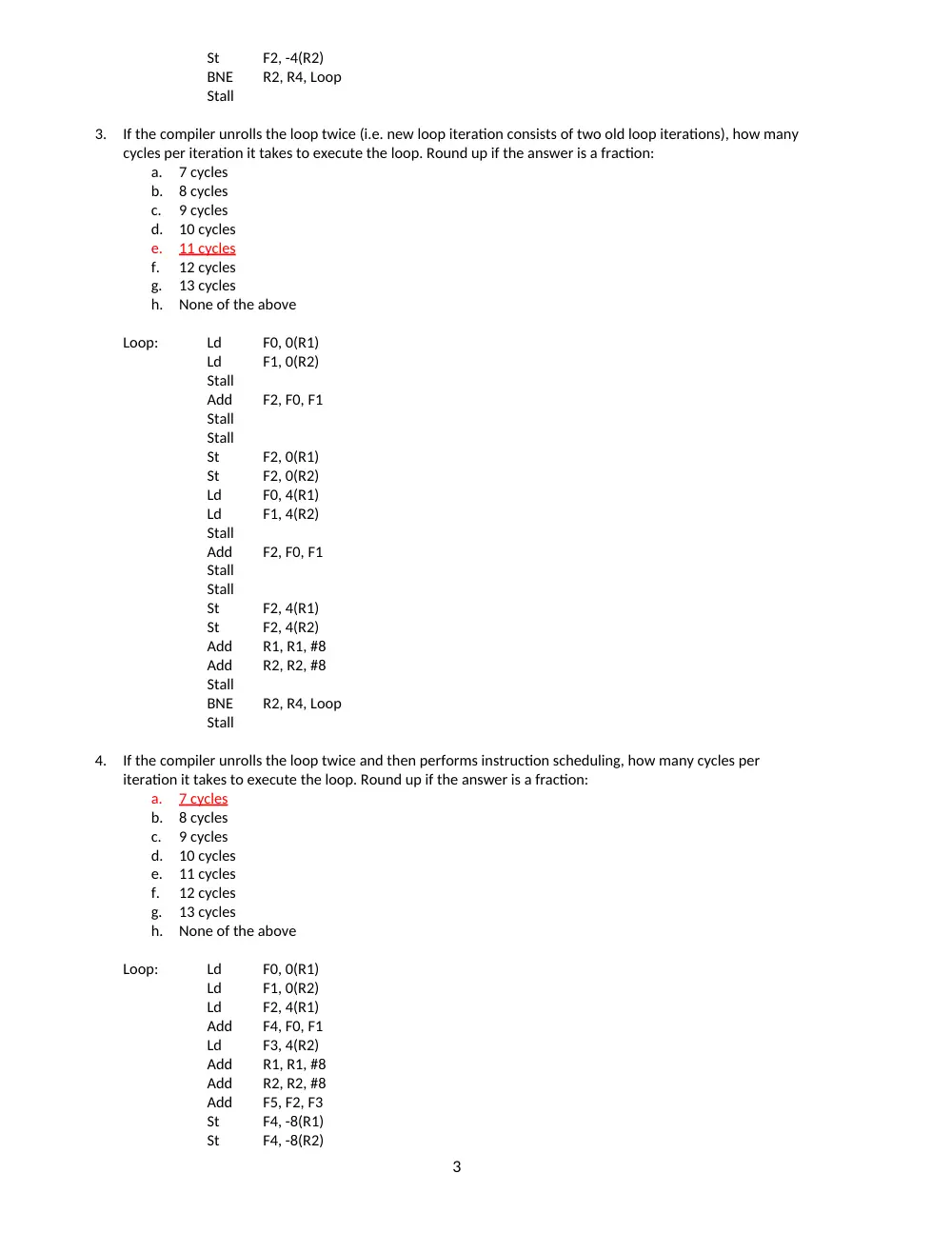
Loop:
Ld
F0, 0(R1)
Ld
F1, 0(R2)
Add
R1, R1, #4
Add
F2, F0, F1
Add
R2, R2, #4
Stall
St
F2, -4(R1)
2
St
F2, -4(R2)
BNE
R2, R4, Loop
Stall
3.
If the compiler unrolls the loop twice (i.e. new loop iteration consists of two old loop iterations), how many
cycles per iteration it takes to execute the loop. Round up if the answer is a fraction:
a.
7 cycles
b.
8 cycles
c.
9 cycles
d.
10 cycles
e.
11 cycles
f.
12 cycles
g.
13 cycles
h.
None of the above
Loop:
Ld
F0, 0(R1)
Ld
F1, 0(R2)
Stall
Add
F2, F0, F1
Stall
Stall
St
F2, 0(R1)
St
F2, 0(R2)
Ld
F0, 4(R1)
Ld
F1, 4(R2)
Stall
Add
F2, F0, F1
Stall
Stall
St
F2, 4(R1)
St
F2, 4(R2)
Add
R1, R1, #8
Add
R2, R2, #8
Stall
BNE
R2, R4, Loop
Stall
4.
If the compiler unrolls the loop twice and then performs instruction scheduling, how many cycles per
iteration it takes to execute the loop. Round up if the answer is a fraction:
a.
7 cycles
b.
8 cycles
c.
9 cycles
d.
10 cycles
e.
11 cycles
f.
12 cycles
g.
13 cycles
h.
None of the above
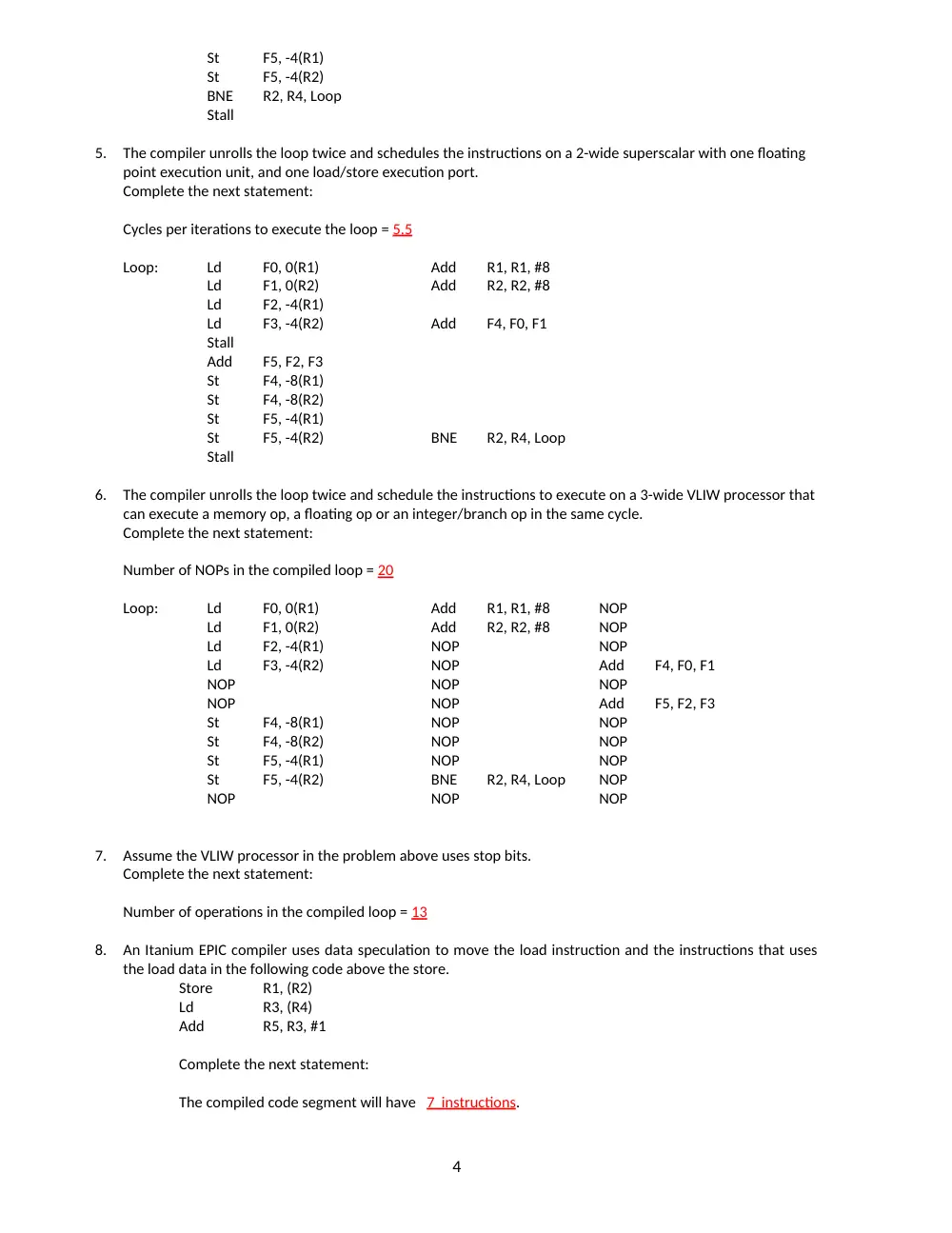
Loop:
Ld
F0, 0(R1)
Ld
F1, 0(R2)
Ld
F2, 4(R1)
Add
F4, F0, F1
Ld
F3, 4(R2)
Add
R1, R1, #8
Add
R2, R2, #8
Add
F5, F2, F3
St
F4, -8(R1)
St
F4, -8(R2)
3
St
F5, -4(R1)
St
F5, -4(R2)
BNE
R2, R4, Loop
Stall
5.
The compiler unrolls the loop twice and schedules the instructions on a 2-wide superscalar with one floating
point execution unit, and one load/store execution port.
Complete the next statement:
Cycles per iterations to execute the loop = 5.5
Loop:
Ld
F0, 0(R1)
Add
R1, R1, #8
Ld
F1, 0(R2)
Add
R2, R2, #8
Ld
F2, -4(R1)
Ld
F3, -4(R2)
Add
F4, F0, F1
Stall
Add
F5, F2, F3
St
F4, -8(R1)
St
F4, -8(R2)
St
F5, -4(R1)
St
F5, -4(R2)
BNE
R2, R4, Loop
Stall
6.
The compiler unrolls the loop twice and schedule the instructions to execute on a 3-wide VLIW processor that
can execute a memory op, a floating op or an integer/branch op in the same cycle.
Complete the next statement:
Number of NOPs in the compiled loop = 20
Loop:
Ld
F0, 0(R1)
Add
R1, R1, #8
NOP
Ld
F1, 0(R2)
Add
R2, R2, #8
NOP
Ld
F2, -4(R1)
NOP
NOP
Ld
F3, -4(R2)
NOP
Add
F4, F0, F1
NOP
NOP
NOP
NOP
NOP
Add
F5, F2, F3
St
F4, -8(R1)
NOP
NOP
St
F4, -8(R2)
NOP
NOP
St
F5, -4(R1)
NOP
NOP
St
F5, -4(R2)
BNE
R2, R4, Loop
NOP
NOP
NOP
NOP
7.
Assume the VLIW processor in the problem above uses stop bits.
Complete the next statement:
Number of operations in the compiled loop = 13
8.
An Itanium EPIC compiler uses data speculation to move the load instruction and the instructions that uses
the load data in the following code above the store.
Store
R1, (R2)
Ld
R3, (R4)
Add
R5, R3, #1
Complete the next statement:
The compiled code segment will have 7 instructions.
4
Scratch Page
5
Scratch Page
6