
EECE 442 Problems Set 1, Spring 2011
American University of Beirut · Communication Systems · 5 pages

More EECE 442 files
- Problems · Spring 2008ProblemsView
- Final Question · Fall 2013Final examView
- Homework 3 · Fall 2013HomeworkView
- Homework 1 · Fall 2013HomeworkView
- Useful File Fourier Transforms · Fall 2013FileView
- Useful File Bessel Table · Fall 2013FileView
- Homework 2 · Fall 2013HomeworkView
- Exam Quiz 1 · Fall 2012ExamView
Show the text of this problems
EECE 442 Communication Systems
February 25, 2011
American University of Beirut, Spring 2010–2011
Handout #2
Due: Friday, Mar. 4, 2011
Problem Set 1
Reminder on Collaboration Policy
The following is an acceptable form of collaboration: discuss with your classmates possible
approaches to solving the problems, and then have each one fill in the details and hand-
write her/his own solutions independently.
An unacceptable form of dealing with homework is to copy a solution that someone else
has written.
At the top of each homework you turn in, list all sources of information you used, apart
of course from the text, books on reserve for this course or discussions with the Prof. A
brief note such as “did problem 7 with May Berite in study group” would be sufficient.
In general, we expect students to adhere to basic, common sense concepts of academic
honesty. Presenting another’s work as if it were your own, or cheating in exams will not
be tolerated.
Problem 1.1 (Fourier Transforms)
We define the Fourier Transform (FT) of a deterministic signal s(t) as,
S(f) =
� ∞
−∞
s(t)e−j2πft dt.
Note that this is a function of the frequency “f” and not of the pulsation “ω = 2πf”. By
adopting this definition, the inverse FT, the transforms of “classical” function, as well as
some of the famous relationships become easier, as the normalization factors disappear.
(a) Using tools acquired in previous classes, prove that with this definition, the Inverse
Fourier Transform (IFT) is
s(t) =
� ∞
−∞
S(f)ej2πft df.
(b) Let s(t) be a Dirac delta function, more specifically,
s(t) = δ(t − τ),
for a given fixed value of τ. Find the FT of s(t) for all possible values of τ.
1
(c) Let s(t) and u(t) be a cosine and a sine function respectively, i.e.,
s(t) = cos(2πfct),
u(t) = sin(2πfct).
Find the FT of s(t) and u(t).
(d) Now let s(t) be a “rect” function, i.e.,
s(t) = rect(t) =
� 1
−1
2 ≤ t ≤ 1
2
0
otherwise.
Find the FT of s(t).
(e) Let s(t) be a “sinc” function, i.e.,
s(t) = sinc(t) = sin(πt)
πt
.
Find the FT of s(t).
(f) If we denote by v(f) the FT of u(t) prove that the FT of v(t) is u(−f).
Problem 1.2
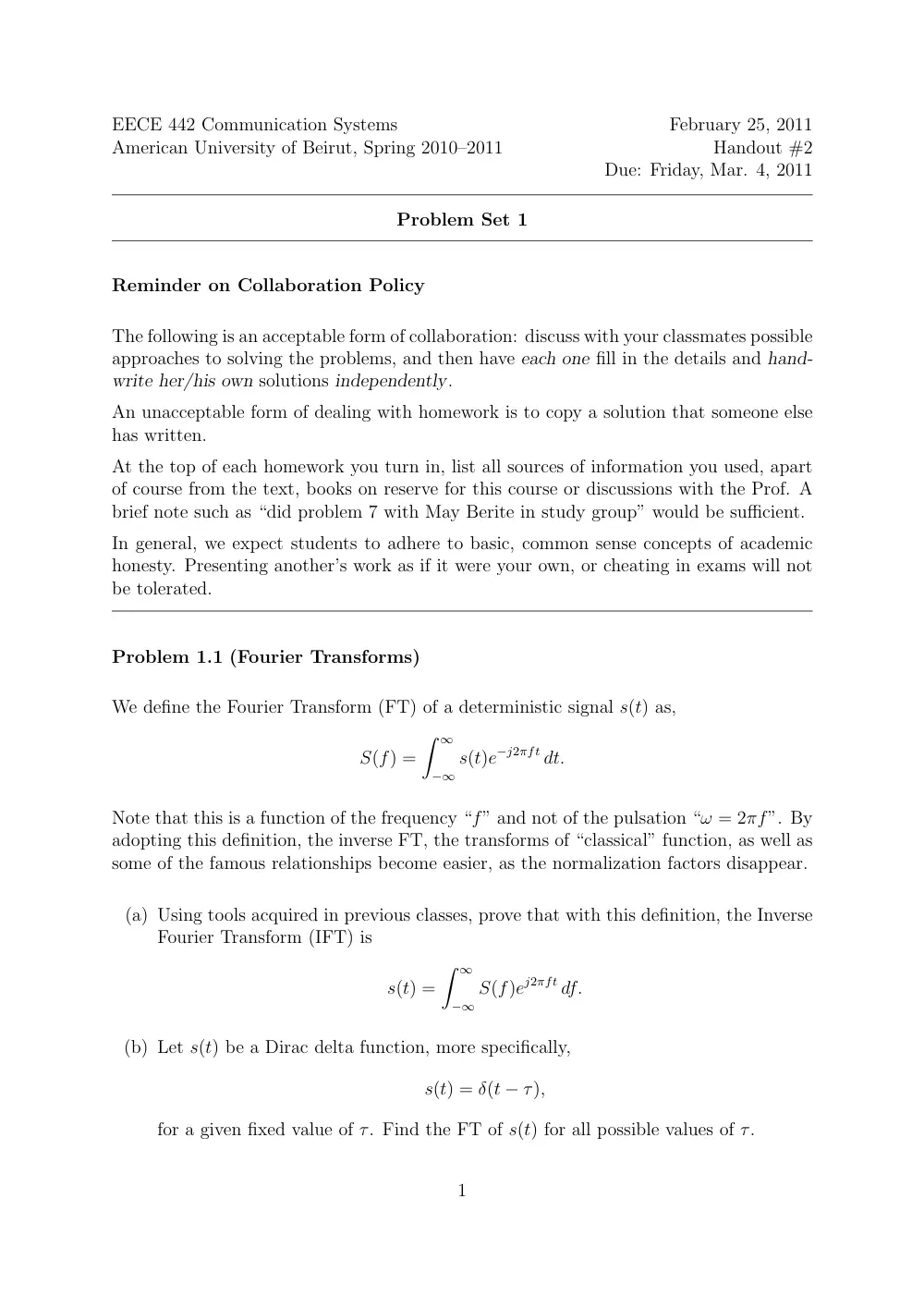
Consider a baseband signal ˜s(t) with Fourier Transform (FT) ˜S(f) shown in Figure 1
-
6
˜S(f)
3
−B
−B/2
B
f
Figure 1: Fourier Transform of ˜s(t).
(a) You decide to sample ˜s(t) every T seconds. How small should T be in order not to
lose information through the sampling process?
(b) What is the energy Es of ˜s(t)?
You form the signal s(t) as follows:
s(t) = ℜ
�
˜s(t)ej2πfct�
,
where the carrier frequency fc is a multiple of B.
2
(c) If Es is the energy of ˜s(t), what is the energy of s(t)?
(d) You decide to sample s(t) every T seconds. How small should T be in order not to
lose information through the sampling process?
(e) Is your result consistent with (a)? Explain.
Consider now the reverse case, where you have a passband signal s(t) and you would like
to define its “baseband” equivalent ˜s(t) such that
s(t) = ℜ
�
˜s(t)ej2πfct�
.
(f) Explain how you would obtain ˜s(t) from s(t).
Problem 1.3 (Implementation of Envelope Detectors)
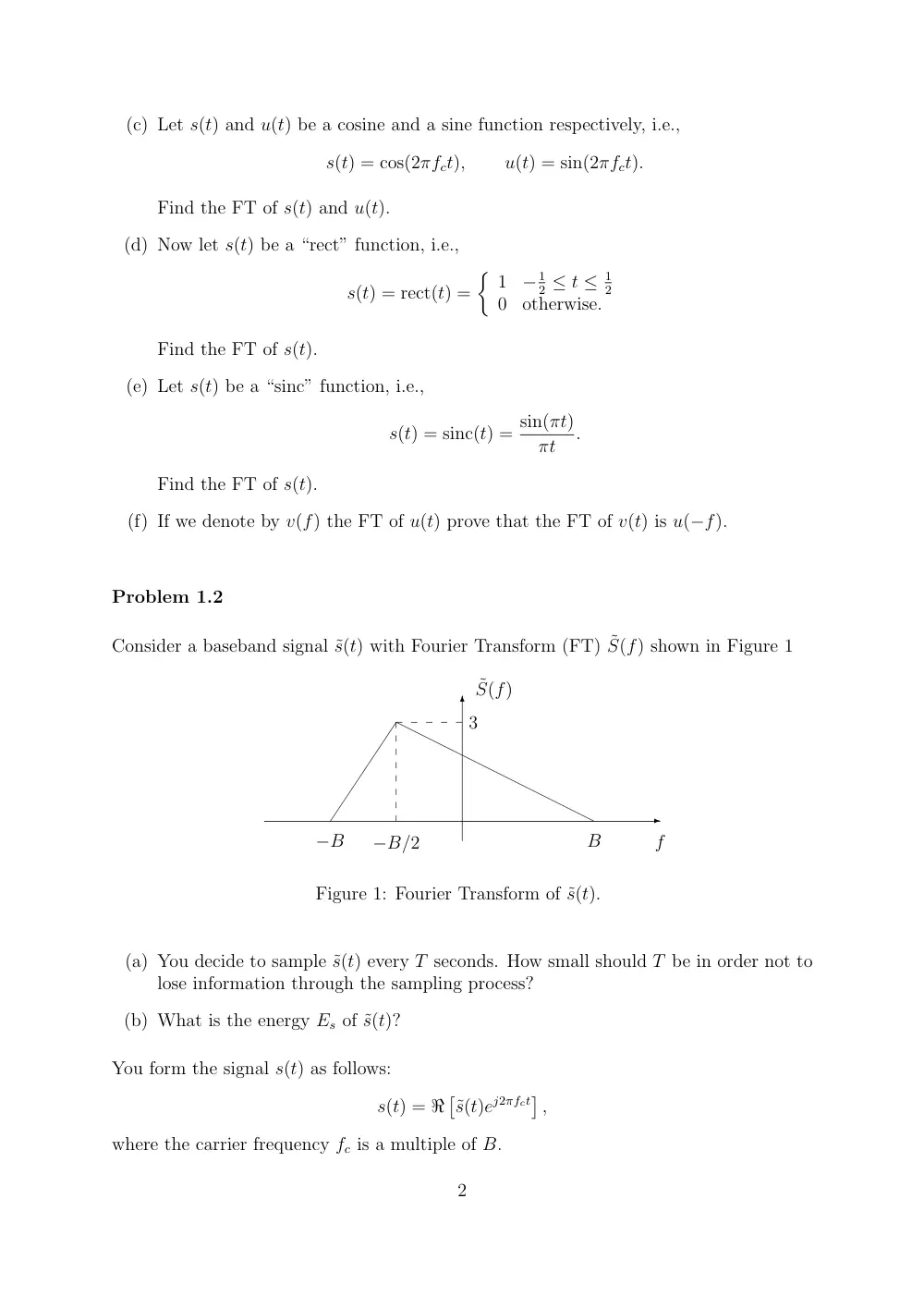
Figure 2 shows the circuit diagram of an envelope detector. It consists simply of a diode
and resistor-capacitor (RC) filter. On a positive half-cycle of the input signal, the diode
is forward-biased and the capacitor C charges up rapidly to the peak value of the input
signal. When the input signal falls below this value, the diode becomes reverse-biased
and the capacitor discharges slowly through the load resistor Rl. The discharging process
continues until the next positive half-cycle. Thereafter, the charging-discharging routine
is continued.
Rs
C
Rl
s(t)
Input
Output
Figure 2: Envelope Detector.
(a) Specify the condition that must be satisfied by the capacitor C for it to charge
rapidly and thereby follow the input voltage up to the positive peak when the
diode is conducting.
(b) Specify the condition which the load resistor Rl must satisfy so that the capacitor
C discharges slowly between positive peaks of the carrier wave, but not so long
that the capacitor voltage will not discharge at the maximum rate of change of the
modulating wave.
3
(c) Draw a schematic diagram of the input and output signals under the conditions in
(a) and (b), when the input s(t) is an AM signal.
(d) Can you propose a way to make the output in (c) “smoother” and closer to the
envelope?
Note: Envelope detectors fall under the category of non-coherent detectors as the phase
of the transmitted signal is not necessary for demodulation, as opposed to the “multi-
plier/low pass filter” presented in class where the exact phase is needed.
Corollary Note: For envelope detectors to work (recover the message signal), it is neces-
sary to have the amplitude modulating the cosine to be always positive.
Problem 1.4 (Power Consumption in DSB-SC)
We investigate in this problem the power consumption of a DSB-SC modulated signal.
Feel free to assume that the information-baring signal m(t) is of “very low frequency
content” when compared to fc.
Consider a DSB-SC wave
s(t) = Acm(t) cos(2πfct),
where the bandwidth W of m(t) is such that W << fc.
Assume that the duration of s(t) is T and compute the power of the signal s(t). Feel
free to make appropriate assumptions on the relations between T, W and fc, and express
your answer function of these parameters, Ac and the power of the message Pm.
Problem 1.5
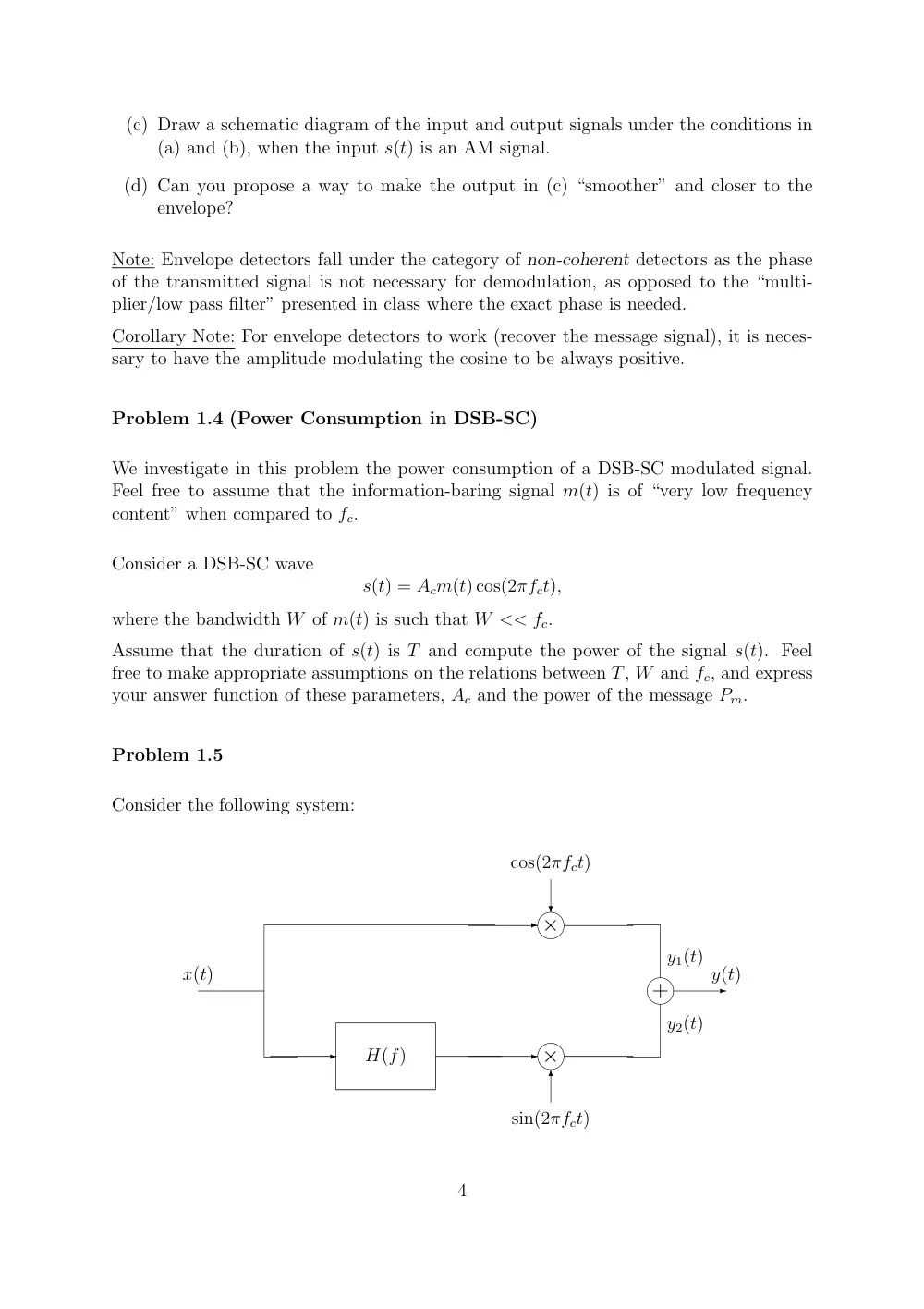
Consider the following system:
- ×
?
cos(2πfct)
-
H(f)
- ×
6
sin(2πfct)
+
-
x(t)
y(t)
y1(t)
y2(t)
4
where,
H(f) =
� j
f ≥ 0
−j
f < 0
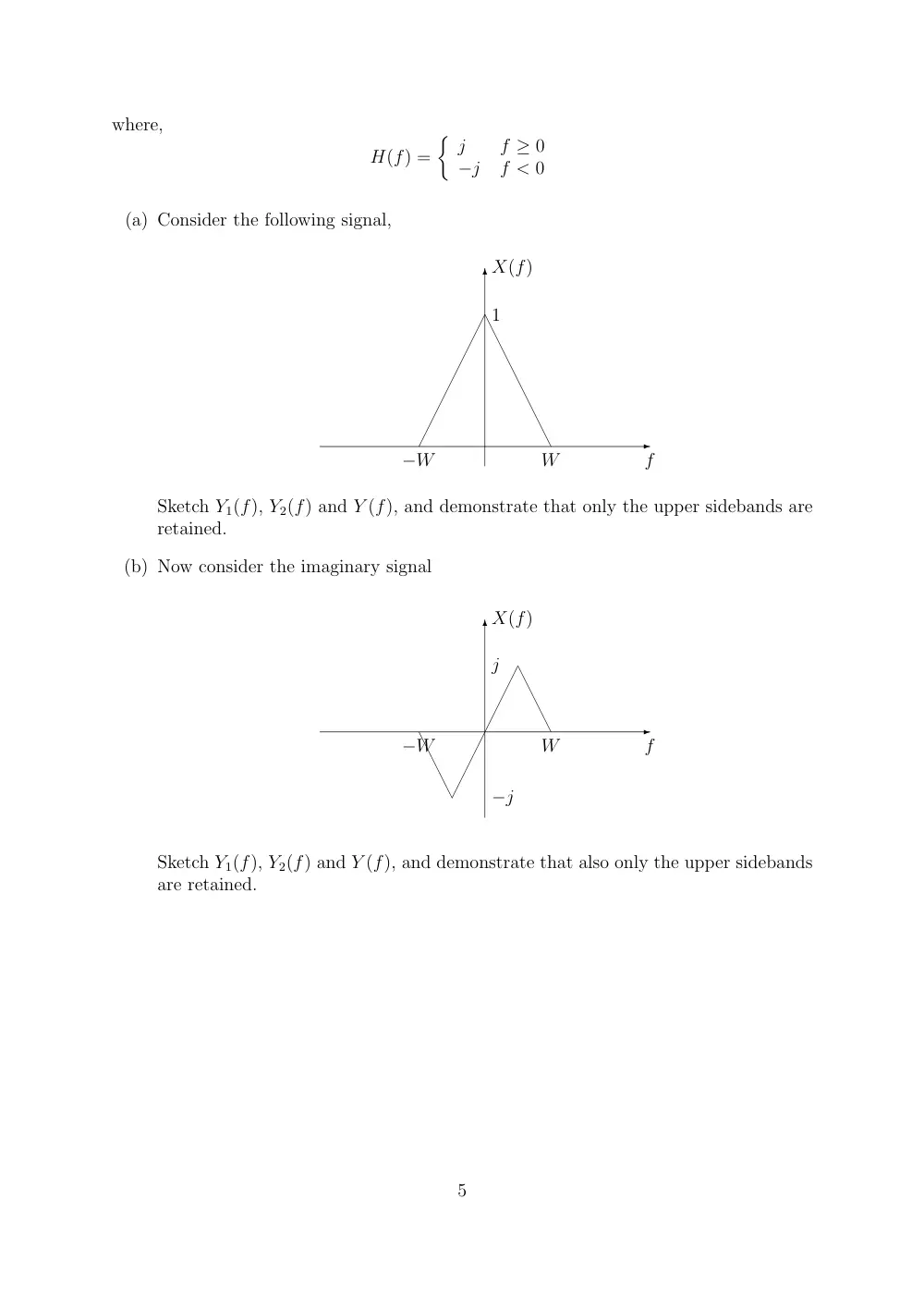
(a) Consider the following signal,
-
6
f
X(f)
−W
W
1
Sketch Y1(f), Y2(f) and Y (f), and demonstrate that only the upper sidebands are
retained.
(b) Now consider the imaginary signal
-
6
f
X(f)
−W
W
j
−j
Sketch Y1(f), Y2(f) and Y (f), and demonstrate that also only the upper sidebands
are retained.
5