
EECE 442 Problems, Spring 2008
American University of Beirut · Communication Systems · 14 pages



Showing the first 10 of 14 pages. Download the PDF to see all of it.
More EECE 442 files
- Problems Set 1 · Spring 2011ProblemsView
- Final Question · Fall 2013Final examView
- Homework 3 · Fall 2013HomeworkView
- Homework 1 · Fall 2013HomeworkView
- Useful File Fourier Transforms · Fall 2013FileView
- Useful File Bessel Table · Fall 2013FileView
- Homework 2 · Fall 2013HomeworkView
- Exam Quiz 1 · Fall 2012ExamView
Show the text of this problems
EECE 442 “Srebemes ad Sebulctes
Comnmcuniciatatre Sy stems tr ID - Analog moaleter
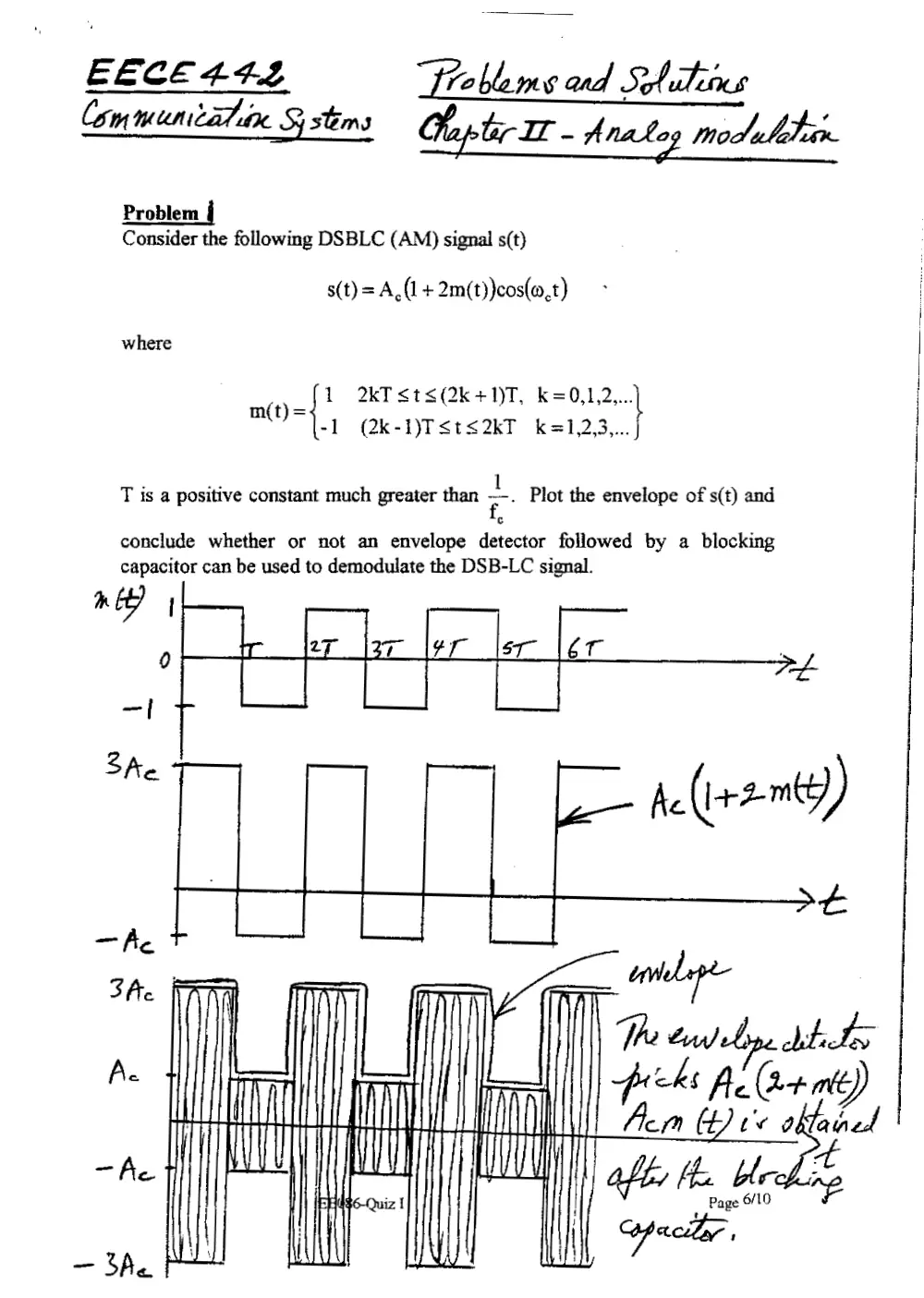
Problem i
Consider the following DSBLC (AM) signal s(t)
s(t)=A,(1+2m(t))cos(,t) >
where
(y= 1 2kT <t<(2k+DT, k=0,1,2....
~|-L (2k-1)T<t<2kT k=1,2,3....
T is a positive constant much greater than ~ Plot the envelope of s(t) and
conclude whether or not an envelope detector followed by a blocking
capacitor can be used to demodulate the DSB-LC signal.
-A
sh i lo
. hol q| pliglnre)
| Aicrn (b) ve aktaned
| i oft te we
“he | Ne lial 7 bh
A) a |
Copeciler
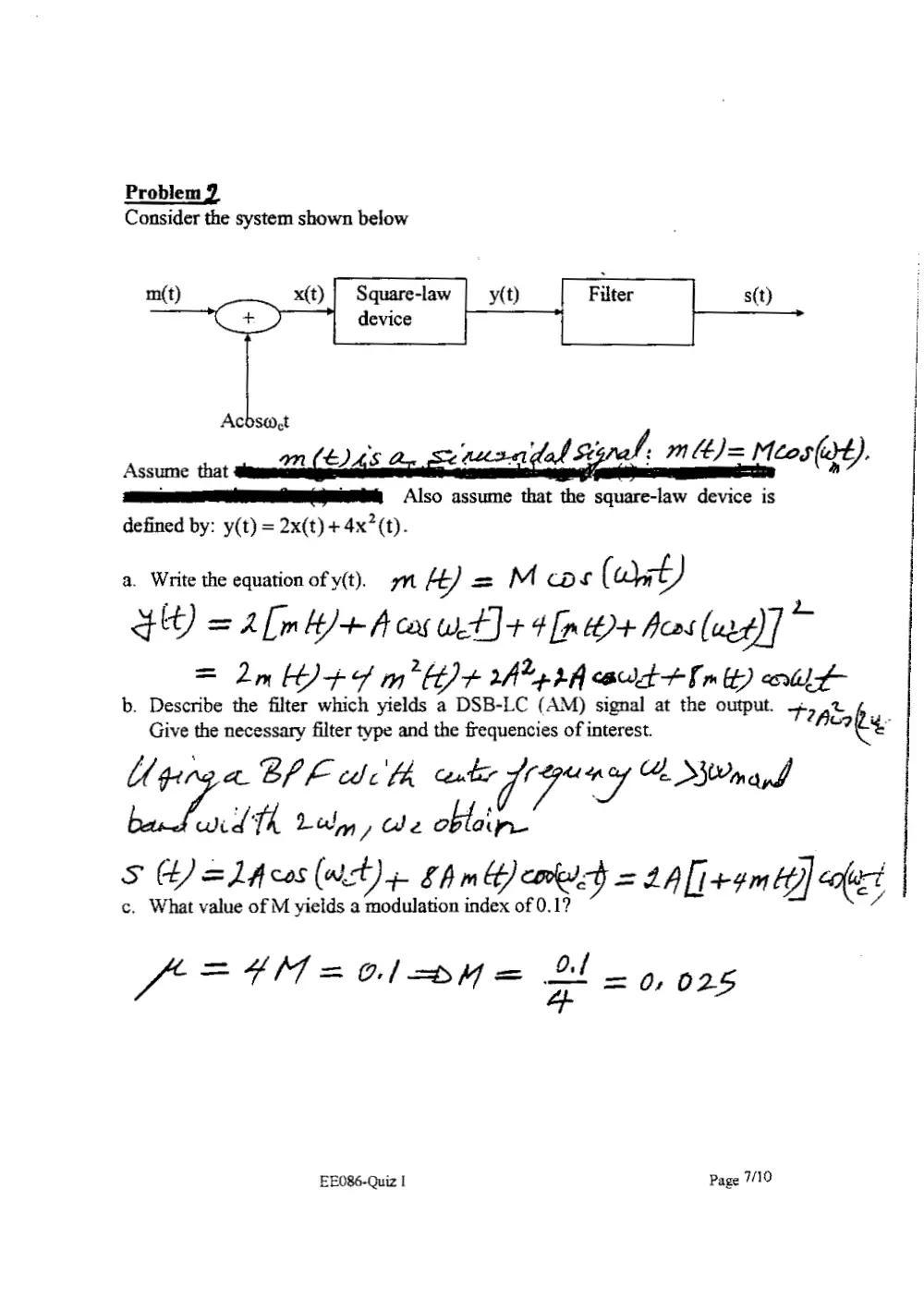
Problem 7
Consider the system shown below
Assume that
nn |= Also assume that the square-law device is
defined by: y(t) = 2x(t)+4x?(t).
a. Write the equation of y(t). yn Ht) = Mos (yt)
4) = A[ mH) +A crs bt] + 4 [ptt Aco (uns)
= 2m LFS mC) tA pth ood tim) rile
b. Describe the filter which yields a DSB-LC (AM) signal at the output. tenth,
Give the necessary filter type and the frequencies of interest. he:
U ger a BPE cdi center (‘ weney Ae SSX mayd
he faith Lily, We al”
SE) =LA cos (at) + Eh mG) old = 24 []+4m ty] colet
c. What value of M yields a modulation index of 0.1?
Lt = 41 = 01 DH = = = 0, 025
EE086-Quiz I Page 7/10
Problem __3
Consider the DSB-LC signal
S(t\)= A, fi + cos(o,,t)cos(2a,,t)}cos(c, t)
where @, >>@,,. Let s(t) be inputted to an ideal band-pass filter centred at
@, and bandwidth 4q,, tad/s.
1. Determine the signal at the output of the band-pass filter.
sh=A[i+ £ out + $ an( 305) | cobct)
= Ae [i+ z cos (uipt) [os (uct) + 4 annec
The BPE picks A. [14 1 colugt)] coluct)
2. Can an envelope detector be used to demodulate the signal determined
in (1)? Ifyes, determine the output of this envelope detector.
pe Atty cay be Leged te ole yd hab
The Sijnak ux (I) dined a has 5aW poteataye
wad. , Phas wi clipes ats nbd cai
AC)+ 4 en lut))
EE086-Quiz | Page 8/10
]
Problem 4
A message signal m(t) of bandwidth 4.8 KHz is DSB-LC (AM) modulated with a carrier
frequency of 1500 KHz. Detection is done using a coherent detector with frequency shift
of 0.2 KHz. Determine the bandwidth of the signal at the output of the receiver given
that the bandwidth of low pass filter in the coherent detector is 10 KHz.
The output of the plod t moclele tir eye
Aa [i+ ke mlA] cos at x os (wroayt
= bre [I+ ke mbt] cos (dae) + FLT
-~BkK He f 001K f 5k F
-O0.1K 4-6
The LPF extpat vss AST Ts by mlt}] ca (Awd)
If haw a ben thvsiltt fokhy.
eee RN REPERTOIRE ht Reta ec tbeablthtn iter re ur ELON hn
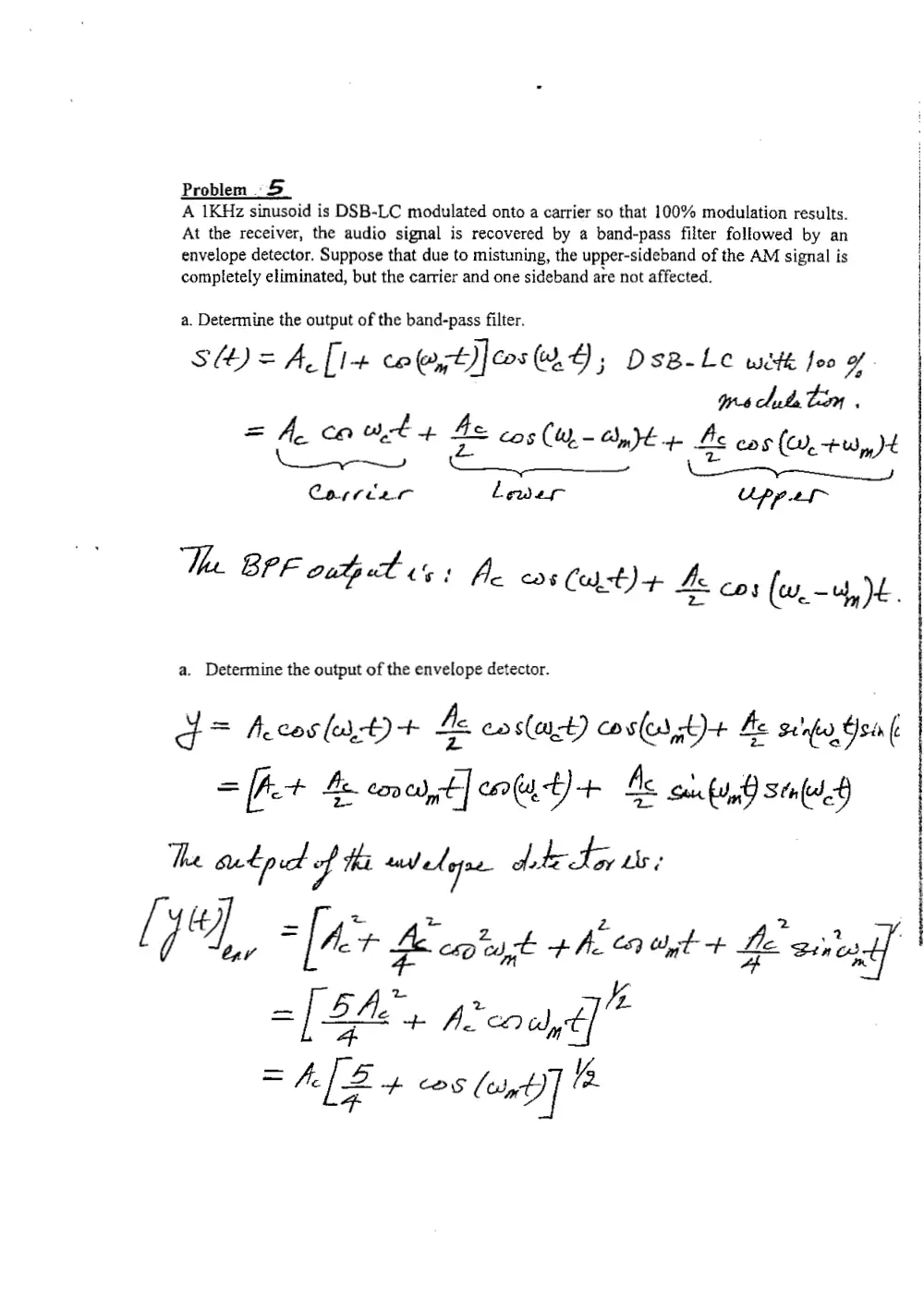
Problem - 5
A 1KHz sinusoid is DSB-LC modulated onto a carrier so that 100% modulation results. |
At the receiver, the audio signal is recovered by a band-pass filter followed by an |
envelope detector. Suppose that due to mistuning, the upper-sideband of the AM signal is
completely eliminated, but the carrier and one sideband are not affected.
a. Determine the output of the band-pass filter.
Slt) = A. [1+ coe t)]os 9; Dsa-Le wet Joo ¥-
L.4 gs hut. 2m .
= Ac. Co oH, + Of cos (Ub, — Sy . Ae
he sot Ee el ted Be ene rit
Cartéar Lewer App et
Te. BPF outs
Beles: Ac cos Capt) Ac e cos (w, ~ ube.
i
1
4
|
q
i
|
|
|
i
H
|
a. Determine the output of the envelope detector. |
:
i
|
|
Ga heoslact+ A co slat) coslorb+ Ae serbe, gsi
fit te cont] cota d.t ecb sis
Te autpid of thi witelgre debe tay
[ f ey - [A+ LE caaiu phe te thy t+ fe eines,
= [5A . prcoey 4”
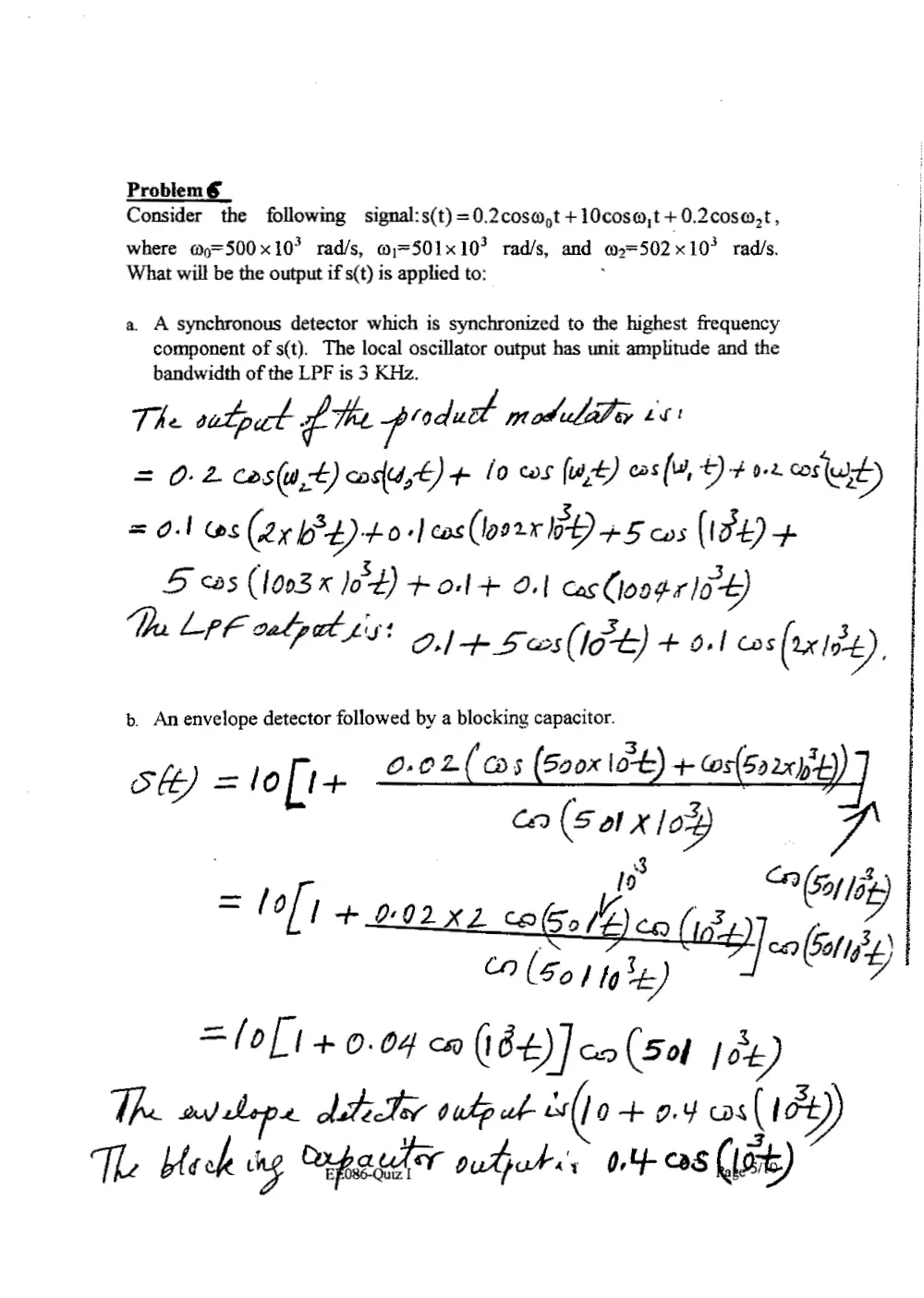
Problem 6
Consider the following signal:s(t)=0.2cosw,t + 10cosa@,t + 0.2cosa,t,
where @=500x10* rad/s, @)=501x10° rad/s, and @.=502x10° rad/s.
What will be the output if s(t) is applied to: .
a. A synchronous detector which is synchronized to the highest frequency
component of s(t). The local oscillator output has unit amplitude and the
bandwidth of the LPF is 3 KHz.
The ootput fhe produ moduleD ey 25!
= 0-2 cos(at) cost) + 10 cos (iat) cs, 8) 4 0-2 costs)
=o.l ws (er bd)+0 cos (992 FD 45 cos (1k) 4
S cas (1003 « lot) Hod + 2. cas Cloogr lot)
Wa Lp cabo 2's! Ol 5 cos (Ie) + 041 cos (uxiee),
b. An envelope detector followed by a blocking capacitor.
3
-02( ws (S00x lot) + @s 1
St) = lo[i+ O-.OL{ ®s (S00x lO) + Ws|Sa2xp
C2 (Sar x lod A
7 s° <9 (bf 135
= tol + O92 x2 0601 co (ip bY] id
. , (8 a
=/oly + 0.04 ca (18-4) J co (Sof >)
The sutebepe cbatecTer oulpat-t(]0-+ 0.4 as( 10%)
Tle Mack ng Capa uder outputs: dl as (15%)
Problem 7
A frequency discriminator detector followed by an integrator is used to demodulate a
phase-modulated signal s(t)=A, cos|2nf,t +k,m(t)]. Determine the output of this
demodulator. °
The. Mipatenheloy subpub (|
~ Aa [a+ hy allt) sea (tt by met)
The topot rfs entlyps dif Lor eo!
A. [tl +4 Ay La fe //
The blre Aricy Cie ctlar catgut co '
Ihe thleg ratdy oectp eit i
he Re m CL),
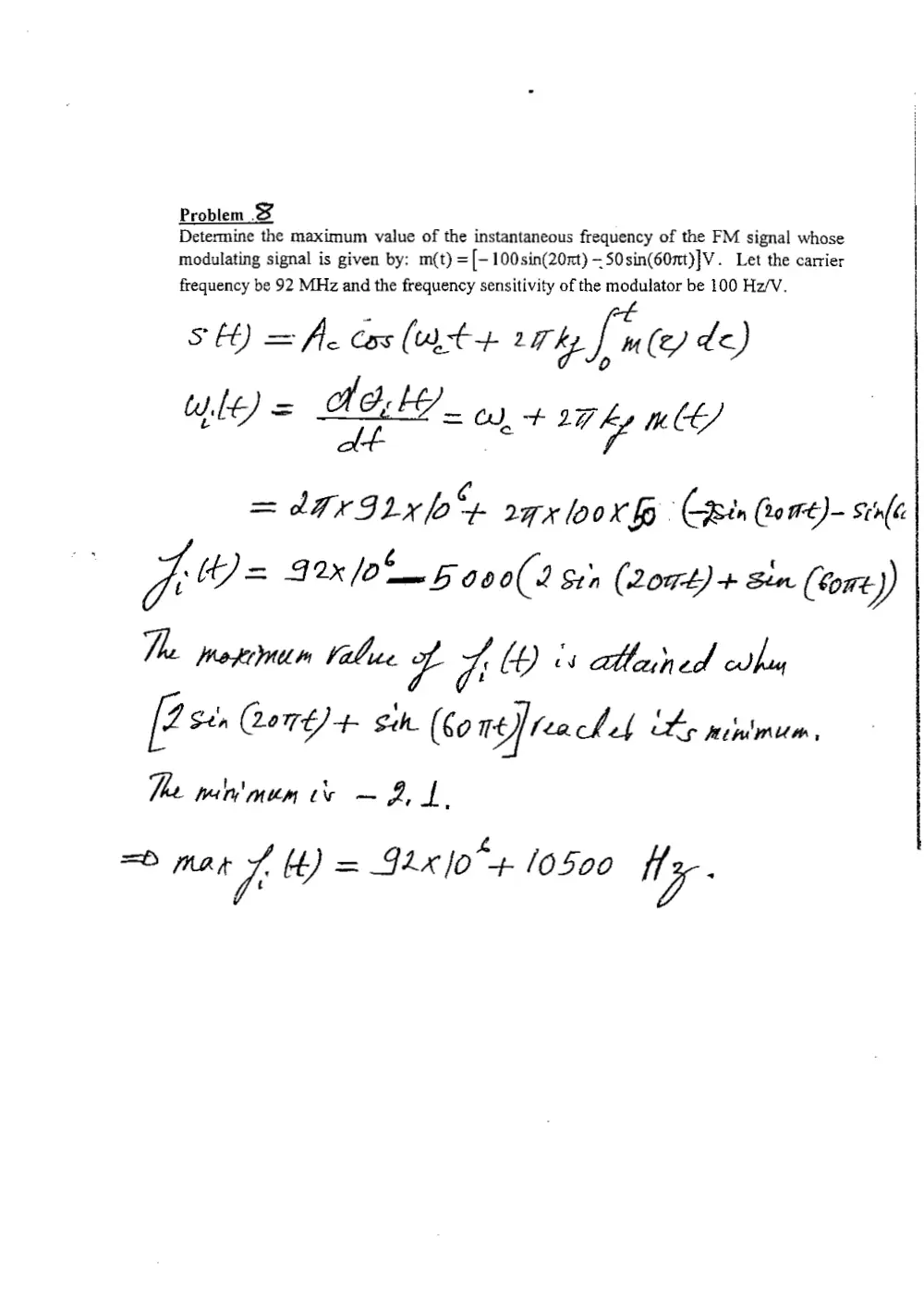
Problem .&
Determine the maximum value of the instantaneous frequency of the FM signal whose
modulating signal is given by: m(t) =[-100sin(20xt) —50sin(60nt)]V. Let the carrier
frequency be 92 MHz and the frequency sensitivity of the modulator be 100 Hz/V.
= bar 92x boy. 29x 00 X bg Cisin Gore) stole
Jev= 92x 0 5 000(2 Sen (owt) + sen (vont)
The mozentin Vile g 7 Lb) 6s cthaned edhuy
[28% Gere it (Congfreachel ts xininsem,
The maly'mum ev — 2, 1,
=O man 70 H) = 92x JO" 4- 10500 Ny
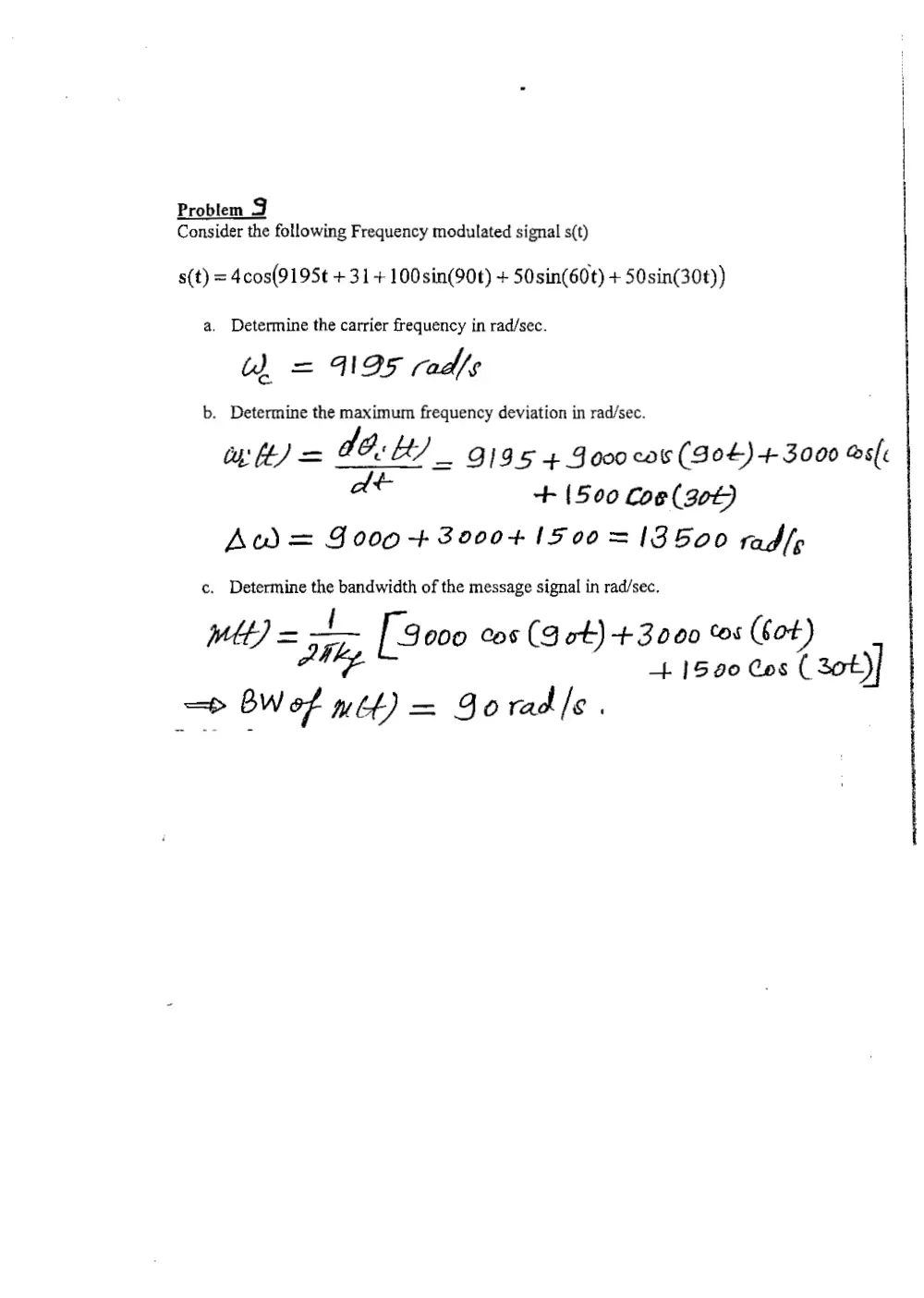
Problem J
Consider the following Frequency modulated signal s(t)
s(t) = 4cos(9195t + 31+100sin(90t) + 50sin(60t) + 50sin(30t))
a. Determine the carrier frequency in rad/sec.
i), = UNDE rad/s
b. Determine the maximum frequency deviation in rad/sec.
ty fL) = AO: be) _ 319-5 4 Jooo cos (Sot) +3000 sfc
dt + (500 Coe( 304)
Aw = 3000 + 300041500 =13500 rad/y
c. Determine the bandwidth of the message signal in rad/sec.
mle) = + [3000 cos (Got) +3000 “os (Got) J |
atky + 1590 Cos ( 30)
= bWot met) = Jorad/s .
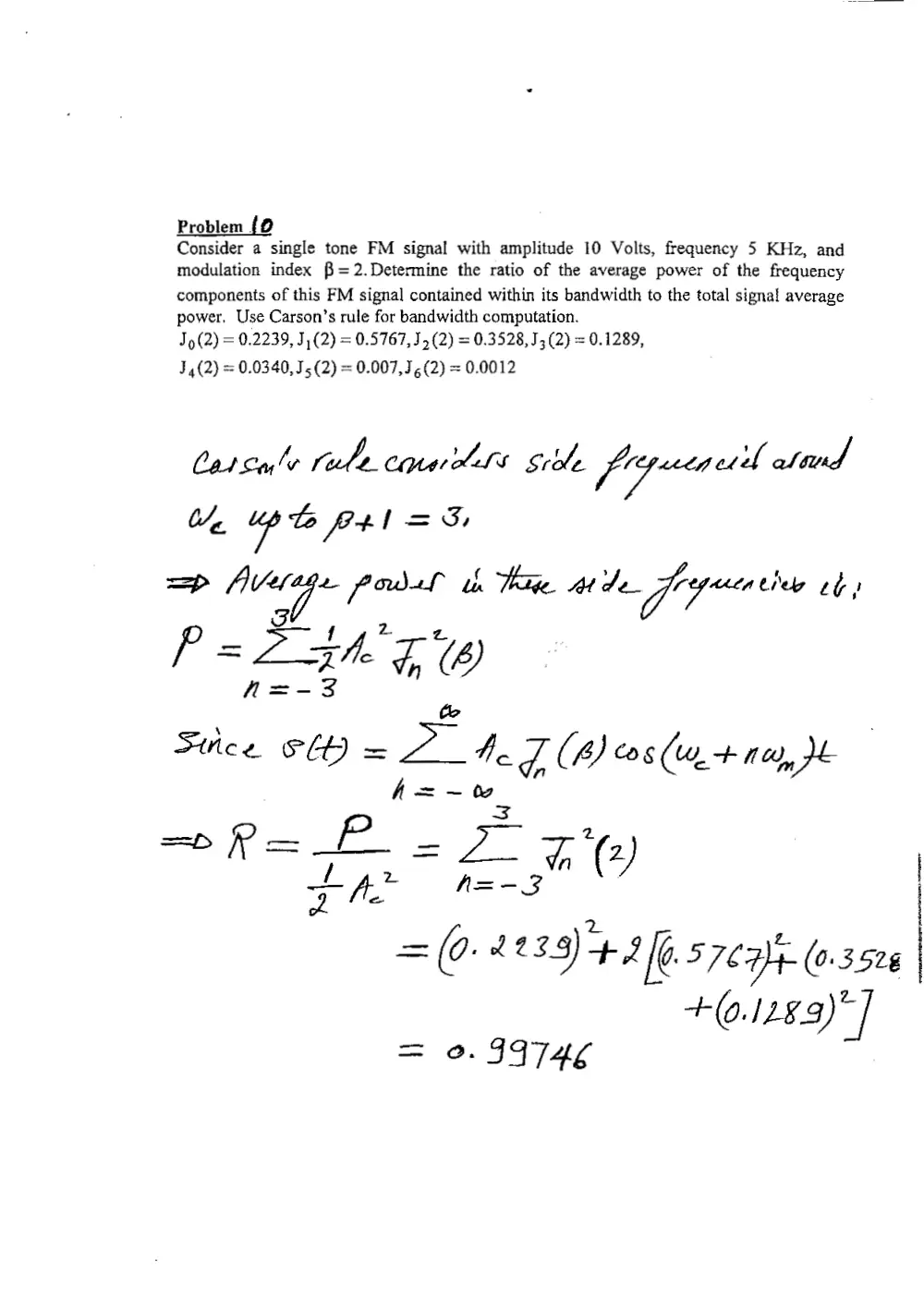
Problem {0
Consider a single tone FM signal with amplitude 10 Volts, frequency 5 KHz, and
modulation index B=2.Determine the ratio of the average power of the frequency
components of this FM signal contained within its bandwidth to the total signal average
power. Use Carson’s rule for bandwidth computation.
Jo (2) = 0.2239, J, (2) = 0.5767, J, (2) = 0.3528, J; (2) = 0.1289,
3 4(2) = 0.0340, J; (2) = 0.007,J.(2) = 0.0012
Catcajle rule. cparolts Srble (ogeesed altud.
Of, pte f+! =,
te
Stice SE) = 24 T (A) 05 (uu, + nig Je
f= ~ be