
EECE 442 Homework 2, Fall 2013
American University of Beirut · Communication Systems · 2 pages · Dr. Youssef Nasser
More EECE 442 files
Show the text of this homework
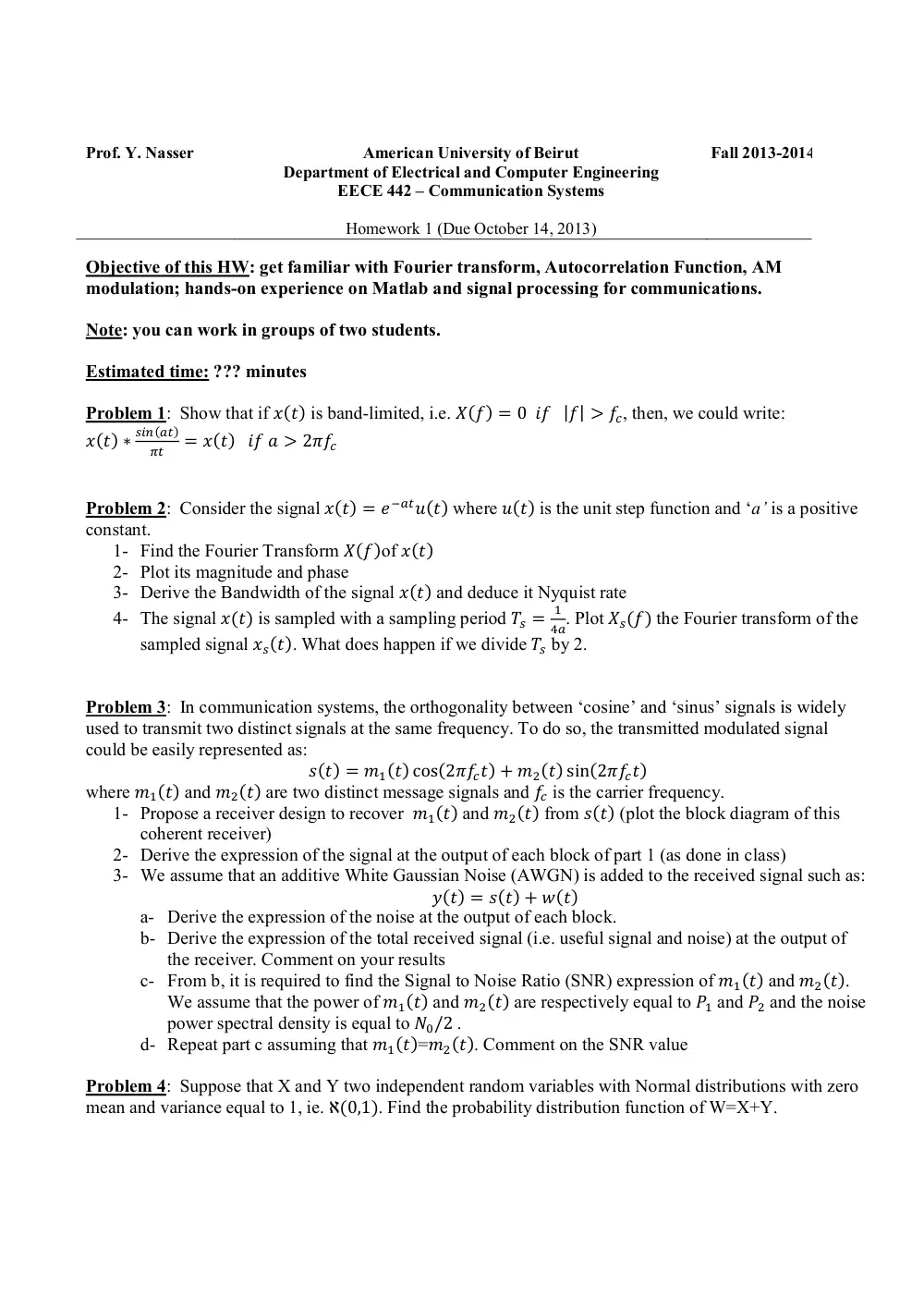
Prof. Y. Nasser
American University of Beirut
Department of Electrical and Computer Engineering
EECE 442 – Communication Systems
Fall 2013-2014
Homework 1 (Due October 14, 2013)
Objective of this HW: get familiar with Fourier transform, Autocorrelation Function, AM
modulation; hands-on experience on Matlab and signal processing for communications.
Note: you can work in groups of two students.
Estimated time: ??? minutes
Problem 1: Show that if �(�) is band-limited, i.e. �(�) = 0 �� |�| > ��, then, we could write:
�(�) ∗
���(��)
��
= �(�) �� � > 2���
Problem 2: Consider the signal �(�) = �����(�) where �(�) is the unit step function and ‘a’ is a positive
constant.
1- Find the Fourier Transform �(�)of �(�)
2- Plot its magnitude and phase
3- Derive the Bandwidth of the signal �(�) and deduce it Nyquist rate
4- The signal �(�) is sampled with a sampling period �� =
�
��. Plot ��(�) the Fourier transform of the
sampled signal ��(�). What does happen if we divide �� by 2.
Problem 3: In communication systems, the orthogonality between ‘cosine’ and ‘sinus’ signals is widely
used to transmit two distinct signals at the same frequency. To do so, the transmitted modulated signal
could be easily represented as:
�(�) = ��(�) cos(2����) + ��(�) sin(2����)
where ��(�) and ��(�) are two distinct message signals and �� is the carrier frequency.
1- Propose a receiver design to recover ��(�) and ��(�) from �(�) (plot the block diagram of this
coherent receiver)
2- Derive the expression of the signal at the output of each block of part 1 (as done in class)
3- We assume that an additive White Gaussian Noise (AWGN) is added to the received signal such as:
�(�) = �(�) + �(�)
a- Derive the expression of the noise at the output of each block.
b- Derive the expression of the total received signal (i.e. useful signal and noise) at the output of
the receiver. Comment on your results
c- From b, it is required to find the Signal to Noise Ratio (SNR) expression of ��(�) and ��(�).
We assume that the power of ��(�) and ��(�) are respectively equal to �� and �� and the noise
power spectral density is equal to ��/2 .
d- Repeat part c assuming that ��(�)=��(�). Comment on the SNR value
Problem 4: Suppose that X and Y two independent random variables with Normal distributions with zero
mean and variance equal to 1, ie. ℵ(0,1). Find the probability distribution function of W=X+Y.
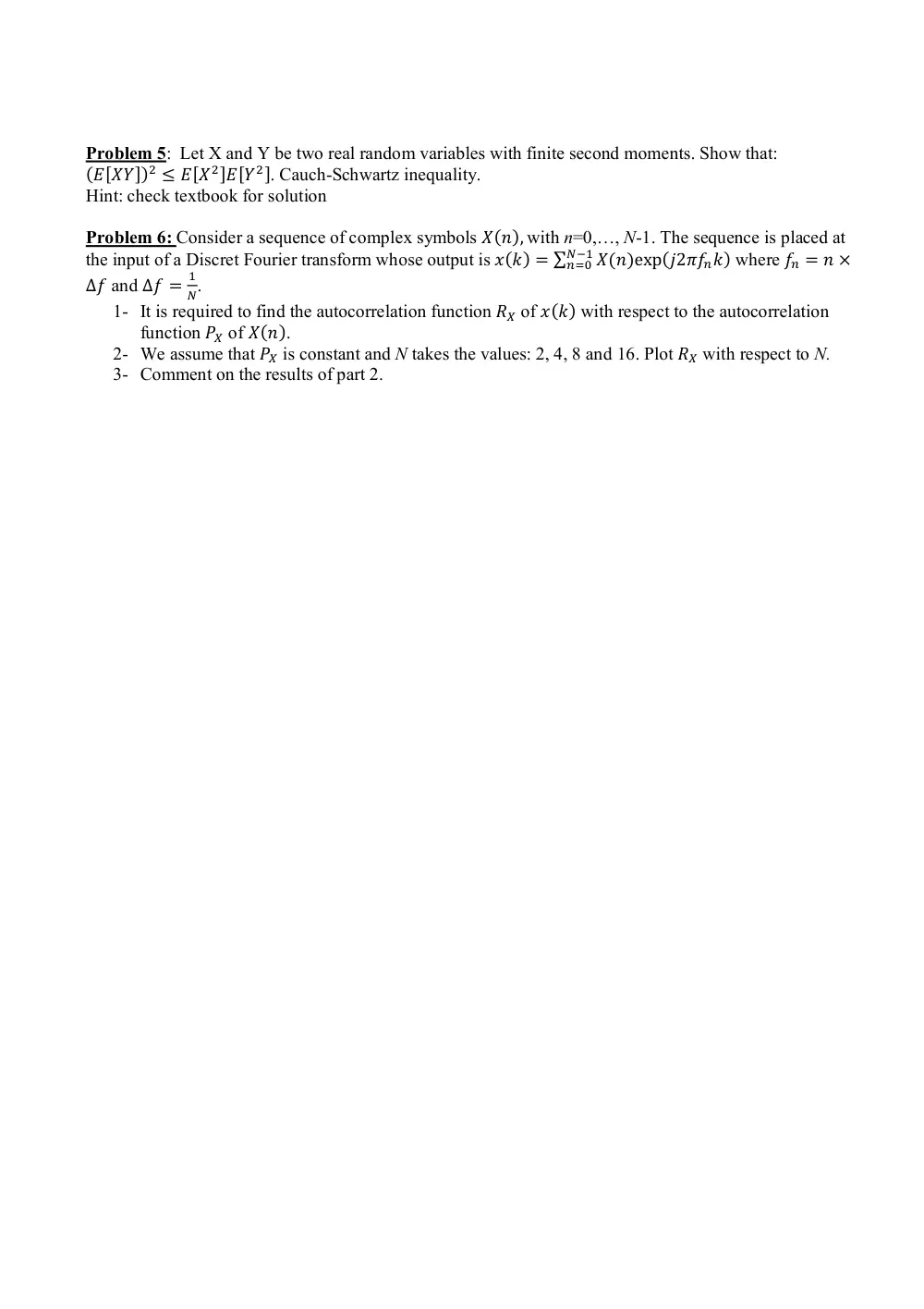
Problem 5: Let X and Y be two real random variables with finite second moments. Show that:
(�[��])� ≤ �[��]�[��]. Cauch-Schwartz inequality.
Hint: check textbook for solution
Problem 6: Consider a sequence of complex symbols �(�), with n=0,…, N-1. The sequence is placed at
the input of a Discret Fourier transform whose output is �(�) = ∑
��� �(�)exp(�2����)
���
where �� = � ×
∆� and ∆� =
�
�.
1- It is required to find the autocorrelation function �� of �(�) with respect to the autocorrelation
function �� of �(�).
2- We assume that �� is constant and N takes the values: 2, 4, 8 and 16. Plot �� with respect to N.
3- Comment on the results of part 2.