
ENG 204 Final, Spring 2001
American University of Beirut · Advanced Academic English · 5 pages
More ENG 204 files
Show the text of this final exam
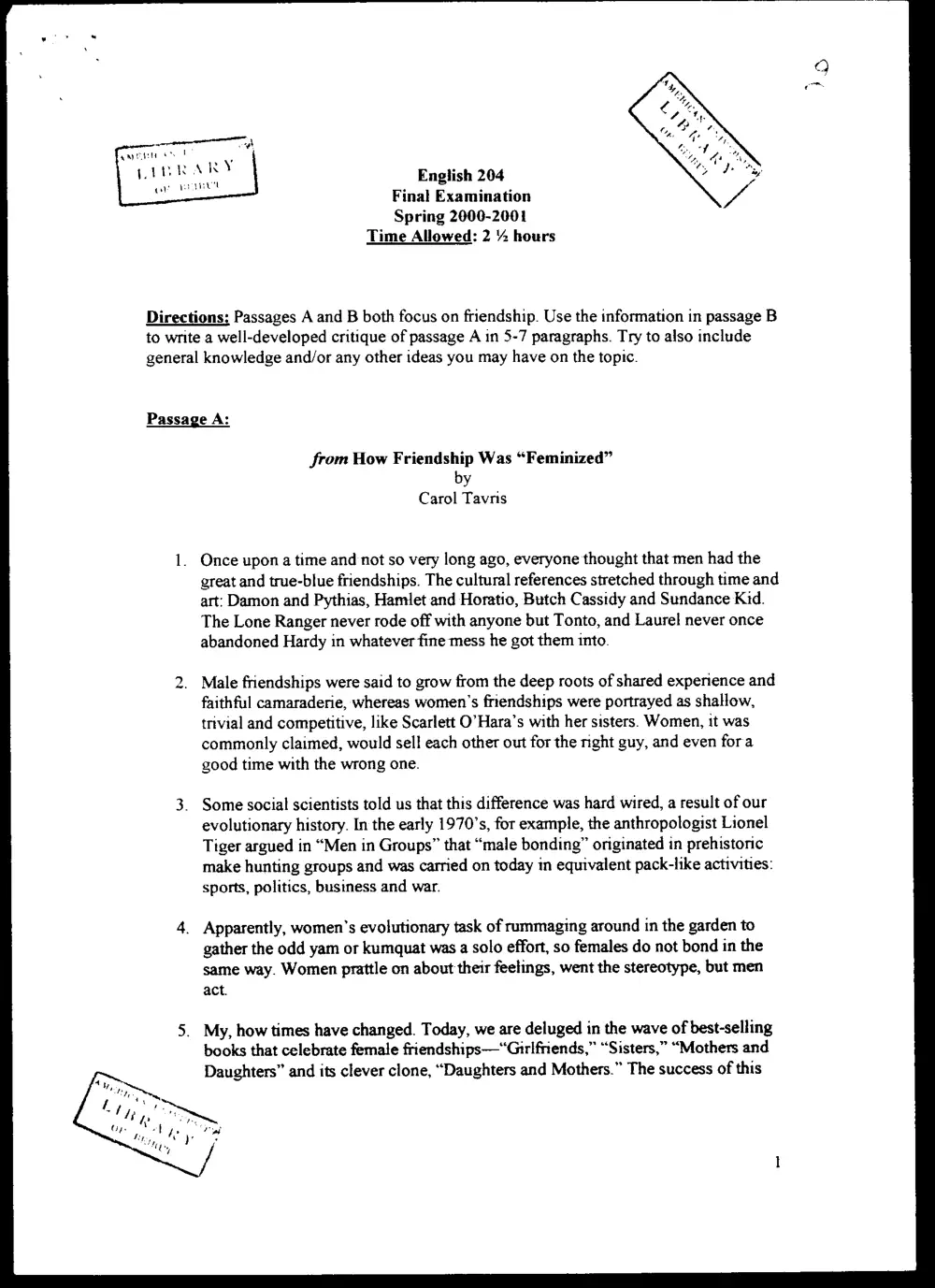
English 204
Final Examination
Spring 2000-2001
Time Allowed: 2 % hours
Directions: Passages A and B both focus on friendship. Use the information in passage B
to write a well-developed critique of passage A in 5-7 paragraphs. Try to also include
general knowledge and/or any other ideas you may have on the topic.
Passage A:
from How Friendship Was “Feminized”
by
Carol Tavris
. Once upon a time and not so very long ago, everyone thought that men had the
great and true-blue friendships. The cultural references stretched through time and
art: Damon and Pythias, Hamlet and Horatio, Butch Cassidy and Sundance Kid.
The Lone Ranger never rode off with anyone but Tonto, and Laurel never once
abandoned Hardy in whatever fine mess he got them into.
. Male friendships were said to grow from the deep roots of shared experience and
faithful camaraderie, whereas women’s friendships were portrayed as shallow,
trivial and competitive, like Scarlett O’Hara’s with her sisters. Women, 1t was
commonly claimed, would sell each other out for the right guy, and even fora
good time with the wrong one.
_ Some social scientists told us that this difference was hard wired, a result of our
evolutionary history. In the early 1970's, for example, the anthropologist Lionel
Tiger argued in “Men in Groups” that “male bonding” originated in prehistoric
make hunting groups and was carried on today in equivalent pack-like activities:
sports, politics, business and war.
. Apparently, women’s evolutionary task of rummaging around in the garden to
gather the odd yam or kumquat was a solo effort, so females do not bond in the
same way. Women prattle on about their feelings, went the stereotype, but men
act.
._ My, how times have changed. Today, we are deluged in the wave of best-selling
books that celebrate female friendships—“Girlfriends,” “Sisters,” “Mothers and
Daughters” and its clever clone, “Daughters and Mothers.” The success of this
10.
11.
genre is partly because the book market is so oriented to female readers these
days.
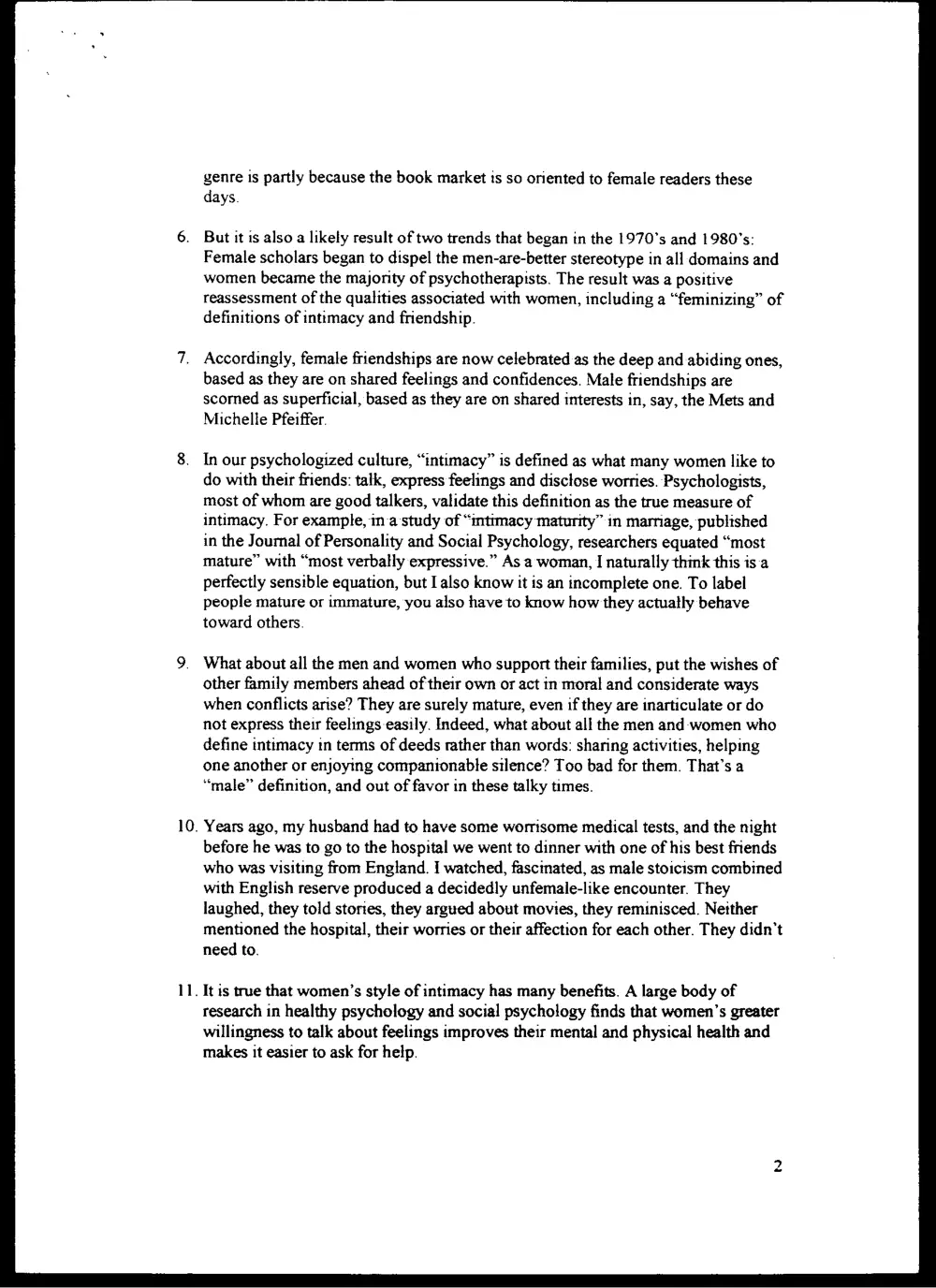
But it is also a likely result of two trends that began in the 1970's and 1980's:
Female scholars began to dispel the men-are-better stereotype in all domains and
women became the majority of psychotherapists. The result was a positive
reassessment of the qualities associated with women, including a “feminizing” of
definitions of intimacy and friendship.
Accordingly, female friendships are now celebrated.as the deep and abiding ones,
based as they are on shared feelings and confidences. Male friendships are
scomed as superficial, based as they are on shared interests in, say, the Mets and
Michelle Pfeiffer.
In our psychologized culture, “intimacy” is defined as what many women like to
do with their friends: talk, express feelings and disclose worries. Psychologists,
most of whom are good talkers, validate this definition as the true measure of
intimacy. For example, ina study of “intimacy maturity” in marriage, published
in the Journal of Personality and Social Psychology, researchers equated “most
mature” with “most verbally expressive.” As a woman, I naturally think this isa
perfectly sensible equation, but I also know it is an incomplete one. To label
people mature or immature, you also have to know how they actually behave
toward others.
What about all the men and women who support their families, put the wishes of
other family members ahead of their own or act in moral and considerate ways
when conflicts arise? They are surely mature, even if they are inarticulate or do
not express their feelings easily. Indeed, what about all the men and-women who
define intimacy in terms of deeds rather than words: sharing activities, helping
one another or enjoying companionable silence? Too bad for them. That’s a
“male” definition, and out of favor in these talky times.
Years ago, my husband had to have some worrisome medical tests, and the night
before he was to go to the hospital we went to dinner with one of his best friends
who was visiting from England. I watched, fascinated, as male stoicism combined
with English reserve produced a decidedly unfemale-like encounter. They
laughed, they told stories, they argued about movies, they reminisced. Neither
mentioned the hospital, their worries or their affection for each other. They didn’t
need to.
It is true that women’s style of intimacy has many benefits. A large body of
research in healthy psychology and social psychology finds that women’s greater
willingness to talk about feelings improves their mental and physical health and
makes it easier to ask for help.
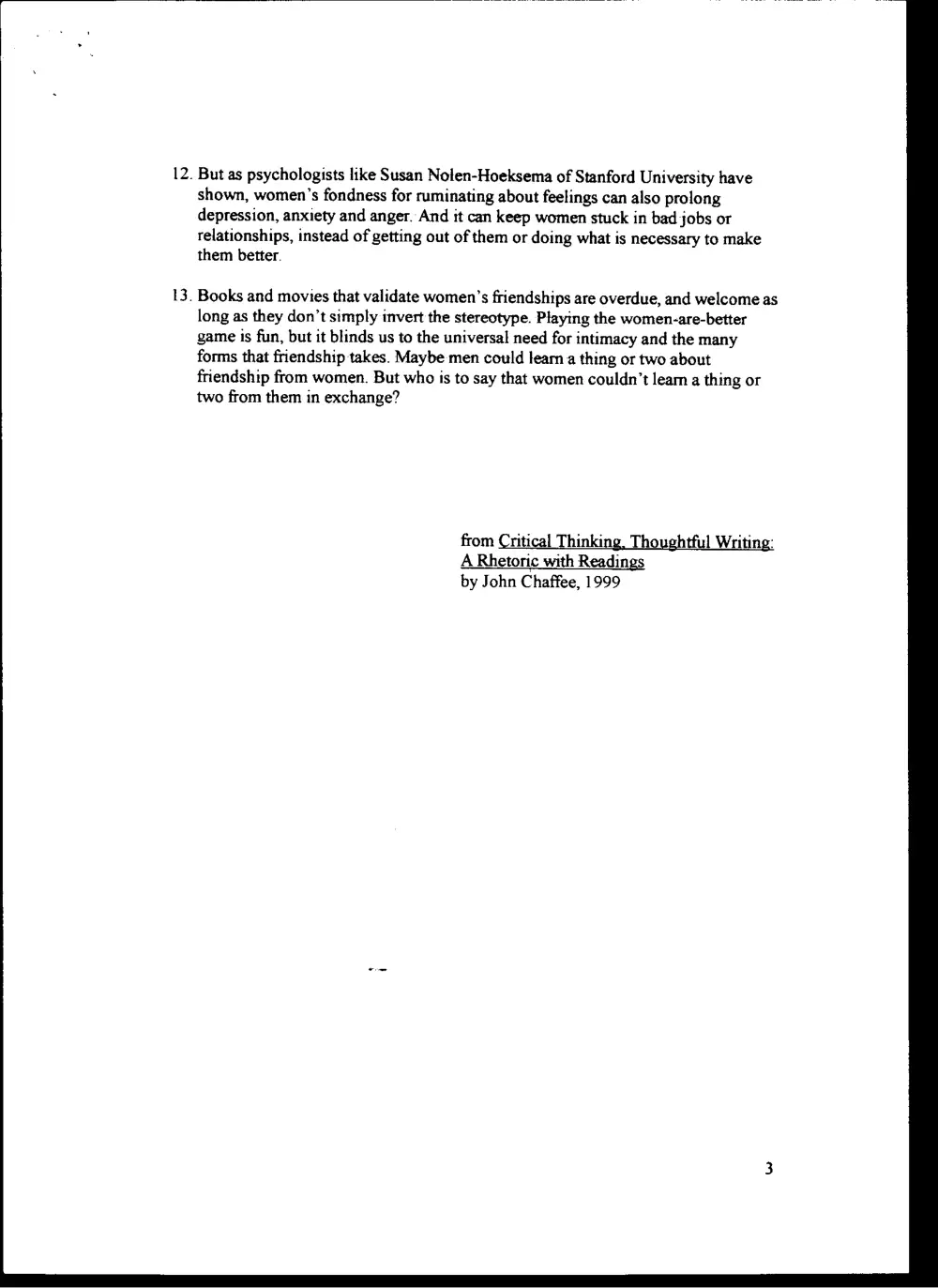
12. But as psychologists like Susan Nolen-Hoeksema of Stanford University have
13.
shown, women’s fondness for ruminating about feelings can also prolong
depression, anxiety and anger. And it can keep women stuck in bad jobs or
relationships, instead of getting out of them or doing what is necessary to make
them better.
Books and movies that validate women’s friendships are overdue, and welcome as
long as they don’t simply invert the stereotype. Playing the women-are-better
game is fun, but it blinds us to the universal need for intimacy and the many
forms that friendship takes. Maybe men could leam a thing or two about
friendship from women. But who is to say that women couldn’t leam a thing or
two from them in exchange?
from Critical Thinking, Thoughtful Writing:
A Rhetoric with Readings
by John Chaffee, 1999
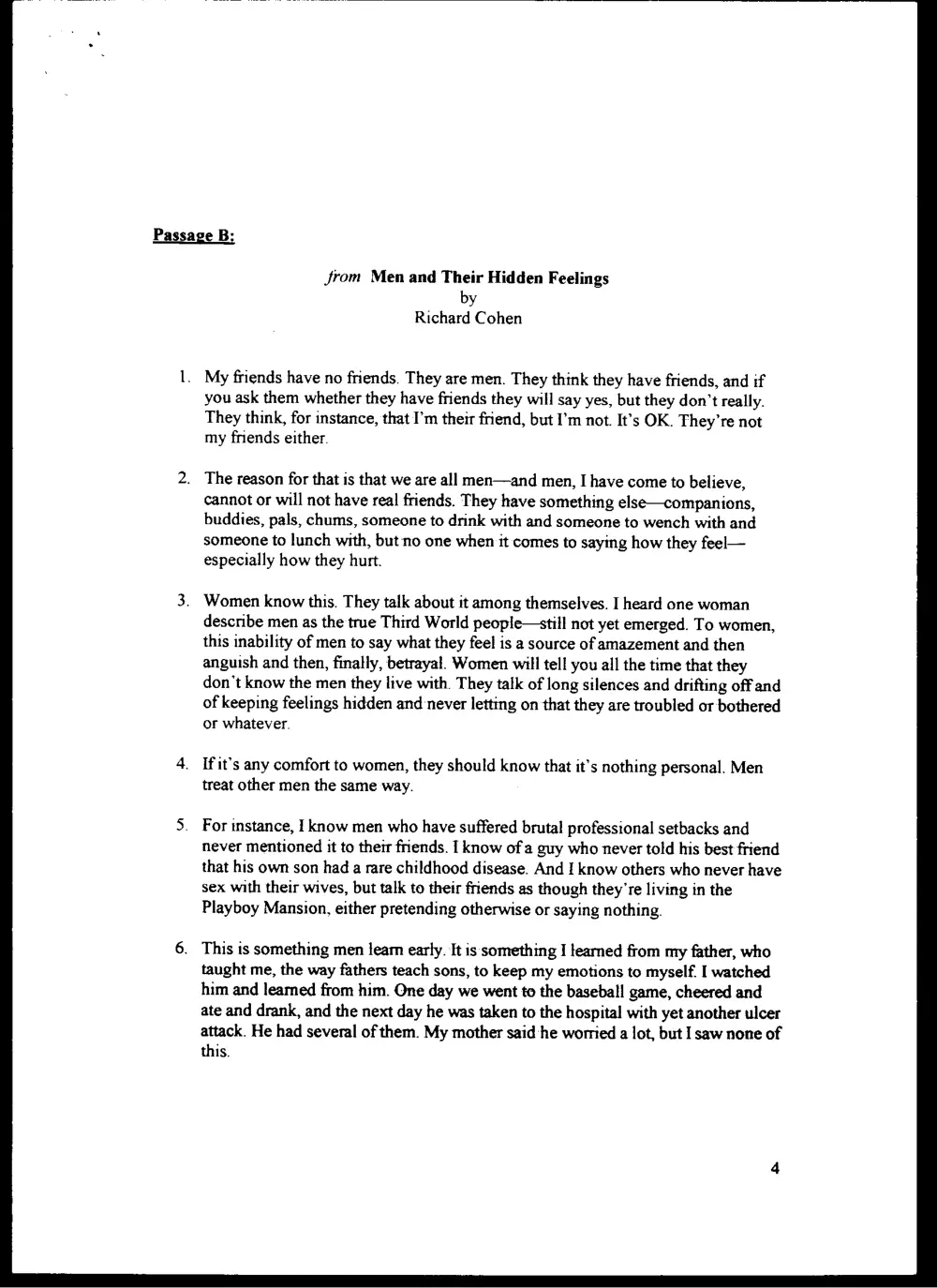
Passage B:
Jjrom Men and Their Hidden Feelings
by
Richard Cohen
1. My friends have no friends. They are men. They think they have friends, and if
you ask them whether they have friends they will say yes, but they don’t really.
They think, for instance, that I’m their friend, but I’m not. It’s OK. They’re not
my friends either.
2. The reason for that is that we are all men—and men, I have come to believe,
cannot or will not have real friends. They have something else—companions,
buddies, pals, chums, someone to drink with and someone to wench with and
someone to lunch with, but no one when it comes to saying how they feel—
especially how they hurt.
3. Women know this. They talk about it among themselves. I heard one woman
describe men as the true Third World people—still not yet emerged. To women,
this inability of men to say what they feel is a source of amazement and then
anguish and then, finally, betrayal. Women will tell you all the time that they
don’t know the men they live with. They talk of long silences and drifting off and
of keeping feelings hidden and never letting on that they are troubled or bothered
or whatever.
4. Ifit’s any comfort to women, they should know that it’s nothing personal. Men
treat other men the same way.
5. For instance, I know men who have suffered brutal professional setbacks and
never mentioned it to their friends. I know of a guy who never told his best friend
that his own son had a rare childhood disease. And I know others who never have
sex with their wives, but talk to their friends as though they’ re living in the
Playboy Mansion, either pretending otherwise or saying nothing.
6. This is something men leam early. It is something I tearned from my father, who
taught me, the way fathers teach sons, to keep my emotions to myself. I watched
him and leamed from him. One day we went to the baseball! game, cheered and
ate and drank, and the next day he was taken to the hospital with yet another ulcer
attack. He had several of them. My mother said ‘he worried a lot, but I saw none of
this.
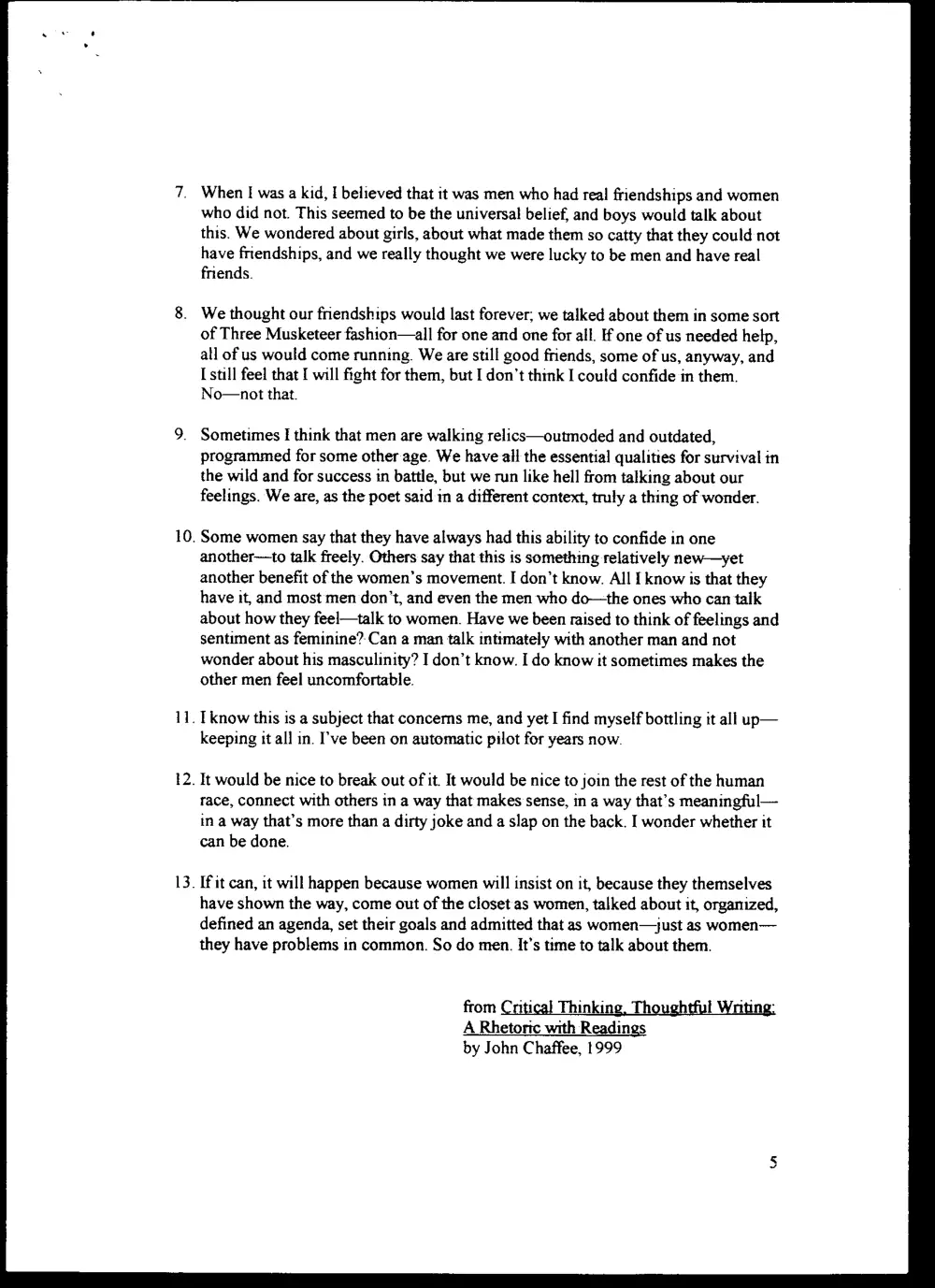
. When I was a kid, I believed that it was men who had real friendships and women
who did not. This seemed to be the universal belief, and boys would talk about
this. We wondered about girls, about what made them so catty that they could not
have friendships, and we really thought we were lucky to be men and have real
friends.
. We thought our fnendships would last forever, we talked about them in some sort
of Three Musketeer fashion—all for one and one for all. If one of us needed help,
all of us would come running. We are still good friends, some of us, anyway, and
[still feel that I will fight for them, but I don’t think I could confide in them.
No—not that.
. Sometimes I think that men are walking relics—outmoded and outdated,
programmed for some other age. We have-all the essential qualities for survival in
the wild and for success in battle, but we run like hell from talking about our
feelings. We are, as the poet said in a different context, truly a thing of wonder.
. Some women say that they have always had this ability to confide in one
another—to talk freely. Others say that this is something relatively new—yet
another benefit of the women’s movement. I don’t know. All I know is that they
have it, and most men don’t, and even the men who do—the ones who can talk
about how they feel—talk to women. Have we been raised to think of feelings and
sentiment as feminine? Can a man talk intimately with another man and not
wonder about his masculinity? I don’t know. I do know it sometimes makes the
other men feel uncomfortable.
. [know this is a subject that concerns me, and yet I find myself bottling it all up—
keeping it all in. 've been on automatic pilot for years now.
. It would be nice to break out of it. It would be nice to join the rest of the human
race, connect with others in a way that makes sense, in a way that’s meaningful—
in a way that’s more than a dirty joke and a slap on the back. I wonder whether it
can be done.
. If it can, it will happen because women will insist on it, because they themselves
have shown the way, come out of the closet as women, talked about it, organized,
defined an agenda, set their goals and admitted that as women—just as women—
they have problems in common. So do men. It’s time to talk about them.
from Critical Thinking, Thoughtful Writing:
A Rhetoric with Readings
by John Chaffee, 1999