
ENG 230 Final, Fall 2001
American University of Beirut · Language in Society · 2 pages
More ENG 230 files
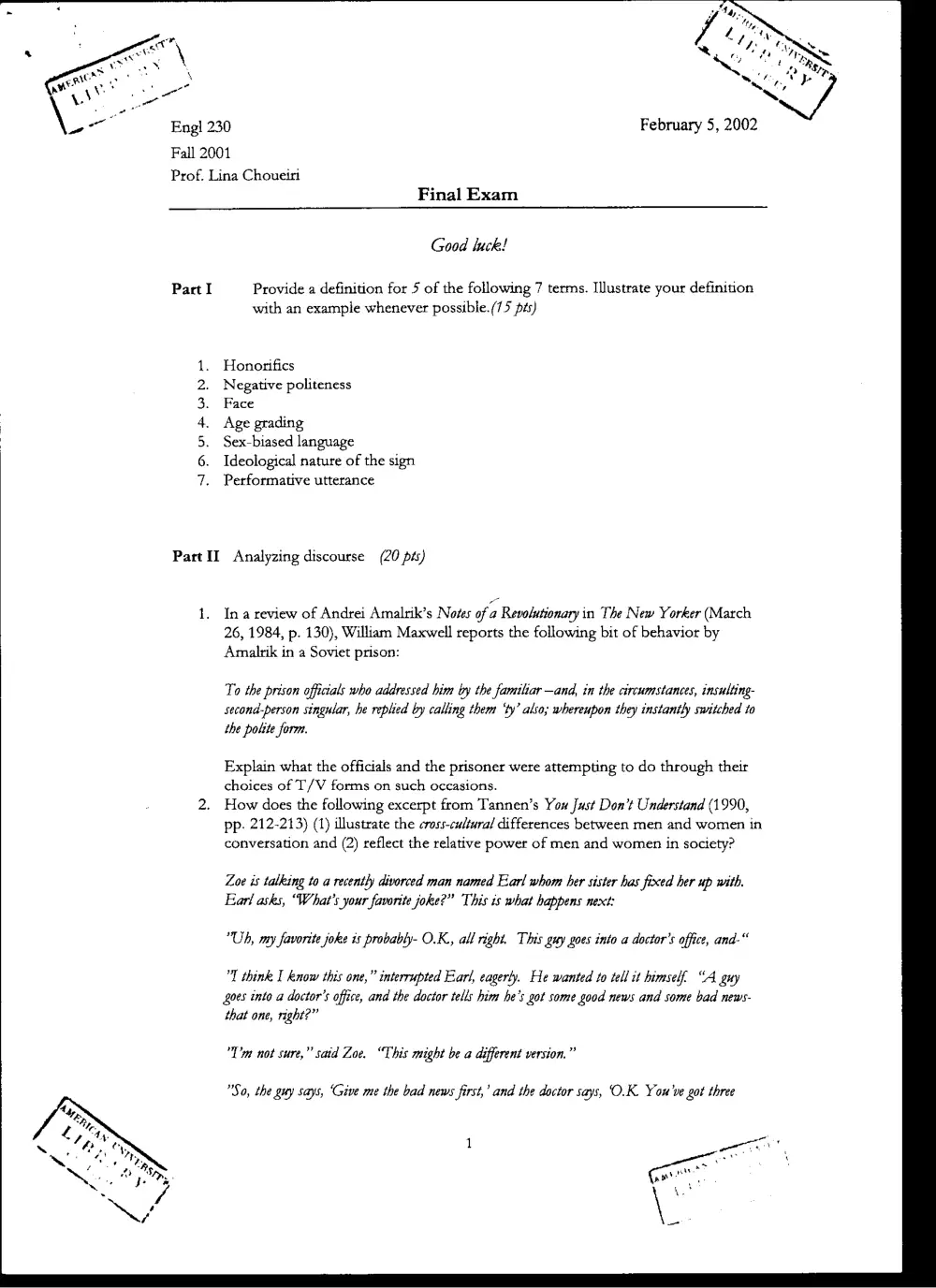
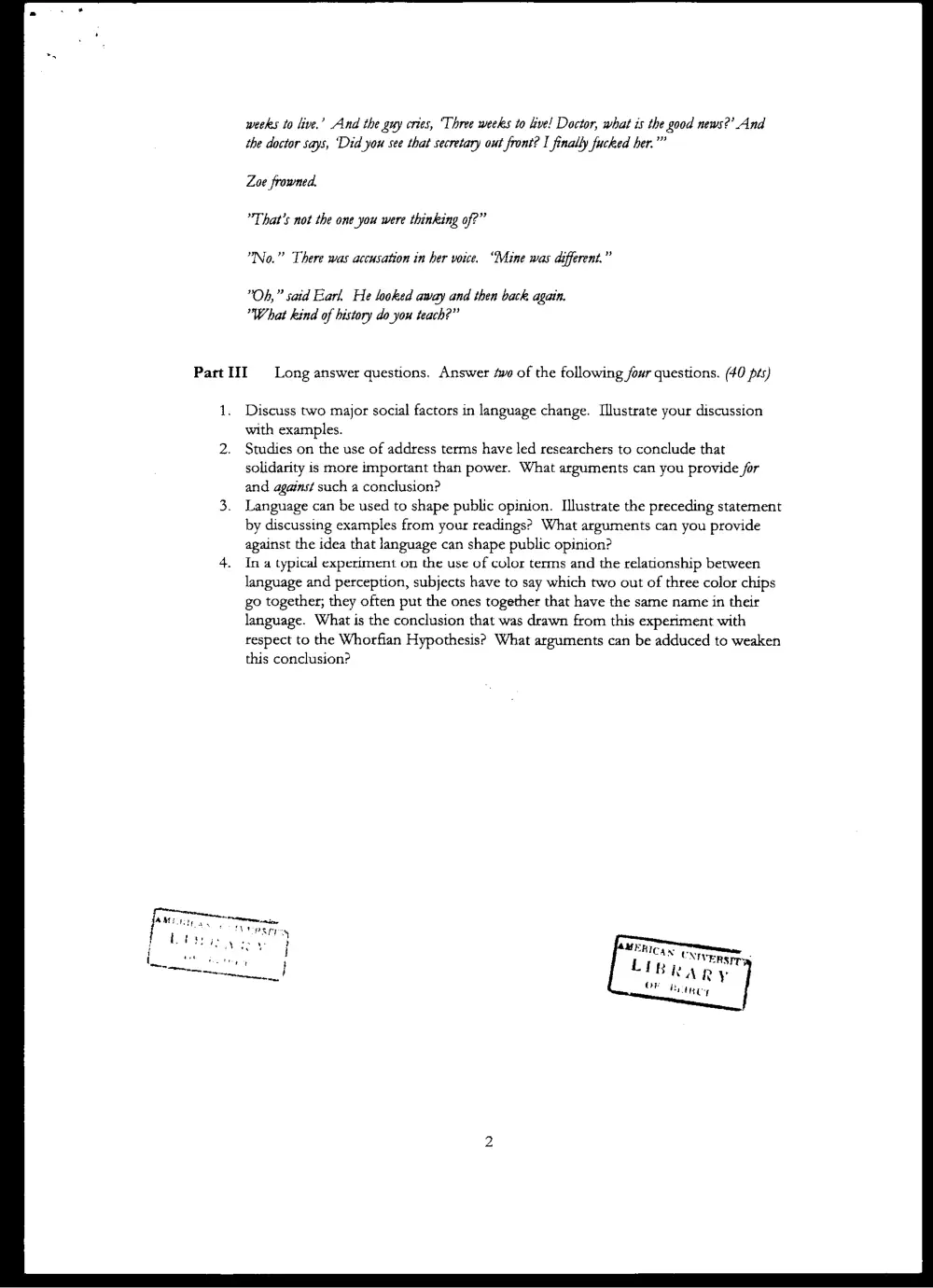
Show the text of this final exam
Engl 230
Fall 2001
Prof. Lina Choueiri
Final Exam
Part I
NAW WON DO
Good luck!
Provide a definition for 5 of the following 7 terms. Illustrate your definition
with an example whenever possible. (75 pts)
Honorifics
Negative politeness
Face
Age grading
Sex-biased language
Ideological nature of the sign
Performative utterance
Part II Analyzing discourse (20 pts)
1.
In a review of Andrei Amalrik’s Notes of a Revolutionary in The New Yorker (March
26, 1984, p. 130), William Maxwell reports the following bit of behavior by
Amalrik in a Soviet prison:
To the prison officials who addressed him by the familiar —and, in the circumstances, insulting-
second-person singular, he replied by calling them ‘ty’ also; whereupon they instantly switched to
the polite form.
Explain what the officials and the prisoner were attempting to do through their
choices of T/V forms on such occasions.
How does the following excerpt from Tannen’s You Just Don’t Understand (1990,
pp. 212-213) (1) illustrate the cross-cultural differences between men and women in
conversation and (2) reflect the relative power of men and women in society?
Zoe is talking to a recently divorced man named Earl whom her sister has fixed her up with.
Earl asks, ‘What's your favorite joke?” This is what happens next:
"Uh, my favorite joke is probably- O.K., all right. This guy goes into a doctor’s office, and-“
"l think I know this one,” interrupted Earl, eagerly. He wanted to tell it himself. “A guy
goes into a doctor's office, and the doctor tells him he’s got some good news and some bad news-
that one, right?”
"Tm not sure,” said Zoe. ‘This might be a different version.”
"So, the guy says, ‘Give me the bad news first,’ and the doctor says, ‘O.K. You've got three
weeks to live.’ And the guy cries, Three weeks to ive! Doctor, what is the good news?’ And
the doctor says, ‘Did you see that secretary out front? I finally fucked her.”
Zoe frowned.
That's not the one you were thinking of?”
No.” There was accusation in her voice. “Maine was different.”
Oh,” said Earl, He looked away and then back again.
"What kind of history do you teach?”
Part HI Long answer questions. Answer Avo of the following four questions. (40 pts)
Discuss two major social factors in language change. Illustrate your discussion
with examples.
Studies on the use of address terms have led researchers to conclude that
solidarity is more important than power. What arguments can you provide for
and against such a conclusion?
Language can be used to shape public opinion. Illustrate the preceding statement
by discussing examples from your readings? What arguments can you provide
against the idea that language can shape public opinion?
In a typical experiment on the use of color terms and the relationship between
language and perception, subjects have to say which two out of three color chips
go together; they often put the ones together that have the same name in their
language. What is the conclusion that was drawn from this experiment with
respect to the Whorfian Hypothesis? What arguments can be adduced to weaken
this conclusion?